
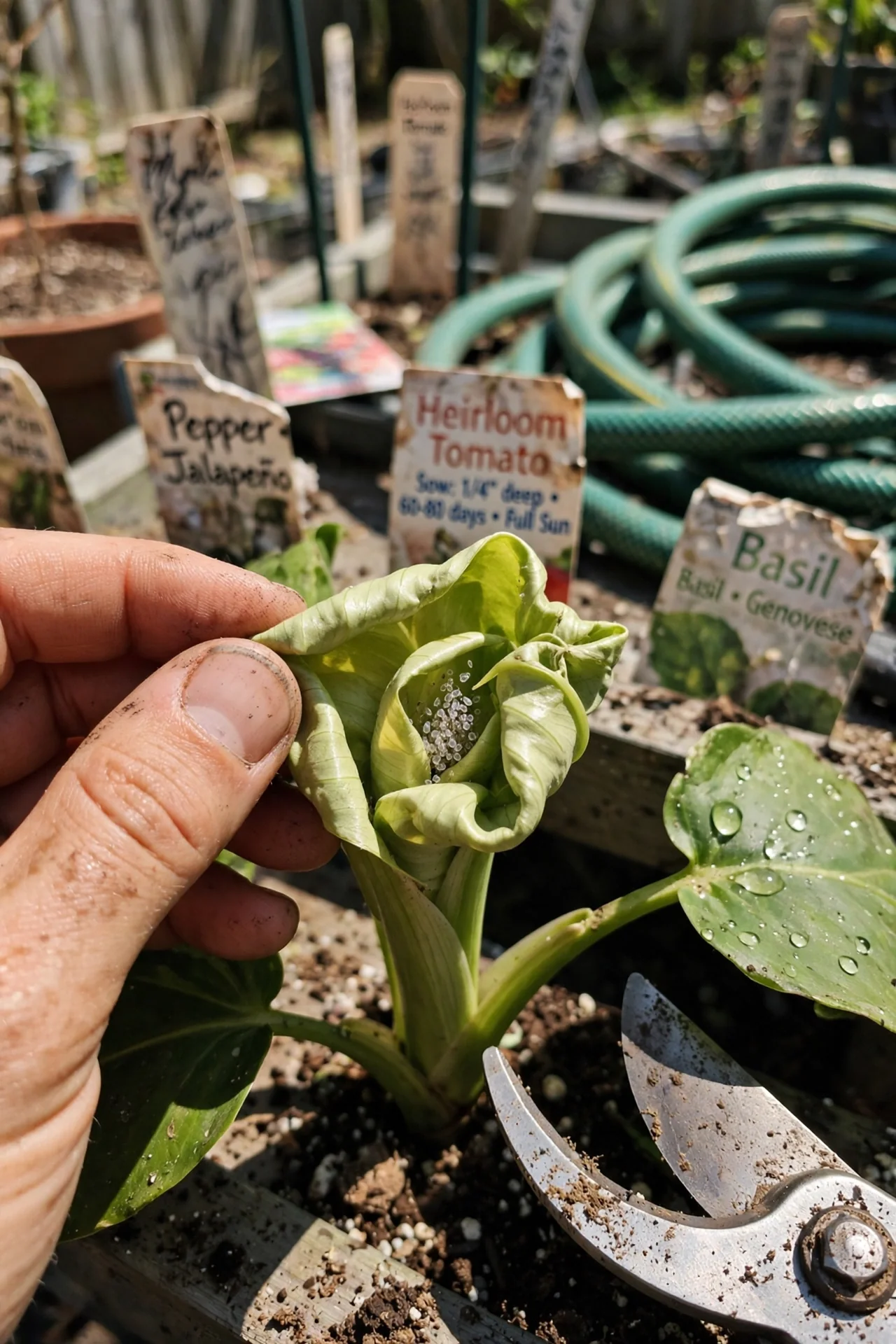
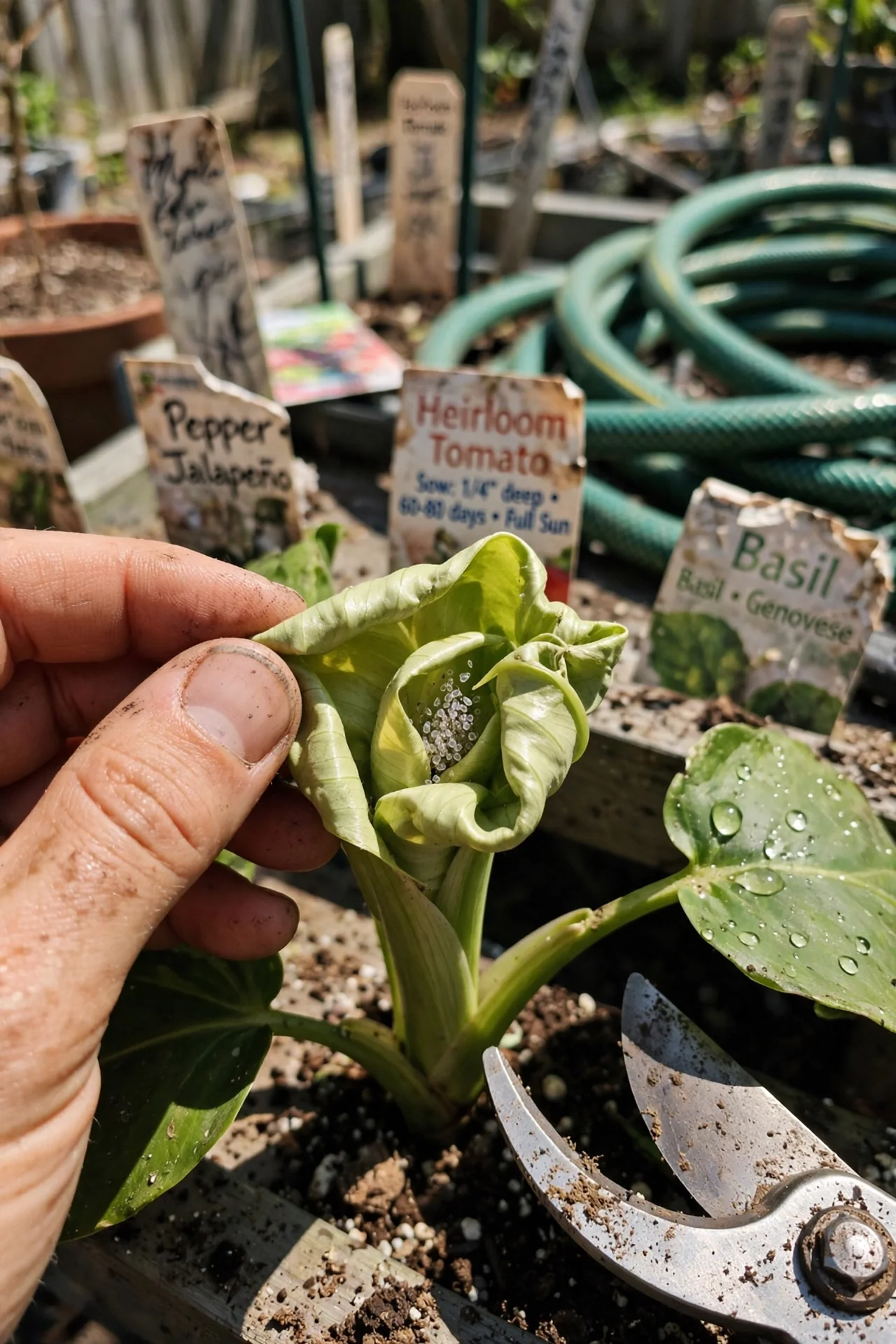
Most houseplant pest guides treat cyclamen mites like spider mites. They tell you to spray the leaves and wait. That approach fails because cyclamen mites live where sprays rarely reach: inside the folded tissue of buds, leaf sheaths, and the plant crown itself. You cannot kill what you cannot wet.
This guide covers houseplant cyclamen mite management. We address detection thresholds, heat treatment protocols, miticide options, biological controls, environmental manipulation, and disposal criteria. We exclude commercial strawberry field management and focus on containerized indoor plants: African violets, cyclamen, begonias, fuchsias, and other ornamentals.
By the end, you will be able to decide whether a plant is worth treating or should be discarded, choose a control method matched to infestation severity, and apply it with timing that accounts for the mite life cycle rather than just spraying and hoping.
Bottom line: If you do not get the treatment into the crown and bud crevices, you have not treated the infestation.
The Yield Grid Decision Grid
Branch 1: You have a single plant with early signs. New leaves are slightly cupped or brittle, buds are smaller than normal, but the plant is still growing. No other plants show symptoms. Recommended: Items 1, 3, 4 below.
Branch 2: Multiple plants are affected or damage is moderate. Several plants show distorted growth, leaves are stunted and hairy at the crown, flowers fail to open. You are willing to invest time and money in treatment. Recommended: Items 2, 5, 7, 8 below.
Branch 3: Infestation is severe or you have a large collection at risk. Crowns are crippled, multiple plants are declining, or you cannot afford to lose valuable specimens. Professional-grade intervention is justified. Recommended: Items 6, 9, 10 below. For a broader overview of houseplant pest identification, see our guide to recognizing hidden mite damage.
Quick Comparison Table
| Option | Key mechanism | Best for | Decision Grid Branch | Reapply Class |
|---|---|---|---|---|
| Hot water dip | Thermal kill of all life stages | Small plants, bare-root divisions | Branch 1 | Once-per-season |
| Insecticidal soap spray | Contact desiccation of mobile stages | Early detection, soft-bodied mites | Branch 1 | Weekly |
| Horticultural oil | Suffocation of eggs and mobile stages | Moderate infestation, smooth-leaved plants | Branch 1 | Weekly |
| Abamectin (Avid) | Translaminar GABA-agonist neurotoxin | Persistent infestations, valuable plants | Branch 2 | Biweekly |
| Sulfur (wettable or dust) | Multi-site contact and vapor activity | African violets, mild to moderate infestation | Branch 2 | Weekly |
| Predatory mites (cucumeris) | Predation of eggs and larvae | Preventative greenhouse programs | Branch 3 | Monthly |
| Abamectin + oil rotation | Neurotoxin plus physical kill | Resistance management, stubborn cases | Branch 2 | Biweekly |
| Heat chamber (whole plant) | Sustained thermal exposure at 44°C | Valuable collections, pre-propagation | Branch 3 | Once-per-season |
| Discard and restart | Elimination of infested biomass | Severely damaged plants, low-value plants | Branch 3 | N/A |
| Integrated program (rotation) | Multiple modes of action sequenced | Large collections, recurring infestations | Branch 3 | Monthly |
1. Hot Water Dip: The Only Single-Application Kill
Best for: Branch 1
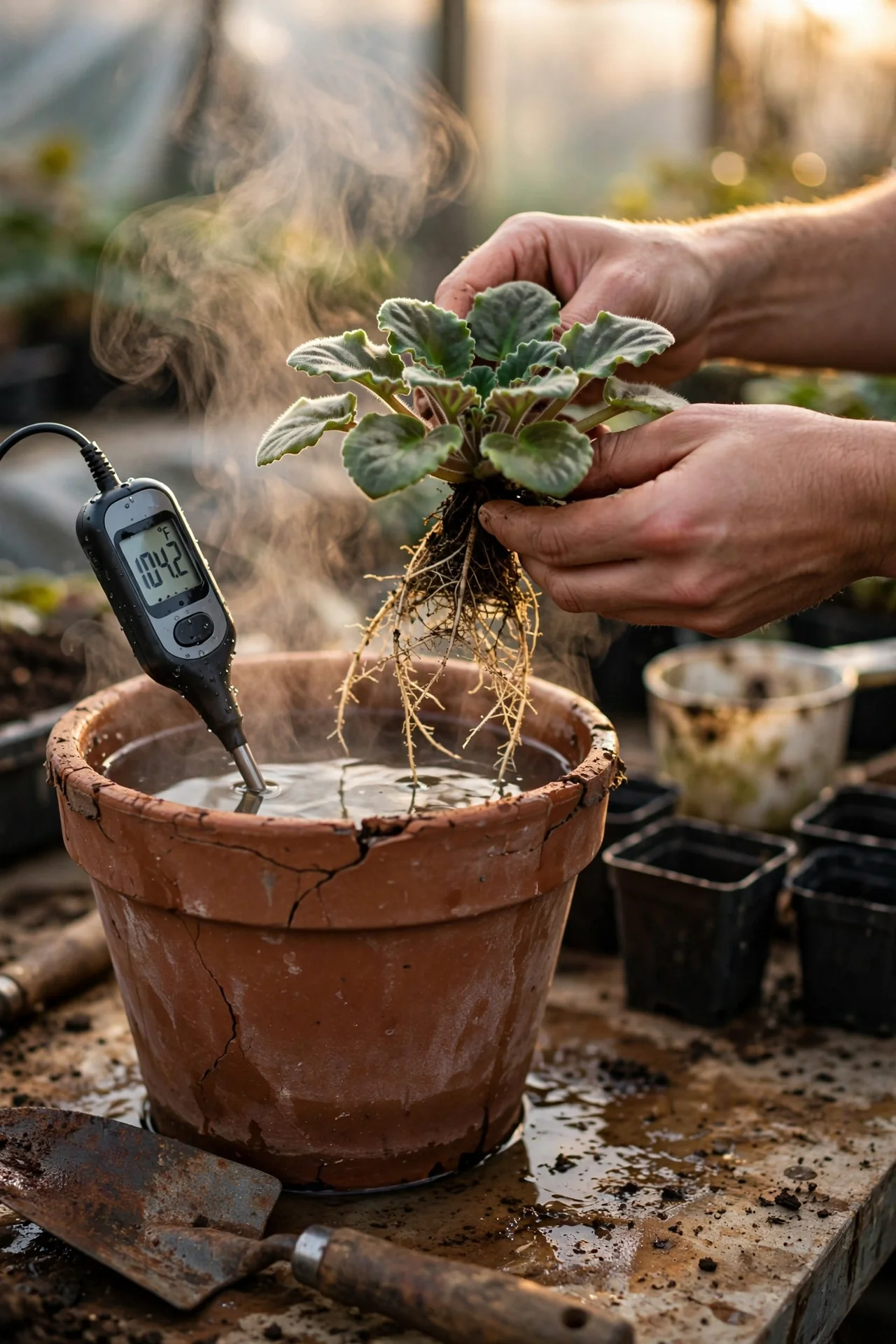
What it is: Submersion of the entire plant (pot and all, or bare-root) in water held at a precise temperature range to kill all cyclamen mite life stages including eggs. This is the only method that can achieve complete kill in a single session, because heat penetrates bud tissue where contact sprays cannot reach.
Threshold numbers that matter: The standard protocol is 111°F (43.9°C) for 15 minutes, or 110°F (43.3°C) for 30 minutes. Water temperature must be maintained throughout. If the temperature drops below 110°F, mite survival increases sharply. If it rises above 115°F, plant tissue damage becomes likely, especially on soft-leaved species like African violets. Cyclamen mite eggs collapse above 96°F (35.6°C) under sustained exposure, but brief dips require the higher thresholds to ensure lethal heat reaches the crown interior.
Procedure: Fill a container large enough to submerge the entire plant and pot. Heat water to 112°F (44.4°C) to allow for a 1-degree drop during transfer. Use a digital probe thermometer, not an infrared gun, because infrared reads surface temperature only. Submerge the plant completely for 15 minutes. After treatment, place the plant in a shaded, humid location for 48 hours to recover from thermal stress. Discard the water.
Common mistake: Treating only the foliage. Cyclamen mites live in the crown and root-shoot junction. Bare-rooting the plant before dipping improves kill rates by removing the soil buffer that insulates the crown.
For plants that cannot tolerate submersion, consider alternative contact treatments for concealed pests.
2. Insecticidal Soap: Low-Cost First Strike
Best for: Branch 1
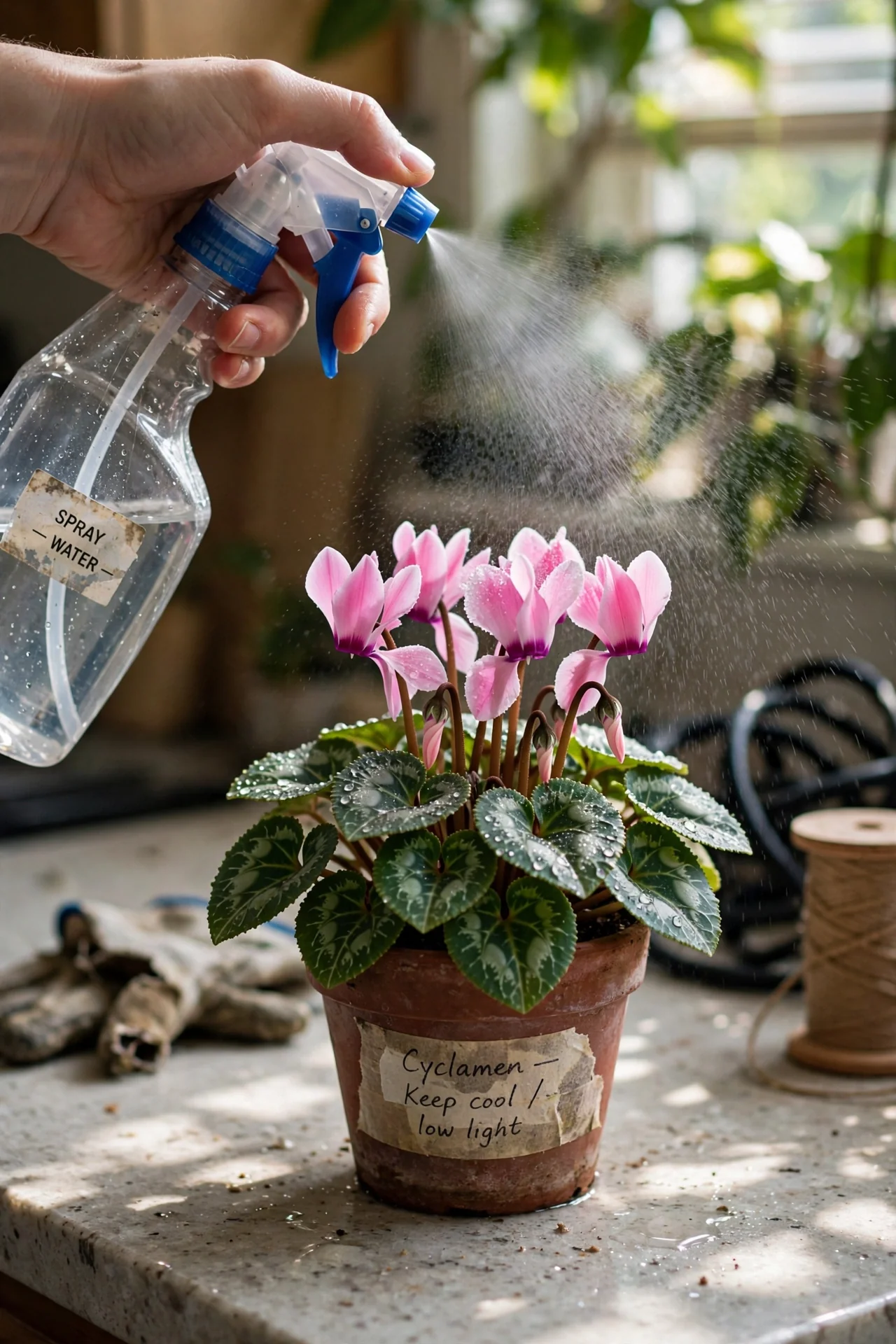
Potassium salts of fatty acids disrupt mite cell membranes on contact. The constraint: soap must coat the mite body directly. Cyclamen mites shelter in unfurled leaves and calyx folds, so coverage must be forced into these spaces with a pressurized sprayer, not a mist bottle. Reapply every 5 to 7 days for a minimum of three applications to catch emerging larvae from eggs that survived the first pass. Soap leaves no residue, so there is no residual protection between applications.
3. Horticultural Oil: Suffocation Where Soap Cannot Reach
Best for: Branch 1
Highly refined petroleum or plant-based oils (mineral oil, neem oil) coat eggs and mobile stages, blocking spiracles and causing death by asphyxiation. Oils spread more evenly than soap on waxy or hairy leaf surfaces. The tradeoff: oil can cause phytotoxicity above 85°F (29.4°C) or in direct sun, and hairy-leaved plants like African violets may retain oil residues that damage tissue. Always test on a single leaf 48 hours before full application. Apply weekly for three weeks, ensuring runoff into the crown.
For oil-sensitive plants, refer to treatment methods that avoid leaf residue buildup.
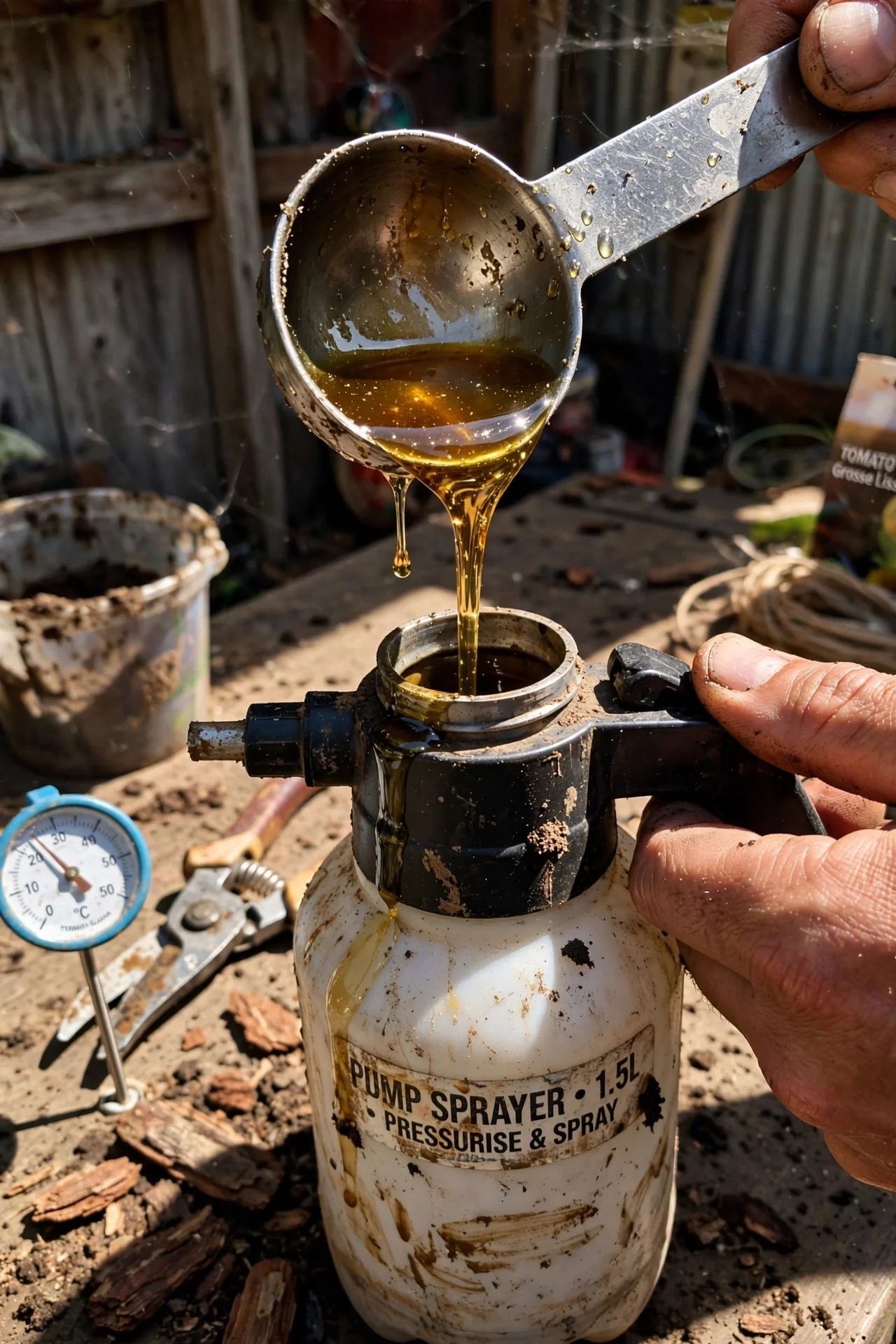
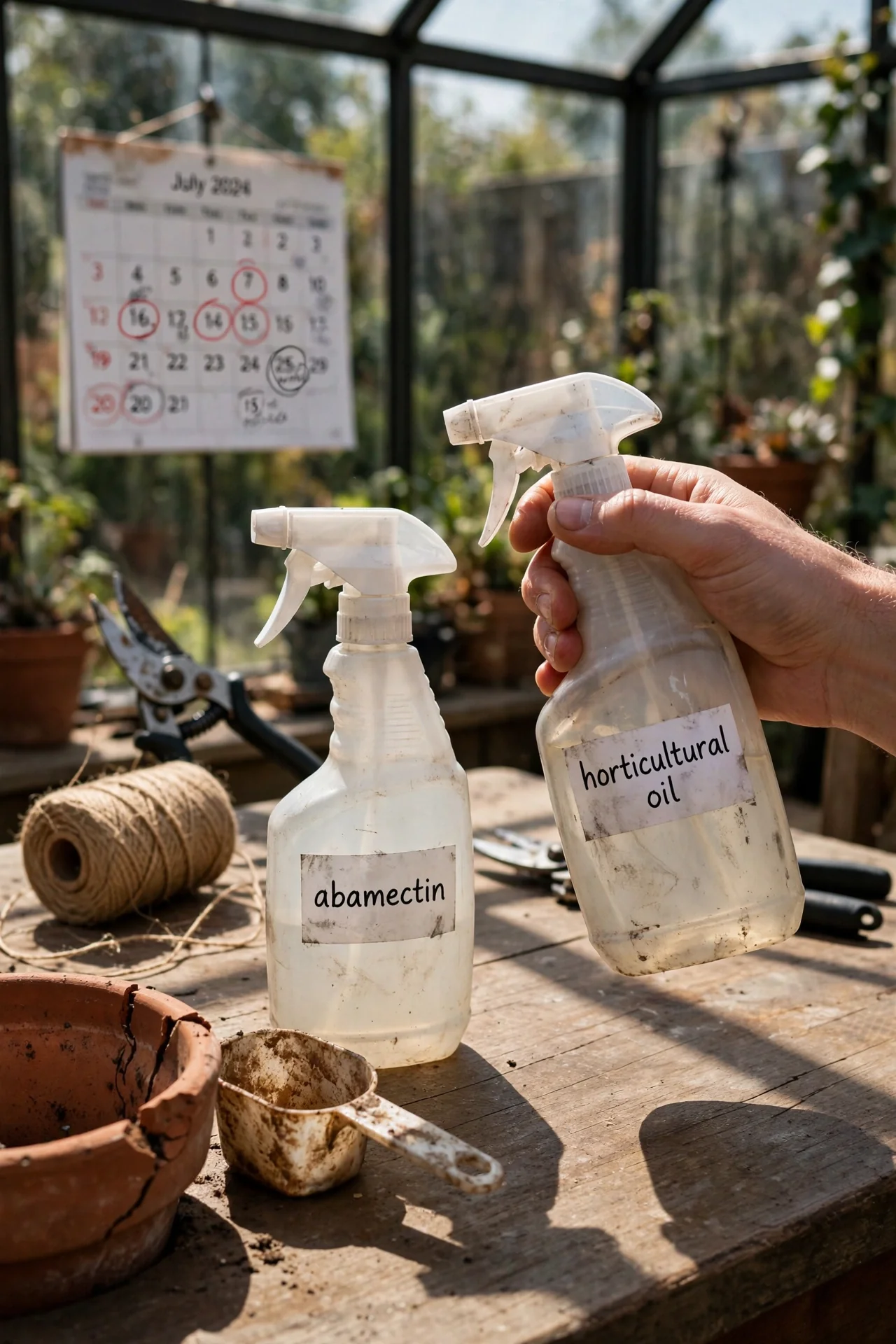
4. Abamectin (Avid 0.15 EC): Translaminar Action for Hidden Mites
Best for: Branch 2
Why it matters: Abamectin is a translaminar miticide, meaning it penetrates leaf tissue and forms a reservoir inside the leaf. Mites feeding on the underside or inside folded tissue ingest the active ingredient even if the spray never contacted them directly. This is the key distinction from contact-only products: abamectin reaches mites in buds.
Measurable protocol: Mix 0.04 fluid ounces per gallon of water (1.18 ml per gallon). Apply as a foliar spray to runoff, directing the nozzle into the crown and leaf axils. Repeat at 7-day intervals for two to three applications. Do not exceed two applications per crop cycle to manage resistance. Abamectin has no ovicidal activity, so the repeat application targets larvae that hatch after the first treatment.
Constraint: Abamectin is a restricted-use product labeled for ornamental use in greenhouses and nurseries. It is not labeled for indoor residential use in many jurisdictions. Apply outdoors only, wearing nitrile gloves and eye protection. Keep treated plants isolated for 24 hours after spray dries.
If you are dealing with persistent infestations on edible plants, see non-systemic alternatives suitable for herbs and leafy greens.
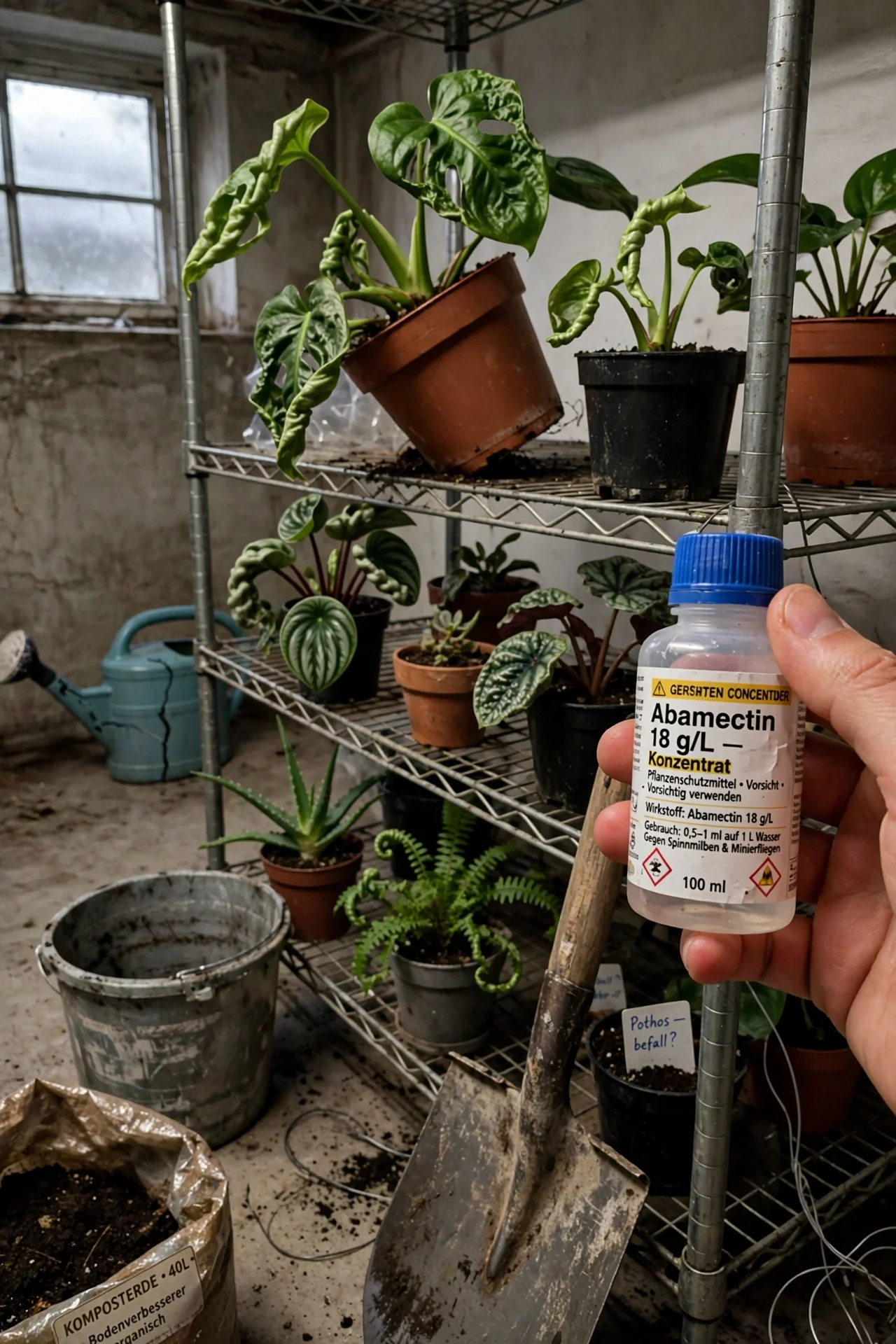
5. Wettable Sulfur: The African Violet Specialist
Best for: Branch 2
Sulfur disrupts mite cellular respiration through both contact and vapor-phase activity. It is one of the few miticides that penetrates the dense crown hairs of African violets where cyclamen mites concentrate. Apply as a wettable powder mixed per label rates, spraying to runoff every 7 to 10 days. Do not apply within two weeks of an oil spray; the combination causes severe phytotoxicity. Sulfur also suppresses powdery mildew, a secondary benefit in humid growing conditions.
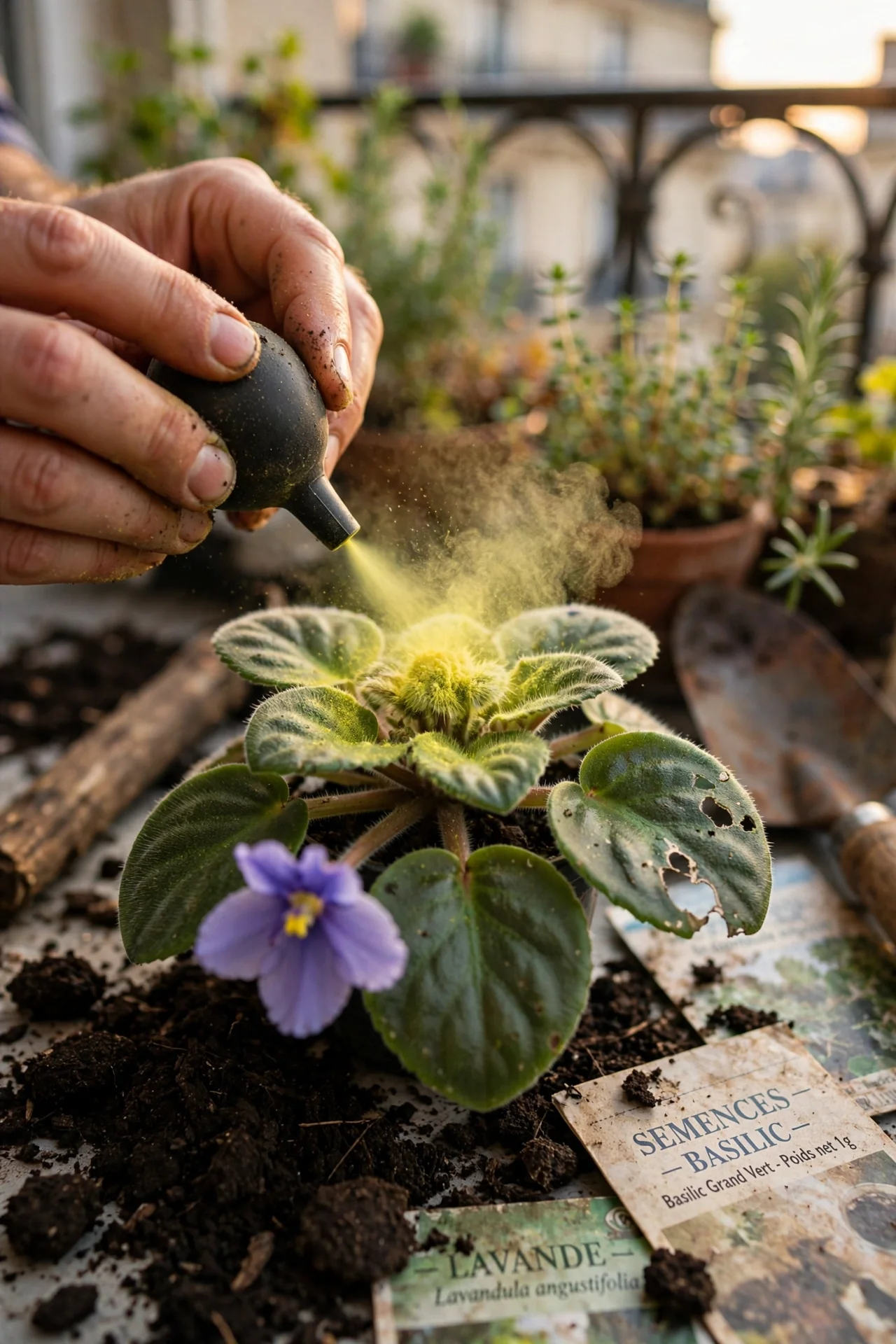
6. Predatory Mites (Neoseiulus cucumeris): Prevention Over Cure
Best for: Branch 3
Neoseiulus cucumeris is a generalist predatory mite that feeds on cyclamen mite eggs and first-instar larvae. It cannot tackle adult cyclamen mites, so it functions as a population suppressor, not an eradicator. Release rates of 5 to 50 predators per square foot, applied every three to four weeks, are standard. This method works best in humidity above 65% and temperatures between 66°F and 80°F (19°C to 27°C). Below 60°F, predator activity drops sharply. A critical constraint: predatory mites fail if miticide residues are present. Wait at least four weeks after your last chemical spray before releasing predators.
For greenhouse-scale biological programs, explore integrated strategies that combine beneficial organisms with cultural controls.
7. Abamectin and Oil Rotation: Breaking the Resistance Cycle
Best for: Branch 2
The problem: Cyclamen mite populations can develop resistance to abamectin when it is used repeatedly without rotation. The solution is to alternate modes of action. A proven sequence: apply abamectin at 0.04 fl oz per gallon in week 1, then horticultural oil at 2% concentration in week 2, then abamectin again in week 3. The oil kills any adults that survived the first abamectin application and smothers eggs laid in the interval, while the alternating chemistry reduces selection pressure for resistance.
Edge case: This rotation is not suitable for plants under heat stress or in bloom, because oil can cause flower drop and leaf scorch when combined with abamectin residues. Wait until flowering finishes before starting the rotation.
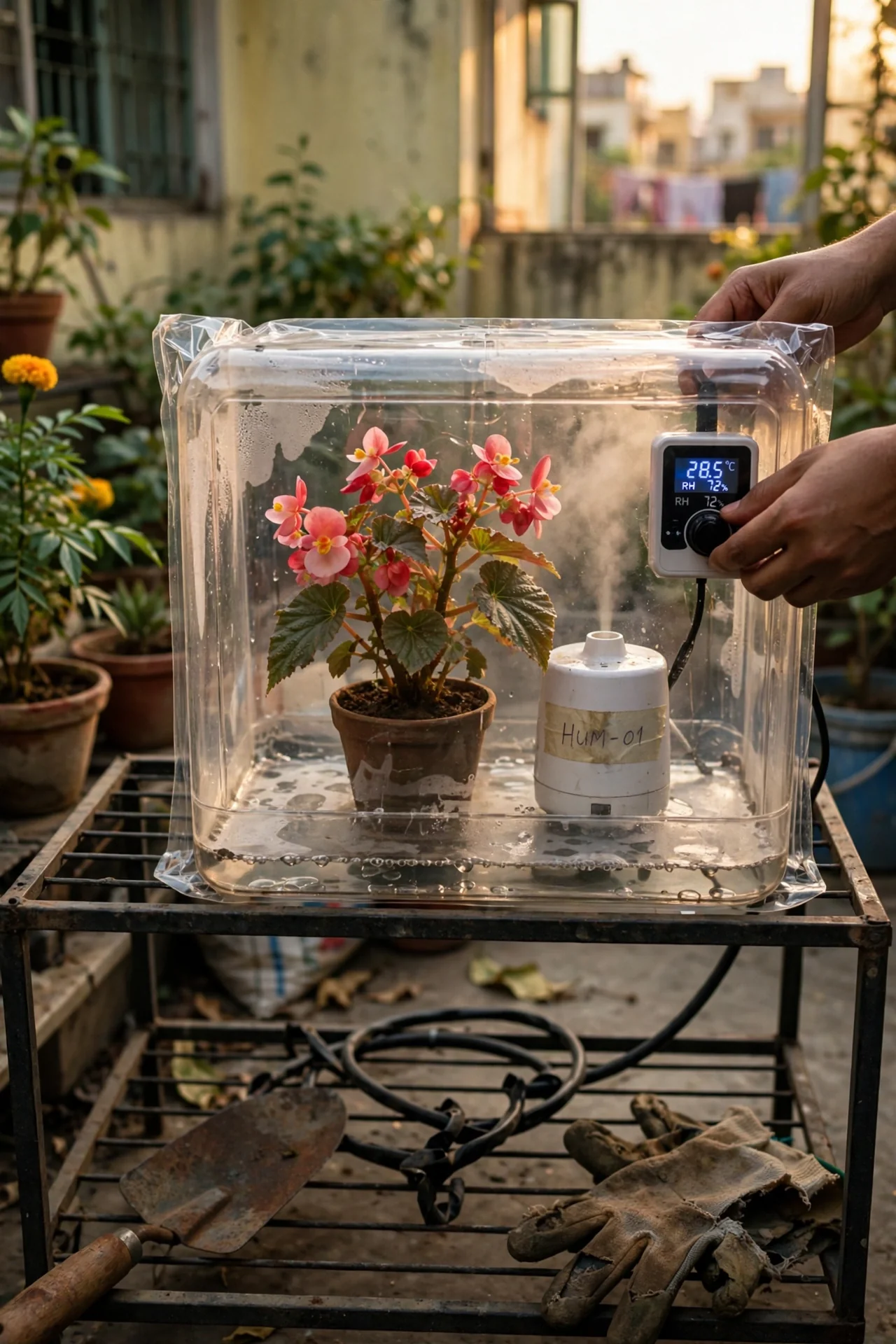
8. Whole-Plant Heat Chamber: Steam Treatment for Collections
Best for: Branch 3
Research on strawberry transplants shows that steam treatment at 44°C (111.2°F) for one hour reduces cyclamen mite numbers by over 99% without compromising plant survival. For houseplant collections, a sealed chamber with a humidifier and thermostat can replicate this. The protocol requires precise temperature control: the entire plant mass must reach 44°C and hold for 60 minutes. Crowns smaller than 6 mm diameter tolerate this well; larger woody crowns may experience tissue damage at the 4-hour mark.
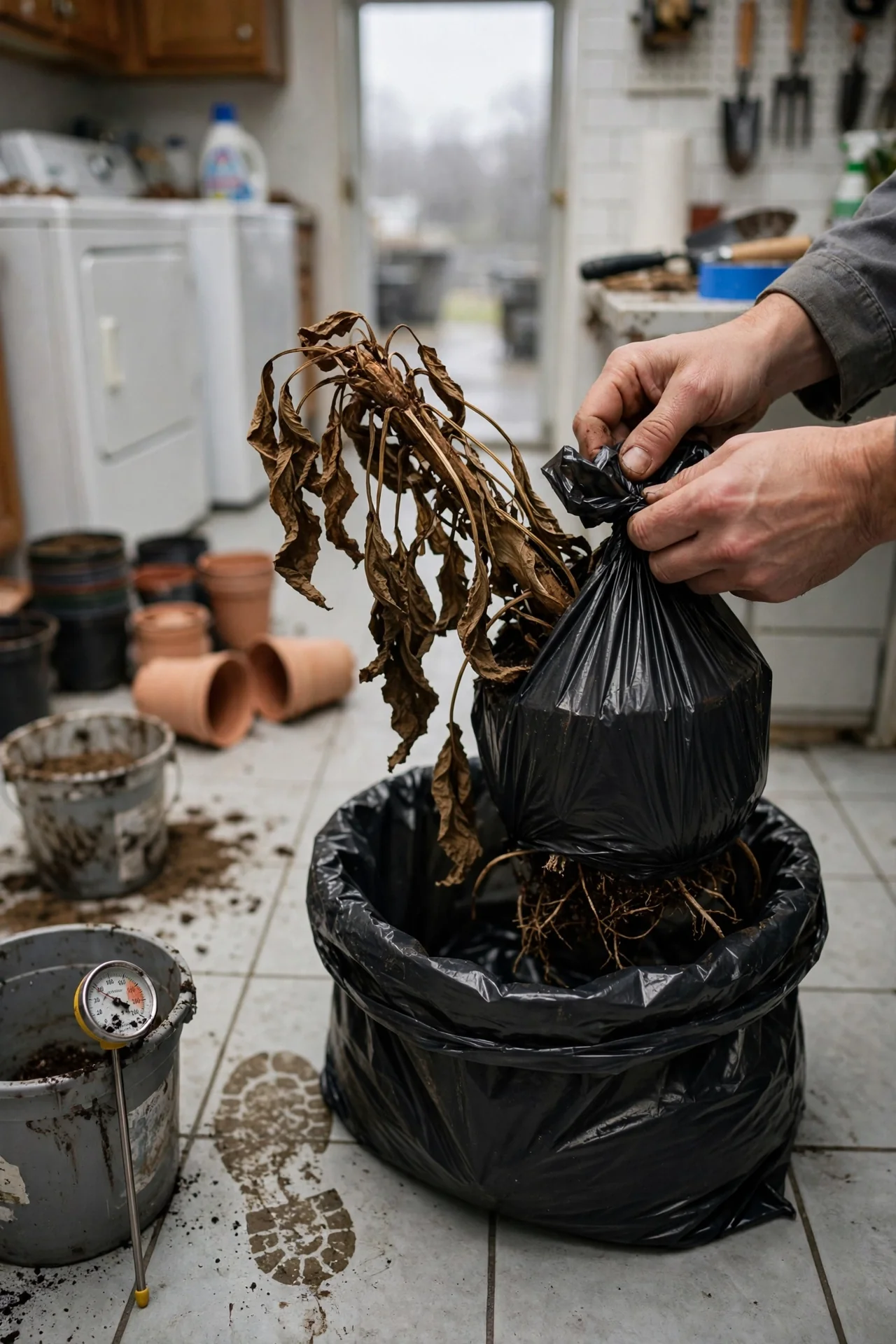
9. Discard and Restart: When Treatment Costs Exceed Replacement
Best for: Branch 3
Decision rule: If more than half the crown is distorted, if the plant has stopped producing new growth for over three weeks, or if the plant is a common variety available for under $15, discarding is the rational choice. Bag the plant in plastic before moving it through your home to prevent mite dislodgement. Do not compost infested material unless your compost reaches 140°F (60°C) sustained for three days. Sterilize the pot with a 10% bleach solution (1 part bleach to 9 parts water) for 30 minutes before reuse.
For guidance on disinfecting pots and tools after pest outbreaks, see our soil-borne pest sanitation protocol.
10. Integrated Rotational Program: The Long-Game Strategy
Best for: Branch 3
What it is: A calendar-based sequence combining cultural controls, physical treatments, and chemical rotations designed to break the cyclamen mite life cycle across multiple generations. This is the approach used by commercial greenhouses managing ongoing mite pressure.
Sample 8-week protocol: Week 1: Isolate all affected plants and reduce ambient humidity below 60% using a dehumidifier. Week 2: Apply abamectin spray to runoff. Week 3: No treatment; monitor for phytotoxicity. Week 4: Apply horticultural oil at 2%. Week 5: Release Neoseiulus cucumeris at 25 mites per square foot. Week 6: Maintain humidity above 65% for predator establishment. Week 7: Inspect new growth with a 20x hand lens for signs of recovery. Week 8: If damage persists on new leaves, repeat abamectin application once and reassess.
Key constraint: This program assumes you can maintain separate environmental zones for treated and untreated plants. Without isolation, mites will recolonize treated plants from untreated reservoirs.
If leaf distortion symptoms persist after treatment, compare your damage pattern with thrips feeding injury to rule out misdiagnosis.
Starter Stack (What to Choose First)
Branch 1 Starter: Early Detection, Single Plant
Combine a hot water dip (Item 1) with a follow-up insecticidal soap regimen (Item 2). The dip provides immediate knockdown of all life stages present, while the soap catches any larvae that hatch from eggs deep in tissue folds over the next two weeks. Total cost: $15 to $30 for a digital probe thermometer, a 5-gallon bucket, and a bottle of ready-to-use insecticidal soap. Time investment: approximately 45 minutes for the initial dip, then 10 minutes per weekly spray for three weeks.
Branch 2 Starter: Multiple Plants, Moderate Damage
Begin with wettable sulfur (Item 5) for African violets and other hairy-leaved plants, paired with an abamectin and oil rotation (Item 7) for smooth-leaved specimens. The sulfur handles mites embedded in dense crown hairs, while the rotation provides both immediate kill and residual protection. Cost: $40 to $90 for a 1-quart Abamectin concentrate, a 16-ounce sulfur powder, and a pump sprayer. Expect to invest two to three hours across four weeks of treatment.
Branch 3 Starter: Severe Infestation or Large Collection
Implement discarding of the worst-affected plants (Item 9) immediately to reduce the mite reservoir, then deploy predatory mites (Item 6) on remaining plants after a four-week chemical hiatus. Follow with the integrated rotational program (Item 10) for plants that show new, undamaged growth. Cost: $60 to $150 for predatory mite shipments (minimum orders typically apply) plus $50 to $100 for miticides and equipment. Time: plan for weekly monitoring and monthly reapplications over a three-month period.
When This Won’t Work
Failure condition 1: The crown is already necrotic. Cyclamen mites inject toxic saliva that disrupts apical meristem tissue. If the growing point has turned brown or black and produces no new leaves for three weeks, the meristem is dead. No miticide can revive dead tissue. The plant will not recover regardless of treatment. The alternative action: discard the plant and sanitize the pot as described in Item 9.
Failure condition 2: Environmental conditions favor mites over predators or miticide efficacy. Cyclamen mites thrive at 60°F to 80°F (15°C to 27°C) with humidity between 70% and 90%. If you cannot lower humidity below 65% or raise temperatures above 85°F (29.4°C) during treatment, mites will reproduce faster than control measures can suppress them. Predatory mites become inactive below 60°F, and some miticides degrade faster in high humidity. The alternative action: move plants to a climate-controlled space, or delay treatment until seasonal conditions shift.
For understanding how environmental conditions affect pest population dynamics, review our guide on managing humidity-dependent mite outbreaks.
Choosing the Right Option for Your Situation
Budget Threshold
If your budget is under $20, you are limited to insecticidal soap (Item 2) and plant disposal (Item 9). Insecticidal soap costs approximately $8 to $12 per ready-to-use bottle. If that fails after three weekly applications, discard the plant rather than escalating. Spending more on treatment than the plant is worth is a common pitfall with cyclamen mites.
Time Threshold
If you cannot commit to at least three treatment sessions spaced 5 to 7 days apart, do not begin miticide treatment. Cyclamen mite eggs hatch in two to three days at 68°F (20°C), and a single application misses the next generation. Half-treated infestations rebound and may develop resistance. Choose hot water dip (Item 1) or disposal (Item 9) if your available time window is under two weeks.
Technical Constraint: Plant Sensitivity to Heat
Not all houseplants tolerate 111°F water. Thin-leaved plants (ferns, calatheas, some begonias) may suffer leaf drop or crown rot after hot water treatment. Before dipping, test a single leaf or a small root division if possible. If the plant cannot tolerate heat, shift to the abamectin rotation (Item 7) or, for organic-only growers, accept that control will be partial and rely on isolation plus oil sprays.
Quick Yes/No Checklist:
- Is new growth still emerging from the crown? Yes: proceed with treatment. No: discard.
- Can you maintain isolation for at least four weeks? Yes: any branch is viable. No: limit to Branch 1 or 3 options.
- Do you have a digital thermometer accurate to ±0.5°F? Yes: heat methods are available. No: avoid Items 1 and 8.
- Are you able to apply sprays outdoors or in a ventilated area? Yes: chemical options open. No: use soap, oil, or predatory mites only.
Expert Q&A
How can I tell cyclamen mite damage from herbicide damage?
Both cause leaf distortion and stunted growth. The distinguishing sign: cyclamen mites leave a characteristic browning and roughening of the crown area where petioles meet the stem. Herbicide damage appears uniformly across exposed foliage without crown-specific symptoms. Examine the plant crown with a 20x hand lens; if you see tiny, translucent, oblong eggs in the folds, it is mites.
Can cyclamen mites spread from houseplants to outdoor garden plants?
Yes. Cyclamen mites crawl from plant to plant when leaves touch, and they can be carried on clothing, tools, or by air currents. If you move an infested houseplant outdoors in summer, mites can colonize nearby garden plants, especially strawberries, fuchsias, and begonias. Keep infested houseplants isolated indoors year-round, and do not reuse outdoor gardening gloves indoors without washing.
Why do cyclamen mites keep coming back after I treat?
The most likely reason is that eggs survived your treatment. Most contact miticides, including insecticidal soap and horticultural oil, do not penetrate the smooth, waxy chorion of cyclamen mite eggs. Eggs hatch two to three days after being laid, and a single treatment misses this window. A minimum of three applications spaced five to seven days apart is required to deplete the egg bank.
Do cyclamen mites go dormant in winter?
Adult females overwinter in plant crowns and debris, becoming active when temperatures rise above 50°F (10°C). In heated indoor environments, there is no true dormancy period; reproduction slows but does not stop. This is why indoor infestations can persist year-round, and why a warm indoor winter provides continuous breeding conditions.
What is the fastest way to confirm cyclamen mites without a microscope?
The “tap test” used for spider mites does not work for cyclamen mites because they do not reside on open leaf surfaces. Instead, look for the symptom triad: cupped, brittle new leaves; excessive hairiness at the crown (especially on African violets); and buds that brown and abort before opening. If all three are present, the probability of cyclamen mites is high enough to begin treatment without waiting for microscopic confirmation.
Conclusion
The decision that determines success is not which product you choose, but whether you deliver it into the crown and bud tissue where cyclamen mites actually live. Surface sprays fail regardless of active ingredient. The single most common mistake is treating once and stopping. Cyclamen mite eggs survive the first pass, and the population rebounds within two weeks.
If you suspect cyclamen mites but are unsure of the diagnosis, start with the symptom checklist in the Q&A above. If you are ready to treat, select your branch from the Decision Grid and begin with the Starter Stack that matches your situation. For a deeper understanding of how microscopic pests behave differently from visible insects, read our article on detecting concealed pest egg masses.