
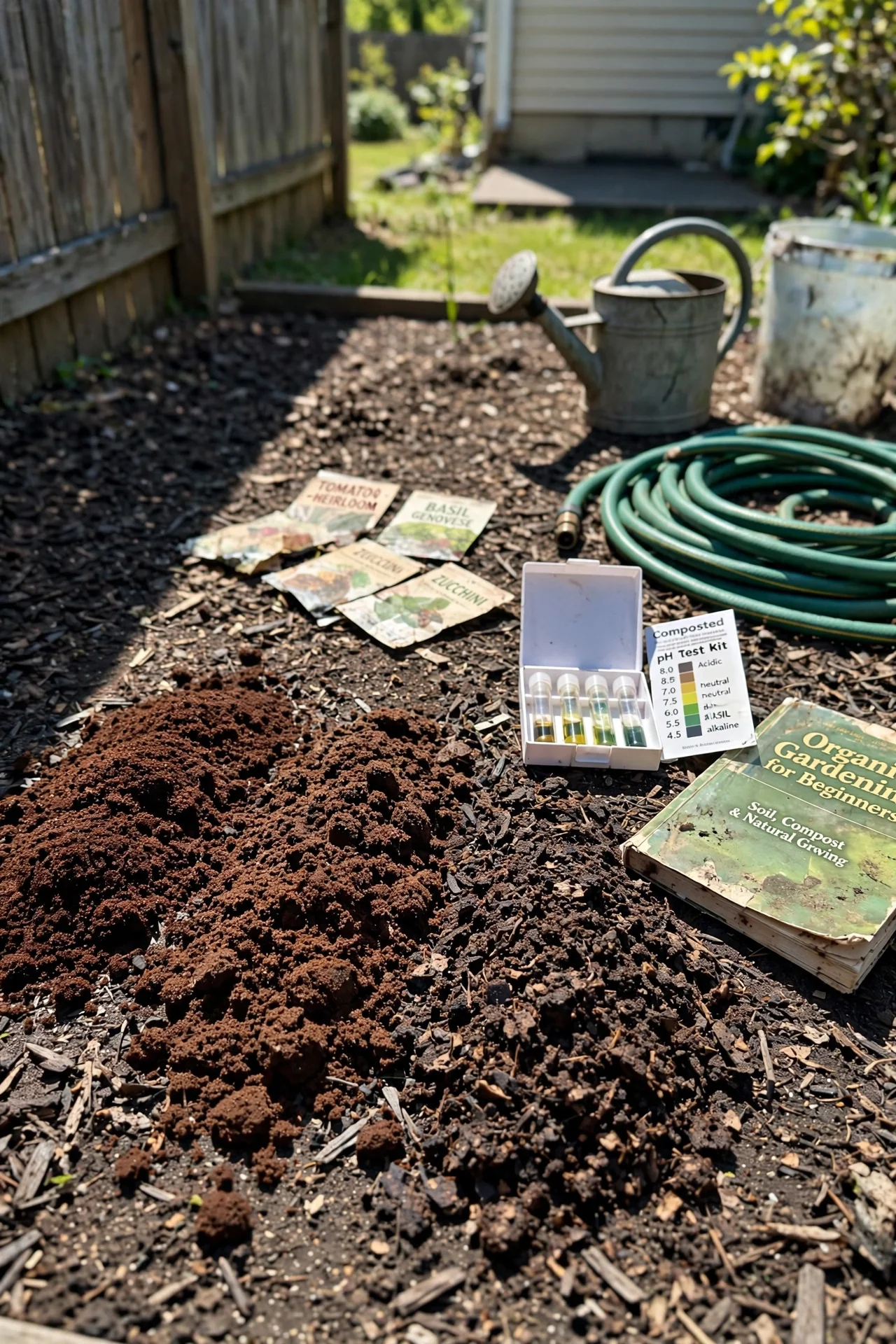
Using coffee grounds in the garden is often pitched as a simple sustainability win. The advice is everywhere: sprinkle them around your roses, dump them into the compost bin, or blend them into a homemade fertilizer. What most advice misses is that coffee grounds sit on a sliding scale of risk depending on whether they are fresh, spent (brewed), or fully composted. Treating all coffee grounds as interchangeable is the fastest route to stunted seedlings and hydrophobic soil. This guide reframes the conversation around measurable conditions: pH, caffeine residue, and decomposition stage. It is not a collection of feel-good tips; it is a decision framework built around what the grounds actually contain and what your soil actually needs.
Bottom line: Compost spent coffee grounds before adding them to garden soil; fresh grounds are almost never the right choice for direct application.
The Yield Grid Decision Grid
Choose your branch based on the state of your coffee grounds:
- Branch 1: Fresh (Unbrewed) Coffee Grounds. pH measures 4.5 to 5.0, caffeine content sits between 0.8 and 1.2 percent. High allelopathic potential. Use only for targeted weed suppression or as a pre-treatment material for vermicomposting where worms gradually neutralize the bioactive compounds.
- Branch 2: Spent (Brewed) Coffee Grounds. pH settles at 6.5 to 6.8; residual caffeine drops to roughly 0.2 percent. Safe for thin direct application and as a green ingredient in compost piles, but still capable of compacting into a water-repellent crust if applied too thickly.
- Branch 3: Composted Coffee Grounds. pH levels off near 7.0, caffeine degradation is complete, and the remaining polyphenols and tannins have broken down through microbial action. This is the form that delivers the soil-conditioning benefits gardeners expect, with none of the phytotoxic risks.
Recommended: Items 1, 2, and 6 below match each branch. For an overview of the underlying composting process, see our composting for beginners guide.
Quick Comparison Table
| Option | Key Mechanism | Best For | Decision Grid Branch | Effort Score (1–5) |
|---|---|---|---|---|
| 1. Fresh Grounds for Allelopathic Weed Control | Caffeine-induced germination inhibition | Established perennial beds with weed pressure | Branch 1 | 4 |
| 2. Spent Grounds as Thin Mulch | Organic matter input with minimal structural risk | Shallow-rooted annuals and around woody shrubs | Branch 2 | 2 |
| 3. Coffee Grounds in Bokashi | Anaerobic fermentation followed by soil integration | Apartment dwellers and cold-climate gardeners | Branch 3 | 3 |
| 4. Vermicomposting with Coffee Grounds | Worm-mediated caffeine degradation | Indoor or balcony worm bin operators | Branch 1 | 4 |
| 5. Slug Deterrence with Spent Grounds | Mucous membrane irritation from caffeine residue | Hostas, ligularias, and other slug-susceptible ornamentals | Branch 2 | 2 |
| 6. Coffee Grounds in Hot Composting | Thermophilic breakdown of recalcitrant compounds | Gardeners managing 1 cubic yard or larger piles | Branch 3 | 3 |
| 7. Biochar from Coffee Grounds | Pyrolysis converts grounds into a stable carbon matrix | Sandy soils requiring long-term water-holding improvement | Branch 1 | 5 |
| 8. Nitrogen Boost in the Compost Pile | Low C:N ratio (approximately 20:1) accelerates decomposition | Compost piles dominated by brown materials | Branch 2 | 2 |
| 9. Compost Tea with Aged Coffee Grounds | Aerobic extraction of microbial metabolites | Foliar feeding and soil drench applications | Branch 3 | 4 |
| 10. Coffee Grounds in Sheet Mulching | Thin interlayer in a multi-layer carbon/nitrogen stack | Converting lawn to planting beds without digging | Branch 2 | 3 |
| 11. Coffee Grounds for Acid-Loving Plants | Short-term pH fluctuation from fresh grounds only | Blueberries, azaleas, and rhododendrons (supplemental, not primary) | Branch 1 | 4 |
| 12. Composted Grounds in Seed Starting Mix | Sterilized, slow-release nutrient base | Seedlings requiring consistent moisture and low salt stress | Branch 3 | 3 |
1. Fresh Coffee Grounds for Allelopathic Weed Suppression
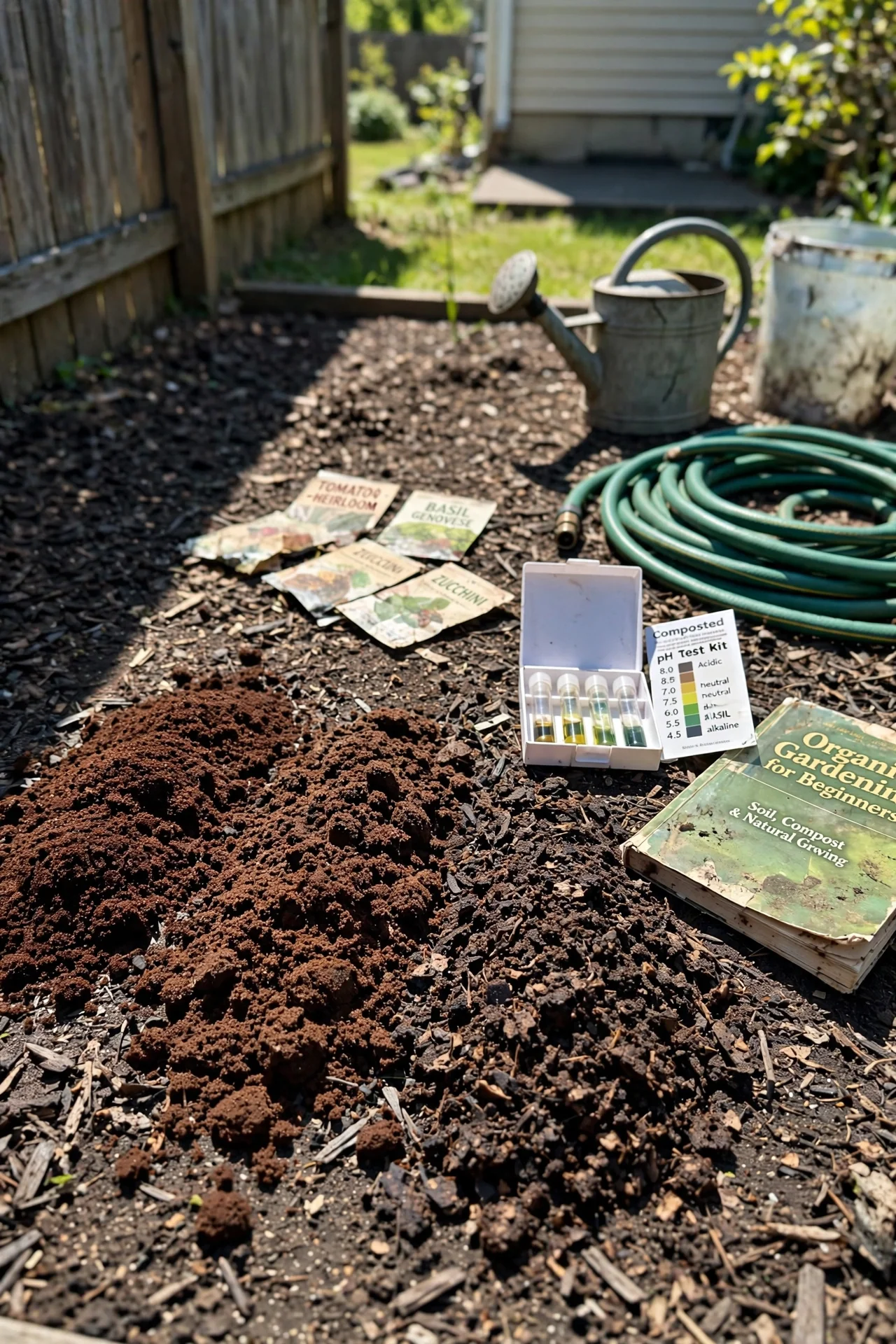
Best for: Branch 1 (Fresh Grounds)
What it is: Fresh unbrewed coffee grounds applied directly to soil surfaces to suppress weed seed germination through caffeine allelopathy. Caffeine inhibits DNA synthesis in germinating seeds by interfering with cell plate formation in root tips. This mechanism is dose-dependent; it works only on small-seeded annual weeds like pigweed and foxtail, not on established perennial roots.
Critical constraint: Allelopathic activity fades within 10 to 14 days as soil microbes metabolize the caffeine. Reapplication is required for season-long suppression, and rain or irrigation accelerates the degradation curve. Do not apply within 2 feet of desired seedlings; the same mechanism that blocks weed germination blocks your lettuce and radish seeds, too.
Mistake to avoid: Assuming fresh grounds act like a pre-emergent herbicide. They do not form a long-lived chemical barrier. Thick layers (over half an inch) create a hydrophobic crust that prevents water infiltration, counteracting any benefit.
2. Spent Coffee Grounds as a Thin Mulch
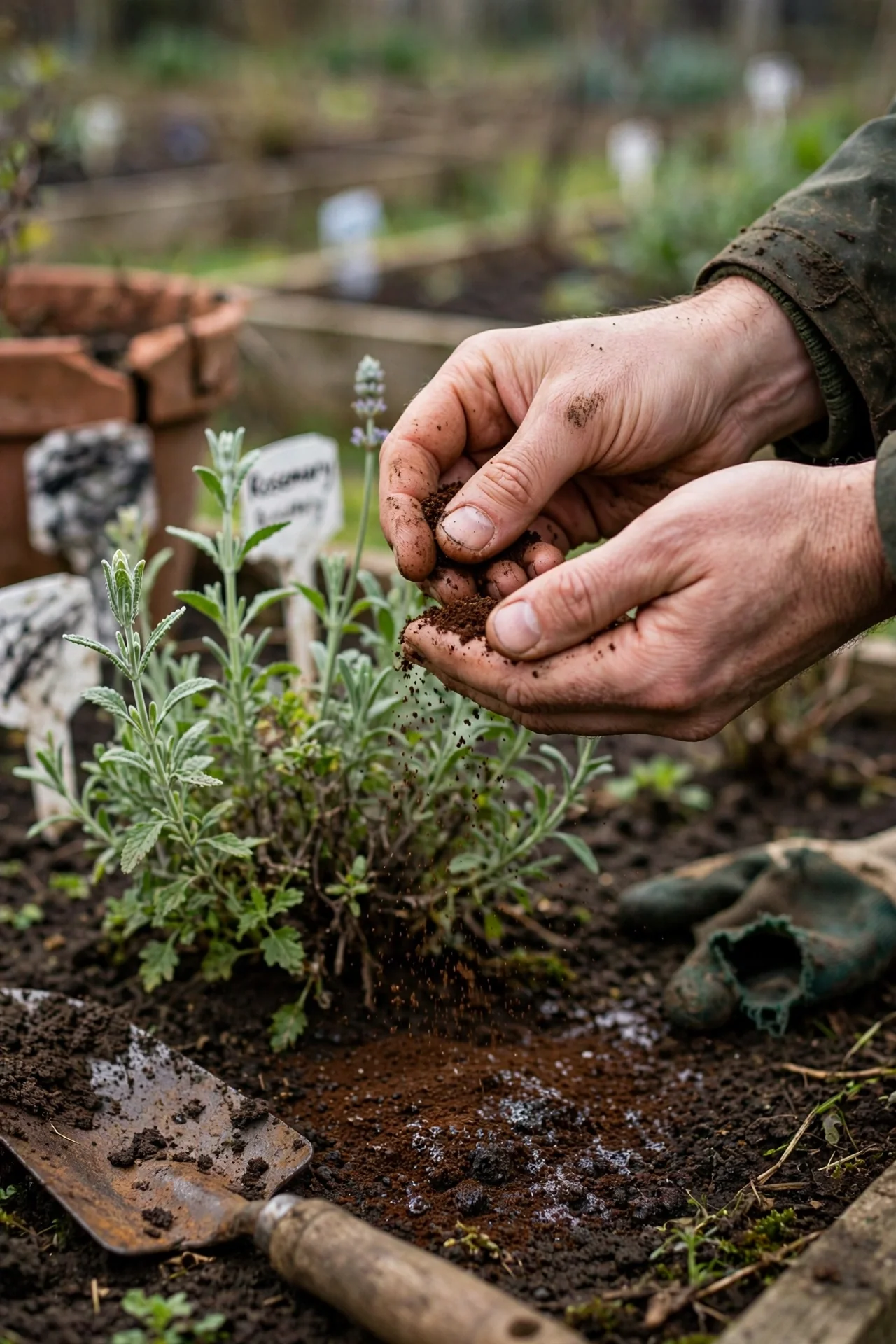
Best for: Branch 2 (Spent Brewed Grounds)
Apply spent grounds no deeper than 0.5 inch and always top-dress with 2 to 3 inches of coarse organic mulch such as shredded leaves or wood chips. Without the cover layer, spent grounds form a crust that repels water and restricts gas exchange at the soil surface. The underlying soil benefits from slow organic matter incorporation as earthworms pull small amounts downward, but the primary value is suppressing evaporative moisture loss from the soil profile underneath the bark or leaf layer.
3. Bokashi Composting with Coffee Grounds
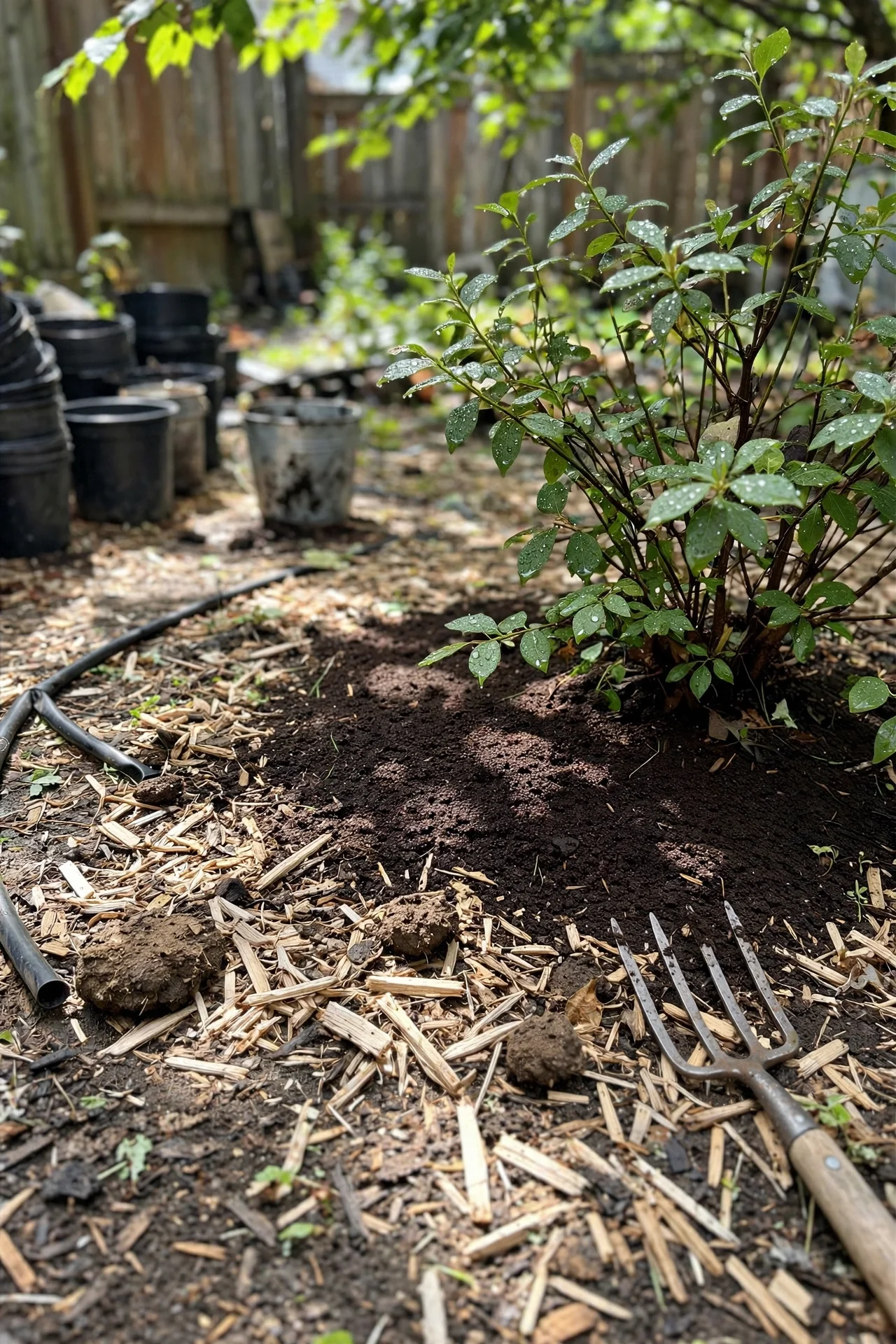
Best for: Branch 3 (Composted Grounds)
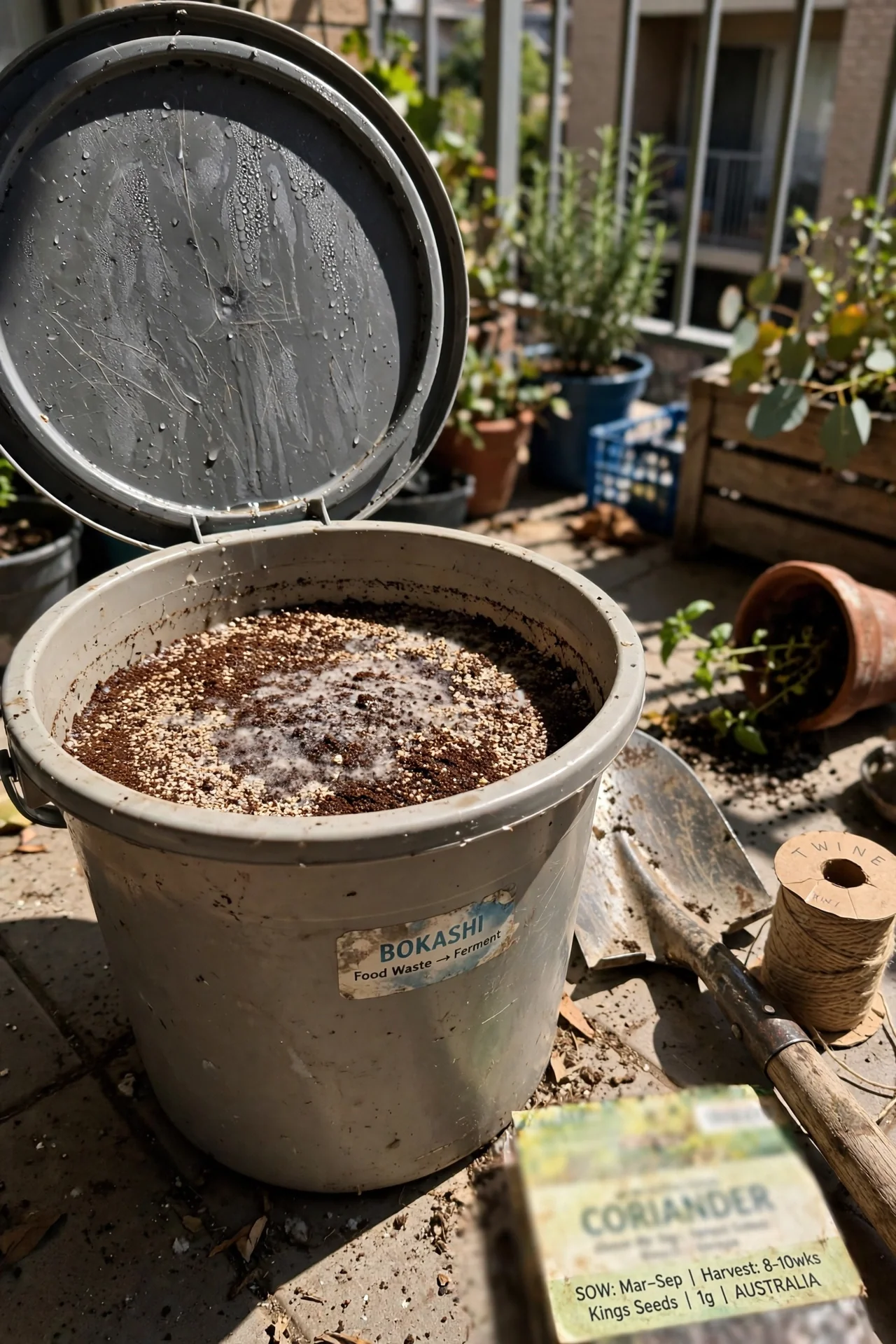
Bokashi ferments coffee grounds anaerobically using inoculated bran, bypassing the aerobic decomposition concern about caffeine toxicity. The fermentation process pre-digests the grounds, and the final product is buried in soil where it finishes decomposition within 2 to 4 weeks. This method fits apartments and cold climates where outdoor piles freeze and is one of the only ways to process fresh grounds without risking phytotoxic carryover. A practical limit: grounds should not exceed 30 percent of the bokashi bucket by volume. For a full process walkthrough, see our bokashi composting guide.
4. Vermicomposting with Coffee Grounds
Best for: Branch 1 (Fresh Grounds)
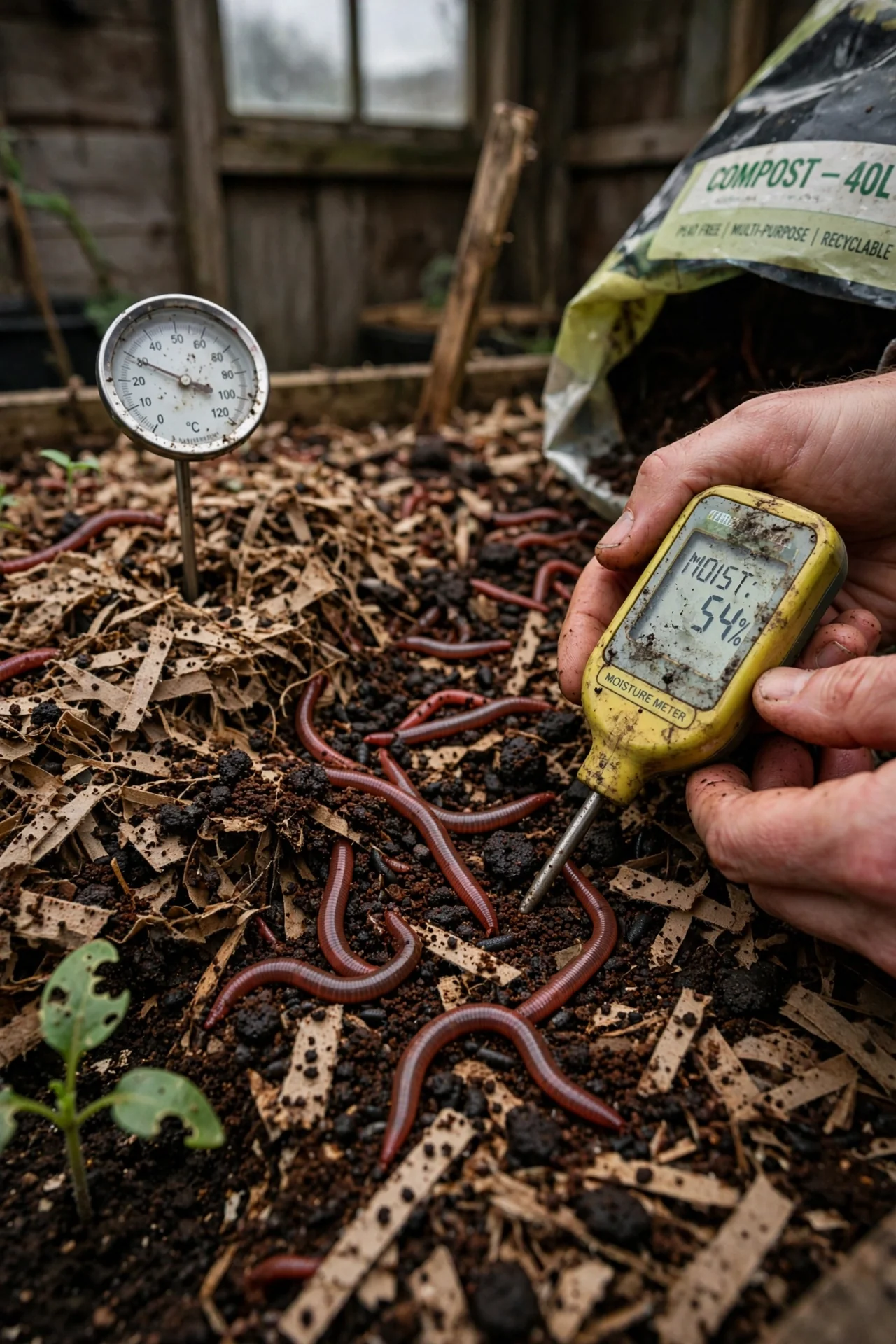
Threshold rule: No more than 1 cup of coffee grounds per square foot of worm bin per week. Red wigglers (Eisenia fetida) tolerate and consume spent coffee grounds readily, but fresh grounds introduce caffeine at levels that can stress or kill worms at higher doses. Research shows that earthworms are capable of substantially reducing caffeine content during vermicomposting, but only when grounds are pre-mixed with carbon-rich bedding (shredded cardboard, coconut coir) at a ratio of at least 3:1 bedding to grounds by volume.
Adjustment: If your worm bin temperature exceeds 80 degrees Fahrenheit (27 degrees Celsius) after adding grounds, reduce the next feed by half. Coffee grounds are nitrogen-dense and can trigger a heat spike in a confined bin. Spread grounds in a thin layer on the surface rather than burying them; worms will consume them gradually as the microbial population softens the material. Your local worm species matters: red wigglers handle coffee grounds better than European nightcrawlers (Eisenia hortensis), which prefer a lower-nitrogen feed. For species selection advice, visit our guide to the best worms for composting.
5. Spent Coffee Grounds for Slug Deterrence
Best for: Branch 2 (Spent Brewed Grounds)
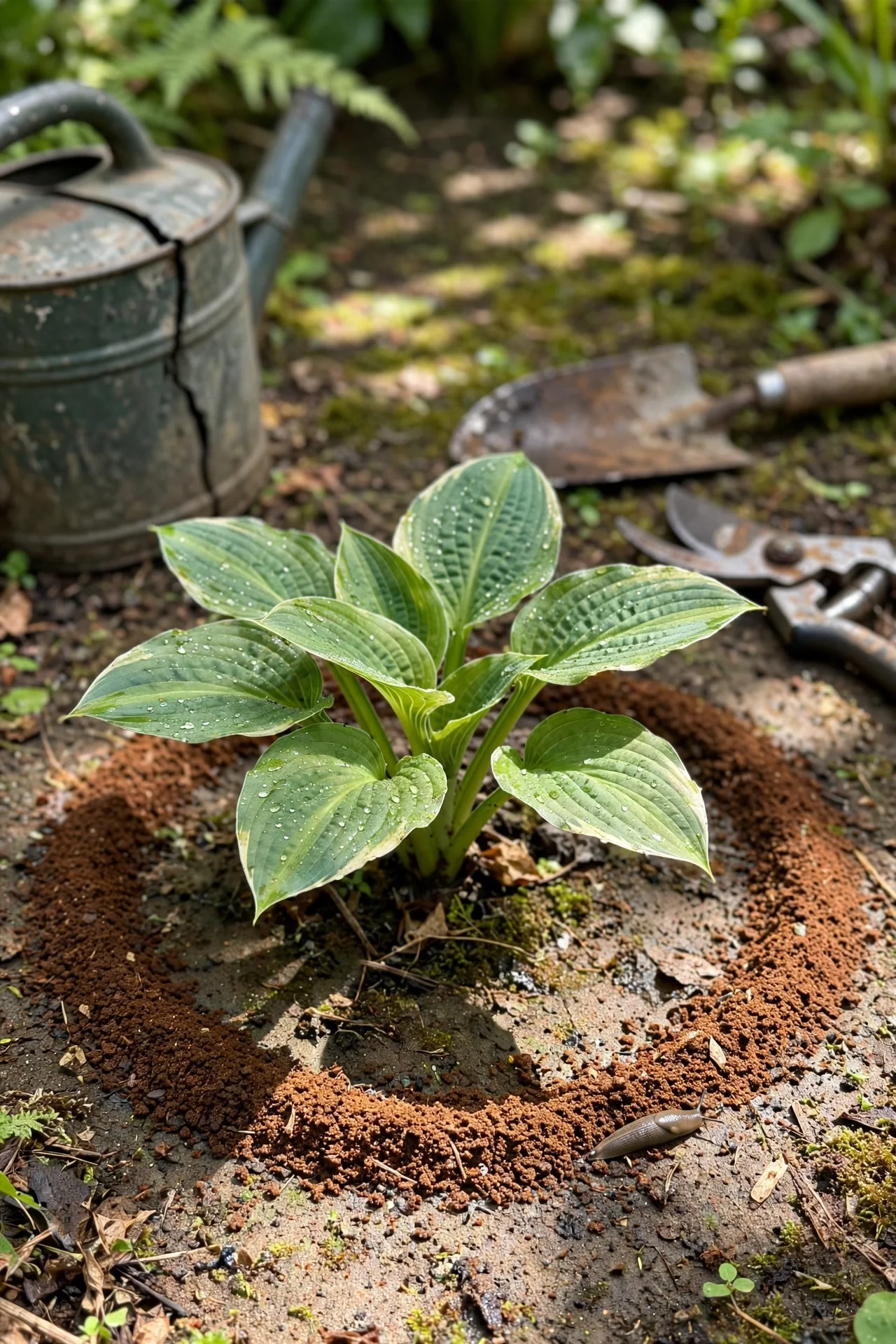
Caffeine irritates the mucous membrane that coats a slug’s foot, deterring them from crossing a dry band of grounds. Apply a 0.25-inch-wide, unbroken ring around hosta crowns or lettuce bed perimeters. Replace the ring weekly or immediately after rainfall. This method works as a deterrent, not a lethal barrier; slugs will breach it if the ring is incomplete or if a damp leaf bridges across the grounds overnight.
6. Coffee Grounds in Hot Composting
Best for: Branch 3 (Composted Grounds)
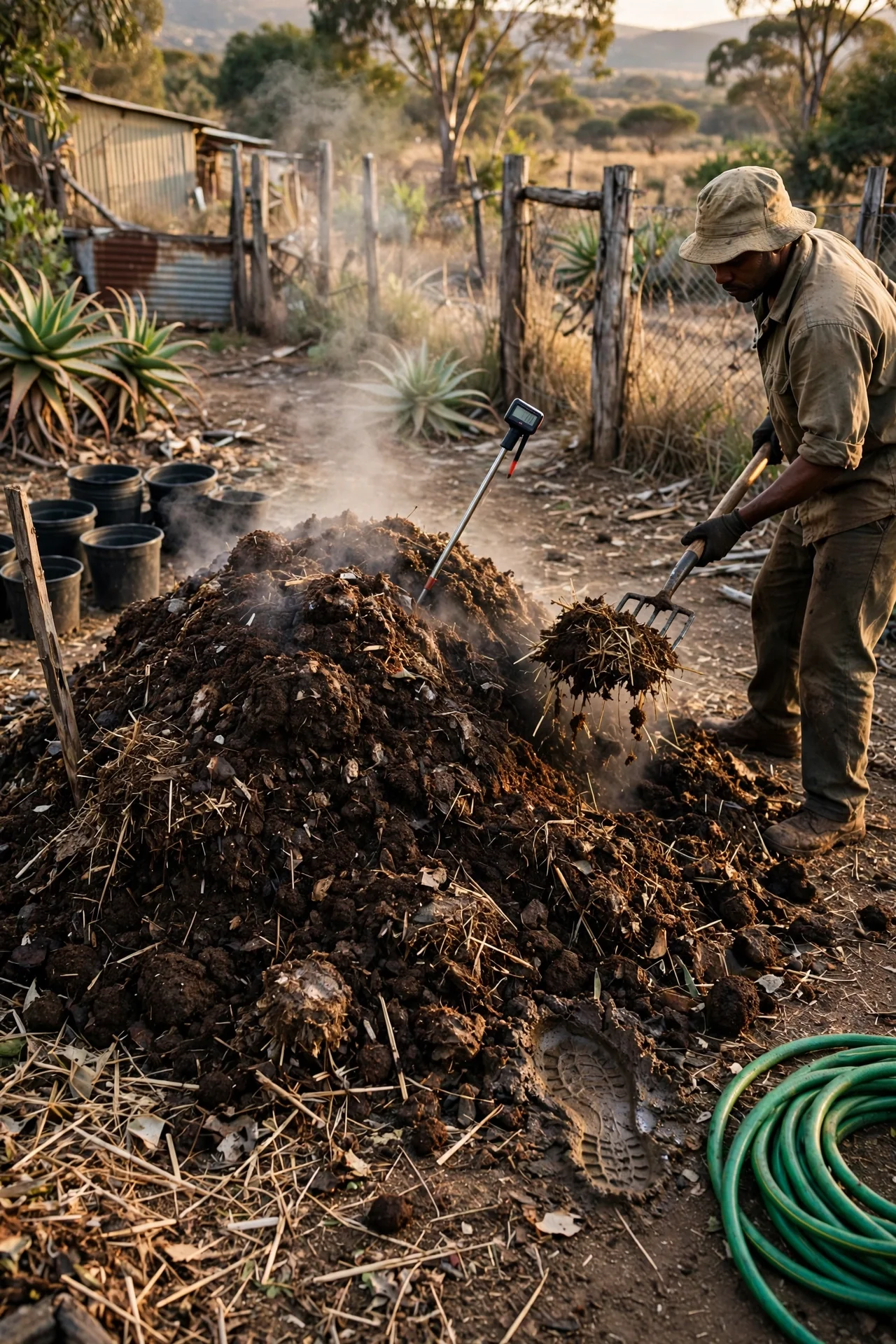
Research recommends keeping coffee grounds to no more than 20 percent of total compost volume; above 30 percent, plant growth is measurably suppressed [Source: Ask Extension]. In a hot pile, combine 1 part grounds with 3 parts carbon-rich browns (dried leaves, straw) and 1 part other greens. Turn the pile every 3 to 5 days, maintaining an internal temperature of 130 to 150 degrees Fahrenheit for at least 15 days. This thermophilic window degrades caffeine and phenolic residues far more reliably than passive cold composting. To learn how to build and manage a pile that sustains these temperatures, see our hot composting method guide.
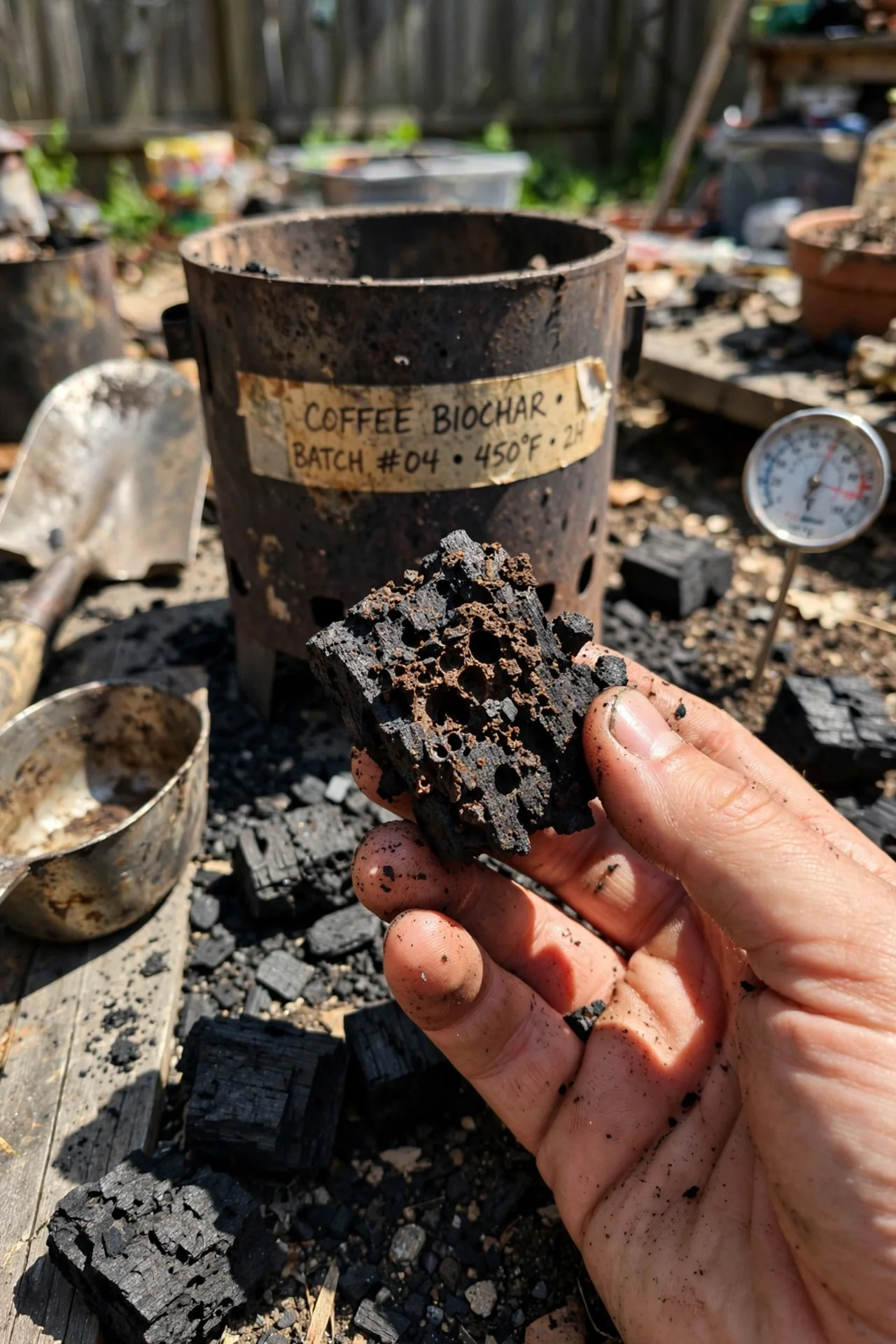
7. Biochar from Coffee Grounds
Best for: Branch 1 (Fresh Grounds)
What it is: Pyrolyzing coffee grounds at 400 to 500 degrees Celsius (752 to 932 degrees Fahrenheit) in a low-oxygen environment converts them into biochar, a stable form of carbon with high surface area and cation exchange capacity. Unlike raw grounds, biochar carries no caffeine, no tannins, and no nitrogen tie-up risk. It acts as a permanent soil structure improver, not a nutrient source.
Edge case: Coffee ground biochar has a uniquely high ash content (12 to 15 percent) compared to wood biochar. This means it raises soil pH slightly over time, which makes it unsuitable for acid-loving plants already growing in borderline alkaline soil. A soil pH test before application is mandatory.
Workflow: Dry fresh grounds completely, pyrolyze in a small-scale biochar kiln or TLUD (top-lit updraft) stove, quench the char with water or diluted compost tea, crush to pea-size pieces, and incorporate at 5 to 10 percent by volume into the top 6 inches of soil. Do not apply uncharged biochar; it will temporarily bind available nitrogen. For soil integration guidance, see our biochar for soil guide.
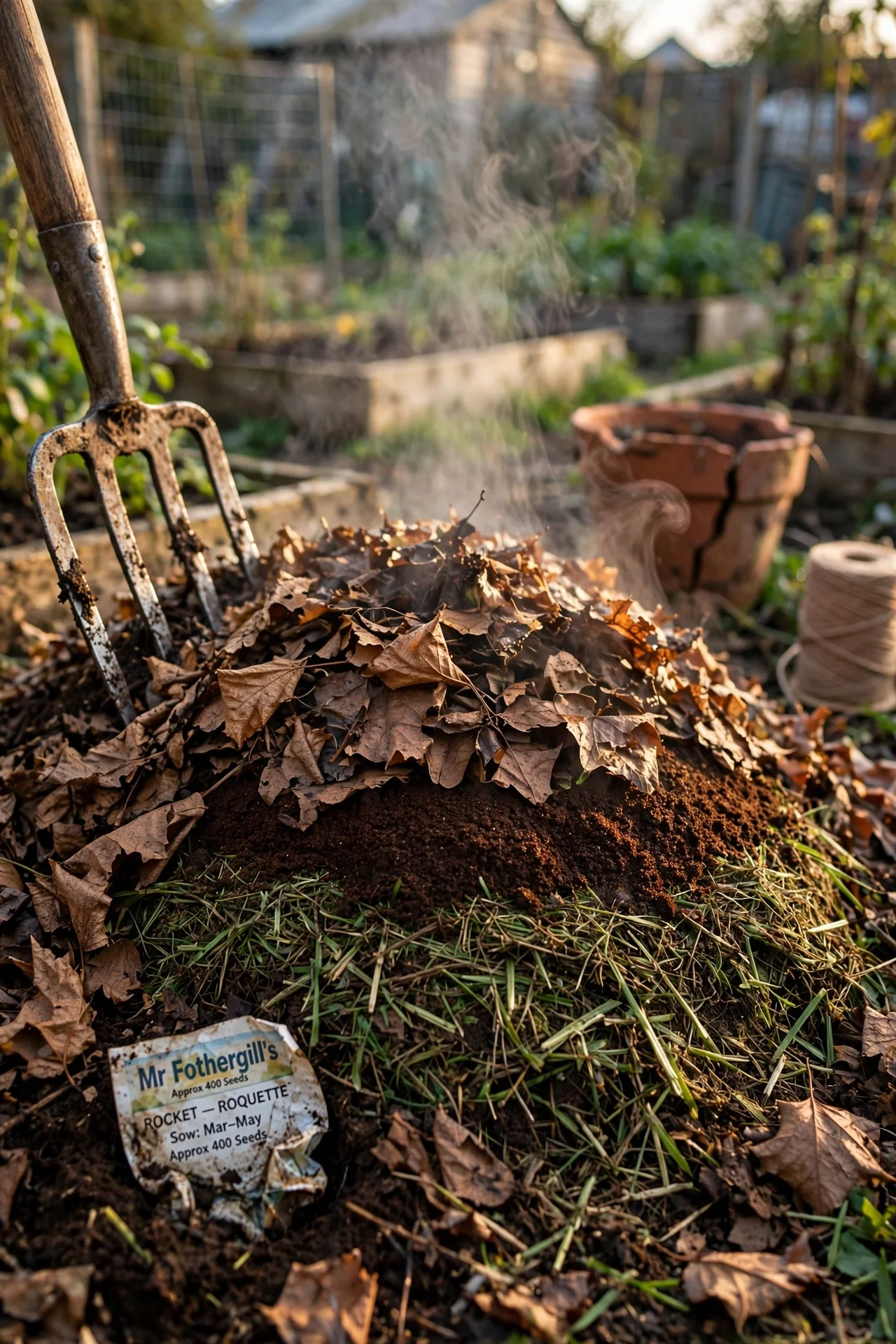
8. Coffee Grounds as a Nitrogen Source in the Compost Pile
Best for: Branch 2 (Spent Brewed Grounds)
Spent coffee grounds carry a carbon-to-nitrogen ratio around 20:1, classifying them as a green material despite their brown appearance. Layer them at roughly 10 percent of pile volume between carbon-heavy layers such as straw or cardboard. They accelerate biological activity within a day of incorporation, which can pull a sluggish cold pile back into active decomposition.
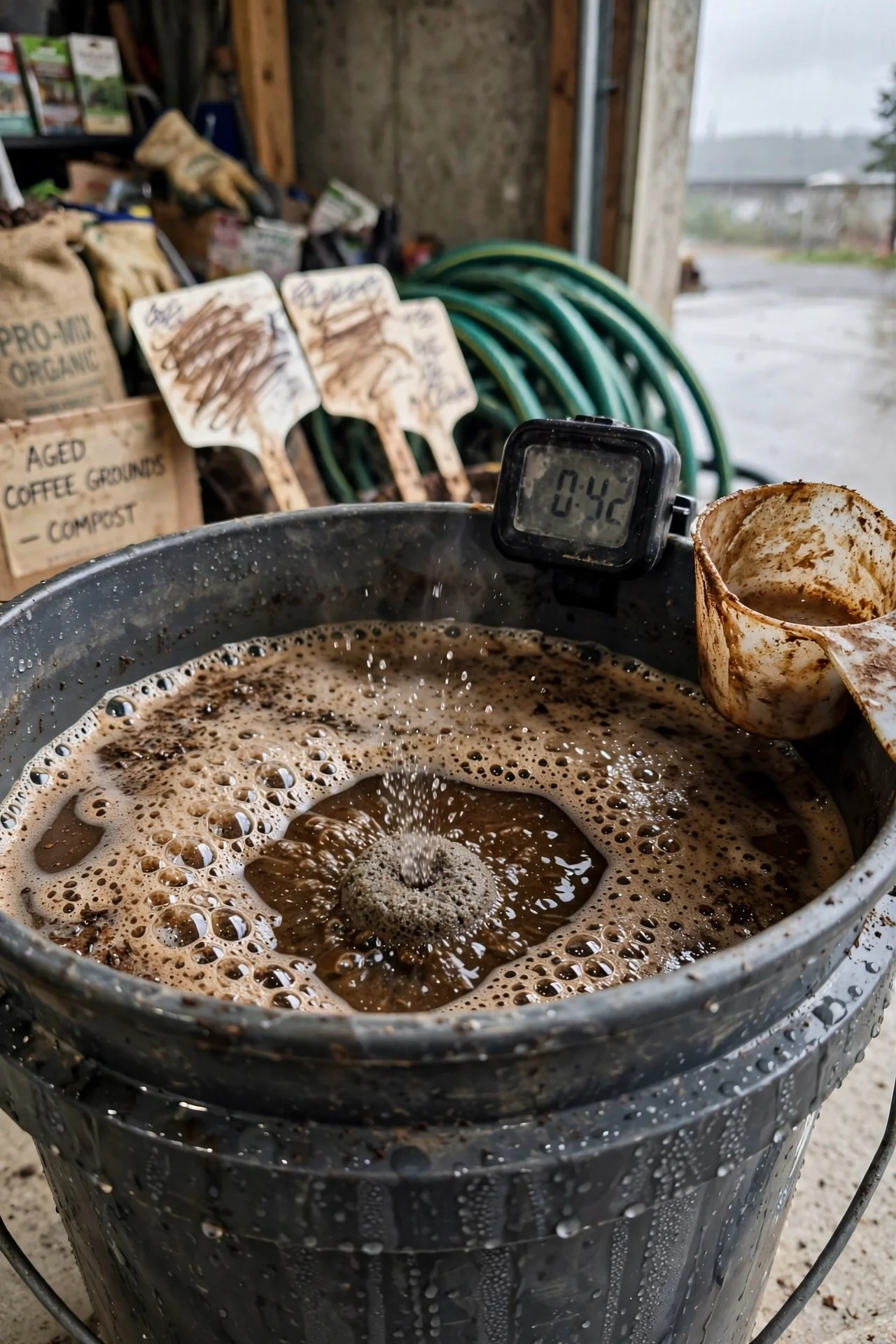
9. Compost Tea Brewed with Coffee Grounds
Best for: Branch 3 (Composted Grounds)
Compost tea made with spent coffee grounds extracts water-soluble microbial metabolites and a modest nitrogen fraction, delivering them as a liquid foliar feed or soil drench. The critical number: steep 1 cup of aged or composted grounds per 5 gallons of dechlorinated water, aerated with an aquarium pump, for no longer than 24 to 36 hours. Longer steeping produces anaerobic conditions that select for pathogenic bacteria. Using fresh grounds in compost tea introduces caffeine and polyphenols directly into the solution, which suppresses soil microbial communities rather than feeding them. For complete setup instructions, see our compost tea guide.
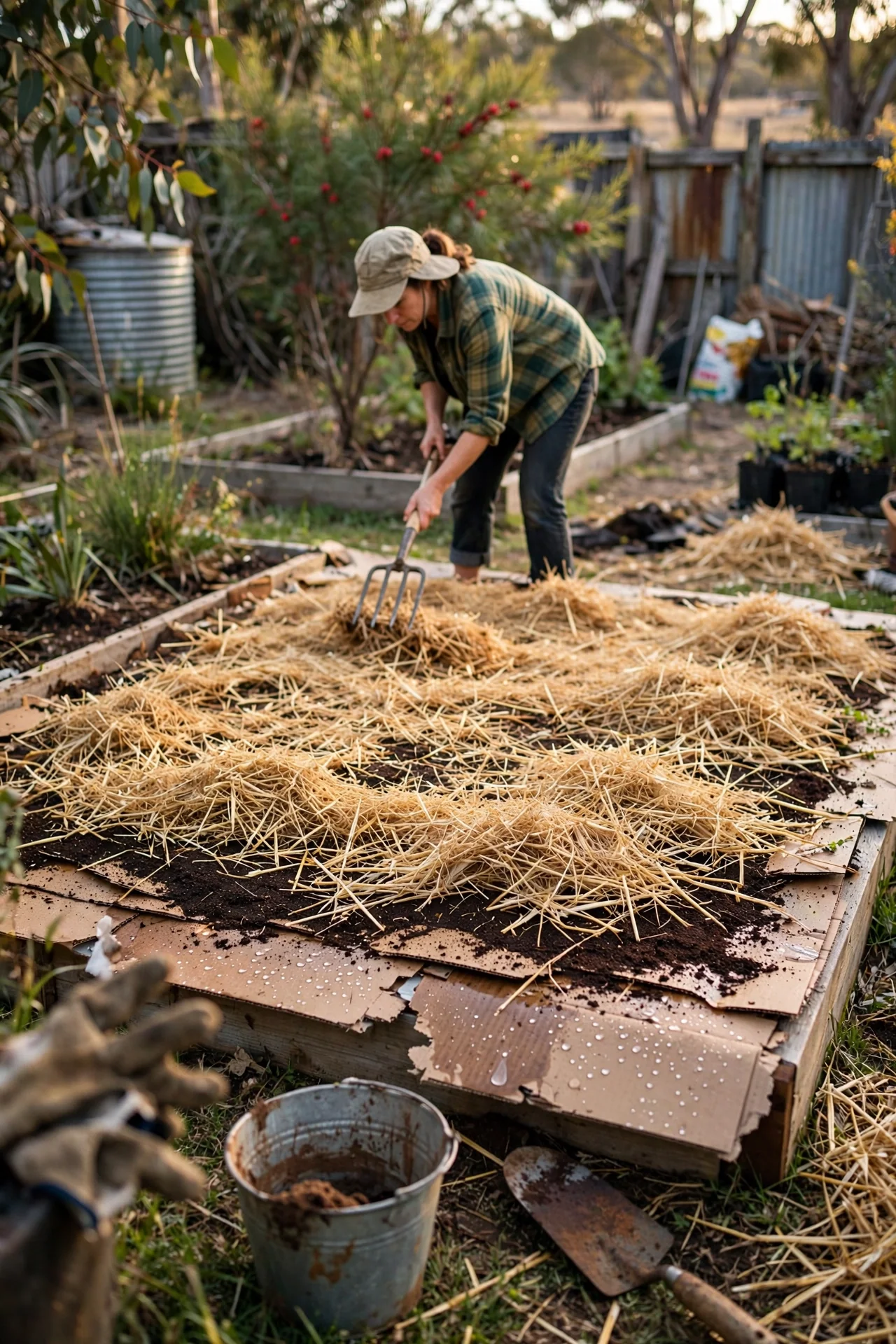
10. Sheet Mulching with Coffee Grounds
Best for: Branch 2 (Spent Brewed Grounds)
What it is: Sheet mulching, or lasagna gardening, builds a layered carbon-and-nitrogen stack directly over existing vegetation to create a planting bed without digging. Coffee grounds serve as a thin green layer within the stack. The exact placement matters more than the total volume: grounds should fill a single 0.25-inch layer between the cardboard base and the primary mulch layer (straw, wood chips, or compost).
Why precision matters: If the grounds layer is thicker than 0.5 inch, it merges into a compacted mat that blocks gas exchange across the entire pile, stalling decomposition and causing the cardboard layer underneath to remain intact for months longer than planned.
Steps: Soak the intended area deeply. Lay overlapping sheets of plain brown cardboard with at least 6-inch margins. Sprinkle spent grounds in a thin, even dusting over the cardboard, stopping 6 inches from the edges. Follow immediately with 8 to 12 inches of carbon-rich mulch (straw, partially decomposed leaves, or a wood chip top layer). Water the finished bed until the profile is saturated. Allow the bed to settle for a minimum of 3 weeks before planting transplants; wait 8 weeks for direct-seeded crops. For a complete layering reference, visit our sheet mulching guide.
11. Coffee Grounds for Acid-Loving Plants
Best for: Branch 1 (Fresh Grounds)
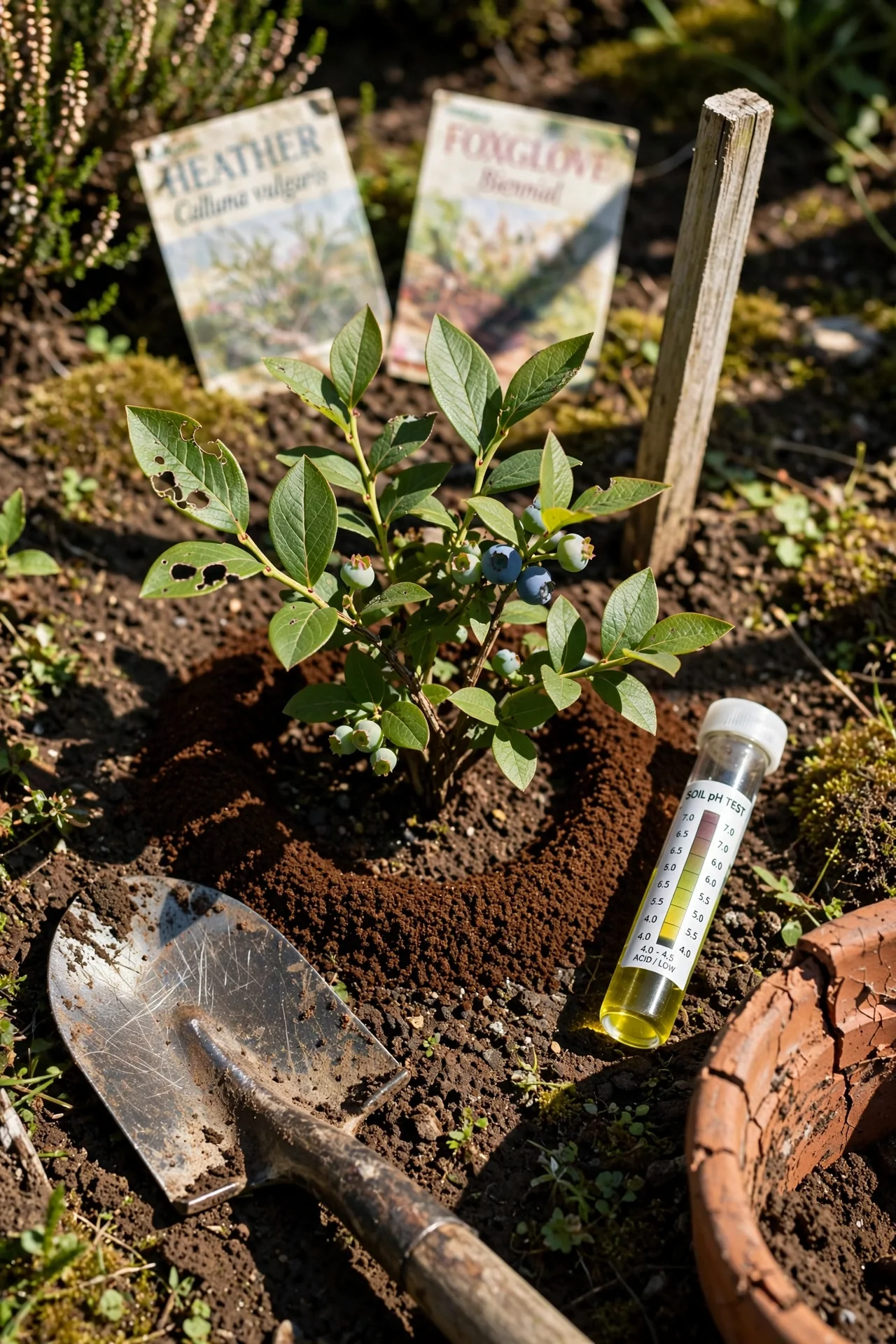
This is where most gardeners get it wrong. Spent coffee grounds are pH neutral (6.5 to 6.8), not acidic. Fresh unbrewed grounds are acidic at pH 4.5 to 5.0, but the acid is water-soluble and washes out within one to two irrigation events, producing no lasting soil pH shift. The OSU Extension Service confirms any pH change is short-lived. For plants like blueberries that genuinely require a 4.5 to 5.5 pH, use elemental sulfur or iron sulfate according to a soil test; coffee grounds are a weak, unreliable, and temporary substitute.
12. Composted Coffee Grounds in Seed Starting Mix
Best for: Branch 3 (Composted Grounds)
Fully composted coffee grounds, screened to a fine crumb through a 0.25-inch mesh, can replace up to 10 percent by volume of peat moss or coconut coir in a seed starting mix. The composted grounds introduce a low-salt, slow-release nitrogen fraction that supports cotyledon-stage seedlings without the electrical conductivity spike common in manure-based composts. The non-negotiable gate: the grounds must have passed through a thermophilic composting cycle reaching 130 degrees Fahrenheit minimum for at least 5 days. Cold-composted grounds retain bioactive caffeine residues that demonstrably inhibit radicle emergence in lettuce and tomato seeds.
Starter Stack (What to Choose First)
Branch 1: Fresh Grounds → Items 4 and 11
Start with vermicomposting (item 4) as your primary processing pathway. A small worm bin costs between $25 and $60 and processes up to 2 cups of coffee grounds per week. If you have established acid-loving ornamentals and access to fresh grounds, supplement with item 11, but only after a soil pH test confirms values above 6.0. The synergy is practical: the worm bin handles your regular kitchen grounds stream, while the occasional fresh ground application to azaleas or blueberries functions as a short-term pH nudge, not a foundational soil amendment.
Branch 2: Spent Grounds → Items 2 and 10
Begin with thin mulch layers (item 2) around existing shrubs. Material cost is zero beyond the secondary mulch cover. Once comfortable with the coverage rate and water absorption pattern, scale up to sheet mulching (item 10) for new bed preparation. The two methods share the same core constraint: the grounds layer must stay under 0.5 inch. Total time investment for thin mulching is roughly 15 to 20 minutes per 100 square feet; sheet mulching demands an hour or more for the same area but eliminates digging.
Branch 3: Composted Grounds → Items 6 and 9
Hot composting (item 6) is the heavy-lifting pathway; it requires a minimum 1-cubic-yard pile and a compost thermometer ($15 to $30). Compost tea (item 9) is the lightweight complement, turning a small quantity of aged grounds into a liquid amendment that covers up to 500 square feet per 5-gallon batch. Together, they provide both a soil-building foundation and a rapid-response fertility boost. Building a hot pile takes a single afternoon; brewing compost tea takes 24 to 36 hours.
When This Won’t Work
Condition 1: Your soil pH is already below 5.5. Adding coffee grounds (fresh or spent) to strongly acidic soil further suppresses microbial activity, slowing the breakdown of organic matter and reducing nitrogen mineralization. Earthworm activity also declines sharply below pH 5.0. If a soil test confirms this threshold, stop using coffee grounds entirely and instead apply pelletized calcitic lime at the rate prescribed by the test to raise pH into the 6.0 to 7.0 range.
Condition 2: You are seeding directly into beds containing uncomposted grounds. Caffeine residues, even at the 0.2 percent level in spent grounds, inhibit radicle emergence in sensitive species including lettuce, tomato, and brassica crops. If you have already applied uncomposted grounds to a bed intended for direct seeding, remove the top 1 inch of soil and replace it with a screened compost-sand mix (70:30 by volume). Wait a minimum of 21 days before planting seeds. Composted grounds that passed through a thermophilic cycle do not present this risk.
If neither condition applies but you are still seeing stunted growth, cut your coffee ground application rate in half. The most common failure mode among enthusiastic first-year users is volume, not chemistry. For guidance on common compost pitfalls, see what not to compost.
Choosing the Right Option Right Option for Your for Your Situation
Budget Threshold3>Budget Threshold
If your budget is>
If your budget is zero, work zero, work exclusively inside exclusively inside Branch 2: Branch 2: items items 2, 2, 5, and5, and 8 8 require require no purchased equipment. no purchased equipment. If you have $ If you have $15 to $60, add15 to $60, add items items 4 (worm4 (worm bin) bin) or 9 (aqu or 9 (aquarium pumparium pump and air stone). and air stone). Items Items 6, 7, and 12 require ongoing material 6, 7, and 12 require ongoing material inputs and inputs and tools tools that push that push the one the one-time cost above $75.
Time>Time Threshold
If>If you can you can commit less commit less than 20 than 20 minutes per minutes per week, stay week, stay in Branch in Branch 2 2 with items with items 2 2, , 5, and 5, and 8.8. Branch 3 Branch 3 requires regular requires regular pile monitoring, turning, and temperature measurement. Branch pile monitoring, turning, and temperature measurement. Branch 1 path 1 path items 4 and 7 demand weekly attention to worm health or pyrolysis monitoring, making them the highest-time-commitment options.
Technical Constraint: Caffeine Sensitivity
Not all plants respond to caffeine the same way. Monocot species (grasses, corn, lilies) show higher tolerance than dicot vegetables (tomatoes, peppers, lettuce). If your garden is predominantly dicot annuals, avoid all uncomposted grounds items 4 and 7 demand weekly attention to worm health or pyrolysis monitoring, making them the highest-time-commitment options.
Technical Constraint: Caffeine Sensitivity
Not all plants respond to caffeine the same way. Monocot species (grasses, corn, lilies) show higher tolerance than dicot vegetables (tomatoes, peppers, lettuce). If your garden is predominantly dicot annuals, avoid all uncomposted grounds applications and route applications and route 100 percent of your grounds through a thermophilic composting process (Branch 100 percent of your grounds through a thermophilic composting process (Branch 3).
Yes/>Yes/No Checklist:
- Has your soil been tested for pH in the last 12 months? Yes → Move to question 2. No → Test before adding any coffee ground product.
- Were the coffee grounds brewed (spent) or fully composted? Yes → Safe to use per Branch 2 or 3 guidelines. No → Restrict to Branch 1 applications only.
- Is the application area planted with seeds or seedlings under 3 inches tall? Yes → Use only fully composted grounds (No Checklist:
- Has your soil been tested for pH in the last 12 months? Yes → Move to question 2. No → Test before adding any coffee ground product.
- Were the coffee grounds brewed (spent) or fully composted? Yes → Safe to use per Branch 2 or 3 guidelines. No → Restrict to Branch 1 applications only.
- Is the application area planted with seeds or seedlings under 3 inches tall? Yes → Use only fully composted grounds (Branch 3). No → SpBranch 3). No → Spent grounds are acceptable.
- Will the grounds layer exceed>Will the grounds layer exceed 0 0.5 inch thickness in any spot.5 inch thickness in any spot? Yes → Thin? Yes → Thin it out it out or cover with a or cover with a coarse mulch coarse mulch layer. No → layer. No → Proceed.
Expert Q&A
Expert Q&ACan I use coffee grounds as the only nitrogen source in my compost pile?
No. Coffee grounds have a carbon-to-nitrogen ratio around 20:1, which is ideal for a green material, but they lack the microbial diversity of a mixed feedstock2>
Can I use coffee grounds as the only nitrogen source in my compost pile?
No. Coffee grounds have a carbon-to-nitrogen ratio around 20:1, which is ideal for a green material, but they lack the microbial diversity of a mixed feedstock. A pile composed of. A pile composed of more than 20 more than 20 percent grounds percent grounds by volume by volume slows decomposition slows decomposition because key because key decom decomposer groupsposer groups are underrepresented. Supplement are underrepresented. Supplement with grass clipp with grass clippings, vegetable scraps, or alfalfa meal to maintain bothings, vegetable scraps, or alfalfa meal to maintain both the the C C:N balance:N balance and microbial and microbial breadth breadth. A. A monoculture monoculture feedstock always feedstock always underperforms underperforms a diverse a diverse mix, mix, regardless of regardless of the math on the the math on the ratio.
3>Why doWhy do some experienced some experienced gardeners swear gardeners swear by fresh by fresh coffee grounds coffee grounds while others while others call them toxic call them toxic?
The>
The disagreement stems from disagreement stems from different application different application contexts. contexts. A A gardener applying gardener applying fresh grounds fresh grounds at at a quarter a quarter-inch-inch rate rate to established to established shrubs in shrubs in sandy sandy,, well-aerated soil sees slow organic matter well-aerated soil sees slow organic matter incorporation and incorporation and no visible no visible harm. harm. Another gardener applying Another gardener applying the the same quantity same quantity to a vegetable bed with germ to a vegetable bed with germinating lettuceinating lettuce seeds seeds sees sees complete crop complete crop failure. failure. The grounds The grounds are chemically are chemically identical; identical; the variable is the variable is whether whether seeds seeds or fine or fine roots are roots are present in present in the critical 14-day the critical 14-day window when window when caffeine is caffeine is still bioactive still bioactive. Context. Context,, not the not the grounds, grounds, determines determines the outcome the outcome.
3>Do decDo decaffeinatedaffeinated coffee grounds coffee grounds remove remove the risk entirely?
Not>Not entirely entirely.. Decaffe Decaffeination removesination removes most most of the of the caffeine, caffeine, but polyphenols, but polyphenols, tannins tannins, and, and chlorogenic chlorogenic acids remain acids remain in spent in spent decaf grounds. These compounds decaf grounds. These compounds suppress certain soil bacteria and can reduce suppress certain soil bacteria nitrogen and can reduce nitrogen mineralization in mineralization in the short term. the short term. Dec Decaffeinatedaffeinated grounds are grounds are safer than safer than c caffeinatedaffeinated grounds for direct application grounds for direct application, but, but composting them composting them first is first is still the still the lower-risk path lower-risk path, especially, especially for vegetable for vegetable beds and beds and seed trays seed trays.
3>How long do coffeeHow long do coffee grounds take grounds take to break to break down in down in soil without soil without composting composting?
>
UnderUnder moist moist, warm, warm conditions ( conditions (soilsoil temperature above temperature above 50 50 degrees Fahrenheit degrees Fahrenheit), spent), spent grounds applied grounds applied as as a thin a thin layer break layer break down visibly down visibly within within 3 to3 to 4 4 weeks. weeks. During this During this period, period, soil microbes soil microbes consume nitrogen consume nitrogen from the surrounding from the surrounding soil to soil to metabol metabolize theize the carbon in carbon in the grounds the grounds, creating, creating a temporary a temporary localized nitrogen localized nitrogen deficit that deficit that affects affects shallow-root shallow-rooted plantsed plants. The. The grounds grounds are gone are gone in a in a month; month; the nitrogen the nitrogen dip dip can can last last 6 6 weeks if weeks if the application the application was heavy was heavy. This. This is why is why agron agronomistsomists recommend composting recommend composting grounds before grounds before soil soil incorporation.
Can>Can I store I store spent spent coffee grounds coffee grounds for later for later use without use without them molding them molding?
>
MoldMold is inevitable is inevitable because because spent spent grounds arrive grounds arrive at roughly at roughly 60 60 percent moisture percent moisture content and content and carry carry a rich a rich microbial inoc microbial inoculum fromulum from the brewing the brewing process. process. If you If you need to need to store them store them, spread, spread them thinly them thinly on a on a tray tray to air to air-dry-dry for for 24 to24 48 to 48 hours, hours, which drops which drops moisture below moisture below the the threshold for mold growth threshold for mold growth. D. Dried groundsried grounds can be can be stored in stored in a paper a paper bag in bag in a cool a cool, dry place for, dry place for up to up to 2 2 weeks. weeks. For longer For longer storage, storage, freeze them freeze them. Mold. Moldy groundsy grounds are not are not hazardous hazardous for composting for composting but but are are less pleasant less pleasant to handle and can to handle and can introduce fungal introduce fungal metabolites metabolites that that affect sensitive affect sensitive plants plants.
2>Conclusion
The single>
The single decision you most impactful decision you can can make with make with coffee grounds coffee grounds is whether is whether to compost to compost them before them before they they touch touch your your soil soil.. Sp Spentent grounds applied directly grounds applied directly as as an ultra-thin layer under a coarse mulch are safe and beneficial for soil structure over time. Everything an ultra-thin layer under a coarse mulch are safe and beneficial for soil structure over time. Everything else else, from verm, from vermicomposticomposting toing to sheet mul sheet mulching toching to biochar production, biochar production, starts to starts to work reliably work reliably only after only after the caffeine the caffeine and polyp and polyphenols degradehenols degrade.
The>
The most most common mistake common mistake we see we see is volume is volume over over form form. A. A gardener who gardener who halves halves their application their application rate and rate and routes routes the surplus the surplus grounds grounds into a into a compost pile compost pile gets dramatically gets dramatically better results better results than one who applies than one who applies twice twice as much as much raw raw material. material. If you If you currently currently have a bucket have a bucket of spent of spent grounds and grounds and no plan no plan, spread them as a, spread them as a quarter-inch amendment on your quarter-inch amendment on your compost pile compost pile, not, not your your garden bed garden bed. For. For gardeners gardeners working working with limited with limited room, room, our our small space composting guidesmall space composting guidea> offers practical offers practical setup setup options options.>