
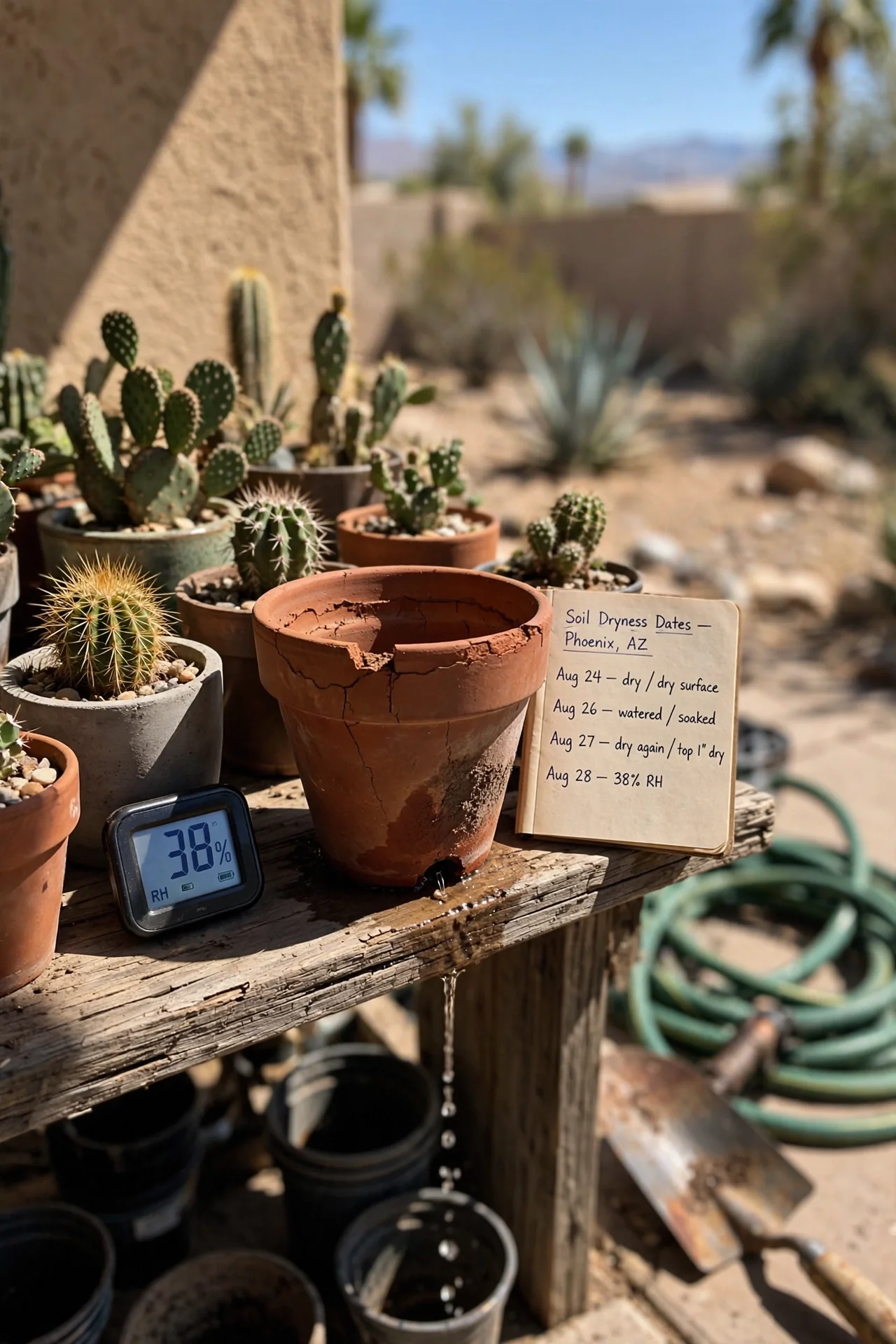
Most cactus watering advice treats your plant like it lives on a calendar. It does not. A cactus drinks when three variables align: the soil has reached a measurable dryness threshold, the plant is in an active growth phase, and the pot drains fast enough that roots never sit in moisture. If any one of those conditions fails, even a perfectly timed schedule will cause rot or dehydration.
This guide covers indoor desert cacti (family Cactaceae) grown in containers under typical home conditions. It excludes holiday cacti (Schlumbergera), jungle cacti (Epiphyllum), and outdoor in-ground plantings. Those plants follow different moisture rules and are addressed in separate guides.
By the end, you will be able to identify which of three watering branches matches your setup, choose a specific approach from nine tested methods, and assemble a starter stack that fits your climate zone, pot type, and available time. Every recommendation ties back to a measurable condition you can check with your finger or a simple tool.
Bottom line: Match your watering method to your pot’s drainage speed and your indoor humidity level, not to a date on the calendar.
The Yield Grid Decision Grid
Branch 1: Fast-draining terracotta pot, indoor humidity below 40%. In this setup, soil dries within 4 to 7 days during the growing season. The primary risk is underwatering, especially near heating vents. Cacti here need more frequent, deeper soaks. Recommended: Items 1, 4, 7 below.
Branch 2: Glazed ceramic or plastic pot, indoor humidity 40% to 60%. Soil retains moisture longer, typically 10 to 18 days between dry-down cycles. The main danger is overwatering if you follow a fast-draining schedule. Timing must shift based on soil feel, not routine. Recommended: Items 2, 5, 8 below.
Branch 3: Low-light placement, humidity above 60%, or winter dormancy period. Evaporation slows sharply. Watering frequency drops to once every 4 to 8 weeks. The most common mistake is maintaining a summer schedule through winter, which causes root rot in dormant plants. Recommended: Items 3, 6, 9 below. For more on how succulent care differs from cactus care in these conditions, see our cactus vs succulent care guide.
Quick Comparison Table
| Option | Key Mechanism | Best For | Decision Grid Branch | Effort Score (1–5) |
|---|---|---|---|---|
| 1. Soak and Dry (Standard) | Full saturation, then full dry-down | Terracotta pots, dry indoor air | Branch 1 | 2 |
| 2. Bottom Watering | Capillary absorption through drainage holes | Glazed or plastic pots, moderate humidity | Branch 2 | 3 |
| 3. Winter Rest Protocol | Near-zero water during dormancy | All pots during winter dormancy | Branch 3 | 1 |
| 4. Seasonal Ramp Method | Gradually increase then decrease frequency | Terracotta pots, seasonal climates | Branch 1 | 3 |
| 5. Finger-Test-Only Schedule | Water only when top 2 inches are bone dry | Glazed or plastic pots, beginners | Branch 2 | 2 |
| 6. Humidity-Adjusted Interval | Extend intervals based on ambient humidity | Humid climates, bathrooms, kitchens | Branch 3 | 4 |
| 7. Deep Drench With Drainage Audit | Heavy soak followed by drainage verification | Terracotta, advanced growers | Branch 1 | 4 |
| 8. Weight-Based Watering | Lift pot; water when noticeably light | Plastic pots, visual learners | Branch 2 | 2 |
| 9. Species-Specific Dormancy Calendar | Match watering to each species’ dormancy type | Mixed collections, experienced growers | Branch 3 | 5 |
1. Soak and Dry (Standard)
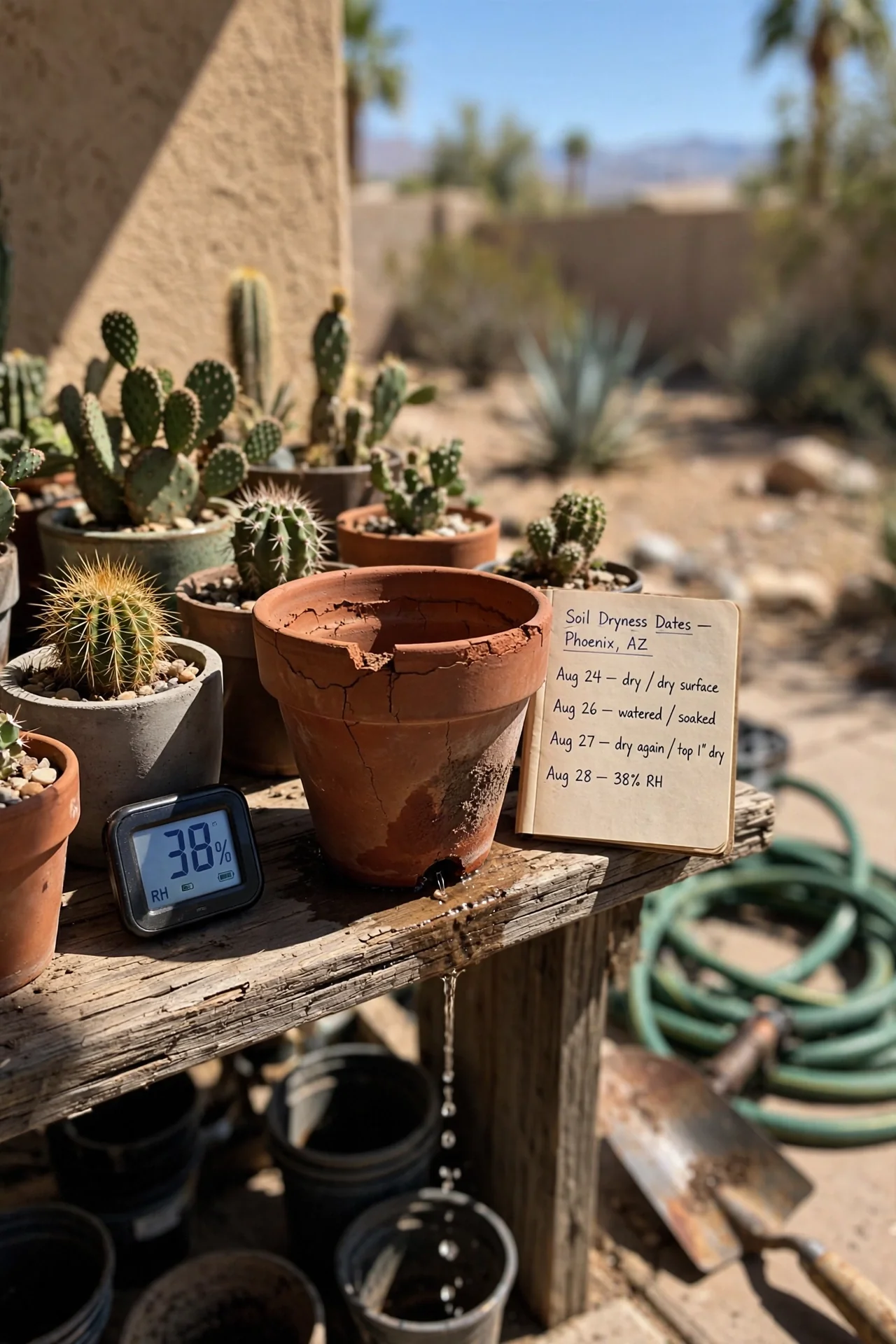
Best for: Branch 1
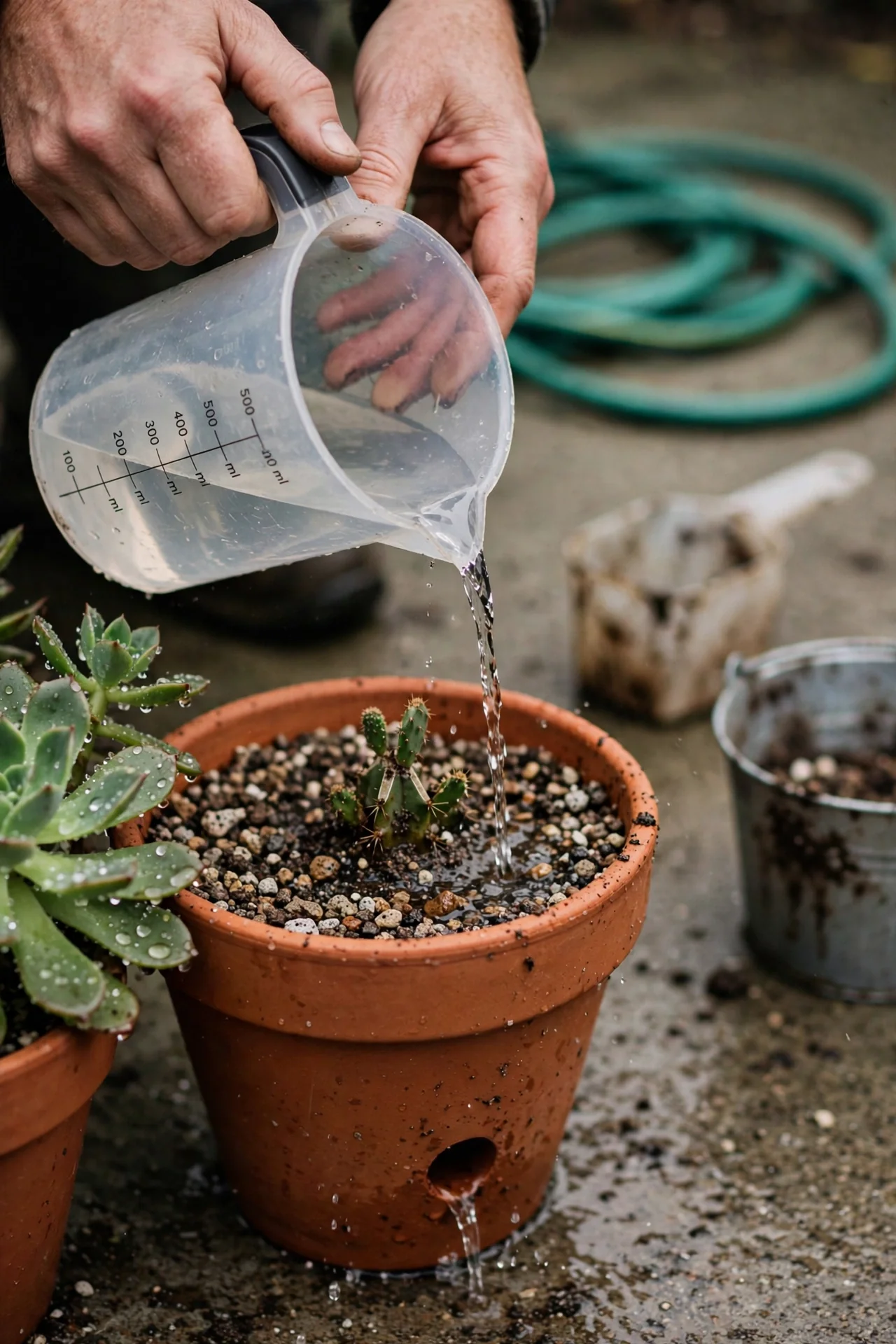
What it is: The classic cactus watering technique: pour water slowly over the soil surface until it flows freely from the drainage holes, then let the pot drain completely. Do not water again until the soil has dried entirely from top to bottom.
Why it works: Desert cacti evolved to absorb sudden, infrequent rainfall that saturates the ground and then drains rapidly. This method mimics that pattern. The full dry-down between waterings prevents the fungal pathogens that thrive in consistently damp soil.
Steps: (1) Check soil moisture with a wooden chopstick inserted to the pot bottom; if it comes out with any dark, damp soil attached, wait. (2) Place the pot in a sink or basin. (3) Pour room-temperature water (20°C to 24°C or 68°F to 75°F) evenly across the soil surface. (4) Continue until water runs from the drainage holes for at least 10 seconds. (5) Let the pot drain for 15 to 20 minutes before returning it to its saucer or cachepot.
Common mistake: Watering on a fixed schedule rather than checking soil dryness first. In terracotta pots under 40% humidity, soil may dry in 5 days in July but take 12 days in September. Always verify dryness before soaking. For help with soil that drains too slowly, see our succulent soil mix recipe.
2. Bottom Watering
Best for: Branch 2
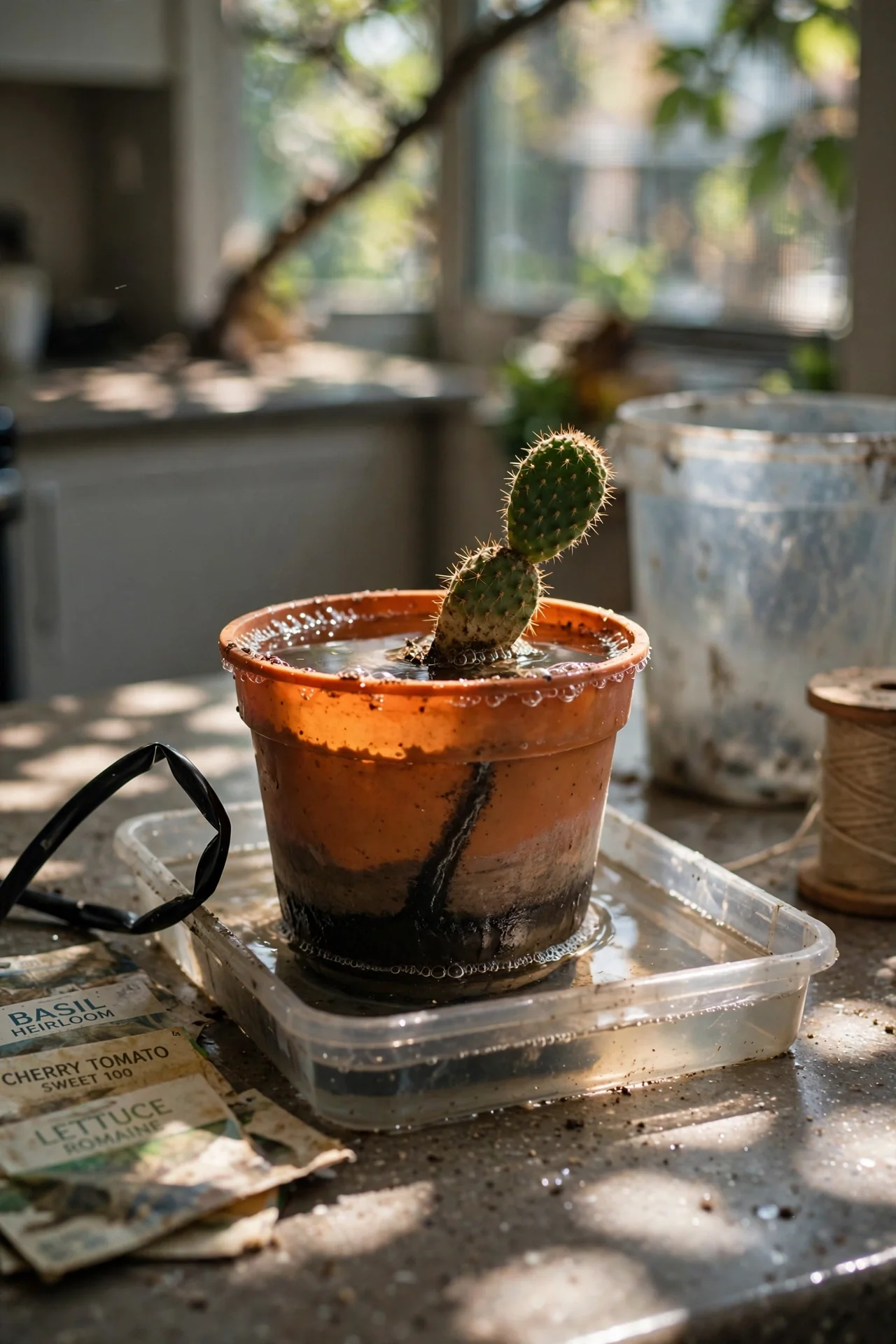
Set the pot in a shallow tray of water and let the soil absorb moisture through the drainage holes for 20 to 30 minutes. Remove and drain. This method prevents crusting on the soil surface and ensures even moisture distribution in peat-heavy commercial mixes. Skip this method if your pot lacks drainage holes, as standing water in a sealed container guarantees root rot. For more on proper drainage setups, read our guide to succulent pot drainage.
3. Winter Rest Protocol
Best for: Branch 3
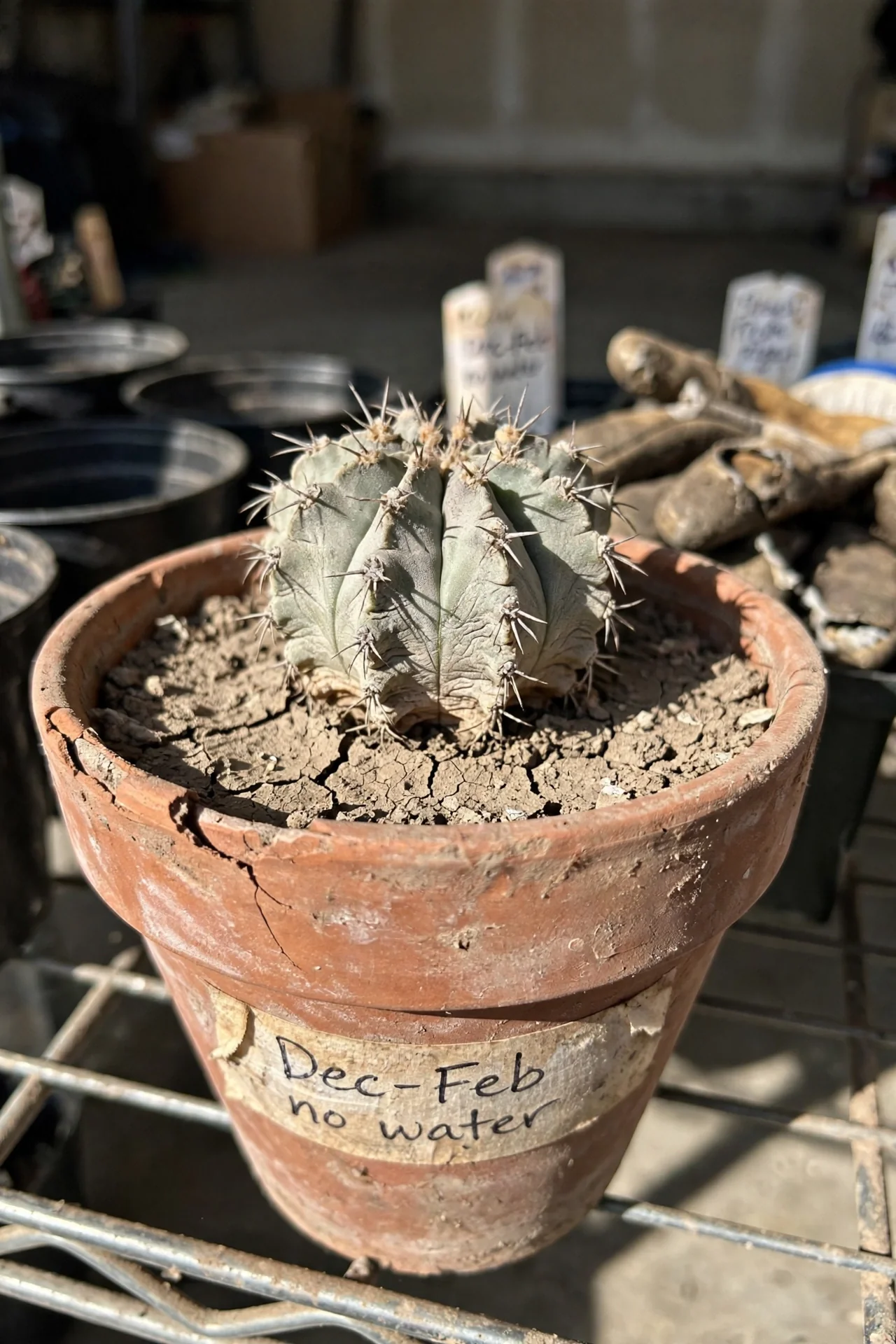
From approximately mid-November through late February, most desert cacti enter dormancy triggered by shorter daylight hours and cooler temperatures. During this period, watering should be reduced to a light sip once every 4 to 8 weeks, just enough to prevent severe shriveling. Some growers suspend watering entirely from December through February with no harm to the plant. The key threshold: if your indoor temperature stays above 21°C (70°F), the plant may not enter full dormancy and will need a small drink monthly. If temperatures stay between 10°C and 15°C (50°F to 59°F), you can withhold water completely. Resume normal watering only when you see new spine growth or a subtle green flush at the growing tip in early spring.
4. Seasonal Ramp Method
Best for: Branch 1
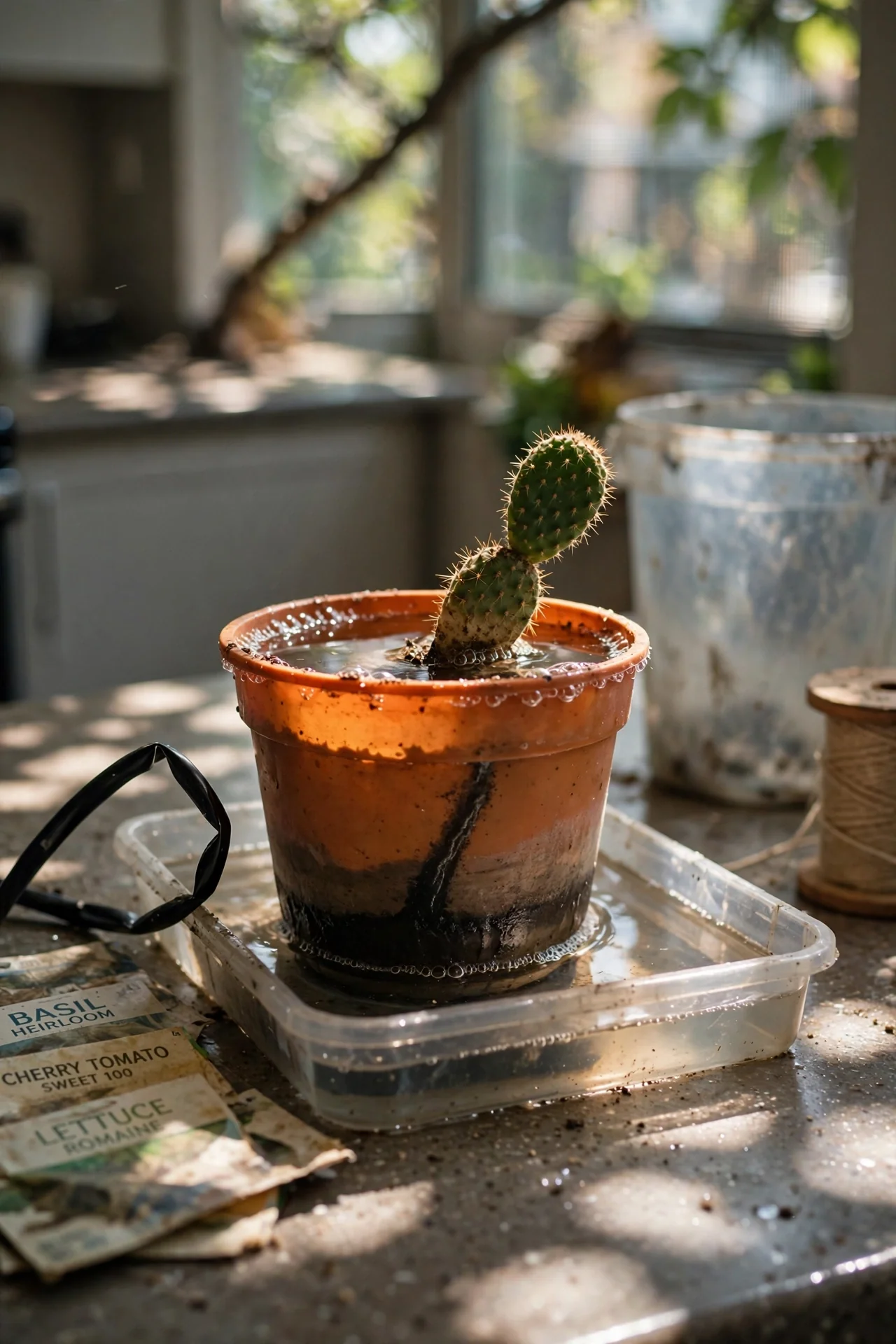
What it is: A structured schedule that gradually increases watering frequency in spring, holds steady through summer, and tapers down through autumn. This approach is especially useful for growers in regions with distinct seasonal light changes, such as the northern US, UK, and Canada.
Ramp-up phase (March to April): Begin with one light watering in early March. Increase to once every 14 days by late April, provided the soil dries completely between sessions.
Peak phase (May to August): Water every 7 to 10 days if soil dryness confirms it. In terracotta pots under dry indoor air, this may mean weekly soaks during heatwaves.
Taper phase (September to October): Stretch intervals from 10 days to 14 days, then 21 days. By late October, transition to the winter rest protocol.
Edge case: If you use grow lights that maintain 14 to 16 hours of daily light year-round, your cactus may not detect seasonal changes. In that scenario, keep a consistent 10-to-14-day interval and monitor soil dryness rather than following the calendar.
5. Finger-Test-Only Schedule
Best for: Branch 2
Insert your finger into the soil to the second knuckle, roughly 5 cm (2 inches) deep. If you feel any moisture or coolness, wait 2 more days and test again. Water only when the soil at that depth feels completely dry and warm. This method eliminates calendar dependency and adjusts automatically to changes in pot type, humidity, and temperature. It is the most reliable low-effort approach for glazed ceramic and plastic pots.
6. Humidity-Adjusted Interval
Best for: Branch 3
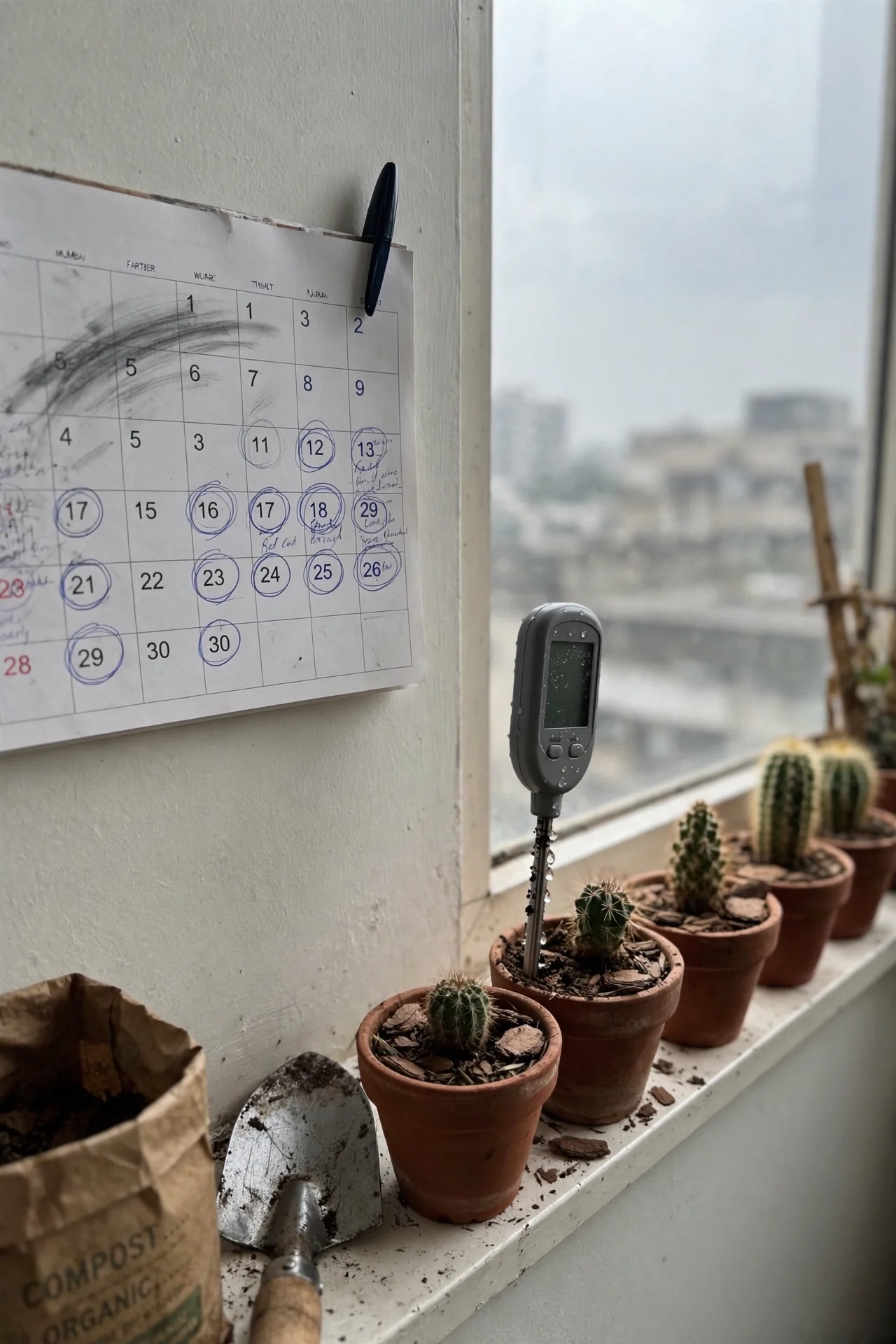
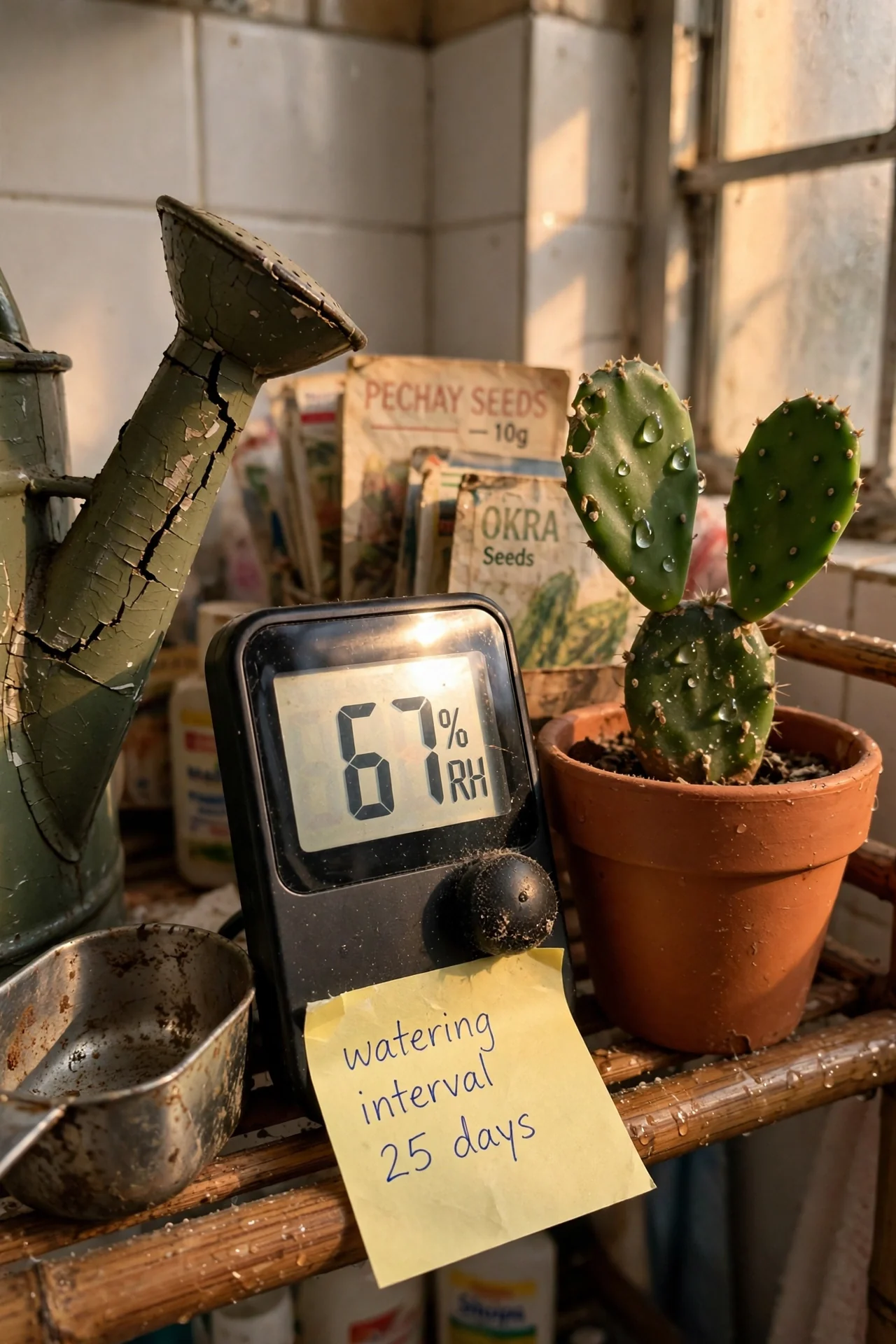
In environments where ambient humidity consistently exceeds 60%, such as bathrooms, kitchens, or tropical climates (Singapore, Philippines, coastal Australia), soil evaporation slows dramatically. A cactus that would dry out in 10 days at 35% humidity may still be damp after 18 days at 65% humidity. Use a basic hygrometer (available for under $10 USD) to track your room’s humidity. For every 10 percentage points above 50%, add 3 to 4 days to your standard watering interval. In practice, this often means watering once every 3 to 5 weeks even during the growing season. If you also have succulents in similar conditions, our succulent watering schedule guide covers parallel adjustments.
7. Deep Drench With Drainage Audit
Best for: Branch 1
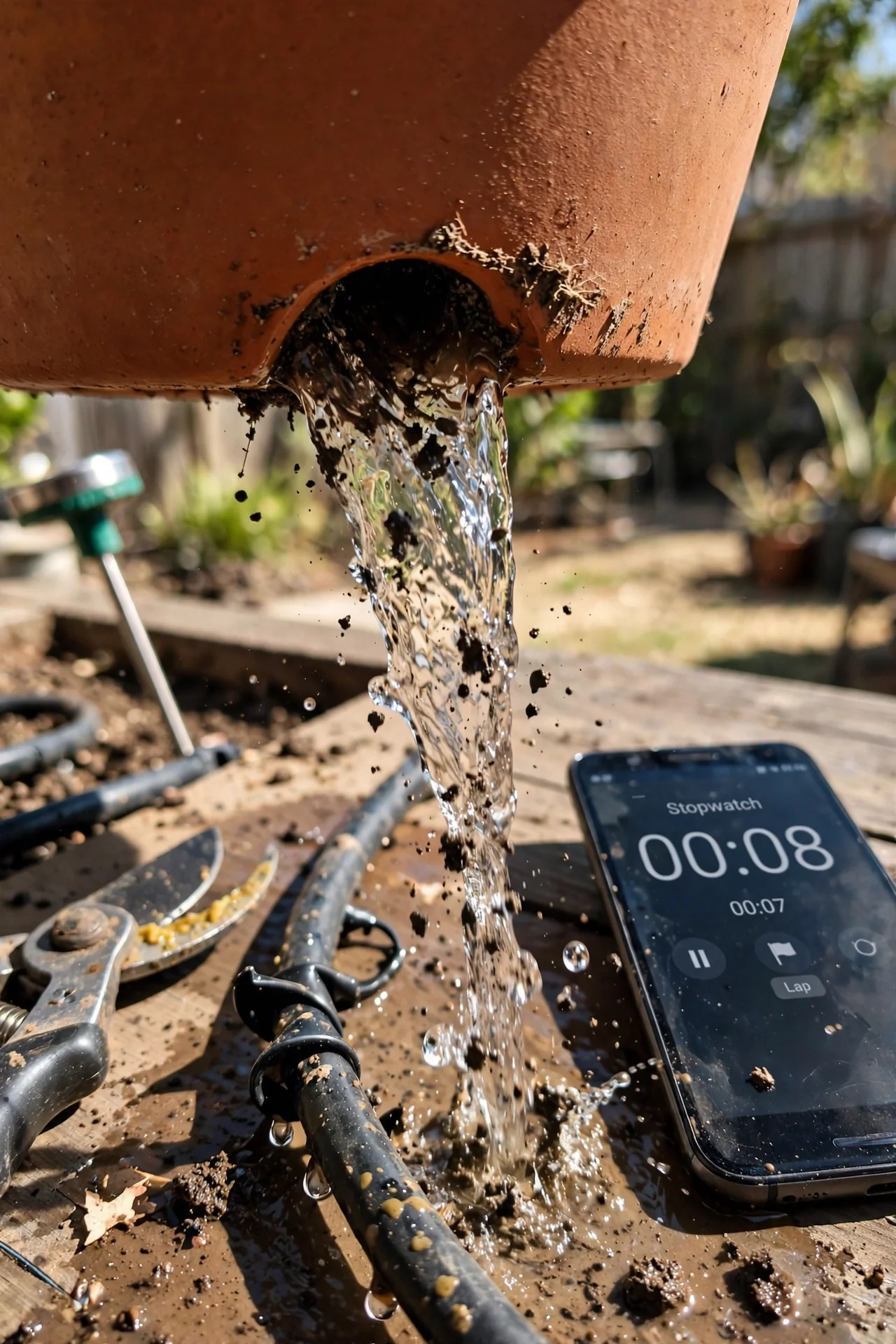
What it is: An advanced soak-and-dry variant that adds a drainage-speed verification step. After a full drench, time how long water takes to exit the drainage holes. In a properly mixed cactus substrate, water should begin emerging within 5 to 10 seconds. If it takes longer than 30 seconds, your soil is retaining too much moisture and needs amendment.
Upgrade option: After timing your drainage, measure the volume of water that exits versus what you poured in. If more than 20% of the water remains in the pot after 10 minutes of draining, repot with a grittier mix. A healthy ratio is roughly 70% to 80% of applied water exiting within 10 minutes.
Why this matters: Slow drainage is the hidden cause of most overwatering deaths. Even if you water infrequently, soil that holds water too long suffocates roots. This audit turns a guess into a measurable variable. If you notice pests after adjusting watering, check our guide to scale on cactus for identification help.
8. Weight-Based Watering
Best for: Branch 2
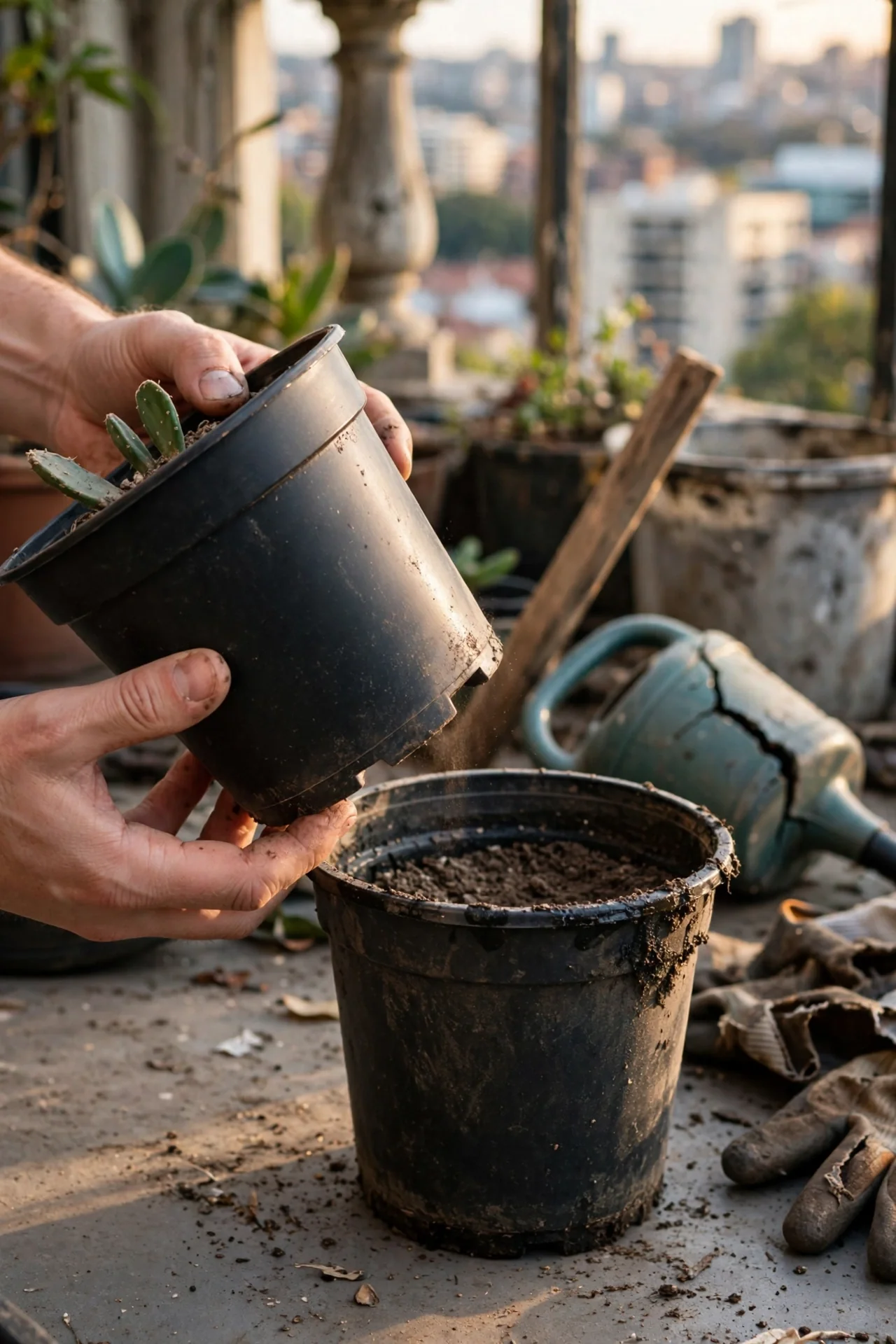
Lift the pot immediately after a thorough watering and note the heft. Check again every few days. When the pot feels noticeably light and the difference is unmistakable, it is time to water. This method works best with plastic pots, which contribute negligible weight themselves. It takes about two wet-dry cycles to calibrate your sense of the right weight, after which it becomes a fast, no-tools-needed check.
9. Species-Specific Dormancy Calendar
Best for: Branch 3
Not all cacti follow the same dormancy schedule. Most common genera (Mammillaria, Echinopsis, Opuntia, Ferocactus) are summer-growing and winter-dormant, matching the standard schedule. However, some species, including certain Ariocarpus and Turbinicarpus, are winter-growers that need light watering from October through March and a dry summer rest. If you keep a mixed collection, map each plant to its dormancy type before setting a group schedule. This approach requires record-keeping and is the highest-effort option in this guide. For those newer to cactus care, our beginner succulents guide offers a gentler starting point.
Starter Stack (What to Choose First)
Branch 1 Starter Stack: Fast-Draining Terracotta, Dry Air
Combine Item 1 (Soak and Dry Standard) with Item 4 (Seasonal Ramp Method). Use the soak-and-dry technique every time you water, and follow the seasonal ramp calendar to adjust frequency across the year. Synergy: the seasonal ramp tells you when; the soak-and-dry method tells you how. Estimated cost: $0 beyond your existing watering can. Time: 5 minutes per watering session.
Branch 2 Starter Stack: Glazed or Plastic Pot, Moderate Humidity
Pair Item 5 (Finger-Test-Only Schedule) with Item 8 (Weight-Based Watering). Use the finger test as your primary check and the weight test as a quick confirmation. Synergy: the finger test catches surface moisture; the weight test reveals deeper water retention. Together they make overwatering extremely unlikely. Time: under 30 seconds per check.
Branch 3 Starter Stack: Low Light, High Humidity, or Winter Dormancy
Start with Item 3 (Winter Rest Protocol) and add Item 6 (Humidity-Adjusted Interval) if your environment is persistently humid. The winter rest protocol covers seasonal dormancy; the humidity-adjusted interval extends your watering gaps during muggy summers. Estimated cost: $5 to $15 for a basic hygrometer if you choose Item 6. Time: 2 minutes per month during dormancy.
When This Won’t Work
Failure condition 1: Pot has no drainage hole. Every method in this guide assumes water can exit the container. In a pot without drainage, even the most carefully timed watering leaves roots sitting in a reservoir of stagnant water at the bottom. The alternative: repot into a container with at least one drainage hole, or use a cachepot system where the inner pot drains freely and is removed for watering. For repotting instructions, see our how to repot succulents guide.
Failure condition 2: Soil contains more than 50% peat or coir by volume. Peat-heavy mixes can hold 10 to 20 times their weight in water and may remain wet for weeks after a single drench. In this soil, even the soak-and-dry method fails because the dry-down phase takes too long. The alternative: repot using a mix that is at least 50% mineral grit (pumice, perlite, or coarse sand) by volume. A simple home mix is 1 part bagged cactus soil plus 1 part pumice or perlite.
Choosing the Right Option for Your Situation
Budget Threshold
If your budget is under $15, choose Item 5 (Finger-Test-Only) or Item 8 (Weight-Based Watering). Both require zero equipment beyond what you already own. If you can spend $15 to $30, add a hygrometer and adopt Item 6 (Humidity-Adjusted Interval) for more precision. Above $30, invest in a fast-draining terracotta pot and pumice for a custom soil mix, then use Item 1 or Item 7.
Time Threshold
If you can spare less than 2 minutes per week for plant care, stick with Item 3 (Winter Rest Protocol) year-round adjusted for season, or Item 5 (Finger-Test-Only). If you have 5 to 10 minutes per week, Item 1 (Soak and Dry) and Item 7 (Deep Drench With Drainage Audit) are manageable and provide better feedback. Item 9 (Species-Specific Calendar) requires 15 to 30 minutes per week for record-keeping and is only recommended for dedicated hobbyists.
Technical Constraint: Low-Light Placement
A cactus placed more than 1.5 meters (5 feet) from a south-facing window (north-facing in the Southern Hemisphere) receives insufficient light for active growth. Under low light, the plant’s water consumption drops sharply regardless of pot type. Even during summer, watering intervals should match Branch 3 guidelines. If your cactus is in a dim corner and you want to keep it there, see our low-light succulents guide for species that tolerate these conditions better than desert cacti.
Quick Yes/No Checklist:
- Does your pot have at least one drainage hole? Yes / No
- Does your soil contain at least 50% mineral grit? Yes / No
- Do you check soil dryness before every watering? Yes / No
- Have you reduced watering frequency by at least 50% during winter months? Yes / No
If you answered No to any question, address that issue before committing to a specific watering method above.
Expert Q&A
Can I water my cactus with tap water?
Tap water is usually fine unless your local supply is very hard (above 150 mg/L calcium carbonate). Hard water can leave mineral deposits on the soil surface and around the pot rim over time. If you notice white crust buildup, switch to rainwater, distilled water, or filtered water. Avoid softened water; the sodium content can damage roots.
How do I know if my cactus is dormant or dead?
A dormant cactus looks slightly deflated and may have a duller color, but it remains firm when gently squeezed. A dead cactus feels soft or mushy, may show dark discoloration at the base, and often collapses under light pressure. If you are unsure, wait 2 weeks and check again. A dormant plant will not deteriorate; a dying one will worsen.
Should I mist my cactus between waterings?
No. Desert cacti absorb water through their roots, not their skin. Misting raises humidity around the plant, which can encourage fungal issues on the stem and does not meaningfully hydrate the plant. The only exception is seedlings under 6 months old, which benefit from light daily misting until their root systems develop.
Why does my cactus wrinkle even though I water it regularly?
Wrinkling can indicate both underwatering and overwatering. If the soil is bone dry and the plant is shriveled, it needs water. If the soil is damp and the plant is wrinkled, the roots may have rotted from overwatering and can no longer take up moisture. Unpot the plant, check for black or mushy roots, and trim any rotted sections before repotting in dry, gritty soil.
Does pot color affect how often I should water?
Yes. Dark-colored pots absorb more heat, which can warm the soil and speed up evaporation. A black plastic pot in direct sun may dry out 2 to 4 days faster than an identical white pot. Glazed ceramic in dark colors also retains heat. If you use dark pots, check soil dryness more frequently and expect slightly shorter watering intervals during summer.
Conclusion
The single factor that determines whether your cactus thrives or rots is not how often you water. It is whether you verify that the soil is dry before you do. Every method in this guide is a variation on that principle, adapted to different pot types, humidity levels, and seasonal conditions.
The most common mistake is treating a cactus watering schedule as a fixed calendar instead of a response to measurable conditions. Pick the branch that matches your pot and environment, test soil dryness before every watering, and reduce frequency sharply during winter. For the next step in building a complete care routine, start with the right soil: read our guide to the best soil for succulents indoors.