
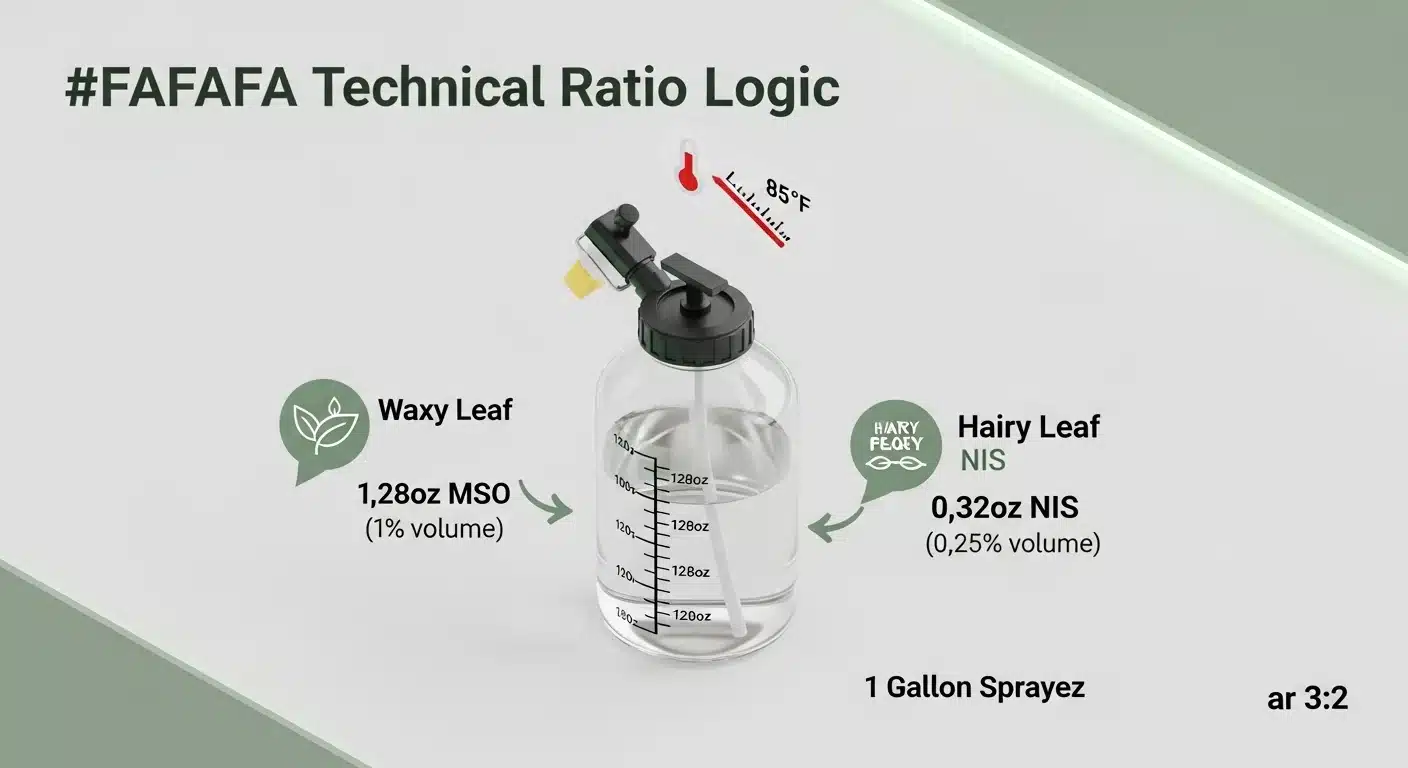
Water does not wet leaves. That is not a metaphor; it is fluid physics. A plain spray mix lands on a waxy leaf cuticle and immediately contracts into a bead, held together by surface tension, then rolls into the soil. The active ingredient never penetrates. The Waxy Runoff failure is the single most common reason systemic herbicides like glyphosate and triclopyr fail on Poison Ivy, Blackberry, and Nutsedge, and it has nothing to do with application rate or product quality.
This calculator determines the exact fluid ounces of adjuvant needed per tank, selects the correct adjuvant class (Non-Ionic Surfactant for hairy or flat-leaf weeds; Methylated Seed Oil for waxy-cuticle plants), and checks whether ambient temperature creates a phytotoxicity risk before you ever pump the sprayer. It does not replace the pesticide label, which is a legal document, and it does not account for tank-mix compatibility between multiple active ingredients. If you need to scale by treated area, the pesticide dilution calculator handles per-acre and per-1000-sq-ft breakdowns separately.
After running the tool, you will know exactly which adjuvant class to buy, how many ounces to measure per fill, and whether your spray day temperature requires a schedule adjustment to avoid crop oil burn.
Use the Tool

How This Calculator Works
Surface Tension Science: When herbicide spray lands on a waxy leaf (like Poison Ivy), water molecules bead up and roll off — taking your expensive chemical with them. Adding a surfactant breaks water’s surface tension, flattening each droplet to cover up to 10× the leaf surface area.
Step 1 — Adjuvant selection rule:
Step 2 — Convert gallons to fluid ounces:
Step 3 — Calculate adjuvant volume:
Step 4 — Temperature check:
Assumptions & Limits:
Have your tank size in gallons ready before you start. If you are using a backpack sprayer, the tank capacity is typically printed on the reservoir; common sizes are 1, 2, and 4 gallons. Know whether the weed you are targeting has a waxy, thick cuticle (Poison Ivy, Blackberry, Kudzu, Nutsedge) or a hairy to flat leaf surface (Dandelion, Clover, Henbit, Bindweed). Check your current outdoor thermometer; temperature drives the burn risk logic and the warning thresholds are not adjustable. For mixing rates on other liquid amendments used the same day, the fertilizer dilution calculator covers nutrient solutions and liquid feed products.
Quick Start (60 Seconds)
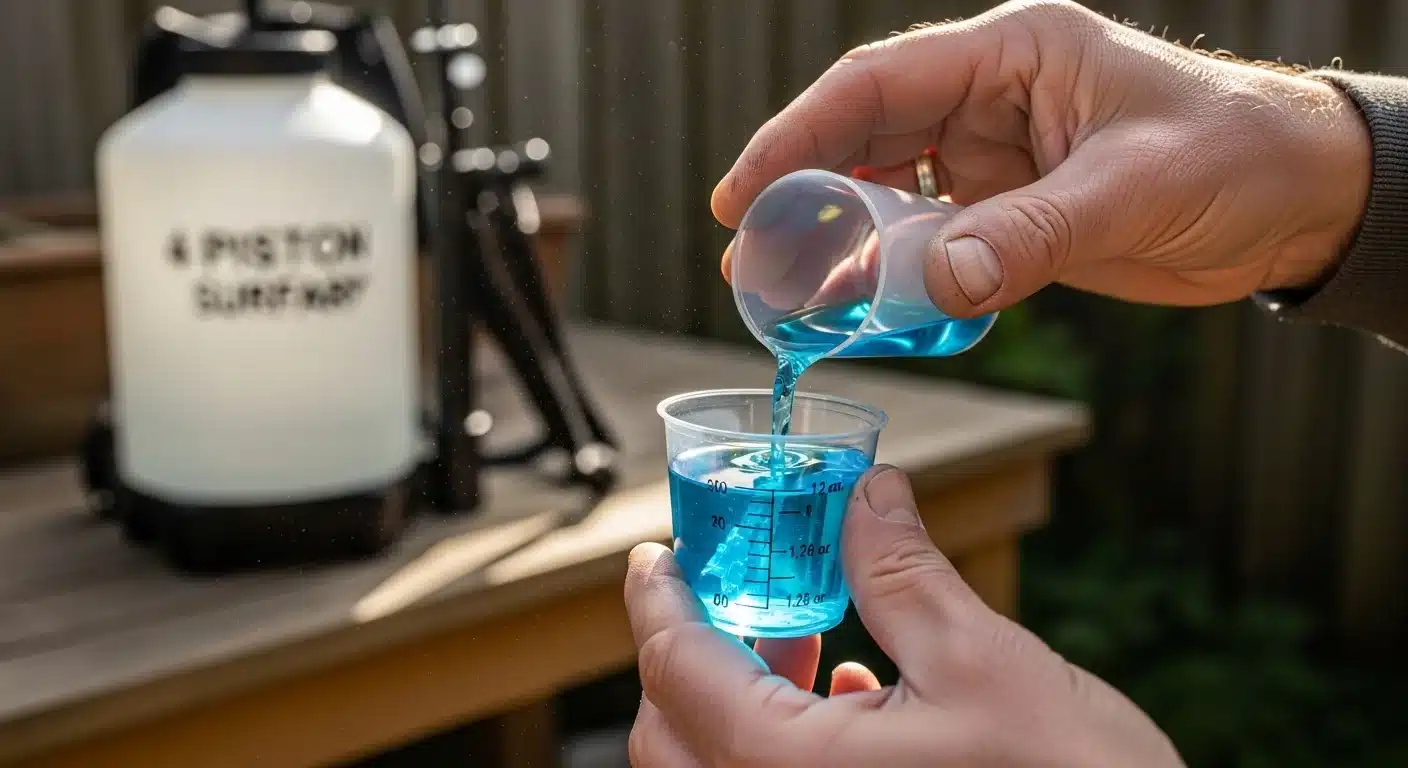
- Total Tank Mix Volume: Enter the full fill volume in gallons, not the volume of chemical you plan to add. A 4-gallon backpack is 4 gallons even if you only spray half of it.
- Target Weed Surface Type: Choose Waxy if the leaf looks glossy, feels rubbery, or is known to repel water when you flick a drop at it. Choose Hairy/Flat for anything soft, fuzzy, or matte-surfaced. When in doubt, choose Waxy; the MSO rate is more conservative and it will not harm the chemistry.
- Chemical Type: Select Systemic Herbicide if the product moves through vascular tissue (glyphosate, imazapyr, triclopyr). Select Contact Fungicide/Insecticide if it only kills what it physically touches. This distinction changes the burn risk calculation at high temperatures.
- Ambient Temperature: Enter the current air temperature in degrees Fahrenheit, not the forecast high. Temperature is evaluated at application time, not at the hottest point in the day.
- Units check: Volume must be in gallons. The tool converts to fluid ounces internally. Do not pre-convert.
- Range limits: Volume accepts 0.1 to 10,000 gallons. Temperature accepts -20 to 130 degrees Fahrenheit. Entries outside these ranges will block the calculation.
- All four fields are required. The Calculate button will not execute if any field is empty or out of range.
Inputs and Outputs (What Each Field Means)
| Field | Unit | What It Means | Common Mistake | Safe Entry Guidance |
|---|---|---|---|---|
| Total Tank Mix Volume | Gallons | The total liquid volume the tank will hold when full, including all components | Entering the chemical volume only instead of the full tank fill | Use the tank’s marked capacity; standard backpack = 4 gal, field sprayer = 15 to 100 gal |
| Target Weed Surface Type | Category select | The physical texture of the target leaf cuticle, which determines whether water beads (waxy) or spreads (flat/hairy) | Selecting Hairy/Flat for Poison Ivy, Blackberry, or Nutsedge because they “look green” | If the leaf repels a water droplet or feels waxy to the touch, always choose Waxy |
| Chemical / Product Type | Category select | Whether the herbicide or pesticide translocates through the plant (systemic) or kills on contact only | Calling glyphosate a “contact” product because it kills quickly | Glyphosate, triclopyr, imazapyr, and 2,4-D are all systemic; most fungicides and pyrethrins are contact |
| Ambient Temperature | Degrees Fahrenheit | Air temperature at the time of application, used to evaluate phytotoxicity risk with oil-based adjuvants | Using the day’s forecast high instead of the current temperature at spray time | Read from a shaded thermometer at spray height; use the number at the moment you fill the tank |
| Adjuvant Volume (output) | Fluid ounces per tank | The calculated amount of NIS or MSO to add per full tank fill | Measuring tablespoons instead of fluid ounces; 1 fluid oz is not the same as a tablespoon (2 tbsp per oz) | Use a dedicated measuring cup with fluid ounce markings; do not estimate by eye for tanks under 10 gallons |
| Adjuvant Concentration Bar (output) | % v/v of tank volume | Visual indicator showing how the calculated rate compares to the 2% danger threshold above which phytotoxicity risk rises sharply | Assuming more adjuvant always means better coverage; exceeding label rates can damage non-target plants | The bar should fill to roughly one-eighth of its track for NIS and one-half for MSO under normal conditions |
If you are also computing how much active ingredient you need scaled to treated acreage, the active ingredient per acre calculator handles that separately and can be paired with this tool’s adjuvant result.
Worked Examples (Real Numbers)
Scenario 1: Homeowner Spraying Poison Ivy with a 4-Gallon Backpack
- Tank Volume: 4 gallons
- Surface Type: Waxy (Poison Ivy)
- Chemical Type: Systemic Herbicide (triclopyr)
- Temperature: 75 degrees Fahrenheit
Result: 4 x 128 x 0.01 = 5.12 fluid oz MSO
At 75 degrees Fahrenheit, temperature is within the safe window, so no burn risk warning fires. The 5.12 oz of Methylated Seed Oil is added to the tank first, followed by the herbicide concentrate, then water to the fill line. Skipping the MSO on Poison Ivy is the primary failure point: without it, triclopyr beads and runs off the leaf entirely.
Scenario 2: Lawn Care Professional Treating Dandelion and Clover in a 25-Gallon Tank
- Tank Volume: 25 gallons
- Surface Type: Hairy/Flat (Dandelion, Clover)
- Chemical Type: Systemic Herbicide (2,4-D amine)
- Temperature: 68 degrees Fahrenheit
Result: 25 x 128 x 0.0025 = 8.0 fluid oz NIS
Eight fluid ounces of 80/20 Non-Ionic Surfactant added to 25 gallons is exactly 0.25% v/v. Dandelion and Clover have soft, non-waxy cuticles; NIS is sufficient and using MSO at this volume would be both unnecessary and more expensive. The moderate temperature produces no warnings.
Scenario 3: Spot Treatment on Nutsedge with a 1-Gallon Sprayer at High Heat
- Tank Volume: 1 gallon
- Surface Type: Waxy (Nutsedge)
- Chemical Type: Contact Fungicide/Insecticide
- Temperature: 88 degrees Fahrenheit
Result: 1 x 128 x 0.01 = 1.28 fluid oz MSO; Foliar Burn Warning fires
Nutsedge has a waxy cuticle that mandates MSO, but at 88 degrees Fahrenheit, the tool activates the foliar burn risk warning. Applying crop oil-type adjuvants above 85 degrees Fahrenheit accelerates uptake of contact products into non-target tissue and can scorch turfgrass. The correct action is to reschedule application before 9 a.m. or after 5 p.m.
Reference Table (Fast Lookup)
| Tank Size (gal) | Surface Type | Adjuvant | Rate (% v/v) | Adjuvant (fl oz) | Adjuvant (cups, approx.) |
|---|---|---|---|---|---|
| 0.5 | Hairy/Flat | NIS | 0.25% | 0.16 | 0.02 |
| 1 | Hairy/Flat | NIS | 0.25% | 0.32 | 0.04 |
| 1 | Waxy | MSO | 1% | 1.28 | 0.16 |
| 2 | Hairy/Flat | NIS | 0.25% | 0.64 | 0.08 |
| 2 | Waxy | MSO | 1% | 2.56 | 0.32 |
| 4 | Hairy/Flat | NIS | 0.25% | 1.28 | 0.16 |
| 4 | Waxy | MSO | 1% | 5.12 | 0.64 |
| 15 | Hairy/Flat | NIS | 0.25% | 4.80 | 0.60 |
| 15 | Waxy | MSO | 1% | 19.20 | 2.40 |
| 25 | Hairy/Flat | NIS | 0.25% | 8.00 | 1.00 |
| 25 | Waxy | MSO | 1% | 32.00 | 4.00 |
| 100 | Hairy/Flat | NIS | 0.25% | 32.00 | 4.00 |
| 100 | Waxy | MSO | 1% | 128.00 | 16.00 |
The cups column is derived at 8 fluid ounces per cup. For field use, a standard liquid measuring cup is a reliable substitute for a graduated cylinder on tanks above 15 gallons where small rounding errors are inconsequential.
How the Calculation Works (Formula + Assumptions)
Show the calculation steps
Step 1: Convert tank gallons to fluid ounces.
There are 128 fluid ounces in one U.S. gallon. Multiply the entered tank volume by 128 to get the total tank capacity in fluid ounces.
Tank oz = Volume (gal) x 128
Step 2: Select adjuvant rate based on leaf surface type.
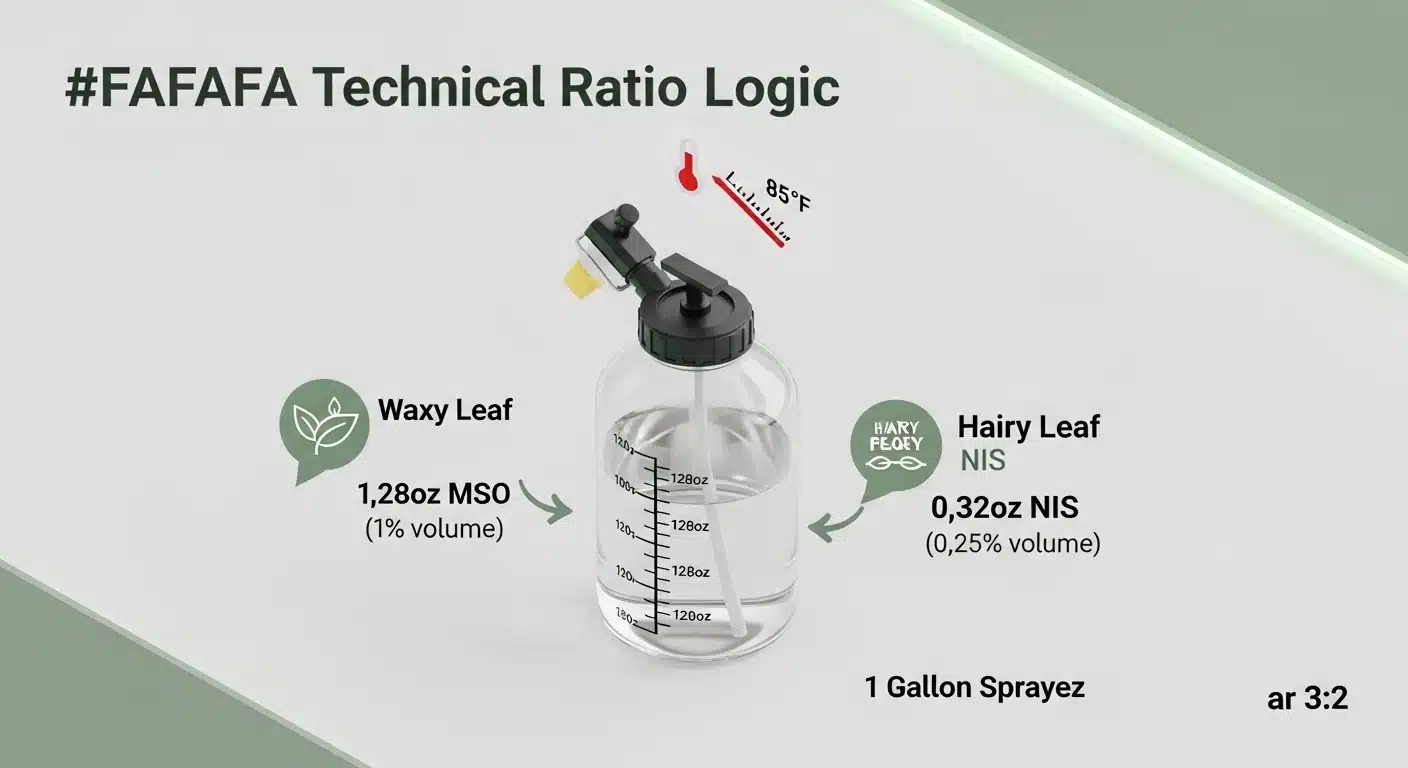
Waxy-cuticle plants require Methylated Seed Oil (MSO) at a 1% volume-per-volume rate. Hairy or flat-leaf plants require Non-Ionic Surfactant (NIS) at a 0.25% volume-per-volume rate. The selection is binary; there is no intermediate value.
Step 3: Calculate adjuvant volume in fluid ounces.
Adjuvant (oz) = Tank oz x Rate
For NIS: Adjuvant oz = Tank oz x 0.0025
For MSO: Adjuvant oz = Tank oz x 0.010
Step 4: Evaluate temperature warnings.
If temperature exceeds 85 degrees Fahrenheit and the chemical type is Contact or surface type is Waxy (which uses crop oil-class adjuvant), the foliar burn warning fires. If temperature exceeds 90 degrees Fahrenheit regardless of chemical type, the extreme heat warning fires. These are threshold checks; no arithmetic is performed on temperature beyond comparison.
Rounding rule: Results are rounded to two decimal places. For tanks above 25 gallons, round up to the nearest 0.25 oz when measuring physically to stay within label tolerance.
Unit conversion chain: gallons to fluid ounces only. No metric conversions are applied.
Assumptions and Limits
- NIS rate of 0.25% v/v assumes a standard 80/20 Non-Ionic Surfactant with an HLB (hydrophilic-lipophilic balance) index of 12 to 15. Surfactants with lower HLB values may require a different rate per their label.
- MSO rate of 1% v/v assumes straight methylated seed oil, not a crop oil concentrate blend. Crop oil concentrates typically specify a different rate; read your specific product’s label before using this output.
- The tool does not account for tank-mix compatibility. Some herbicide-adjuvant-fertilizer combinations cause precipitation or inversion; a jar test is recommended before filling a full tank.
- The temperature burn risk logic applies to the adjuvant type selected, not to a specific herbicide’s tolerance. Some formulations have stricter temperature limits than the thresholds used here.
- Commercial tanks above 300 gallons should pre-dissolve adjuvant in a bucket of warm water before adding to the main tank. This tool calculates volume only; dispersion method is the operator’s responsibility.
- The calculator does not account for carrier water quality. Hard water (high calcium or magnesium) can deactivate NIS; adding a water conditioner like ammonium sulfate may be necessary in regions with high mineral content.
- Results do not replace the registered pesticide label. The label is the law; if the label specifies a rate that differs from this tool’s output, follow the label.
Standards, Safety Checks, and “Secret Sauce” Warnings
Critical Warnings
- The Waxy Runoff Trap: Applying a systemic herbicide to Poison Ivy, Blackberry, or Kudzu without MSO produces near-zero cuticle penetration. The water molecule’s surface tension is stronger than the herbicide’s contact affinity on these surfaces. A standard NIS used in place of MSO on a waxy target is not a partial solution; it is insufficient for the job. The tool enforces the selection so this substitution cannot be made silently.
- Foliar Burn at High Temperature: Methylated Seed Oil and crop oil concentrate adjuvants accelerate transpiration and stomatal uptake. Above 85 degrees Fahrenheit, this mechanism becomes a liability: the same pathway that drives systemic movement also allows non-selective tissue damage to spread beyond the target. The burn-risk warning in the tool fires at 85 degrees Fahrenheit for contact products and 90 degrees Fahrenheit across all types, matching standard label guidance ranges.
- Exceeding 2% Total Adjuvant Concentration: The bar visualization in the tool marks 2% v/v as the upper threshold. Going above this level does not improve coverage; it raises phytotoxicity risk in surrounding vegetation and can destabilize the emulsion in the tank. MSO at 1% fills the bar to half its length by design, leaving the safety margin visible.
- Hard Water Deactivation: In regions with calcium carbonate hardness above 200 ppm, NIS efficacy drops measurably. This is outside the tool’s scope, but awareness of local water quality is a standard pre-spray check. Many herbicide labels include a water conditioner recommendation for hard-water areas.
Minimum Standards
- NIS must be 80/20 grade (80% polyoxyethylene tallow amine or equivalent, 20% inert). Lower-grade surfactants often sold for pool chemistry are not equivalent and should not be substituted.
- Always add adjuvant to the tank before the herbicide concentrate, not after. Pre-loading the adjuvant allows it to disperse and buffer the chemical’s carrier solvent.
- Apply marking dye alongside adjuvant on large areas to prevent re-application over treated zones. The herbicide cost-per-acre loss from double-treating exceeds the dye cost in virtually every scenario.
Competitor Trap: Most surfactant ratio guides online give a single blanket recommendation, such as “add 1 teaspoon per gallon,” with no adjustment for surface type, chemical class, or temperature. That advice is calibrated for hairy-leaf broadleaf weeds and is actively counterproductive on waxy-cuticle plants like Poison Ivy. A homeowner following generic ratio instructions will spray $80 of triclopyr at 1% NIS on Blackberry and watch it fail, then blame the product. The correct intervention is adjuvant class selection first, then rate math. This tool enforces that order.
Understanding herbicide residues after application is a related concern; the herbicide carryover calculator estimates how long active ingredient persists in soil at different conditions. For operators also managing soil chemistry alongside weed pressure, the soil pH sulfur calculator covers amendment rates for acidification without conflating those inputs with spray math.
Common Mistakes and Fixes
Mistake: Using NIS on Waxy-Cuticle Weeds (Poison Ivy, Blackberry, Nutsedge)
Non-Ionic Surfactant lowers surface tension, but not enough to overcome the hydrophobic wax layer on plants like Poison Ivy. The spray droplet spreads slightly, evaporates, and leaves residue on the surface rather than penetrating the cuticle. Systemic herbicides require actual translocation through the leaf tissue to reach the root system. Using NIS here produces the appearance of application without the chemistry of absorption.
Fix: Switch to Methylated Seed Oil (MSO) at 1% v/v for any plant with a visibly waxy or rubbery leaf surface.
Mistake: Measuring Adjuvant by Tablespoon for Small Tanks
For a 1-gallon tank at 0.25% NIS, the correct dose is 0.32 fluid ounces, which is slightly less than two teaspoons. Many operators round to “one capful” or “one tablespoon,” but a standard tablespoon is 0.5 fluid ounces. That is 56% over the target rate. At small volumes, measurement precision has a proportionally large effect.
Fix: Use a graduated measuring cup or a 5 mL syringe for tanks under 4 gallons. The extra 30 seconds of precision protects both efficacy and chemical economy.
Mistake: Applying MSO or Crop Oil Concentrate During Peak Heat
Oil-based adjuvants open the stomata and accelerate tissue uptake in both directions. During peak afternoon heat above 85 degrees Fahrenheit, this mechanism draws the carrier solvent and any co-formulants into leaf tissue faster than the plant can process them. The result is localized necrosis that looks like successful kill but is actually non-selective scorch, including damage to desirable turfgrass or nearby plants.
Fix: Reschedule oil-based adjuvant applications to before 9 a.m. or after 5 p.m. when canopy temperatures have dropped below 82 degrees Fahrenheit.
Mistake: Treating Tank Volume as Chemical Volume
This error is extremely common with concentrated herbicides sold in small bottles. An operator filling a 4-gallon tank with 2 ounces of concentrate and 3.9 gallons of water may enter “2 oz” as the volume, producing an adjuvant dose calibrated for 2 fluid ounces instead of 4 gallons. The resulting spray has 64 times too little surfactant to function. The active ingredient per acre tool uses the same gallon-first logic to avoid this class of error in rate calculations.
Fix: Always enter the total tank fill volume (the capacity of the container), not the volume of concentrate being added.
Mistake: Ignoring Water Hardness in High-Mineral Regions
NIS molecules bind competitively to dissolved calcium and magnesium ions before they can function as wetting agents. In areas with water hardness above 200 ppm, the effective NIS concentration in the tank can drop substantially below the target 0.25%, even if the measured dose is correct. This failure mode is invisible during mixing and shows up only as reduced coverage and increased beading at application.
Fix: Add ammonium sulfate (typically 2 to 4 pounds per 100 gallons) or a dedicated water conditioner to the tank before NIS when working in hard-water regions. Check the herbicide label for specific water conditioner guidance.
Next Steps in Your Workflow
Once you have the adjuvant volume, the next decision is nozzle selection. Flat fan nozzles (TeeJet 8002 or 8004 series) produce the droplet size range (200 to 400 microns) that works best with NIS-amended water on broadleaf targets. Finer droplets below 150 microns increase drift risk; coarser droplets above 500 microns reduce surface contact area on small-leafed weeds. If you are also calculating fertilizer applications as part of the same field visit, the lawn fertilizer calculator handles granular and liquid nutrient rates separately so you can plan both passes without conflating the chemistry.
Tank mixing sequence matters. The correct order is water to half fill, then water conditioner if used, then NIS or MSO, then herbicide concentrate, then remaining water to the fill line. Agitate gently and check for foam before capping. If you are managing soil nutrient levels alongside the weed control program, the NPK calculator can help you schedule fertilizer applications to avoid nutrient-herbicide antagonism in the weeks following treatment.
FAQ
What is the difference between crop oil concentrate and non-ionic surfactant?
Crop oil concentrate (COC) is a petroleum or vegetable oil-based adjuvant, typically used at 1% v/v, designed to penetrate waxy cuticles by softening the lipid barrier. Non-ionic surfactant (NIS) is a synthetic wetting agent that reduces water surface tension, used at 0.25% v/v, effective on hairy and flat-leaf surfaces. They are not interchangeable; using NIS where MSO is needed produces underperformance, not just reduced efficacy.
Can I use dish soap as a substitute for non-ionic surfactant?
Dish soap contains anionic and nonionic detergents plus fragrances, dyes, and defoamers not rated for agricultural use. It can cause excessive foaming in the tank, may degrade certain herbicide chemistries, and has no standardized HLB value. The rate required to achieve the same surface tension reduction as 80/20 NIS is unpredictable. Agricultural NIS is inexpensive; it is not a cost worth cutting.
Why does my glyphosate not work on Poison Ivy even after adding surfactant?
Glyphosate works systemically and requires translocation through living phloem tissue. Poison Ivy has a thick, waxy cuticle that standard NIS cannot penetrate adequately. The correct adjuvant is MSO at 1% v/v. Additionally, Poison Ivy treated in late summer when the plant is moving sugars downward to the root system translocates herbicide more effectively than spring-treated plants.
What does “v/v” mean in adjuvant ratio math?
Volume per volume (v/v) means the ratio of adjuvant volume to total tank volume, expressed as a fraction. A 0.25% v/v rate means 0.0025 fluid ounces of adjuvant per fluid ounce of total tank mix. The formula converts this to practical units: gallons multiplied by 128 (oz/gal) multiplied by the decimal rate gives the result in fluid ounces directly.
Is it safe to apply MSO near flower beds or vegetable gardens?
MSO is an adjuvant, not an active ingredient, and is not independently phytotoxic at label rates. However, MSO amplifies herbicide uptake in any plant it contacts, including non-target ornamentals and edibles. Buffer distance and spray direction matter. Applications above 85 degrees Fahrenheit increase drift volatility. The safety risk is the herbicide reaching non-target plants through the enhanced penetration pathway MSO creates.
How do I know if my NIS is the correct 80/20 grade?
The product label should state 80% polyoxyethylene tallow amine or polyethoxylated tallow amine as the active ingredient, with 20% inert ingredients, and specifically identify the product as “agricultural surfactant” or “non-ionic surfactant.” Products labeled for pools, automotive use, or household cleaning are not equivalent. If the label lists HLB value, look for 12 to 15 as the acceptable range for foliar applications.
Conclusion
The non-ionic surfactant ratio is not a universal constant. It changes based on what the spray water must overcome: hairy-leaf weeds need surface tension broken at 0.25% NIS, waxy-cuticle plants need the lipid barrier dissolved at 1% MSO, and high ambient temperatures add a third variable that determines whether oil-based adjuvants become phytotoxic liabilities. The calculation is simple arithmetic once the right inputs are in place; the error almost always happens one step earlier, in adjuvant class selection.
The single most avoidable failure in foliar spray programs is applying NIS to waxy-cuticle weeds and wondering why the herbicide did not work. Use the tool above to get the exact ounce count for your tank, confirm the adjuvant type is matched to the leaf surface, and check the temperature before you fill. For operators building a complete soil and plant health program, the compost ratio calculator is a useful companion for managing organic matter inputs alongside chemical weed control programs across growing seasons.