
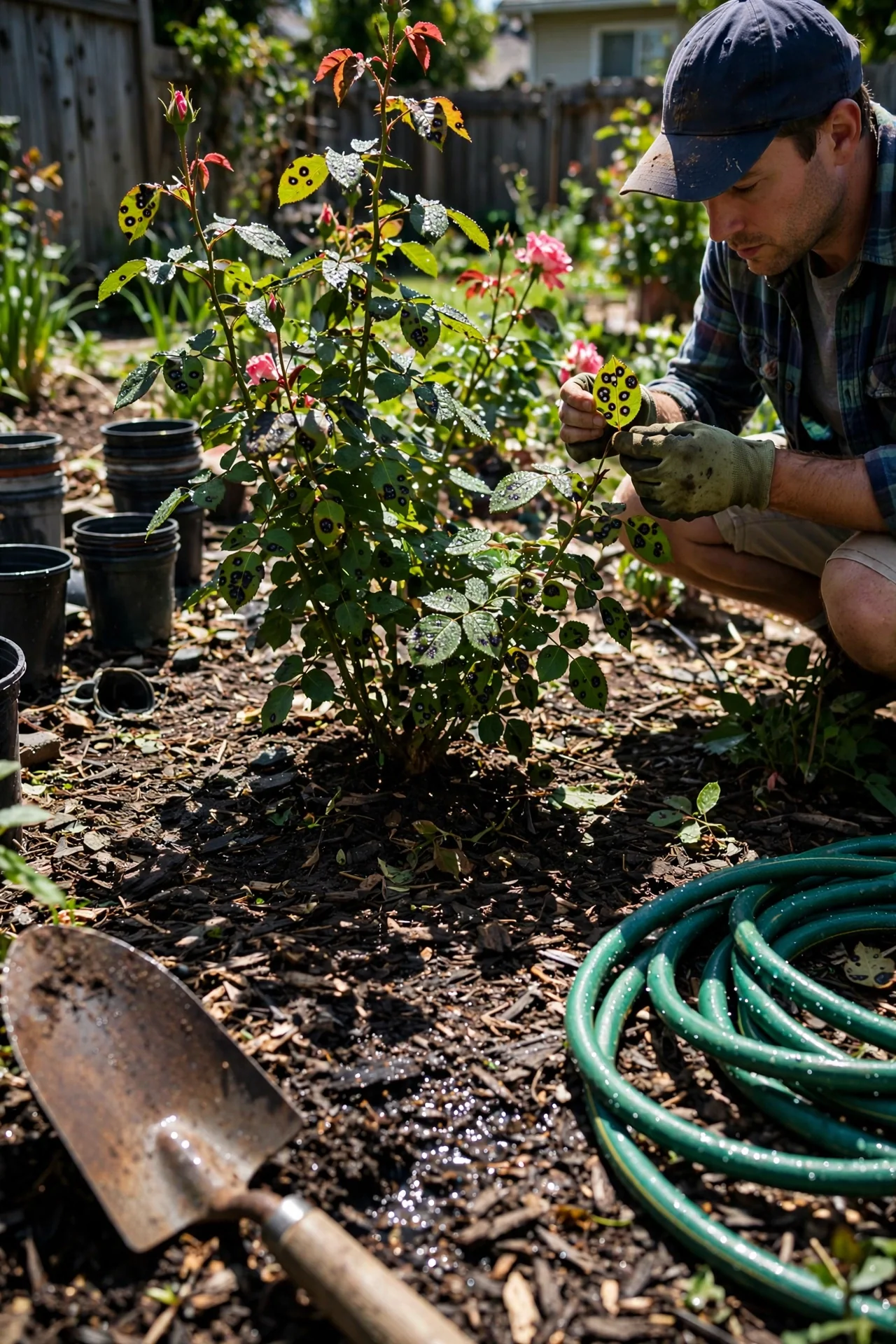
Most advice on black spot treats it like a single problem with a single solution. That is why gardeners in dry climates waste money on aggressive spray programs they do not need, while gardeners in humid regions lose roses by under-applying the right controls at the wrong time. The fungus Diplocarpon rosae is an opportunist: it exploits a specific window of leaf wetness and temperature, and your defense needs to match your actual exposure, not a generic checklist.
This guide covers black spot of roses caused by Diplocarpon rosae. It excludes other leaf spot diseases such as Cercospora leaf spot, downy mildew, and nutrient-deficiency spotting, all of which require different interventions. It also excludes post-harvest handling and commercial nursery production protocols, focusing instead on home-garden decision-making.
By the end, you will know which of three infection-pressure branches you are in, which control method matches that branch, how often each method needs reapplication, and what combinations work together without wasting money or labor.
Bottom line: Choose your control tier based on your local wet-leaf hours per week and your rose variety’s known susceptibility, not on what worked for a gardener in a different climate.
The Yield Grid Decision Grid
Match your situation to one of the three branches below. The branches are built around a measurable fact: Diplocarpon rosae spores require at least 7 continuous hours of leaf wetness to infect, and the disease cycle completes in 10 to 11 days under optimal temperatures of 68 to 75 degrees Fahrenheit. Your branch depends on how often those conditions occur in your garden.
Branch 1: Low Infection Pressure. You garden in a climate with fewer than 15 rain days during the growing season, humidity rarely exceeds 50 percent for extended periods, and you grow modern resistant varieties such as Knock Out, David Austin disease-resistant selections, or Canadian Explorer series roses. You may see occasional spotting on lower leaves in late summer but no significant defoliation. Recommended: Items 1, 2, 3 below.
Branch 2: Moderate Infection Pressure. Your area receives 15 to 30 rain days during the growing season, humidity frequently reaches 70 percent, and you grow a mix of resistant and moderately susceptible varieties. You see black spot annually but it remains manageable with some cultural intervention. Recommended: Items 4, 5, 6 below.
Branch 3: High Infection Pressure. You garden where rain exceeds 30 days per season, humidity stays above 80 percent for long stretches, and you grow highly susceptible varieties like hybrid teas or floribundas in a multi-species garden. Black spot appears early and defoliates plants repeatedly despite basic sanitation. Recommended: Items 7, 8, 9, 10 below.
For rose diseases that look similar but behave differently, see our guide on powdery mildew on roses, which follows a different environmental pattern and requires a different control strategy.
Quick Comparison Table
| Option | Key Mechanism | Best For | Decision Grid Branch | Reapply Class |
|---|---|---|---|---|
| Resistant Varieties | Genetic defense | New plantings, garden renovation | Branch 1 | Once-per-season |
| Watering Discipline | Leaf-dryness preservation | All gardens, especially drip-irrigated | Branch 1 | Once-per-season |
| Sanitation (Leaf Removal) | Inoculum reduction | All gardens with any infection history | Branch 1 | Once-per-season |
| Pruning for Airflow | Faster leaf drying | Dense, mature rose plantings | Branch 2 | Once-per-season |
| Mulching (Splash Barrier) | Physical spore-blocking | Ground-planted roses, rainy climates | Branch 2 | Once-per-season |
| Potassium Bicarbonate Spray | pH disruption on leaf surface | Organic gardens, early outbreaks | Branch 2 | Biweekly |
| Neem Oil | Anti-sporulation and repellency | Light to moderate pressure | Branch 3 | Weekly |
| Sulfur (Wettable or Dust) | Multi-site contact fungicide | Preventive programs, non-sensitive varieties | Branch 3 | Weekly |
| Copper-Based Fungicides | Contact protectant, enzyme inhibition | High pressure, bacterial complex present | Branch 3 | Weekly |
| Chlorothalonil (Synthetic) | Multi-site contact, persistent residue | Severe pressure, non-organic gardens | Branch 3 | Biweekly |
1. Start With Resistant Varieties (The Only One-Time Fix)
Best for: Branch 1, and every gardener planning new rose beds.
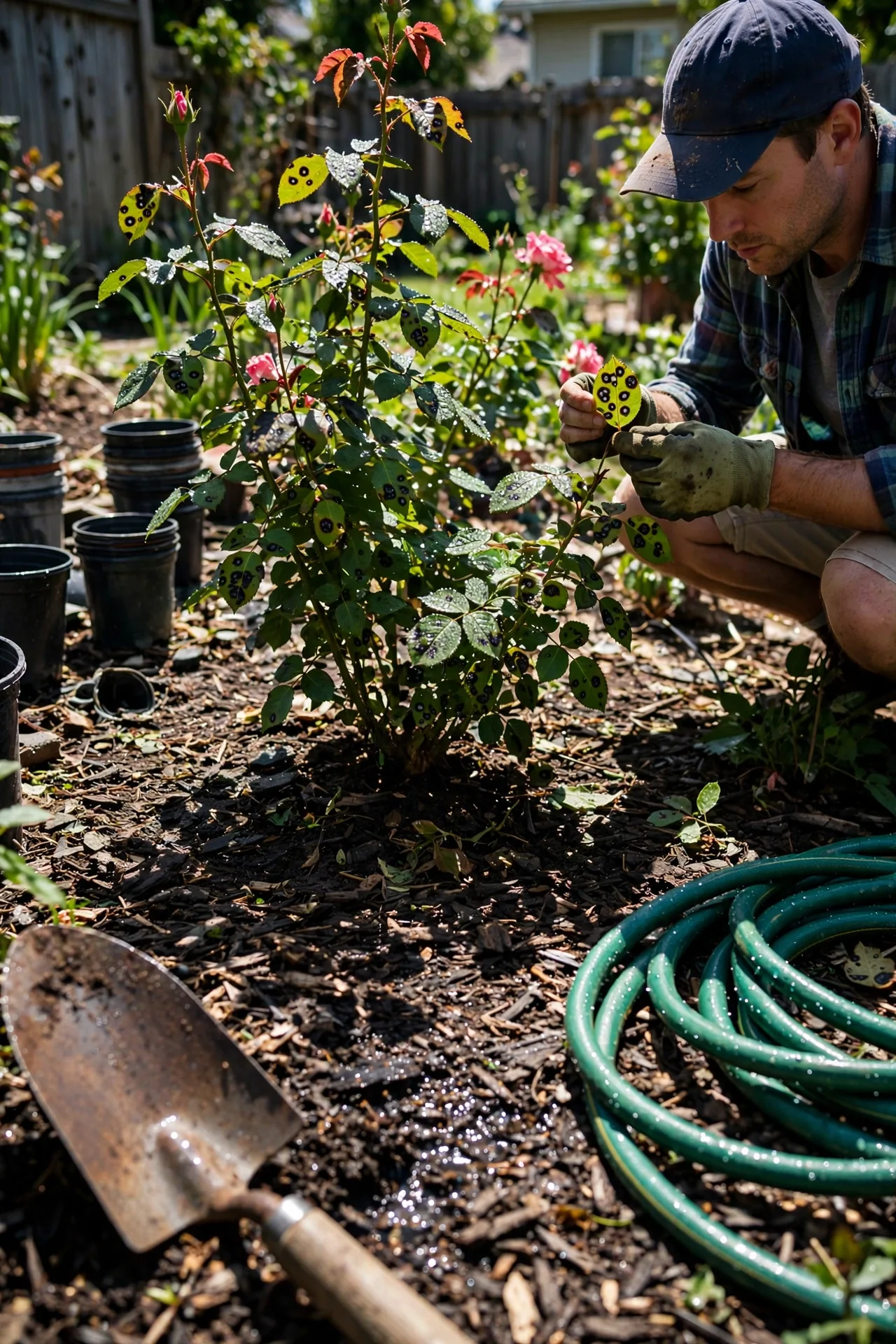
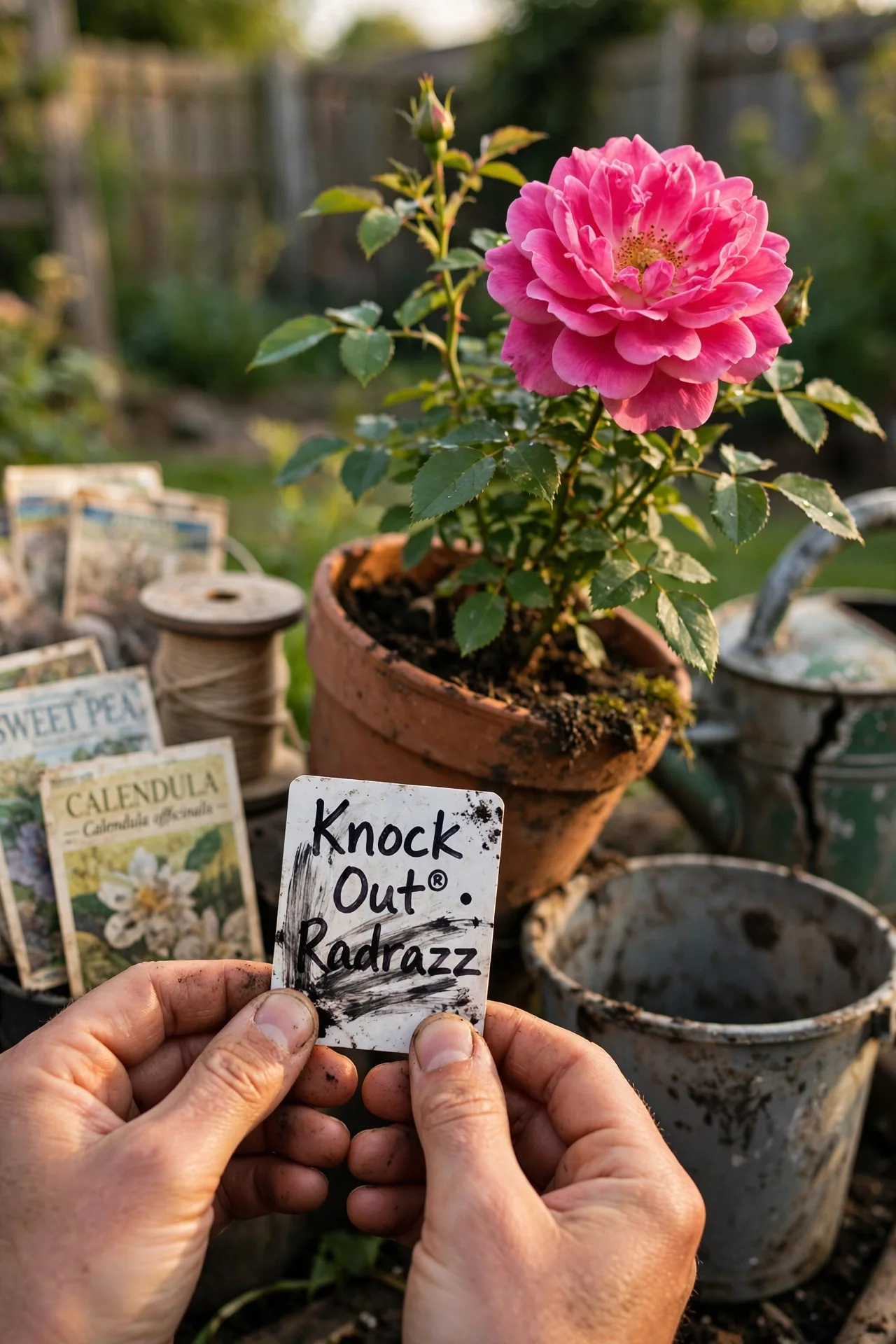
Genetic resistance is the only black spot control you install once and never reapply. Modern breeding programs have produced roses with durable, multi-race resistance that holds across different regions. The Knock Out family, the Canadian Explorer series, and rugosa hybrids carry polygenic resistance that reduces infection probability even under moderate pressure. This is not immunity: under sustained high humidity and heavy inoculum, resistant varieties may still develop minor spotting, but they typically avoid the defoliation spiral that kills susceptible plants.
Edge case: Resistance can break down regionally as local pathogen races adapt. If a supposedly resistant variety defoliates two years in a row in your garden, the local Diplocarpon rosae population may have shifted. Rotate to a different resistance source.
Steps: (1) Check your local extension service list of regionally adapted resistant cultivars. (2) When replacing roses, prioritize resistance ratings over flower form. (3) Even resistant roses benefit from Branch 1 cultural practices.
2. Keep Leaves Dry: Water Only the Soil
Best for: Branch 1. Relevant to every garden regardless of pressure level.
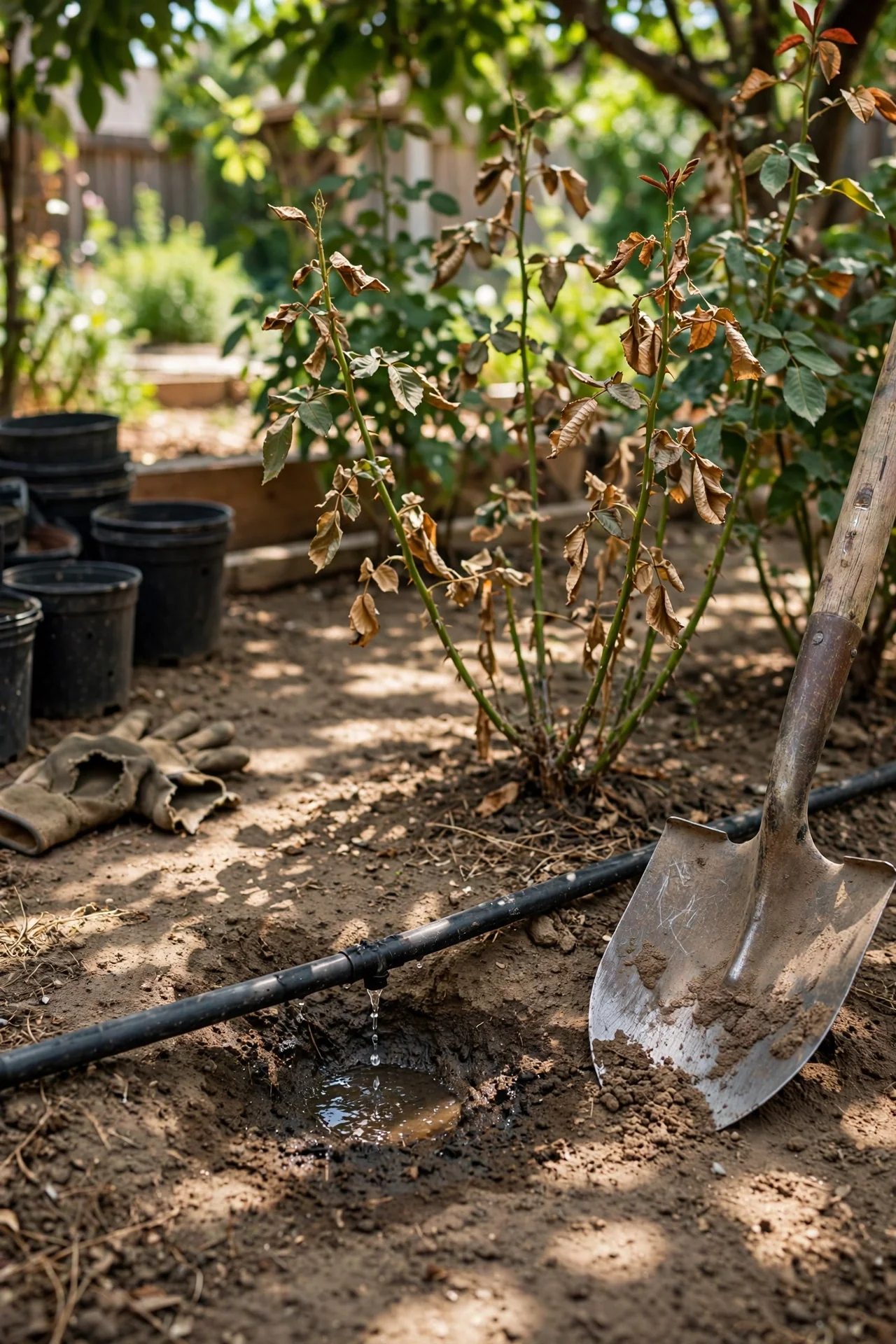
The single most leveraged cultural practice is eliminating overhead irrigation. When water hits foliage and stays for 7 continuous hours, infection succeeds. Use drip irrigation or soaker hoses placed under the mulch line. If you must water overhead, do it between 5 a.m. and 9 a.m. so leaves dry before the fungal germination window closes. The constraint: this requires irrigation infrastructure. A $30 soaker hose kit eliminates the largest controllable infection vector in a typical rose garden.
3. Remove Every Fallen Leaf Before Spring Growth Starts
Best for: Branch 1 and Branch 2. Non-negotiable if you had any black spot the previous season.
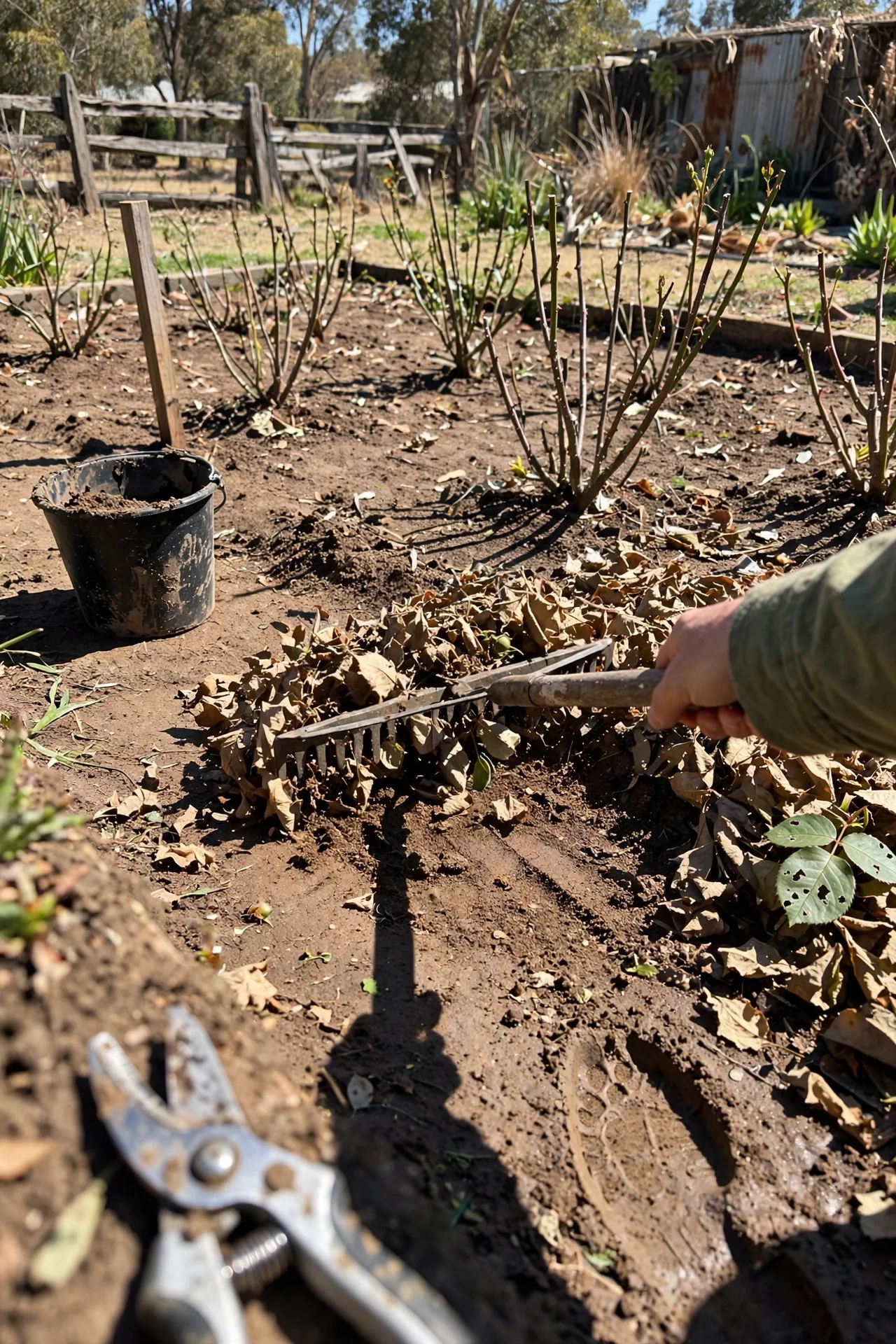
Diplocarpon rosae overwinters in infected fallen leaves and stem lesions. A single uncleaned rose bed can harbor enough ascospores to initiate the first spring infections, which then produce conidia that drive the epidemic. Rake and dispose of all leaf litter from under and around roses before bud break. Do not compost this material: home compost piles rarely reach the sustained 140 degrees Fahrenheit needed to kill fungal spores. Bag and trash it, or burn where local codes permit. One thorough winter cleanup reduces primary inoculum more than any mid-season spray can compensate for.
4. Prune for Airflow, Not Just Shape
Best for: Branch 2. Critical for gardens with dense, multi-year rose plantings.
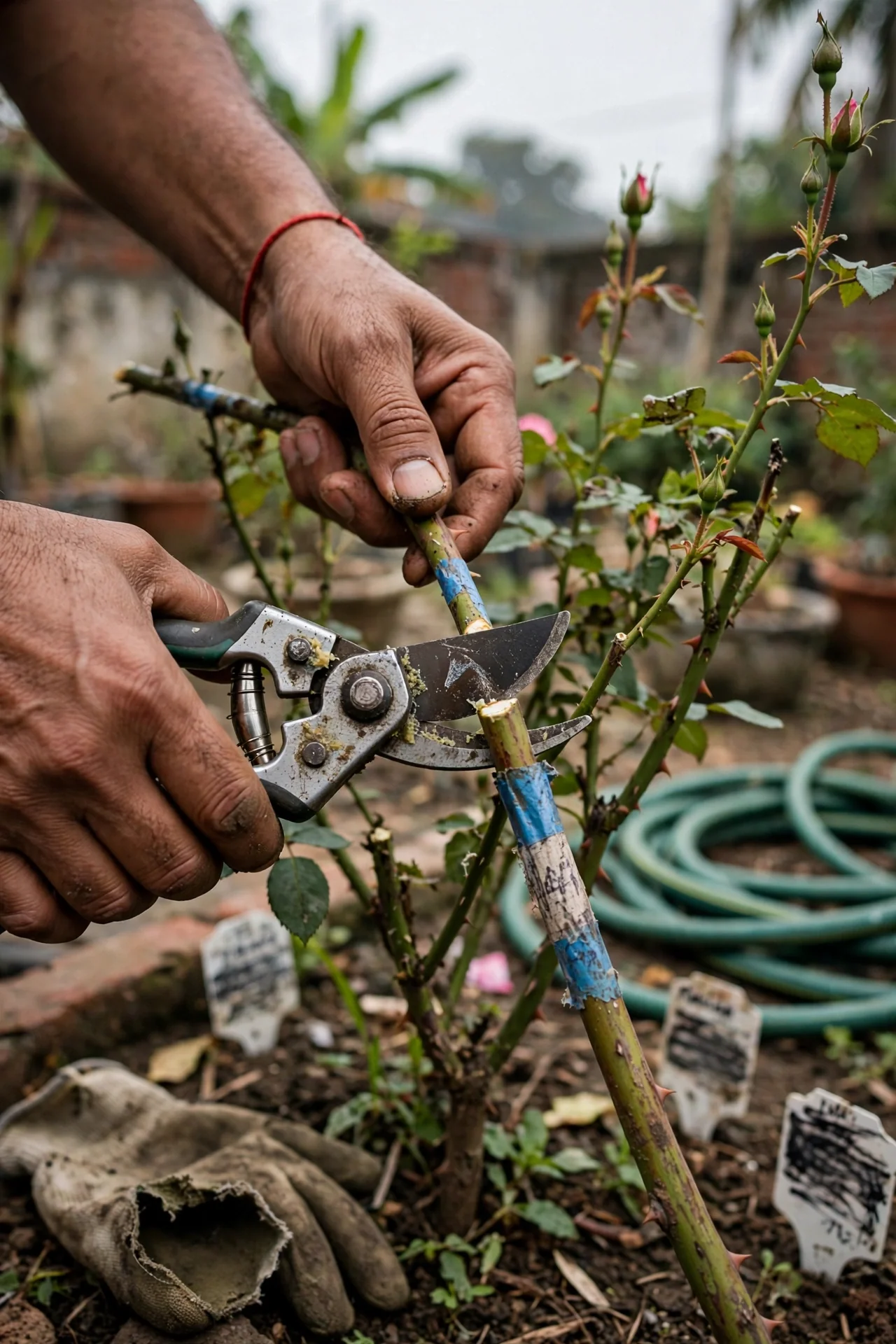
Most pruning advice focuses on bloom production. For disease control, the priority is opening the center of the plant so that air moves freely and leaves dry faster after rain or dew. Remove inward-growing canes, any cane thinner than a pencil, and all dead or crossing wood. The target is a vase-shaped structure where you can see daylight through the middle of the bush. This mechanical drying effect shortens the leaf-wetness period below the critical 7-hour threshold, especially in the lower canopy where humidity lingers longest. Pair this with wider plant spacing: 3 feet minimum between mature rose bushes in humid climates.
If your garden also struggles with wet-soil diseases, review our guidance on overwatering symptoms to distinguish root-zone problems from foliar infection.
5. Lay Mulch as a Splash Barrier
Best for: Branch 2. Highest impact in gardens where roses are planted in soil, not containers.
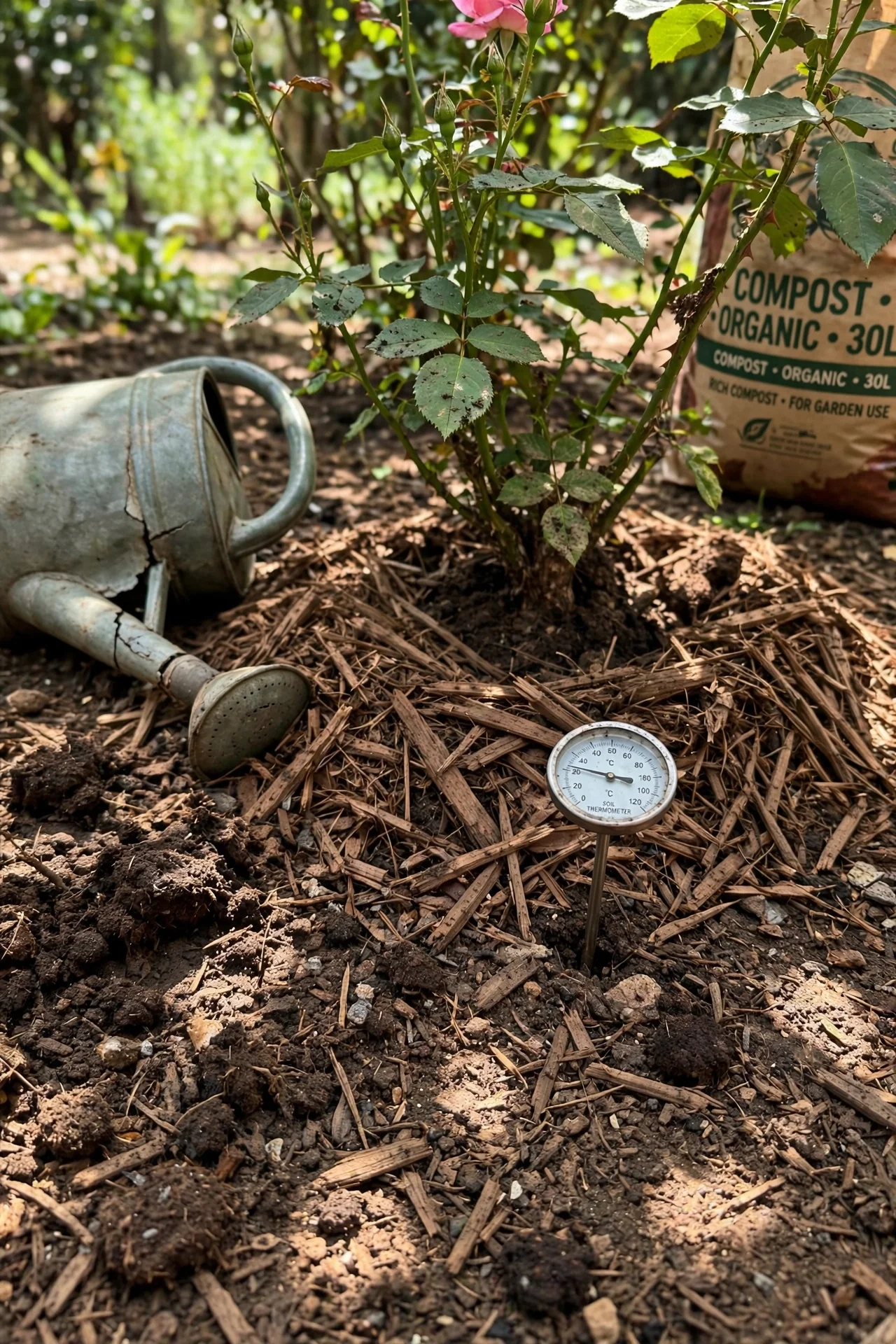
Raindrops hitting bare soil launch a fine aerosol of water and soil particles carrying spores upward onto lower leaves. A 2- to 3-inch layer of mulch (shredded hardwood, pine straw, or composted bark) absorbs the impact and blocks this splash pathway. Replace mulch annually in late winter after sanitation cleanup, since old mulch itself can harbor spores near the surface. This is a once-per-season task that costs less than a single bottle of fungicide.
6. Use Potassium Bicarbonate as an Organic Preventive
Best for: Branch 2. Use at first sign of spotting or when forecasts predict extended wet periods.
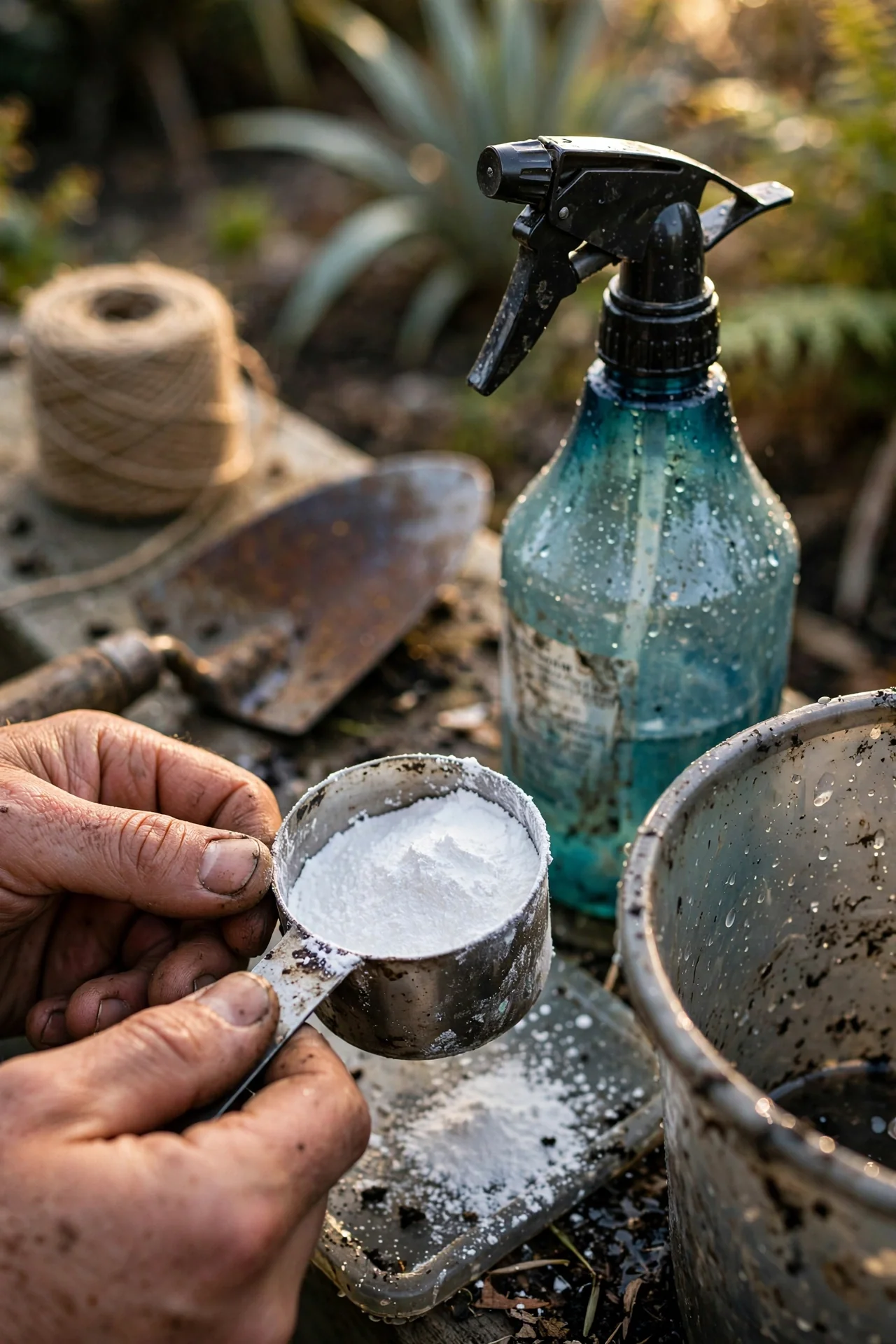
Potassium bicarbonate (often sold as a ready-to-use “biofungicide”) works by altering the pH of the leaf surface, making it inhospitable to germinating Diplocarpon rosae spores. It is contact-only, has no curative activity on established infections, and must be applied before infection occurs. A standard dilution is 1 tablespoon per gallon of water, applied to full leaf coverage every 10 to 14 days. Mix fresh each time; solution efficacy degrades within 24 hours. The constraint is that potassium bicarbonate washes off in rain, so reapply after any storm exceeding half an inch. This method fails if you cannot commit to the reapplication rhythm.
7. Deploy Neem Oil When Spotting Begins
Best for: Branch 3. The first escalation point when cultural controls alone are insufficient.
Cold-pressed neem oil (not clarified hydrophobic extract) contains azadirachtin, which interferes with fungal sporulation. It does not cure existing leaf spots, but it suppresses the production of new conidia, slowing the epidemic. Apply as a 1 percent solution (roughly 2.5 tablespoons per gallon) with a few drops of mild liquid soap as emulsifier, covering both upper and lower leaf surfaces. Neem breaks down under UV light within 5 to 7 days, so weekly reapplication is required during active disease pressure. Avoid spraying when temperatures exceed 85 degrees Fahrenheit; neem oil can cause phytotoxicity on heat-stressed rose foliage. For more detail on fungal suppression in organic systems, see our guide on powdery mildew treatment approaches, which shares overlapping application principles.
8. Apply Wettable Sulfur as a Low-Cost Preventive Program
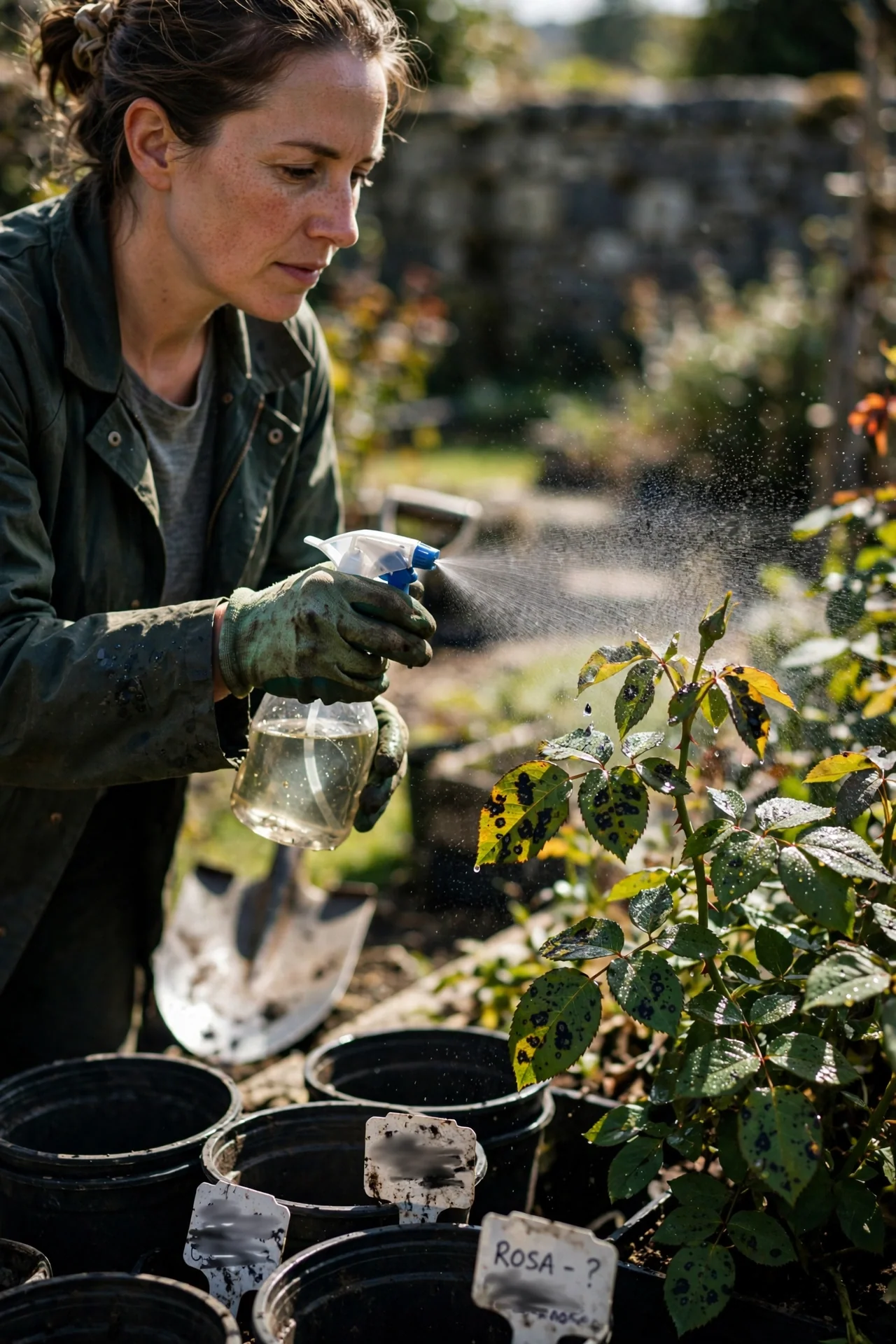
Best for: Branch 3. Economical for gardens with more than five rose bushes.
Sulfur is a multi-site contact fungicide that disrupts fungal respiration at multiple points, making resistance development extremely rare. Apply wettable sulfur at a rate of 2 to 3 tablespoons per gallon of water, starting at bud break and repeating every 7 to 10 days throughout the growing season. Sulfur works preventively; it has little effect on established lesions. Two constraints matter: do not apply sulfur within two weeks of an oil spray (including neem), as the combination causes leaf burn, and do not use sulfur when temperatures exceed 90 degrees Fahrenheit, as phytotoxicity risk rises sharply. Sulfur is also effective against the mites that vector some rose viruses; see our article on tomato leaf curl virus for context on vector management principles.
9. Use Copper Fungicides for Complex Infections and Wet Winters
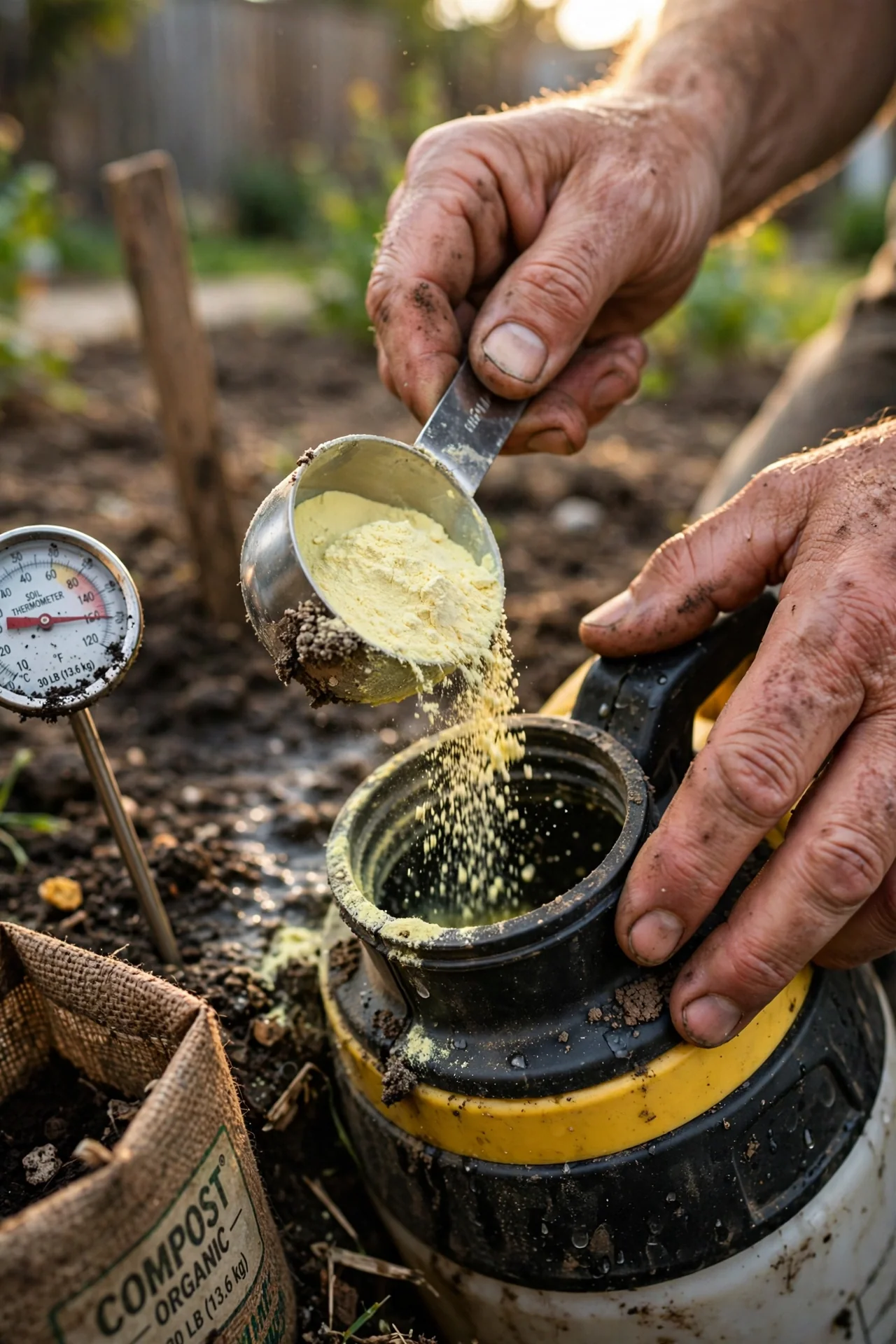
Best for: Branch 3. Indicated when black spot co-occurs with bacterial leaf spot or when you need a winter cleanup spray.
Copper-based fungicides (copper octanoate, copper hydroxide, or Bordeaux mixture) provide broad-spectrum contact protection against both fungi and bacteria. This makes copper the preferred choice when you cannot confidently distinguish black spot from bacterial leaf scorch on visual symptoms alone. Apply a dormant-strength copper spray after pruning but before bud break to reduce overwintering inoculum on canes. During the growing season, apply at labeled rates every 7 to 10 days. Note the accumulation risk: copper does not degrade in soil and can reach toxic levels in repeatedly treated beds. Rotate with sulfur or other modes of action if treating for multiple years. For a related pathosystem where copper is a standard tool, read our guide on bacterial leaf scorch identification and management.
10. Reach for Chlorothalonil When Everything Else Has Failed
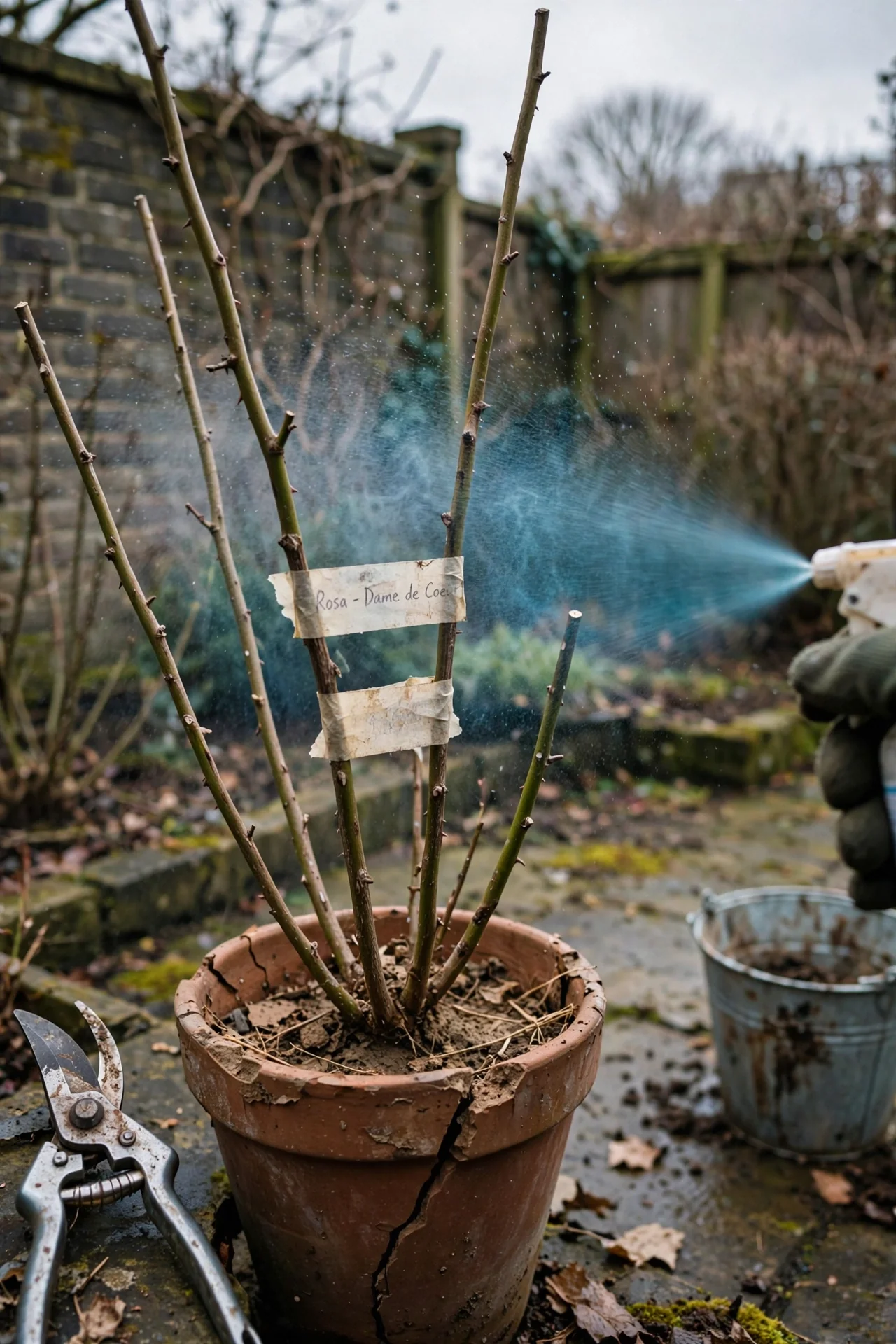
Best for: Branch 3. Reserved for gardens where defoliation has reached more than 30 percent of the plant in prior seasons despite consistent organic programs.
Chlorothalonil is a broad-spectrum, multi-site contact fungicide with residual activity lasting 7 to 14 days. Unlike systemic fungicides (myclobutanil, propiconazole), chlorothalonil does not penetrate plant tissue, which means it cannot cure established infections but also faces lower resistance risk. Apply at the first sign of leaf spot and repeat at 10- to 14-day intervals, shortening to 7 days during prolonged wet periods. Chlorothalonil is not labeled for use in some countries, including the UK for home garden use, so verify local registration before purchasing. Its environmental persistence means it must be used as a last-resort tool, not a default option. For guidance on sterilizing equipment between applications to avoid spreading spores, see our guide on how to sanitize garden tools properly.
Starter Stack (What to Choose First)
Branch 1: The Prevention-Only Stack
Pair Resistant Varieties (Item 1) with Sanitation (Item 3). The resistant variety reduces your baseline vulnerability; thorough winter leaf removal eliminates the primary inoculum source. Together, these two one-time actions can hold black spot below threshold in low-pressure climates with zero sprays. Estimated cost: $25 to $45 for a disease-resistant bare-root rose plus one afternoon of raking per season.
Branch 2: The Cultural-Plus-Organic Stack
Combine Pruning for Airflow (Item 4) with Potassium Bicarbonate (Item 6). Opening the canopy shortens leaf-wetness duration, reducing infection probability, and the bicarbonate spray catches any spores that survive the faster drying time. Pruning is a once-per-season task; the spray adds 10 to 15 minutes per application every two weeks during the growing season.
Branch 3: The Full-Pressure Program
Layer Sulfur (Item 8) as your workhorse preventive with Copper (Item 9) for early-season sanitation and late-season cleanup. Sulfur provides economical, resistance-resistant protection during peak growth; the dormant copper spray knocks down overwintering inoculum before new leaves emerge. Together they cost roughly $30 to $50 per season for a garden of 10 roses and require a weekly commitment during the growing season, plus two off-season applications.
When This Won’t Work
Condition 1: You are dealing with Cercospora leaf spot, not Diplocarpon rosae. Cercospora produces darker, more angular lesions with purplish margins and appears later in the season, often after black spot is controlled. Sulfur and potassium bicarbonate have reduced efficacy against Cercospora species. If your “black spot” persists through a well-executed sulfur program, submit a sample to your extension diagnostic lab for confirmation. The alternative action is switching to a chlorothalonil-based program or a targeted strobilurin fungicide if Cercospora is confirmed.
Condition 2: The underlying problem is chronic root stress, not a leaf pathogen. Roses growing in compacted clay, chronically overwatered soil, or root-bound containers will show leaf spotting and yellowing that mimics black spot. If your sanitation and fungicide program produces no improvement across a full season, dig a small root inspection hole 12 inches from the crown and check for root discoloration, mushiness, or constriction. Correct the drainage or potting issue first. See our guide on root rot in houseplants for diagnostic principles that apply equally to outdoor roses.
Choosing the Right Option for Your Situation
Budget Threshold: Under $30 Per Season
Stick to Items 1 through 5: resistant varieties, watering discipline, sanitation, pruning, and mulch. These five methods cost nearly nothing beyond basic garden tools and labor. If you still see significant spotting, add Item 6 (potassium bicarbonate) at roughly $12 per season for a single bush.
Time Threshold: Less Than 30 Minutes Per Week
Choose Items 1, 2, 3, 4, 5, and 8. Sulfur mixing and spraying takes about 20 minutes per session for up to 10 bushes. If even that is too much, stick with Branch 1 or Branch 2 methods and accept that some spotting is inevitable in wet years.
Technical Constraint: High Summer Temperatures Above 90 Degrees Fahrenheit
Sulfur and neem oil both pose phytotoxicity risks above 85 to 90 degrees Fahrenheit. In hot-summer climates, shift your active spray window to early morning (5 a.m. to 8 a.m.) and rely more heavily on chlorothalonil (Item 10) if organic certification is not required, as it carries lower heat-risk than sulfur or oil.
Yes/No Checklist:
1. Have you identified your infection-pressure branch using rain-day frequency? Yes / No
2. Have you removed all last season’s leaf litter before bud break this spring? Yes / No
3. Are you willing to reapply your chosen spray on the schedule specified in the comparison table? Yes / No
4. Have you eliminated overhead irrigation or shifted it to early morning only? Yes / No
Expert Q&A
Can black spot spread on pruning tools?
Yes, but the risk is lower than with bacterial or viral diseases. Diplocarpon rosae spores can adhere to blade surfaces and transfer between plants during wet conditions. Wiping secateurs with a 70 percent isopropyl alcohol solution or a 10 percent bleach solution between bushes is recommended if you are pruning actively infected canes. Dry pruning of dormant plants carries negligible transmission risk.
Does lime sulfur dormant spray actually help?
Lime sulfur applied as a dormant spray (before bud break) can reduce overwintering fungal biomass on canes and near the soil surface. It is most useful in Branch 3 gardens with heavy infection pressure the previous year. Apply at a dilution of 1:10 with water, but never use on foliage that has emerged, as it causes severe phytotoxicity on green tissue.
Why does black spot return even after a full sanitation cleanup?
Sanitation reduces your local inoculum, but Diplocarpon rosae spores travel on wind-driven rain from neighboring gardens up to several hundred feet away. Complete elimination is impossible in most suburban settings. The goal of sanitation is to delay the onset of infection until plants are large enough to tolerate some spotting, not to achieve permanent eradication.
Can I compost rose leaves if I use a hot compost system?
Theoretically yes if your pile sustains 140 degrees Fahrenheit for at least three days and you turn it so all material reaches that temperature. In practice, most home compost systems do not achieve uniform heating. The safer course is to dispose of infected rose leaves in municipal green waste, where commercial composting facilities reliably reach pathogen-killing temperatures.
Is there any biological control that works against black spot?
Bacillus subtilis strain QST 713 (sold commercially as a biofungicide) has shown suppressive activity against Diplocarpon rosae by colonizing leaf surfaces and producing antifungal metabolites. It requires application before infection and reapplication every 7 to 10 days. Research is ongoing, but it represents the most viable biological option for organic gardens facing moderate pressure.
Conclusion
The #1 mistake in managing black spot is applying a high-intensity fungicide program to a low-pressure situation, or a low-effort cultural approach to a high-pressure garden. Match your effort to your measured infection risk, not to anxiety. Use the Decision Grid branches to calibrate your response, and start with the free interventions (sanitation, watering discipline, pruning) before spending on sprays.
If you take away one action from this guide, make it the winter leaf cleanup. No fungicide compensates for a season’s worth of spores lying beneath your roses. For the next step in building a complete rose disease management plan, read our guide on powdery mildew on roses, which often co-occurs with black spot and requires a coordinated control timeline.