
Aglaonema care advice often reads like a universal checklist: water every 7 days, provide bright indirect light, and feed monthly. Yet the real decisions that keep these tropical foliage plants thriving depend on the specific conditions of the room where they live. Treating a plant in a dry, north-facing office the same way as one in a steamy bathroom ignores the single biggest lever you control: matching care moves to the microclimate you actually have, not the one a care tag assumes.
This guide focuses on soil moisture management, light optimization, humidity enhancement, feeding routines, and maintenance pruning. It excludes pest treatments and detailed propagation, which are separate topics. What remains is a set of ten actionable interventions, each mapped to a branch of a decision grid based on measurable light and humidity conditions.
By the end, you will know exactly which combination of practices suits a low-light dry environment, an average living room, or a bright humid space. You will also learn when a practice works against you and how to adjust seasonally without guesswork.
Bottom line: Pick the care stack that aligns with your room’s actual microclimate, then tweak it when seasons change.
The Yield Grid Decision Grid
Start by identifying which branch most closely describes the spot where your aglaonema spends most of its time. This determines which care practices below will have the greatest impact.
Branch 1: Low-light, dry air. The room gets minimal indirect light (reading a book is difficult without a lamp) and the air feels dry enough to cause static shocks or dry skin in winter. Heating or air conditioning runs often. Recommended: Items 1, 6, 4 below. Even among aglaonema varieties, some tolerate darker corners better; check our aglaonema varieties guide to pick a cultivar suited to low light.
Branch 2: Medium indirect light, average humidity. The plant sits in a spot where you can comfortably read a paperback without turning on a light, but direct sun never hits the leaves. Humidity is moderate, similar to a typical furnished living room. Recommended: Items 5, 2, 8 below.
Branch 3: Bright indirect light, higher humidity. The plant is within 3 feet of an east- or west-facing window and the surrounding air feels humid, comparable to a bathroom after a shower or a kitchen where a kettle boils regularly. A humidifier may be in use. Recommended: Items 3, 7, 10 below.
Quick Comparison Table
| Option | Key mechanism | Best for | Decision Grid Branch | Effort Score |
|---|---|---|---|---|
| 1. Watering by Weight | Hefting pot to sense moisture reserve | Low-light, dry rooms | Branch 1 | 2 |
| 2. Monthly Leaf Shower | Mechanical dust removal and pest disruption | Moderate conditions | Branch 2 | 2 |
| 3. LECA Semi-Hydro | Passive hydroponic wicking and oxygenated root zone | Bright, humid spaces | Branch 3 | 4 |
| 4. Slow-Release Fertilizer Sticks | Controlled nutrient release triggered by moisture | Low-light, low-maintenance setups | Branch 1 | 1 |
| 5. Bottom Watering Routine | Capillary action draws water upward | Consistently warm rooms | Branch 2 | 3 |
| 6. Humidity Tray Setup | Evaporative microclimate around foliage | Dry indoor air | Branch 1 | 2 |
| 7. Light Meter Calibration | Mapping lux/PPFD to window distance | Growers optimizing variegation | Branch 3 | 2 |
| 8. Pruning for Bushier Growth | Breaking apical dominance at nodes | Leggy plants in adequate light | Branch 2 | 2 |
| 9. Soil Mix Customization | Adjusting porosity and water-holding | Chronic overwaterers or dense soil | Branch 2 | 3 |
| 10. Seasonal Relocation | Shifting plant position with sun angle and temperature | Homes with strong seasonal light shifts | Branch 3 | 1 |
1. Watering by Weight Check
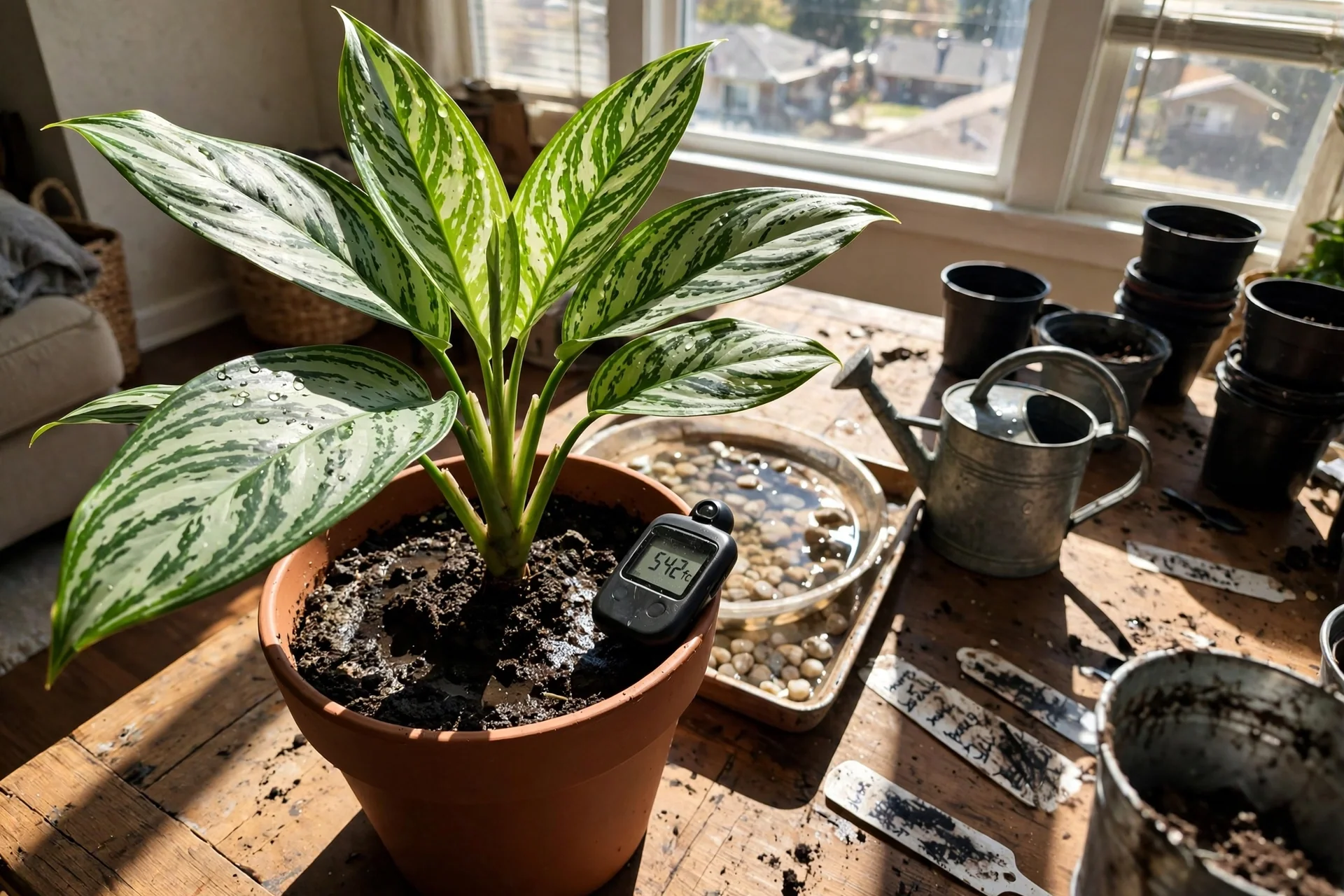
Best for: Branch 1
What it is: A moisture-assessment technique that replaces calendar-based watering with the physical heft of the pot. Because low-light, dry rooms slow evaporation unevenly, a schedule almost always over- or under-shoots.
For: Any aglaonema in a plastic nursery pot inside a cachepot. Ceramic or heavy containers may mask weight differences.
Steps: The day after a thorough watering, lift the pot and note the heft. Check again every 3–4 days until the pot feels noticeably lighter. Water only when lightness matches a dry reference weight you establish once.
Common mistake: Waiting until the leaves droop. Like peace lilies, aglaonemas can wilt from thirst, but repeated wilting causes lower leaf loss. Use weight, not wilting, as the primary signal.
2. Monthly Leaf Shower
Best for: Branch 2
Use this if dust accumulation is visible and your plant is in a manageable-sized pot. Skip if your tap water is extremely hard, as mineral deposits can create white residue on leaves. The main edge case: plants in heavy floor-standing containers are awkward to move; spot-clean with a damp cloth instead. The shower both cleans stomata and physically dislodges immature pests like spider mites before colonies build.
3. LECA Semi-Hydro Conversion
Best for: Branch 3
Threshold rule: Only adopt this method if you can maintain a nutrient solution pH between 5.8 and 6.2 and commit to flushing the reservoir with plain water every 4 weeks to prevent salt accumulation. If leaf tips turn brown despite correct pH, reduce nutrient concentration by half. Similar to Anthurium crystallinum, aglaonema adapts well to semi-hydro, but its slower growth in low light makes salt sensitivity more pronounced.
4. Slow-Release Fertilizer Sticks
Best for: Branch 1
The 10-minute workflow: At the start of the growing season when indoor temperatures consistently exceed 65°F (18°C), press one stick per 6-inch pot into the soil near the root zone, following package spacing instructions. Water the plant as usual; the coating releases nutrients when soil moisture is present. This one action covers feeding for roughly 3–4 months, eliminating the need to remember biweekly liquid feeds in a low-light setting where growth is modest. For an upgrade, supplement with a dilute seaweed extract foliage spray once a month to supply micronutrients that coated sticks may omit, but only if the room has adequate ventilation to dry leaves quickly.
5. Bottom Watering Routine
Best for: Branch 2
What: Placing the pot in a tray of water and letting the soil wick moisture upward. Steps: Fill a saucer with room-temperature water, set the pot in it for 25–30 minutes, then remove and let excess drain completely. Mistake: Leaving the pot sitting in water permanently, which saturates the root zone and invites fungal rot. Bottom watering encourages roots to grow downward and reduces the chance of fungal gnats breeding on the soil surface.
6. Humidity Tray Setup
Best for: Branch 1
Use this when: You notice brown leaf edges during heating season and cannot run a humidifier. Skip if: The room has strong airflow from a ceiling fan or open window, which dissipates the humidity before it reaches the foliage. An edge case: in very dry indoor climates, a tray alone may not raise localized moisture enough; combine it with clustering plants. Many calatheas demand similar humidity boosts, and grouping them with aglaonema creates a shared, more stable microclimate.
7. Light Meter Calibration
Best for: Branch 3
Threshold rule: For medium to bright indirect conditions, aim for a photosynthetic photon flux density (PPFD) reading between 50 and 150 µmol/m²/s at leaf level. If using a lux meter app on a smartphone, 1,000 to 2,500 lux corresponds to the low end of that range for many aglaonema cultivars. When leaves lose variegation and turn mostly green, increase light gradually by moving the plant 12 inches closer to the window. Monstera care also benefits from precise light mapping, but aglaonema tolerates lower minimums.
8. Pruning for Bushier Growth
Best for: Branch 2
10-minute workflow: Sterilize bypass pruners, identify a leggy stem, and cut just above a node at a 45-degree angle. Dab the cut with cinnamon powder to deter fungus. For an upgrade, place the cutting in water to root a new plant. Like dieffenbachia, aglaonema responds well to heading cuts, but avoid pruning more than a third of the total stems at once in low-light conditions; the plant needs remaining foliage to fuel recovery.
9. Soil Mix Customization
Best for: Branch 2
What: A custom blend of 3 parts peat moss or coco coir, 1 part perlite, and 1 part fine orchid bark. For: Creating fast drainage and air pockets while retaining enough moisture for roots between waterings. Steps: Combine in a container, moisten slightly to reduce dust, and pot the plant firmly without compacting. Mistake: Adding garden soil or sand, which collapses pores and suffocates roots. Most philodendron mixes work for aglaonema, but cut the bark portion in half if your indoor air is dry.
10. Seasonal Relocation
Best for: Branch 3
Use this: In late spring, move the plant up to 2 feet closer to an east or west window to capture longer daylight hours. In early autumn, pull it back to avoid cold drafts and low-angle sun that can scorch leaves. Skip if: Your home has consistent climate control year-round or you use grow lights on a timer, as the environment changes little. An edge case: sudden moves from a dim corner to bright indirect light can cause bleaching; transition over a week. Bird of paradise benefits from similar seasonal shifts, but aglaonema is more sensitive to temperature drops below 60°F (15°C).
Starter Stack (What to Choose First)
Branch 1 Starter: Watering by Weight + Humidity Tray
Lift-checking prevents the overwatering that low-light, dry rooms encourage because soil dries slowly, while the humidity tray offsets the arid air that causes crispy tips. Together they create a stable, low-maintenance rhythm. Expect to spend about 5 minutes per week checking pot weight and refilling the tray; the tray costs roughly $5–15 if repurposing a shallow dish with pebbles.
Branch 2 Starter: Bottom Watering Routine + Monthly Leaf Shower
Bottom watering keeps the root zone evenly moist without compacting the soil surface, and the monthly shower removes the dust layer that cuts light absorption in average indoor light. The combination reduces pest pressure passively. Time investment: 30 minutes once a month for the shower, plus 5 minutes per watering session.
Branch 3 Starter: LECA Semi-Hydro + Light Meter Calibration
In bright, humid conditions, LECA eliminates soil-borne variables and delivers consistent moisture and oxygen, while calibrating light ensures you don’t waste the higher growth potential. The light meter step is a one-time mapping exercise of roughly 20 minutes. Semi-hydro setup costs vary from $15 for a simple net-pot and reservoir to $40+ for a multi-plant system.
When This Won’t Work
If your tap water has high dissolved mineral content (total dissolved solids above 300 ppm), you will likely see persistent brown leaf tips no matter which care branch you follow. In that case, switch to rainwater, distilled, or reverse osmosis water for both watering and humidity trays. Continue the same care routines, but alter the water source.
When room temperatures routinely drop below 60°F (15°C) at night, particularly in unheated sunrooms or near drafty windows, aglaonema leaves can develop translucent, water-soaked patches that progress to mush. No care stack fully compensates for sustained cold stress. The alternative is to move the plant to a consistently warmer interior spot. For plants that tolerate cooler conditions more readily, see our rubber plant care guide for a hardier choice.
Choosing the Right Option for Your Situation
Budget threshold
Most practices require little to no financial outlay. A humidity tray can be made from household items, and slow-release fertilizer sticks cost a few dollars per season. The only notable expense jump is LECA semi-hydro, which can reach $40 upfront for containers, clay pebbles, and a dedicated nutrient solution. Start with the free weight-check method and a DIY tray before investing in a full hydro conversion.
Time threshold
If you have fewer than 10 minutes per week for plant care, prioritize Items 1, 4, and 6 (weigh, stick, tray). These fit a low-effort routine. If you enjoy weekly tinkering, bottom watering and light meter spot-checks add engagement without heavy time loads.
Technical constraint
Aglaonema roots are fleshy and rot-prone in continuously wet, cool soil. Any practice that extends soil moisture, like bottom watering in a cold room, must be paired with a well-draining mix (Item 9) and temperatures above 65°F (18°C). Ignoring this constraint leads to root loss even in an otherwise perfectly chosen branch.
Yes/No checklist:
Does my room get enough light to read without a lamp? (Yes = Branch 2 or 3; No = Branch 1)
Is the relative humidity low enough that I experience static shocks? (Yes = Branch 1)
Am I willing to mix nutrient solutions and flush pots monthly? (Yes = consider Item 3)
Does the indoor temperature stay above 60°F (15°C) all year? (No = address cold before any other tactic)
Expert Q&A
Can aglaonema be grown permanently in water instead of soil?
Yes, but only if you use a hydroponic nutrient solution and change it every 7–10 days. Stagnant water without aeration leads to root rot. Transition a cutting rather than a soil-rooted plant, and keep water level below the stem base to avoid crown rot.
Why does my aglaonema get brown tips even when I water correctly?
Brown tips often trace to fluoride or soluble salts in tap water, not watering frequency. Flush the soil with distilled water every 6–8 weeks to leach buildup. Low humidity amplifies the symptom by accelerating transpiration, pulling more salts to the leaf margins.
Is aglaonema toxic to pets?
Yes, aglaonema contains calcium oxalate crystals that cause oral irritation, drooling, and difficulty swallowing if ingested by cats or dogs. Keep plants out of reach and consult a veterinarian immediately if a pet chews leaves.
How do I bring out more pink or red in variegated aglaonema varieties?
Boost light intensity gradually to the upper end of bright indirect (around 2,000–2,500 lux). Lower nitrogen in the fertilizer during the active growing season can also intensify red pigments, but avoid eliminating nitrogen entirely, as that stunts growth.
Should I mist my aglaonema leaves daily?
Misting provides only a brief humidity spike and can invite fungal issues if leaves stay wet for hours in still air. A humidity tray or a small humidifier delivers more consistent moisture without wetting foliage directly.
Conclusion
The key decision in aglaonema care is whether your room leans dry and dim, balanced and moderate, or bright and humid. Aligning your care stack with that reality prevents the number one mistake: watering on a fixed schedule in low light. Once you match the right practice to the right microclimate, seasonal tweaks keep the plant steady year-round.
For another tropical foliage plant that thrives with a similarly relaxed approach in lower light, explore our hoya care guide.