
Josh spent years as the family’s quiet wallet. When a relative put a $3,600 dinner bill in his name, he decided the grown-ups could handle it.
When Josh’s mom sent him to the kids’ table at his cousin’s engagement dinner, he stayed quiet, until the event manager asked him to cover a $3,600 balance he’d never agreed to. What followed is a story about family boundaries, financial manipulation and what happens when the one who always pays finally stops.
Plenty of family stories involve one person quietly footing the bill, but this one is told with an unusual amount of restraint. We liked how small the humiliations are, and how quickly they add up. If you’ve ever been handed a check you never agreed to, you’ll recognize the feeling before the first section ends. We’ve retold the story in full below from a first-person account shared online.
The Family’s Favorite Placeholder
Josh is 32, and if you’ve ever been the extra chair at your own family’s table, you already know where this is going. His relatives have a strange talent for making him feel like he never quite belonged. He was never the golden child, the troublemaker or the baby. He was the placeholder, the one who showed up, smiled politely and quietly picked up the check.
It wasn’t always like this. He remembers normal dinners, family vacations and a few Christmas mornings when he was genuinely happy. Then his dad left, his older brother started making six figures, and his mom decided that brother could do no wrong. Somewhere in there Josh stopped being part of the picture and became background noise.
He moved out at 19, put himself through school and worked his way up at a mid-size logistics firm. Now he makes good money, though you’d never guess it from how his family treats him. The better he does, the colder they get, as if success is something he isn’t allowed to have, or something they’re entitled to profit from without acknowledging the work.
The latest insult arrived wrapped in white linen napkins. His cousin Melanie, his aunt’s youngest, was throwing an engagement dinner, and his aunt had decided it would be a “family-sponsored” event, which in this family is code for “Josh is paying.” He learned he was invited through a forwarded email with no greeting, just a time, a date, a location and a “Don’t be late” from his mom in her most passive-aggressive tone.
He hadn’t seen most of them in over a year. The last time, his mom introduced him to a friend as “the one who’s still single, still renting and still doesn’t visit enough,” and she said it like a joke. Every instinct told him to stay home. He went anyway, maybe because a small part of him hoped someone would acknowledge him, or maybe to prove to himself that he was past caring.
A Wristband and a Plastic Fork
The restaurant was upscale, out of reach for most of his family unless they were pretending to be something they weren’t. Josh arrived fifteen minutes early in a navy blazer and pressed slacks, hoping at least to look like he belonged. The hostess asked his name, gave him a confused look and handed him a plastic wristband. “Buffet wristband,” she said, pointing to a back corner where a few silver trays sat under dim lighting.
He asked if this wasn’t a seated dinner. She checked her list. “You’re with the Gomez party, right? It says here you’re on the kids list.”
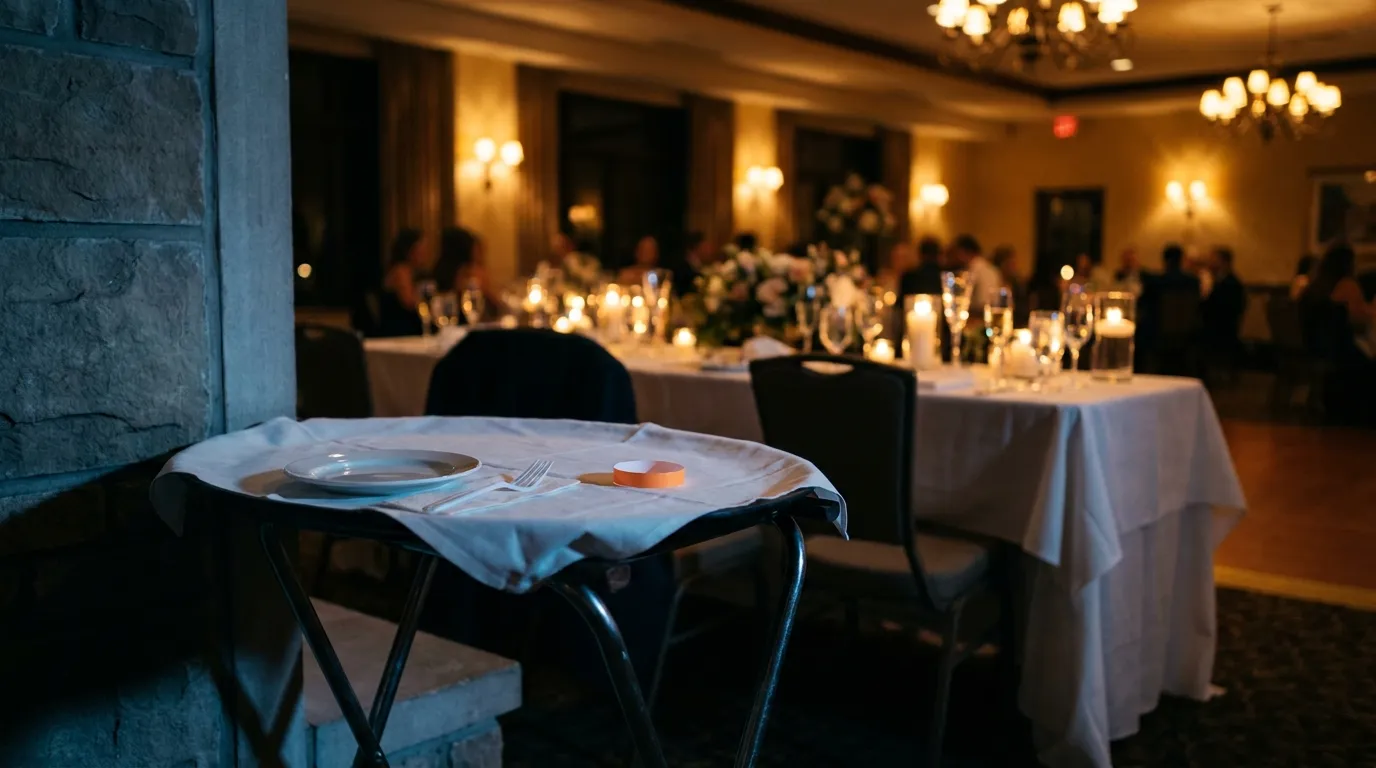
The room was bright and loud, with long tables set in a U around a flower-covered centerpiece where Melanie and her fiancé, Jason, posed for photos. At the head of the U sat the grown-up table: Josh’s mom, his aunt, his brother and his wife, and a few cousins, all sipping champagne. Josh looked for his chair and didn’t find one.
“Josh, over here!” his mom called, waving like she was hailing a cab, and pointed to a fold-out table with uneven legs, surrounded by teenagers and younger cousins. “You can sit with the kids. Grown-ups are at that table,” she snapped, tossing him a plastic fork still wrapped in a thin napkin. His aunt Linda, who still owes him $2,000 from 2019, burst out laughing and said he should be glad they’d let him come this time.