He put the pages down on the carpet samples very slowly, the way a man puts down something breakable that he has already broken.
“Lorraine. This is family.”
“The notes don’t have a family rate,” she said. “They have a due date.”
Ott said, quietly, “I’m going to wait in the truck,” and went.
Derek’s face went through the whole catalogue in the space of a minute — the charm, the grin, the injured son, the businessman, the man who had never in his life been the one without a card to play — and landed somewhere Lorraine had never seen on him before. Somewhere small.
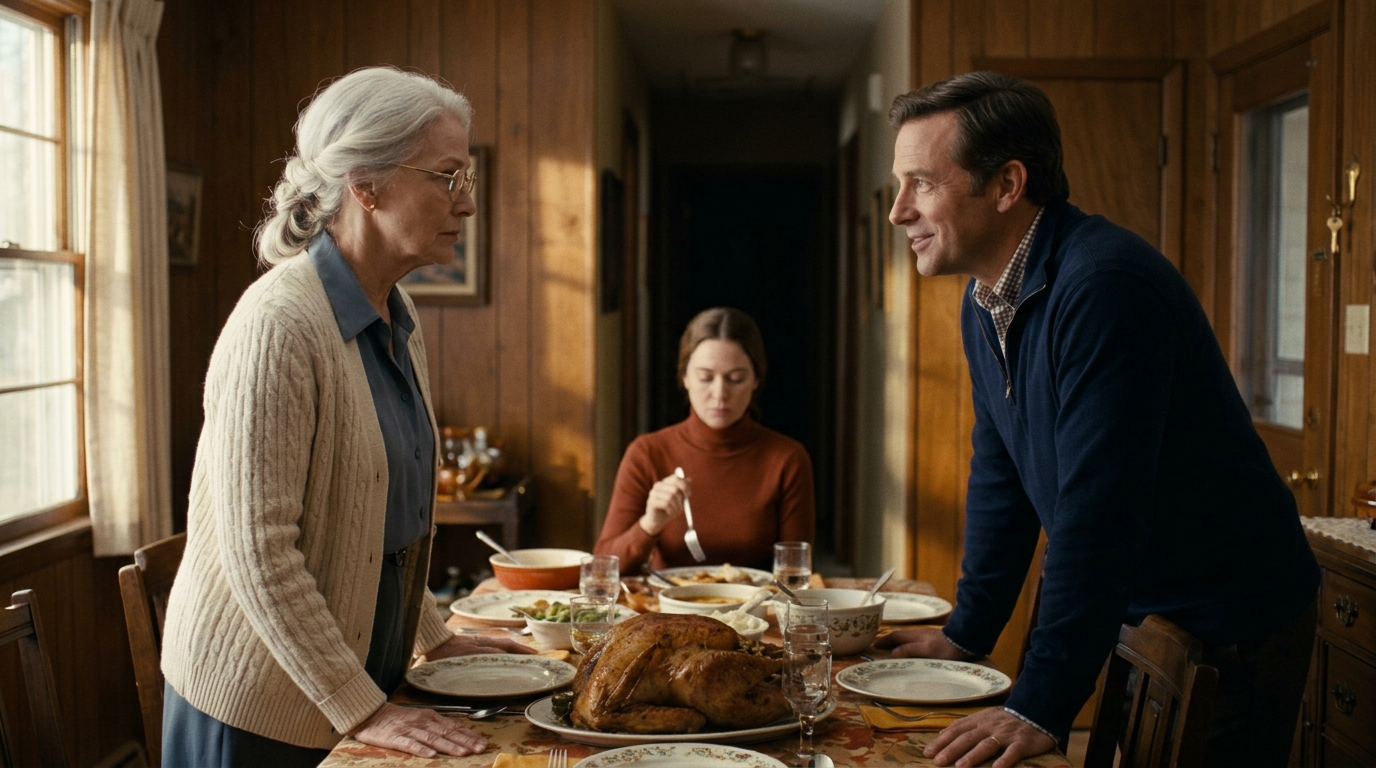
“You knew at dinner,” he said. “You sat there and let my mother talk about curtains.”
“I let her talk,” Lorraine said. “You let her move in. Those are different sins.”
He called his mother that night. Lorraine knows because Pauline was crying on the stairs by nine, holding her phone away from her ear as if it had bitten her, and because at ten past ten Ray’s truck started in the driveway and did not leave for twenty minutes, the two brothers inside it doing whatever it is brothers do when one of them has been lying for a year.
Marlon left Tuesday morning before anyone was up. He left a note on the kitchen counter, thank you for the dinner, and drove back to Toledo with his car full of nothing.
But the meeting that mattered was on Monday, in Lorraine’s dining room, with the good table cleared and Hollis Krantz sitting at the end of it with a legal pad, and Derek’s family seated in a row with their hands in their laps, all of them told the truth in one sentence: this house belongs to Lorraine, and there is no version of the future, near or far, in which it belongs to Derek.
Pauline asked whether the money could just be forgotten. Hollis said it could, and that it would be Lorraine’s decision, and that forgiving a note secured by a recorded deed is a legal act and not a Christmas gesture, and everybody looked at the tablecloth.
Ray asked whether the basement was still available. That got a laugh, and Lorraine let it, because Ray was the only one in the family who had ever asked her a question instead of telling her something.
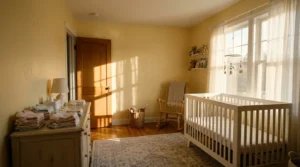
Kendra asked nothing. She packed her son’s cot back in the box and drove Tyler home and cried in the driveway, which Lorraine saw from the window and did not go out for, because a woman who has just been lied to by her son-in-law is not required to be everybody’s soft place on the same weekend.
Nadine came last. She came on the Tuesday afternoon the note came due, alone, and she stood in the front room — Walter’s room, the one with the good light and the picture of him on the lake in 1994 — and she said the thing Lorraine had been waiting six days to hear.
“I signed it,” Nadine said. “I was standing right there. I knew he stopped paying in the spring. I knew what he was telling people, and I sat at your table and let him give away your rooms, and I have never been so ashamed of myself in my life.”
“Why?”
“Because if I said it out loud at Thanksgiving, I’d have to say out loud that my marriage is a business that has been insolvent for a while.”
Lorraine crossed the room and put her arms around her daughter, who was taller than her and had been taller than her since 1998, and held on for a while.
“You’re not insolvent,” she said into her shoulder. “You’re badly managed. There’s a difference, and it’s fixable.”
The terms came down to paper on the third of December, two days after the note had come due and gone unpaid, and Hollis read them out loud in the dining room, and Derek signed all four copies with a pen Lorraine had been keeping in the drawer for exactly this.
The balloon was extended to the first of March. The interest resumed at two hundred twenty-seven dollars a month, paid by standing transfer on the first, so that nobody had to be reminded and nobody had to be ashamed. Derek signed a written acknowledgment of the sixty-eight thousand dollars and of the recorded deed of trust, which he had spent six years pretending did not exist, and agreed that any sale, transfer or new borrowing against Larkspur Lane would require Lorraine’s written consent, because the collateral for her money was the roof over her daughter’s head. He agreed, in writing, that no one had any right, title, interest or permission to occupy her house, now or at any point in the future, and that if any relative ever again asked him where they would live, the answer was not her address.
And he agreed to say it out loud, in front of his mother, his brother, his sister and his cousin, which he did on a Sunday afternoon in the front room, in a voice that got quieter as it went, and which cost him more than the sixty-eight thousand dollars ever had.
Pauline moved in with Kendra, and it worked out better than anyone expected, which Lorraine noted without surprise; a woman who wants to be needed will find a place that needs her.
Derek did not lose the company. He lost the Findlay contract story, which had never been quite true, and he lost the habit of arriving at Lorraine’s door with a folder and a sad face, which had been true for nineteen years. In February he made his payments on time. In March he asked Hollis, through Lorraine, whether he might refinance the balloon with a bank instead, and Lorraine said yes, and meant it, and that was the whole of the forgiveness she was prepared to give him — not the debt, but the door.
On a Saturday in April, Lorraine carried the front room’s second armchair up to the attic, took down the picture of Walter on the lake, and hung it back where it had been for eleven years before six strangers and a carpet sample landed in her dining room.
Then she went out to the back door, and she took her keys off the sideboard where she had been keeping them since Thanksgiving, and she hung them on the brass hook.
She stood there a moment with her hand still on the ring, hearing the house make its old noises, the furnace ticking, the gutter running in the corner, the refrigerator humming its one note. Forty-one years. She had come in this door with a box of dishes and a husband and no curtains, and she would go out of it one day, and in between it was hers — not because a paper said so, though a paper did, and not because a notary said so, though a notary had.
Because she had never once, not for a single afternoon in nineteen years, mistaken being kind for being confused.