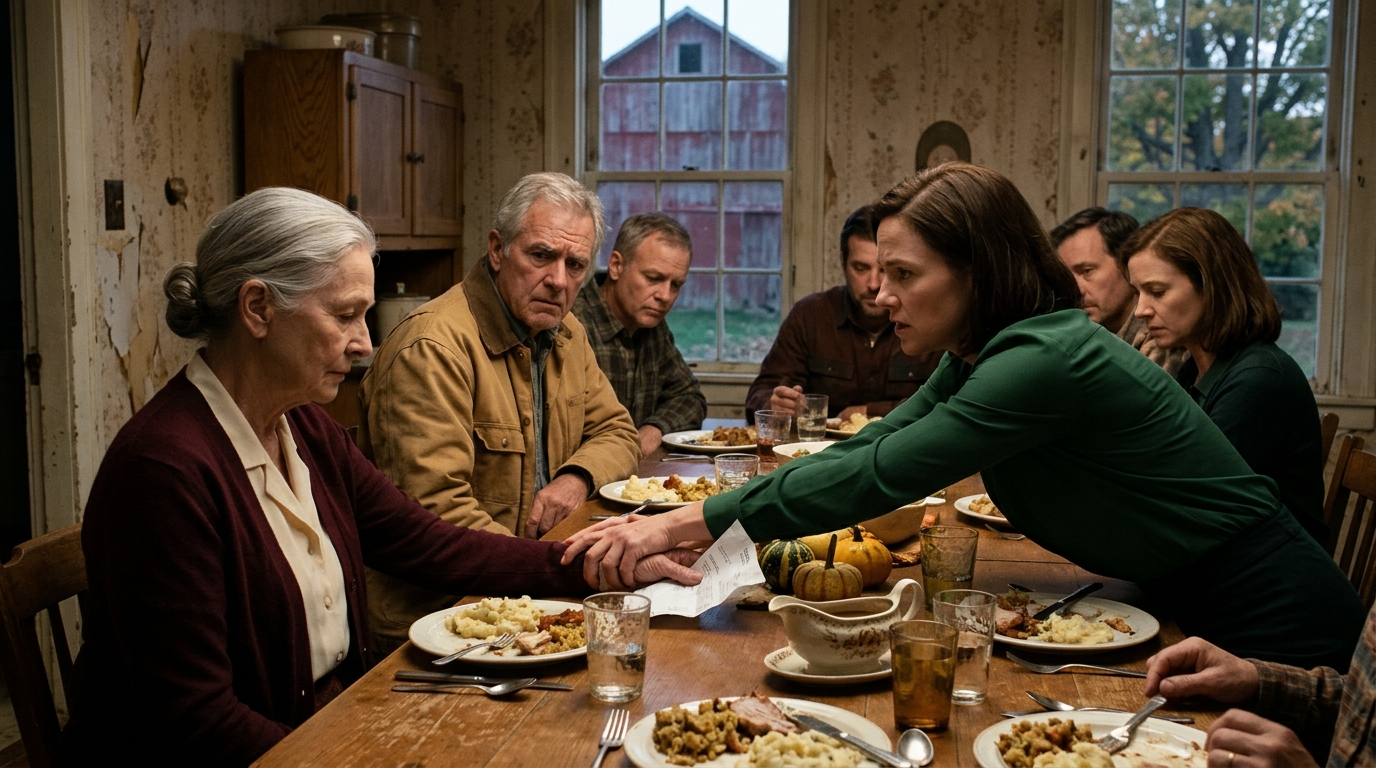
“Some of this isn’t for the supper.”
Mara snapped her head toward him.
“You’re taking her side now?”
“I’m asking what the money was for.”
She didn’t answer.
I had spent years believing Eli would eventually find his confidence again. I had hoped he would recognize when something was unfair without needing someone else to explain it.
That evening, he finally began asking questions.
I told him that Margaret had already contacted the timber buyer.
The buyer had confirmed that the proposed sale was not moving forward because the ownership records did not match the information supplied during the preliminary discussions.
No trees had been cut.
No timber had been removed.
The boundary markers remained intact.
The buyer had also agreed to communicate directly with Margaret if anyone approached again claiming to represent me.
Mara looked at the envelope.
“So that’s it? You’re just going to shut everything down?”
“Yes,” I said. “Until I choose otherwise.”
“You don’t even need all that land.”
I looked through the window.
“I don’t need to use every tree to own it.”
She had heard those words before.
This time, she didn’t laugh.
Frank stood and thanked me for the meal. Denise quietly helped collect the plates.
I told them they were welcome to stay, but they said they would leave us to talk.
Before Frank reached the door, he stopped beside me.
“Walter would have been proud of you.”
I smiled.
“Thank you, Frank.”
When the neighbors had gone, the farmhouse felt different.
The same dishes remained on the table. The same chairs stood around it. The red barn was still visible through the windows.
But the illusion that Mara and Eli could decide what happened to my property had finally been broken.
Eli asked whether he could speak to me alone.
Mara went upstairs.
He sat at the kitchen table and held his head in his hands.
“I’m sorry.”
I waited.
“I should never have let her speak to you like that.”
“No,” I said. “You shouldn’t.”
“I thought we could sell some timber and clear our debts.”
“Why didn’t you ask me properly?”
He looked embarrassed.
“Because I knew you’d say no.”
“Then you already had your answer.”
He nodded.
He explained that their financial problems were worse than I had understood. Eli’s small contracting business had lost several customers, and Mara had accumulated personal expenses they were struggling to cover.
They had started looking at the timber as a solution.
Mara believed that if they could get a preliminary agreement from a buyer, I would eventually accept the sale.
Eli admitted he had not checked the deed.
He had relied on what Mara told him.
I listened without interrupting.
When he finished, I asked him whether he understood why I was upset.
He said he did.
I told him the problem wasn’t that he needed money. Families could help one another through difficult times.
The problem was that he had treated my willingness to help as permission to make decisions for me.
He had allowed Mara to present an invoice in front of neighbors, then pushed a pen toward me as though signing away my dignity was the simplest way to keep the peace.
He looked at the floor.
“I don’t know how to fix it.”
“Start by being honest.”
He asked whether I wanted them to leave.
I told him I needed time to think about their living arrangement.
They had originally agreed to stay for six months. That period had passed, and the arrangement had never been reconsidered properly.
I was willing to give them a reasonable period to find somewhere else, but I would not allow another attempt to negotiate over my property.
Mara came downstairs before we finished.
She had changed into a sweater.
“Are you throwing us out?”
I answered calmly.
“I’m reviewing an arrangement that was supposed to be temporary.”
She laughed bitterly.
“So we’re homeless now?”
“No. You have time to make plans. But this is my home, and the decision about who lives here is mine.”
She turned toward Eli.
He didn’t defend her.
That silence told me more than another argument could have.
The following morning, I called Margaret.
She confirmed that the buyer had received the ownership clarification. She also recommended that I update my property records, review the farm’s access arrangements and keep all future discussions about the timber in writing.
I agreed.
We arranged for the boundary markers to be checked and the original documents to remain in secure storage.
I also asked Margaret to help me write a simple household agreement for any future temporary occupants.
It would state which expenses were shared, who was responsible for maintenance and which areas of the property were private.
No vague promises.
No assumptions.
No informal agreements that could later be used against me.
A week later, Eli and Mara began packing.
They found an apartment in town.
Eli came to me before they left and apologized again.
This time, I believed he understood at least part of what he had done.
Mara remained distant.
She didn’t apologize for the invoice or the timber negotiations. I didn’t demand an apology that she wasn’t prepared to offer.
I simply wished them well.
Eli carried the last boxes to his truck.
Before leaving, he looked toward the barn.
“Do you think you’ll ever sell the timber?”
“Maybe one day.”
“Would you tell me first?”
I looked at him.
“I would tell you if I wanted to. But I wouldn’t need your permission.”
He nodded.
That was the last thing we said about the woodland.
I eventually reviewed the grocery invoice with the receipts. I paid the agreed share of the harvest supper ingredients and kept a copy of the accounting.
I didn’t send Mara another bill.
I didn’t need to.
The point had never been to embarrass her in return.
The point was to make clear that kindness was not a contract transferring ownership of my home.
Months passed.
The farmhouse grew quieter.
I returned to my old routines. I made coffee in the morning, checked the garden, walked past the barn and kept an eye on the weather.
Frank and Denise came by occasionally.
They never asked me to repeat the story. They simply treated me the way they always had.
One afternoon, I walked behind the barn.
The trees stood in the autumn light, their leaves moving gently in the wind.
I remembered Walter standing in that same place, telling me that a person should never confuse patience with surrender.
I ran my hand over the old fence post.
The land was still mine.
The barn was still standing.
And the trees were still growing.
I went back into the farmhouse and found the cream envelope in the drawer where I kept important documents.
I opened it once more, checked the certified deed and returned it to its place.
There was no dramatic victory to celebrate.
No shouting.
No public punishment.
Just a woman who had spent years being generous and had finally remembered that she was allowed to say no.
The next harvest supper, I invited the neighbors again.
I cooked the meal myself, just as Walter and I used to do.
Frank brought apple cider. Denise brought a pie. We sat around the same wooden table.
Nobody presented me with an invoice.
Nobody asked me to sign away anything.
After dinner, I carried the remaining plates into the kitchen.
Then I looked out the window at the red barn.
The timber stood behind it, exactly where it had always stood.
For forty-two years, I had owned those trees.
And I still did.
I had not lost my home.
I had not lost my land.
Most importantly, I had not lost the right to decide what happened next.
That evening, I placed the sealed cream envelope back in the drawer, turned off the kitchen light and locked my own front door.
For the first time in a long while, the farmhouse felt entirely like home again.
Article ending: Complete. The deed, proposed sale, grocery dispute, living arrangement and family confrontation are all resolved.