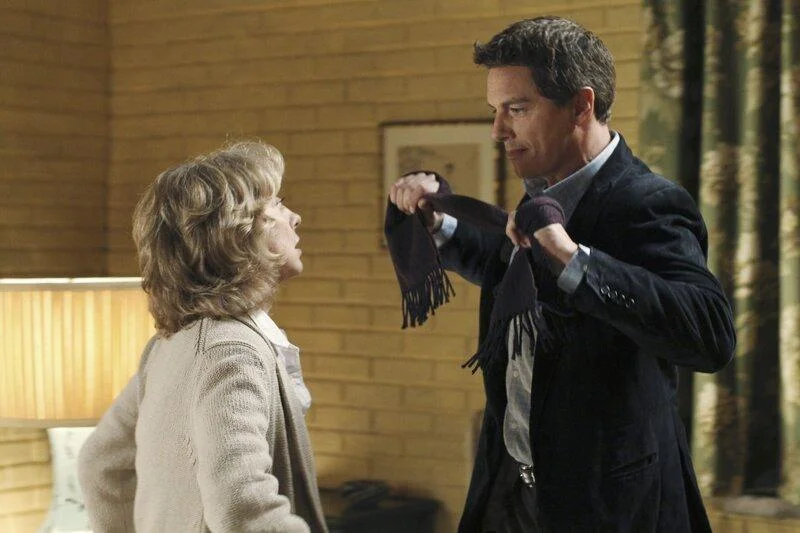
The coat was perfectly ordinary.
That was what made the moment so painful.
Mark had taken something as simple as a coat and used it to decide whether I deserved to stand beside my family.
I placed it over the back of my chair.
Claire stood beside me.
“Can I help you put it on?”
I looked at her for a moment.
“Yes.”
She helped me into the coat.
Mark remained beside the fireplace.
Nobody was taking the photograph.
I told him that he needed to leave for the evening. He argued that he was Claire’s husband and that he had every right to stay.
I explained that being married to my daughter did not give him ownership of my house.
Robert offered to walk him to the door.
Mark turned to Claire.
“You’re coming with me.”
Claire shook her head.
“Not until we finish talking.”
That answer surprised him more than anything I had said.
He left alone.
The door closed behind him, and the dining room became quiet.
Not the uncomfortable silence from earlier.
This time, nobody was waiting for me to apologize for making someone uncomfortable.
Claire sat beside me.
“I should have stopped him.”
“Yes,” I said.
She looked down.
“I was afraid of another argument.”
“I understand that. But I was afraid of being treated like a stranger in my own home. I needed you to understand that too.”
She began crying.
I held her hand, but I didn’t tell her that everything was fine.
It wasn’t.
Trust does not return because someone cries after being confronted with evidence.
We talked for a long time. Claire admitted that Mark had been making decisions for both of them. She had become so accustomed to avoiding disagreements that she had stopped recognizing when she was allowing someone else to hurt people.
I told her that I loved her, but I would not allow that love to become permission for anyone to control me.
The following morning, I spoke with my attorney about the household arrangements and my existing estate documents. We reviewed who had access to the property and clarified that no one had authority to make decisions on my behalf.
The recordings were retained privately. I did not post them online or send them around the family. Their purpose was to establish what had happened, not to create a public spectacle.
Mark eventually sent an apology.
It was short and initially focused on how uncomfortable the evening had become.
I didn’t accept it immediately.
I told him that an apology needed to acknowledge the actual behavior, not simply the argument that followed it.
Claire began visiting without him. Sometimes she brought dinner. Sometimes we sat together and talked about ordinary things.
Rebuilding our relationship took longer than either of us expected.
I didn’t demand that she choose between her husband and her mother. I demanded that she recognize that loving someone did not mean accepting everything they did.
The next family gathering was smaller.
Robert came early and helped arrange the dining room. Claire brought flowers and placed them beside Daniel’s old photograph.
I wore my burgundy coat when I greeted everyone at the door.
Before dinner, Robert picked up the camera tripod.
“Should we take another family photograph?”
I looked around the room.
“Only if everyone wants one.”
Claire smiled.
“I do.”
This time, nobody arranged the photograph without asking me.
I stood beside my daughter, with Robert on my other side. The coat stayed on my shoulders.
The small camera above the sideboard remained exactly where it had always been.
I no longer needed it to remind me that my voice mattered.
When the photograph was taken, I didn’t look toward the person holding the camera to check whether I was included.
I already knew I belonged there.
And that, more than anything Mark had said or done, was the part I wanted to remember.
The house was still mine. My dignity was still mine. And nobody would ever again decide whether I deserved a place in my own family.
Additional article development — the family history behind the silence
The reason Evelyn had tolerated Mark’s behavior for so long was not that she lacked the courage to challenge him. It was that she had spent years trying to protect her relationship with Claire.
After Daniel died, the house became more than a building. It was the place where Claire had learned to ride a bicycle, where Daniel had repaired the kitchen cabinets and where the family had celebrated ordinary occasions that became important only after they were gone.
Evelyn had wanted Claire to feel that she could always return.
When Claire married Mark, Evelyn welcomed him into that history. She offered him a key, made room for his belongings during visits and encouraged the couple to use the house whenever they needed somewhere comfortable to gather.
Gradually, the arrangement changed.
Mark began treating invitations as obligations. He would announce that relatives were coming rather than asking whether Evelyn wanted company. He criticized the furniture, suggested replacing Daniel’s photographs and complained whenever Evelyn made a decision without consulting him.
At first, Claire explained that Mark was simply particular.
Then she began repeating his explanations.
Evelyn recognized the change but hesitated to confront it. She remembered how excited Claire had been when she announced her engagement. She remembered the wedding photographs, the speeches and the promises everyone had made.
She did not want every family gathering to become an argument about Mark.
But there was a difference between welcoming a son-in-law and surrendering control of a home.
That distinction became particularly important when Evelyn noticed that conversations about her future were happening without her participation.
Mark sometimes spoke as though her decisions were temporary inconveniences. He suggested that Claire should manage household arrangements and that Evelyn should let younger people take responsibility.
Evelyn didn’t object to help. She objected to being treated as though help required permission to take over.
The camera had originally been a practical decision, not a weapon. She had installed it because she wanted a reliable record of activity near the dining room and side entrance. Its position above the sideboard gave it a clear view of the room without changing the appearance of the home.
The recordings became useful when memories and explanations began contradicting one another.
Evelyn kept the originals. She did not edit them to make anyone look worse, and she did not circulate private footage among relatives. She wanted an accurate record, not a collection of embarrassing moments.
That distinction mattered when she spoke to her attorney.
The attorney explained that a recording could help establish what had happened, but it did not automatically decide ownership disputes or replace formal property documents. Evelyn understood. She was not expecting a camera to solve every problem.
She wanted her decisions to remain her own.
The Thanksgiving incident finally made that boundary impossible to ignore.
The photograph was supposed to represent a family. Instead, Mark had used it to demonstrate who he believed had the right to decide who belonged.
Evelyn’s response was not about winning an argument.
It was about refusing to let another person rewrite what had happened in her own home.
The conversation that changed Claire’s understanding
After Mark left, Claire remained at the dining table.
She stared at the empty place where the recording device had been.
“Why didn’t you tell me you had footage of him before?”
Evelyn folded her hands.
“Because I wanted you to make your own decisions.”
“But you knew he was behaving like this.”
“I knew some things. I suspected others. I didn’t want to accuse him without knowing what I was talking about.”
Claire looked toward the fireplace.
“I thought you didn’t like him because you wanted everything to stay the way it was when Dad was alive.”
Evelyn shook her head.
“I don’t need everything to stay the same. I need people to understand that change doesn’t mean I stop having a say.”
Claire began describing arguments she had previously dismissed as ordinary marital disagreements. Mark had complained about Evelyn’s belongings, criticized the way she organized the house and suggested that family visits would be easier if Claire handled the invitations.
She had believed she was keeping everyone happy by avoiding confrontation.
Now she understood that her silence had made the situation easier for Mark and lonelier for her mother.
“I should have said something when he took your coat,” Claire whispered.
“Yes,” Evelyn replied. “You should have.”
It was not the answer Claire wanted, but it was the honest one.
They spent the rest of the evening talking about boundaries. Evelyn made it clear that Claire would always be welcome, but Mark could not use her daughter’s relationship as a reason to control the household.
Claire did not promise that everything would change immediately.
She promised to stop pretending that nothing was wrong.
That was a beginning.
More stories you may like