Mara looked at the figures. “He could have told us the expansion failed.”
“He thought we’d say no,” Nora replied.
Ruth closed the folder. “We would have said no to selling our building without a proper discussion. That is not the same thing as abandoning him.”
The investigation continued beyond those first days. Police and financial investigators obtained additional records through appropriate processes. The family did not know in advance whether charges would follow, and the attorney cautioned them against confusing a compelling paper trail with a completed prosecution. But the immediate danger was contained: no sale closed, and Ruth secured the accounts and permissions that Ethan had been using.
Ethan left Nora six voicemails in two days. The first accused her of ruining him. The second said he was sorry she had become upset. In the third he admitted he’d grabbed her but insisted the sleeve was already weak. By the sixth, he was crying and asking to come home.
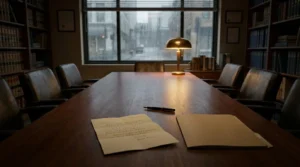
Nora listened to the messages once and saved them. She had spent too long translating his excuses into apologies he had not actually made. When he asked to meet, she chose a public conference room at her attorney’s office and brought a support person. She had decided to separate, and she wanted a clear discussion of belongings, housing, and contact—not a conversation in which her memory could be argued away.
Ethan came without his blazer. He looked exhausted. “I never meant to hurt you,” he said.
“You grabbed me because you wanted the agreement.”
“I panicked.”
“You told your family I was unstable. You did that before anyone had read a word.”
He pressed his palms together. “I thought if I got through Friday, I could pay everyone back. Then I would tell them.”
“You were going to tell your mother after her building was sold?”
He looked at the table. “I thought I was saving the bakery.”
“No,” Nora said. “You were trying to save yourself from telling the truth. You made the rest of us pay for that.”
Ethan asked if they could try counseling as a couple. Nora told him she would not commit to reconciliation. She had arranged individual support and had people she trusted around her. His distress was real, but it did not require her to return to a relationship in which he had frightened and discredited her.
“Was any of it real?” he asked, meaning their marriage.
“Yes,” she said. “That’s why this hurts.”
She left before he could turn her answer into another promise.
For the next several weeks, Bennett Family Bakery opened at six as it always had. Mara took over the books with an independent accountant. Ruth returned to greeting customers when her surgeon cleared her for light duties, though she still needed help lifting mixing bowls. Some neighbors asked awkward questions after the attempted sale became known. Ruth answered only what she could verify: the sale had been unauthorized, it had been stopped, and the family was cooperating with the investigation.
She refused to describe Nora as confused or hysterical, even when old friends hinted that family matters should stay private. “Nora brought me a document,” Ruth said once, setting change on the counter. “I read it. That’s how we protected the shop.”
Nora stayed with her friend for a while and began looking for a small apartment of her own. She also took her dress to a tailor. The woman examined the torn left shoulder seam and said she could make it nearly invisible.
Nora thought about that word. Invisible was what she had tried to make every earlier hurt: the dinner parties where Ethan joked about her grief, the arguments she rewrote in her head to make his anger seem reasonable, the silence that followed each time she asked a question he didn’t like.
“Could you mend it with a visible seam?” she asked. “Something strong, not decorative.”
The tailor suggested a narrow line of matching teal thread reinforced from the inside. Nora agreed. She did not want the dress destroyed, and she did not need anyone to pretend the tear had never happened.
Months passed. The legal case moved in uneven stages, with documents requested, witnesses interviewed, and decisions made by people outside the family. Ethan resigned from his financial role at the bakery. His creditors pursued the obligations of his separate business. The family building remained Ruth’s, and the bakery kept serving the neighborhood that had supported it for decades.
One Sunday, Ruth invited Nora to help decorate the bakery’s front window for its thirty-second anniversary. Mara had ordered paper flowers, and customers had contributed photographs from the bakery’s earliest years. Ruth chose an old picture of Jonah painting the blue letters by hand. Nora set it in the center of the display.
“Your mother made a beautiful dress,” Ruth said when she saw Nora wearing the repaired teal satin.
“She did.” Nora smoothed the strengthened shoulder seam. “I had it fixed.”
Ruth smiled, but her eyes filled. “I’m sorry my son treated you that way.”
“You didn’t do it.”
“I know. But I watched him make himself the person everyone had to believe. I should have challenged it sooner.”
Nora looked through the window at a little girl pointing to the trays of cinnamon rolls. “You believed me when it mattered,” she said. “And afterward, you kept believing me.”
Ruth reached for her hand with her uninjured right one. This time Nora took it.
At closing, Mara switched off the display lights. Through the glass, the old blue lettering shone against the evening street. Ruth locked the door and handed Nora one of the small anniversary cookies shaped like a house.
“You know,” Ruth said, “Jonah always said a good bakery needs two things: a foundation that doesn’t move and people who tell you when the oven’s too hot.”
Nora laughed for the first time that day. “That sounds like him.”
She walked toward her car with the cookie in one hand and her coat in the other. The dress moved easily over her shoulder. The seam held. Behind her, the bakery remained where it belonged—not because no one had tried to take it, but because the people who loved it had finally refused to ignore what was right in front of them.
And Nora no longer needed to persuade someone who hurt her that she knew what had happened. She knew. That was enough to begin again.