
Most balcony herb garden advice treats every balcony like a generic sunny rectangle. The result is predictable: gardeners buy basil and cilantro because a listicle said so, then watch one bolt and the other wilt. The real decision is not which herbs look pretty together. It is whether your balcony acts like a wind tunnel, a heat trap, or a light-starved corridor. Until you read those three conditions, you are shopping blind.
This guide covers 12 herb-growing approaches ranked by how well they solve specific microclimate problems: wind shear, reflected heat, shade patterns, and container-driven root stress. We exclude indoor-only hydroponic cabinets, full-scale rooftop raised beds, and ornamental-only plantings. Everything here is designed for a container on a railing, wall, or floor of a balcony that faces real outdoor conditions.
By the end, you will know which two herbs to start with based on your wind exposure, which container material actually matters for your sun hours, and where a hanging planter beats a railing planter (and where it fails). You will also know when the correct answer is to not grow herbs at all and choose an alternative that actually thrives.
Bottom line: Match the herb to the microclimate first, the container second, and the aesthetic third.
The Yield Grid Decision Grid
Choose the branch that matches your balcony’s dominant condition. If two conditions compete, default to the harder constraint (wind beats shade; reflected heat beats wind).
Branch 1: Sheltered and Sunny (6+ hours direct sun, wind below 12 mph typical)
Your main limit is container size and watering discipline, not light. Mediterranean woody perennials (rosemary, thyme, oregano, sage) thrive here. Fast-growing annuals (basil, cilantro) will also produce heavily but demand more frequent watering. Recommended: Items 1, 4, 7, 10 below.
Branch 2: Wind-Prone or Partially Shaded (4–6 hours sun, or frequent gusts above 15 mph)
Wind strips moisture from leaves faster than roots can replace it. Choose low-profile, small-leaf herbs that hug the soil or tolerate desiccation. Dense, woody-stemmed varieties outperform broad-leaf types. Recommended: Items 2, 5, 8, 11 below.
Branch 3: Deep Shade or Heat-Trap (under 4 hours direct sun, or south-facing concrete alcove with reflected afternoon heat)
Photosynthesis is the bottleneck in shade; heat stress is the bottleneck in a heat trap. Pick herbs that evolved as forest understory plants (shade) or that enter summer dormancy (heat). Recommended: Items 3, 6, 9, 12 below.
For a deeper dive on plants that handle unobstructed southern exposure, see our full sun balcony plants guide.
Quick Comparison Table
| Option | Key Mechanism | Best For | Decision Grid Branch | Effort Score (1–5) |
|---|---|---|---|---|
| 1. Rail-Mounted Rosemary Hedge | Dense woody growth deflects wind; deep roots tolerate container dry-down | Sunny, windy railings | Branch 1 or 2 | 1 |
| 2. Creeping Thyme Floor Mat | Ground-hugging habit escapes wind shear; tiny leaves reduce transpiration | Windy, exposed floors | Branch 2 | 1 |
| 3. Mint Confinement Bucket | Rhizome containment prevents escape; thrives in damp, shaded corners | Shady, moist spots | Branch 3 | 3 |
| 4. Self-Watering Basil Tower | Reservoir base buffers midday drought; vertical stacking saves floor space | Sunny, space-constrained | Branch 1 | 3 |
| 5. Chive Border Screen | Upright, hollow leaves shed wind; clumping habit resists blow-over | Wind-buffeted railings | Branch 2 | 2 |
| 6. Shade-Tolerant Parsley Bowl | Flat, broad leaves capture low-angle light efficiently | North-facing, low light | Branch 3 | 3 |
| 7. Hanging Oregano Cascade | Trailing habit keeps foliage off hot decking; air pruning prevents root binding | Heat-trap balconies | Branch 1 or 3 | 2 |
| 8. Sage Windbreak Strip | Pubescent leaves reduce evaporative loss; stiff stems resist flattening | Wind-exposed railings | Branch 2 | 1 |
| 9. Lemon Balm Cool-Spot Container | Mint-family vigor tolerates low light; lemony scent deters shade-favoring pests | Cool, shaded corners | Branch 3 | 2 |
| 10. Cilantro Succession Rig | Two-week sowing intervals outrun bolting; shallow roots suit rail planters | Sunny, short-season | Branch 1 | 4 |
| 11. Tarragon Dry-Zone Pot | French tarragon requires dry soil; wind accelerates drainage exactly as needed | Dry, windy spots | Branch 2 | 2 |
| 12. Chervil Under-Grow-Light Shelf | Supplementary LED compensates for deep shade; cool-season annual avoids heat stress | Extreme shade, cool microclimates | Branch 3 | 4 |
1. Rail-Mounted Rosemary Hedge
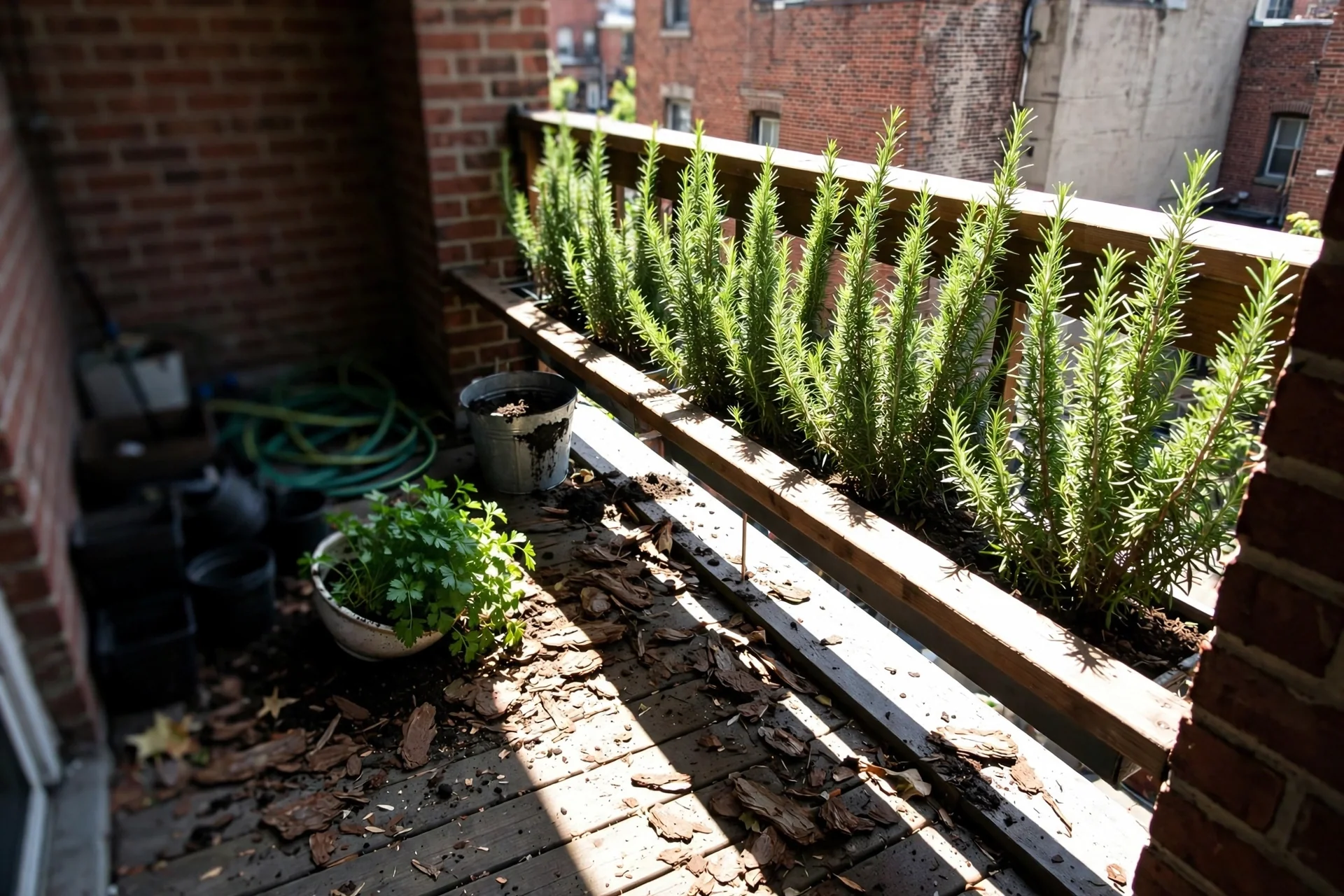
Best for: Branch 1 or 2
What it is: A continuous row of upright rosemary cultivars (‘Tuscan Blue’ or ‘Arp’) planted in a single long railing planter (minimum 12 inches deep, 30 inches long). What it does: The stiff, needle-like foliage creates a low windbreak that protects more delicate herbs placed behind it while producing harvestable leaves year-round in USDA zones 8–10. Steps: (1) Choose a planter with drainage holes spaced every 6 inches. (2) Fill with a mix of 60% coconut coir and 40% coarse sand (pH 6.0–7.0). (3) Plant rosemary starts 10 inches apart; crowding triggers fungal issues in humid climates. (4) Water only when the top 2 inches of soil are bone-dry; rosemary roots sitting in moisture below 10°C (50°F) develop root rot within 10–14 days. Common mistake: Treating rosemary like basil by watering on a schedule. Rosemary signals water need by losing leaf turgor, not by drooping.
For vertical-growing strategies that complement this setup, read our balcony hanging planters guide.
2. Creeping Thyme Floor Mat
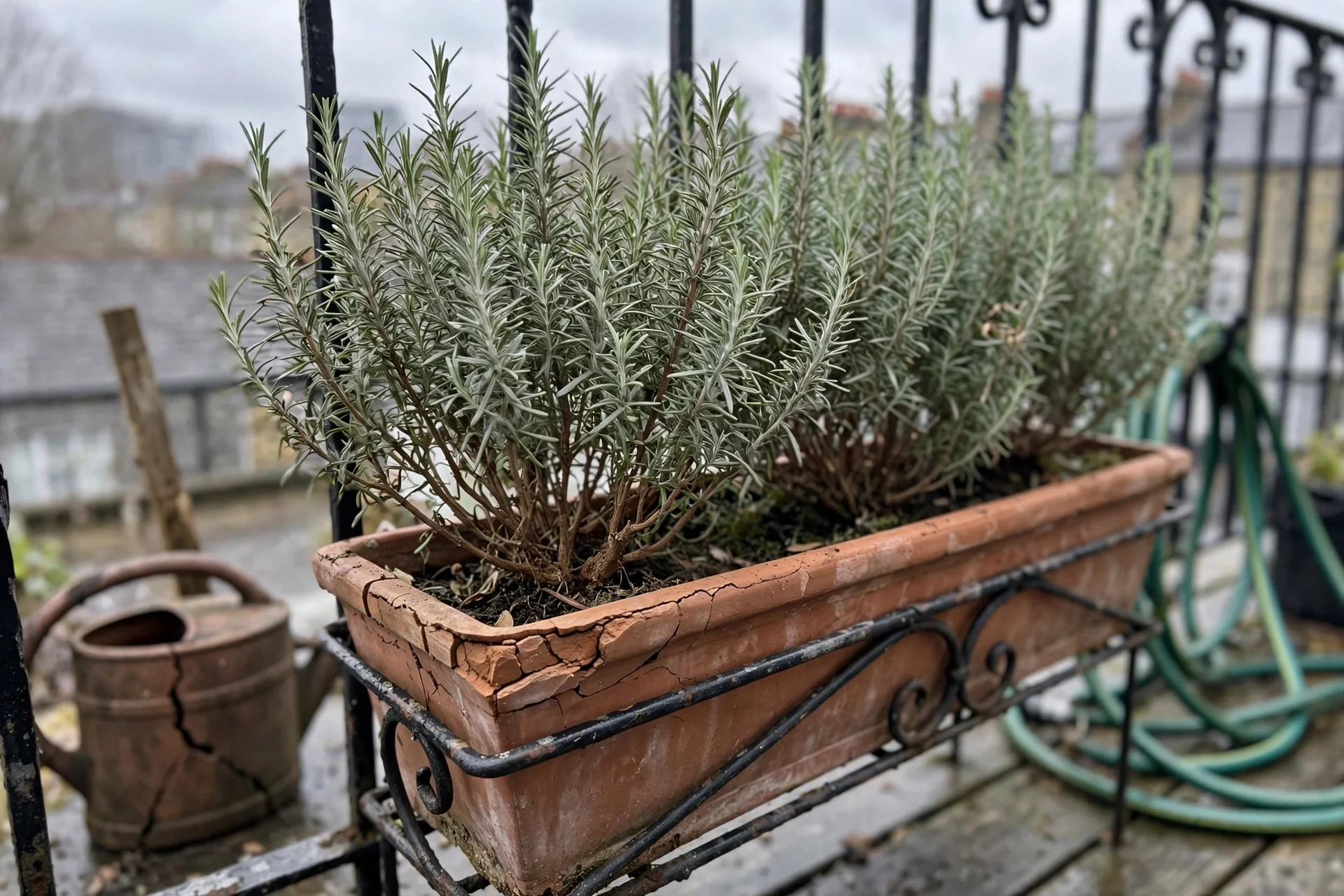
Best for: Branch 2
Creeping thyme (Thymus serpyllum) grows 1–3 inches tall and spreads into a dense mat, making it nearly immune to wind damage. Plant in a shallow tray (4–6 inches deep) filled with gritty mix; water only after the surface crusts over. The mat stays harvestable down to -20°C (-4°F). One tray supplies enough thyme for a household of two. The edge case: creeping thyme flowers attract bees aggressively in late spring; position the tray away from doorways if anyone in the household has a venom allergy.
3. Mint Confinement Bucket
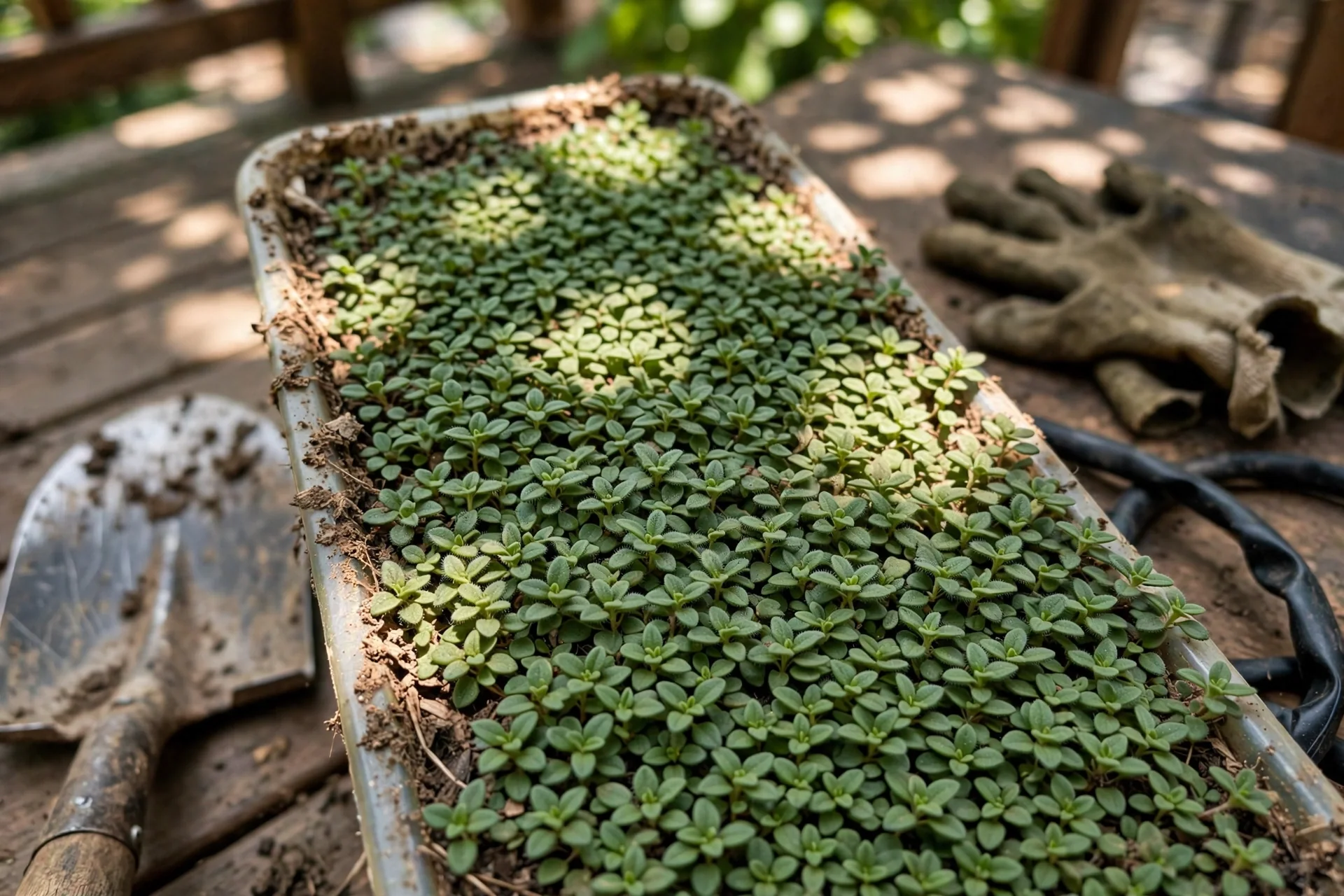
Best for: Branch 3
Mint’s rhizomes travel horizontally and will colonize every container they touch. The solution is a dedicated 5-gallon bucket with no drainage holes in the bottom 4 inches to create an underground barrier; drill holes at the 5-inch mark instead. This keeps roots suspended above the water table. Mint thrives in 3–4 hours of dappled sun where other herbs fail. The edge case: spearmint tolerates damp soil, but peppermint in the same setup develops rust fungus above 70% ambient humidity unless airflow across the leaves exceeds 2 mph. Use a small clip-on fan in still, humid corners.
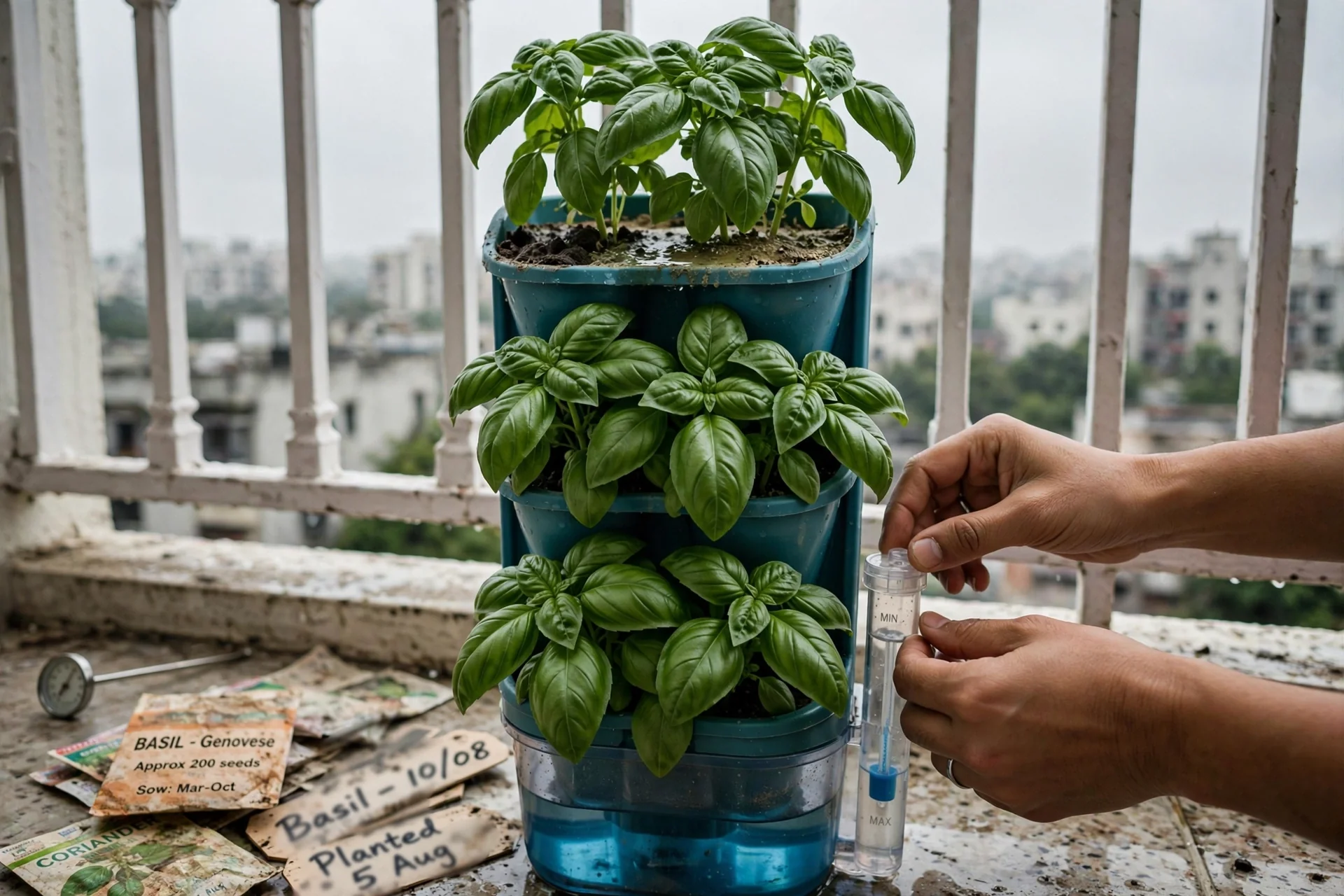
4. Self-Watering Basil Tower
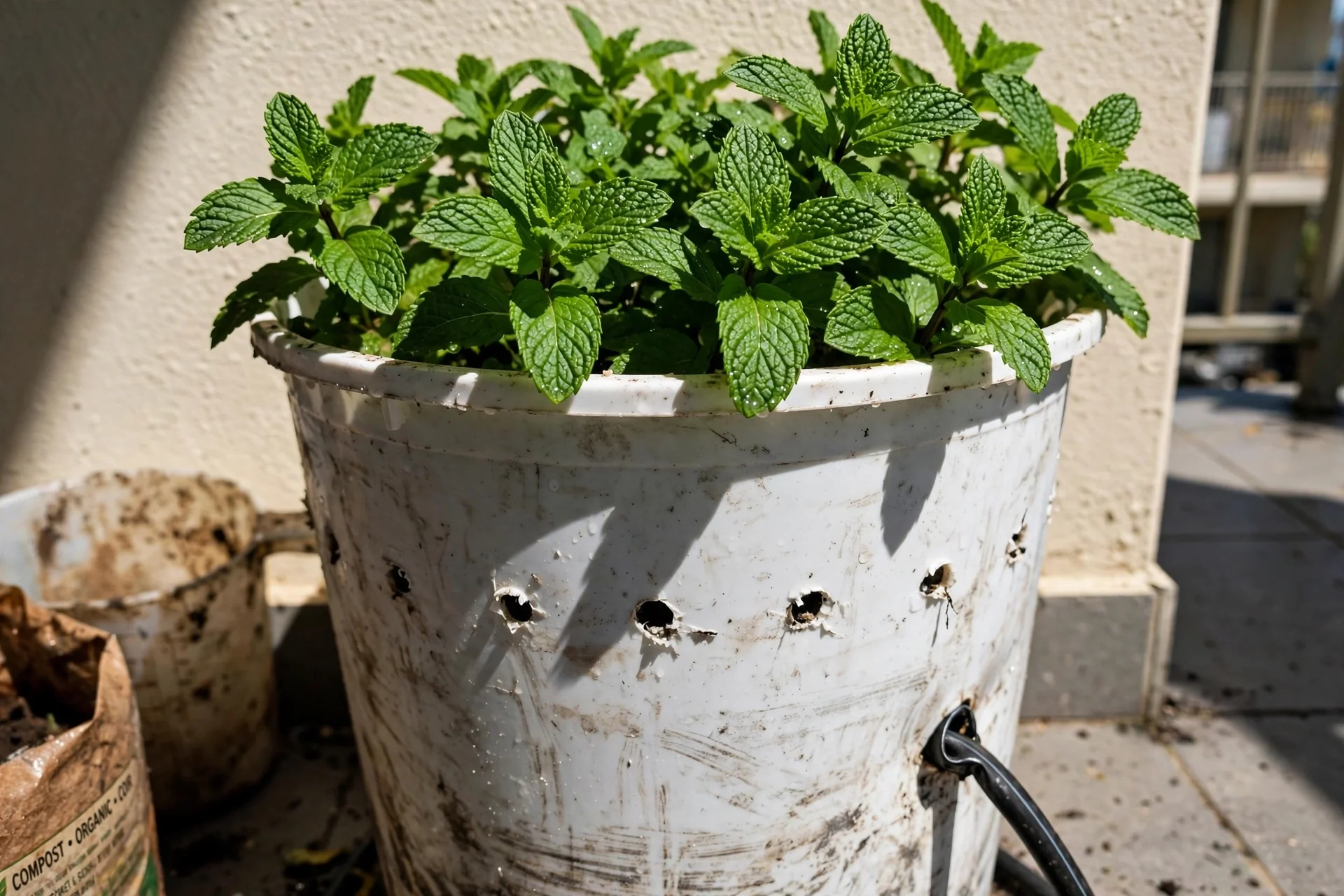
Best for: Branch 1
Use: A stackable, self-watering planter with a 2.5-gallon reservoir supplies basil with consistent moisture across 3–4 planting pockets. Basil wilted from dry-down rarely recovers full leaf turgor; a reservoir eliminates that failure mode. Skip if: Your balcony receives fewer than 6 hours of direct sun; basil grown in sub-6-hour light produces leggy stems and leaves with diminished essential oil content. Edge case: In temperatures above 35°C (95°F), the reservoir may warm enough to encourage pythium root rot; insulate the reservoir compartment with a reflective sleeve or move the tower into afternoon shade.
If your balcony light is marginal for sun-loving herbs, check our balcony lighting ideas for supplementary options.
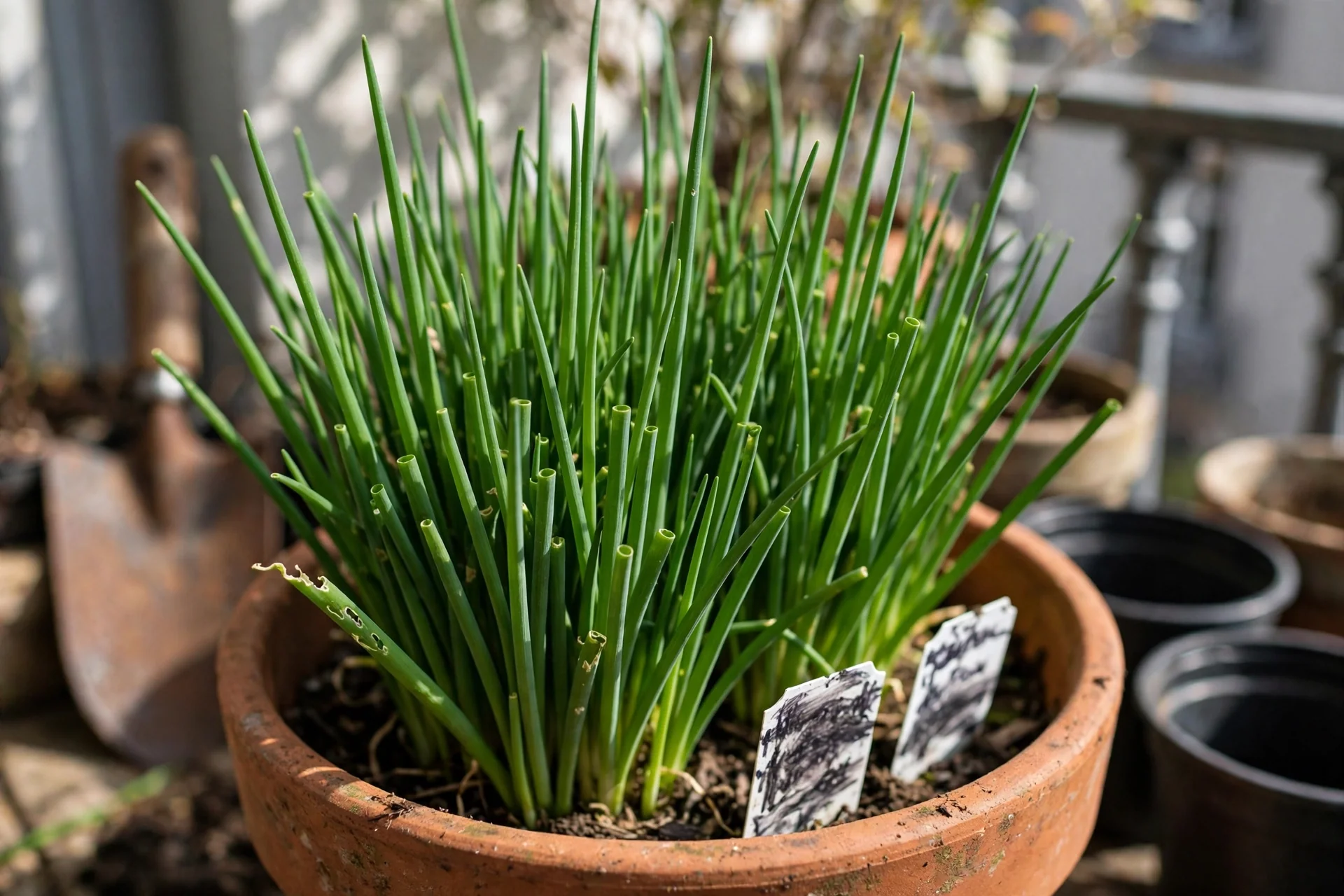
5. Chive Border Screen
Best for: Branch 2
Chives (Allium schoenoprasum) grow upright in dense clumps with hollow, cylindrical leaves that wind passes through without snapping. Plant 5–7 bulbs per 8-inch pot and position them as a front-row buffer on a windy railing. Harvest by cutting 2 inches above soil level to avoid damaging the basal plate. Chives survive winter dormancy down to -35°C (-31°F) and re-emerge in spring when soil temperatures reach 4°C (39°F). The constraint: chive flowers produce viable seed that colonizes nearby pots; deadhead before seed heads open if containment matters.
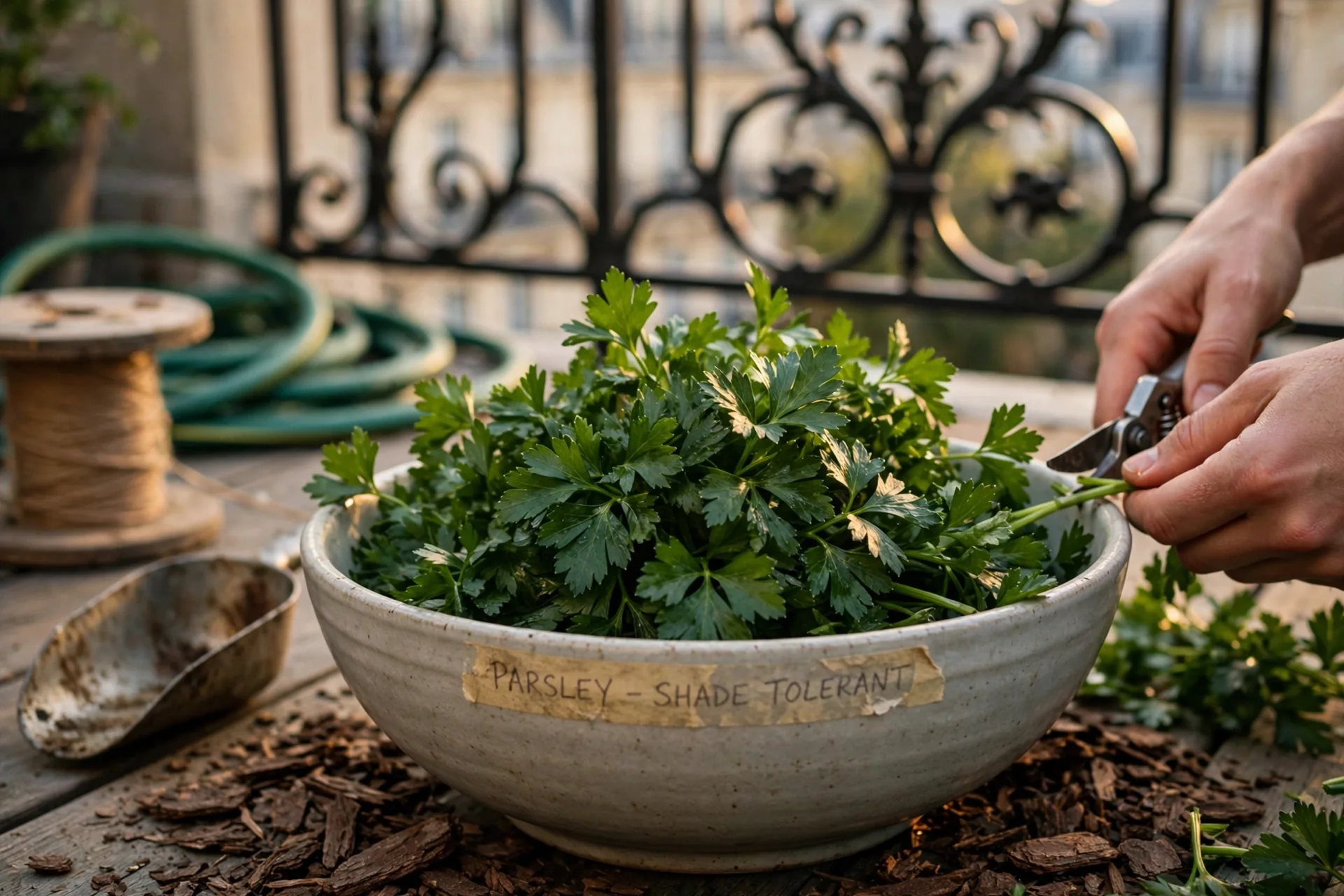
6. Shade-Tolerant Parsley Bowl
Best for: Branch 3
A wide, shallow bowl (14–16 inches diameter, 8 inches deep) planted with flat-leaf Italian parsley makes efficient use of low-angle light. Parsley’s rosette growth form captures morning and late-afternoon rays that taller herbs miss. Soil temperature range for germination is 10–30°C (50–86°F), but established plants tolerate light frost down to -4°C (25°F). The mechanism: parsley is a biennial; it focuses on leaf production in year one and bolts in year two. Plan to replace plants each spring for continuous harvest.
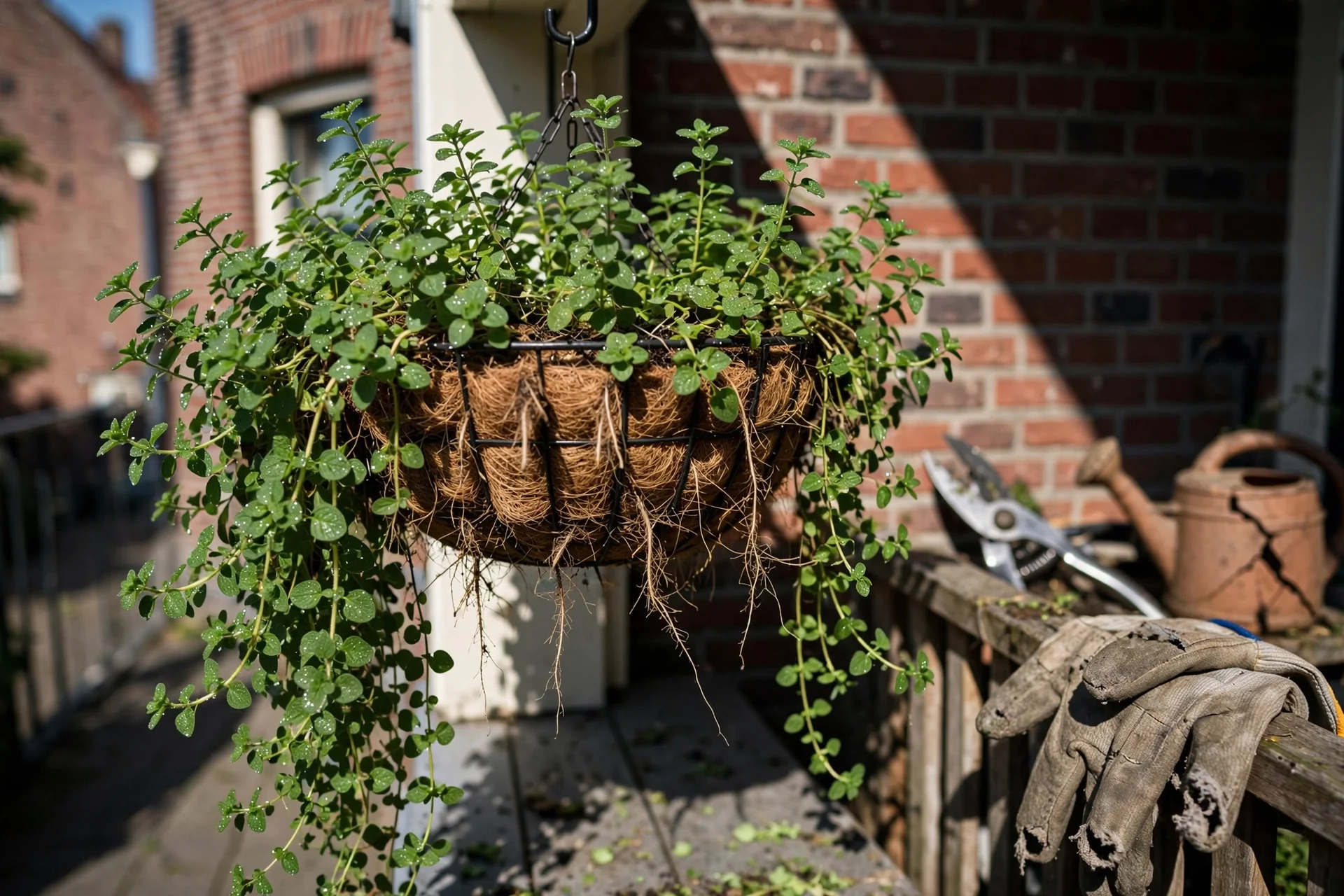
7. Hanging Oregano Cascade
Best for: Branch 1 or 3
Threshold rule: Oregano grown in a hanging basket with a diameter of at least 12 inches survives reflected balcony heat that would kill basil in a railing planter. The suspended position keeps roots 18–24 inches above heat-radiating decking; air circulation around the entire root ball prevents soil temperatures from exceeding 32°C (90°F), the point where oregano root function declines. Adjustment: In climates where ambient humidity stays above 65% for more than 72 consecutive hours, switch from a plastic hanging pot to a breathable coir-lined wire basket to reduce fungal pressure on the crown.
For balcony layouts that integrate hanging elements with privacy screening, see our privacy plants for balcony guide.
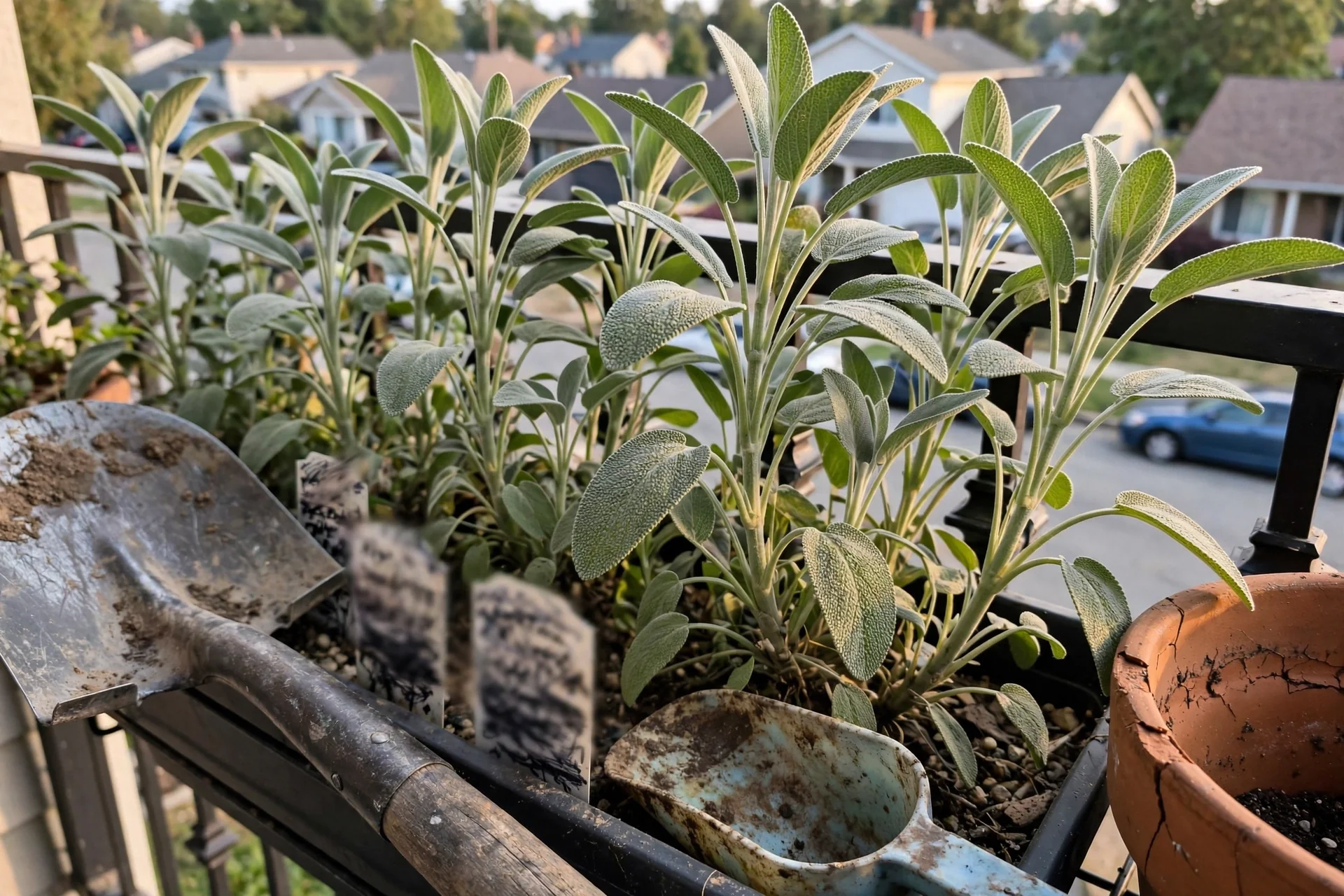
8. Sage Windbreak Strip
Best for: Branch 2
Common sage (Salvia officinalis) tolerates wind speeds up to 25 mph without leaf tearing because its pubescent (fuzzy) leaf surface traps a boundary layer of still air. Plant in a railing planter with a minimum depth of 10 inches; space plants 12 inches apart. Prune by one-third after flowering to maintain compact, wind-resistant form. Sage’s drought tolerance means it can go 7–10 days between waterings even in windy conditions.
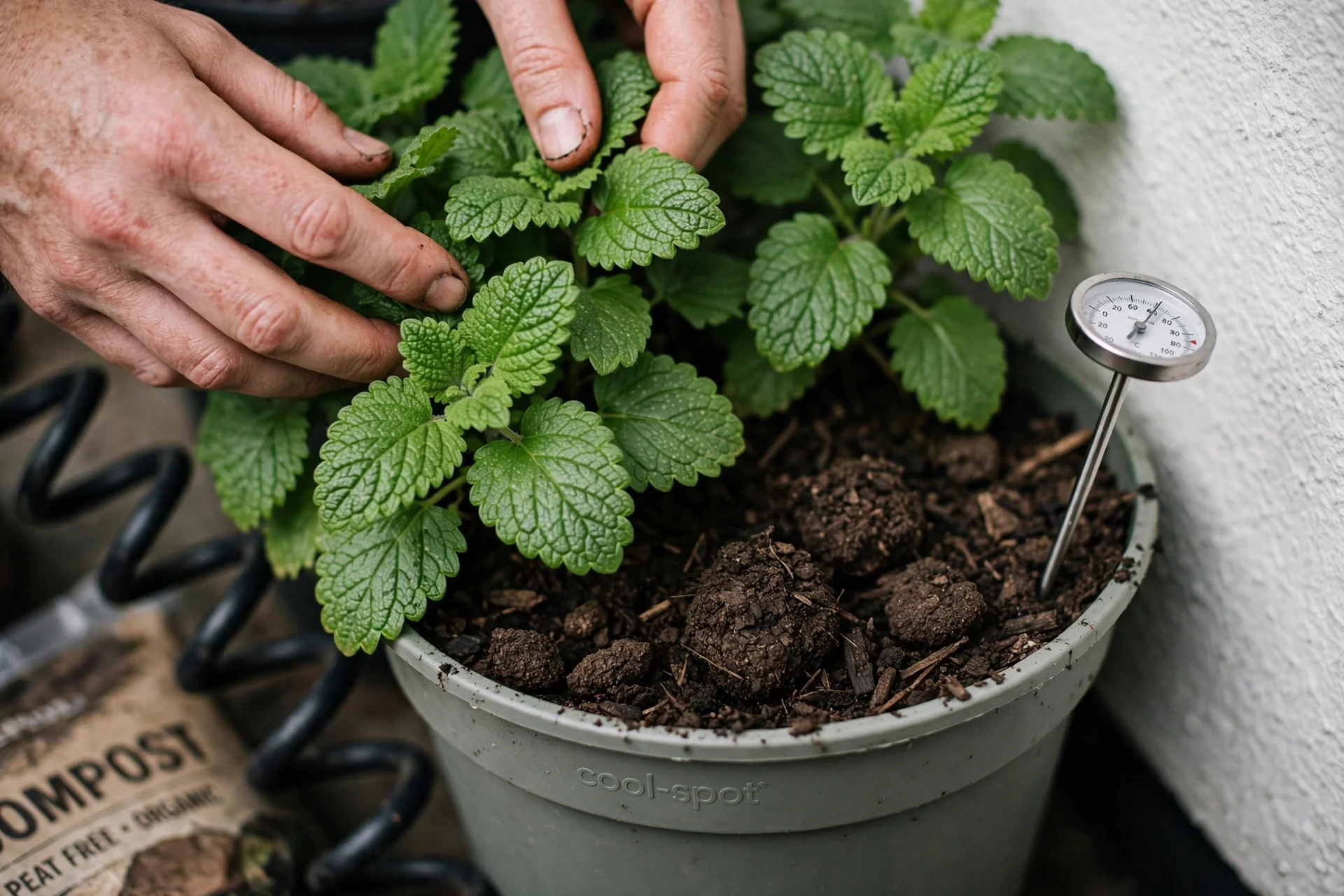
9. Lemon Balm Cool-Spot Container
Best for: Branch 3
Lemon balm (Melissa officinalis) performs in 3–4 hours of indirect light because it evolved as a forest-edge species. Its vigorous growth in shade is both its strength and its liability: an 8-inch pot will fully root-fill within one growing season, at which point growth stalls. Repot into a container one size larger each spring, or divide the root mass and replant the healthiest third. The lemony scent, while pleasant, attracts whitefly in enclosed balcony corners; yellow sticky traps placed 6 inches above the canopy catch the first wave before populations build.
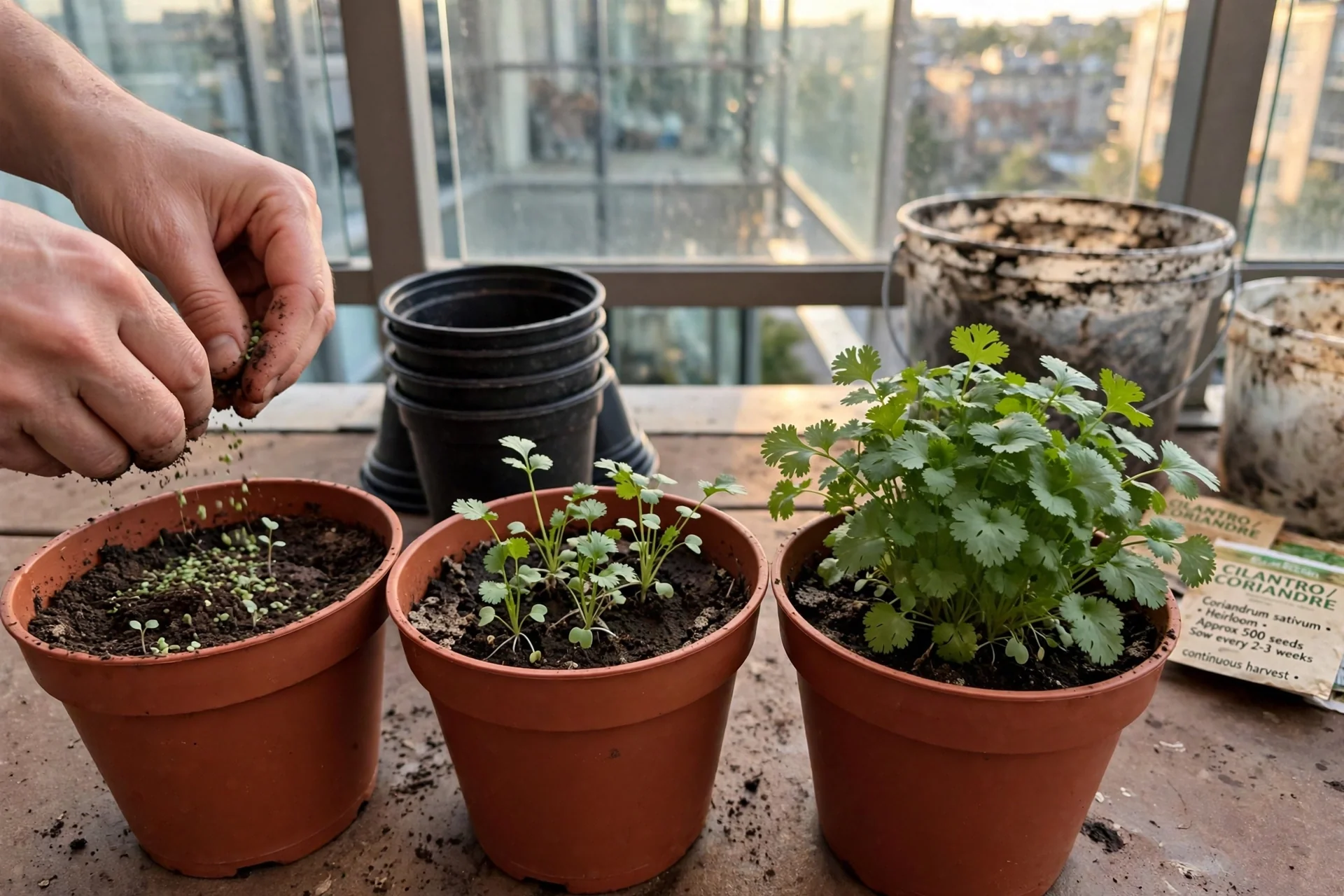
10. Cilantro Succession Rig
Best for: Branch 1
10-minute workflow: (1) Fill three identical 6-inch pots with the same seed-starting mix. (2) Sow cilantro seed 0.5 inches deep at a density of 12–15 seeds per pot. (3) Label pots with sowing date. (4) Start pot 1 now, pot 2 in 14 days, pot 3 in 28 days. (5) Harvest entire pot when plants reach 6 inches tall; immediately reseed that pot. Upgrade option: Use a shallow railing planter divided into three compartments with removable dividers. This lets you slide out a spent section and refill without disturbing adjacent plantings. The constraint: cilantro bolts when soil temperature exceeds 24°C (75°F); in south-facing setups, expect the succession rhythm to compress to 10-day intervals during peak summer.
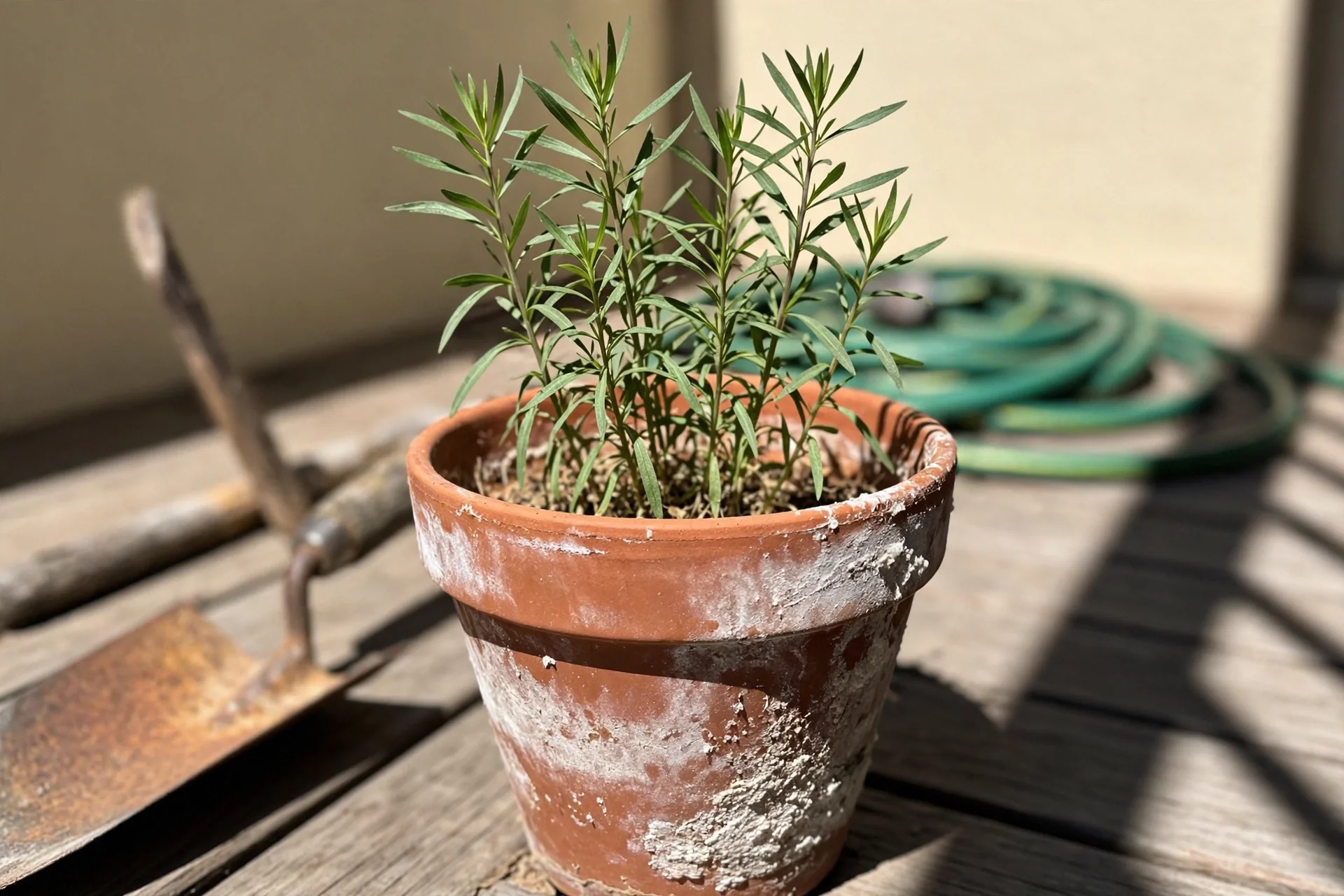
11. Tarragon Dry-Zone Pot
Best for: Branch 2
French tarragon (Artemisia dracunculus var. sativa) demands soil that drains freely and dries between waterings, conditions that wind naturally accelerates. Use a terracotta pot (unsealed) to wick moisture outward through the walls; pair with a mix of 50% potting soil and 50% perlite. Never fertilize with high-nitrogen feeds; excess nitrogen produces tall, flavorless growth that wind flattens. Tarragon goes dormant below 5°C (41°F) and resprouts when temperatures stabilize above 10°C (50°F).
12. Chervil Under-Grow-Light Shelf
Best for: Branch 3
Chervil (Anthriscus cerefolium) is a cool-season annual that bolts in heat and refuses to grow in deep shade without supplementary light. For a north-facing balcony receiving under 3 hours of direct sun, install a single T5 fluorescent or LED strip (6500K color temperature, 20–25 watts) positioned 4–6 inches above the plant canopy. Run the light 14 hours per day during the growing season. Chervil germinates at soil temperatures between 12–18°C (54–64°F); above that range, germination rate drops sharply. Sow directly in the final pot; chervil transplants poorly because of its taproot. Harvest by snipping outer leaves before flowers appear; once flowering begins, leaf flavor turns bitter.
Starter Stack (What to Choose First)
Branch 1 Starter: Rosemary Hedge + Self-Watering Basil Tower
The rosemary hedge establishes a permanent windbreak and supplies a year-round kitchen staple. The basil tower plugs into the protected zone behind it, producing high-value leaves from late spring through early fall. Together, these two items cover the two hardest-working culinary herbs for a sunny, sheltered balcony. Cost range: $55–$90 USD for containers and starts. Time to first harvest: rosemary usable immediately from nursery starts; basil ready in 3–4 weeks.
Branch 2 Starter: Creeping Thyme Floor Mat + Chive Border Screen
Both plants tolerate wind without structural damage and require minimal intervention after planting. The thyme mat covers the floor zone where wind is weakest; the chive screen shields the railing edge. Synergy: chives deter aphids that occasionally target thyme in humid conditions. Cost range: $30–$50 USD. Time to first harvest: 2 weeks for chives, 4–6 weeks for thyme to establish enough coverage for harvest.
Branch 3 Starter: Mint Confinement Bucket + Shade-Tolerant Parsley Bowl
Mint and parsley occupy the same low-light, moist-soil niche but in different dimensions: mint spreads horizontally, parsley grows upward. They do not compete for root space when kept in separate containers. Cost range: $20–$35 USD. Time to first harvest: mint usable from runners within 2 weeks; parsley leaves ready for snipping at 8–10 weeks from seed or immediately from nursery starts.
When This Won’t Work
Failure condition 1: Wind speeds routinely exceed 30 mph. At this threshold, even rosemary and sage suffer mechanical damage: leaf stripping, stem breakage, and desiccation that no amount of watering reverses. If your balcony faces unobstructed prevailing winds above this speed, install a solid windbreak (polycarbonate panel or dense trellis with 50% porosity) before planting any herbs. Without a windbreak, the only viable option is to bring containers indoors on high-wind days.
Failure condition 2: Balcony receives under 2 hours of direct sun and no supplementary lighting is possible. At this light level, even shade-tolerant herbs (mint, parsley, chervil) produce thin, etiolated growth that attracts pests and yields negligible harvest. The alternative: switch to ornamental shade plants or install a compact LED grow shelf as described in Item 12.
For furniture layouts that complement the windbreak strategy above, see our balcony seating ideas.
Choosing the Right Option for Your Situation
Budget Threshold: Under $40 USD
Skip the self-watering systems and multi-tier towers. Focus on Items 2, 3, 5, 6, and 11: all require a single container, a bag of potting mix, and a nursery start or seed packet. Total cost per item stays between $12 and $25. The main trade-off is watering frequency; without reservoirs, expect to water every 1–3 days in summer.
Time Threshold: Under 15 Minutes per Week
Avoid cilantro succession rigs (Item 10) and grow-light shelves (Item 12), which require weekly monitoring and adjustment. Choose Items 1, 2, 8, and 11: these woody or drought-adapted herbs need watering checks once per week and harvesting on demand. Total weekly maintenance stays under 15 minutes.
Technical Constraint: Balcony Weight Limits
Large self-watering reservoirs and deep terracotta pots add significant weight. A 5-gallon bucket of wet soil weighs approximately 45 lb (20 kg). If your balcony has a posted weight limit, calculate total load before installing multiple heavy containers. Use lightweight fabric pots or plastic planters and avoid saturated reservoirs for upper-floor balconies. A typical railing planter (30 inches long) filled with damp potting mix weighs 25–35 lb; four such planters plus a seating arrangement may exceed structural limits on older buildings.
Yes/No Checklist:
Did you measure sun hours with a phone app, not by memory? Yes / No
Did you check wind speed with a handheld anemometer or weather station, not by feel? Yes / No
Did you calculate total wet-soil weight against your balcony’s posted limit? Yes / No
Did you identify one branch of the Decision Grid before buying any plants? Yes / No
Expert Q&A
Which herbs survive winter on a balcony without being brought indoors?
Woody perennials (rosemary, thyme, oregano, sage) survive in situ if their containers are insulated with bubble wrap or burlap and soil volume is at least 3 gallons. Smaller pots freeze solid in sustained temperatures below -5°C (23°F), killing roots. Move small pots against a building wall to capture radiant heat.
Can I grow herbs from kitchen scraps on a balcony?
Soft-stem herbs (basil, mint, lemon balm) root from cuttings placed in water for 7–14 days, provided you take 4-inch stem sections below a node. Woody herbs (rosemary, thyme) root more reliably from semi-hardwood cuttings treated with rooting hormone. Regrowing from grocery store clippings works for green onions and celery bases, but those are vegetables, not herbs.
Why do my balcony herbs taste bland compared to store-bought ones?
Essential oil production in herbs is a stress response to intense light, modest water, and lean soil. Overwatering and overfertilizing produce fast, watery growth with diluted flavor compounds. Reduce watering frequency, stop nitrogen-heavy feeding, and ensure your sunniest spot actually delivers 6+ hours of direct light.
What is the single most common balcony herb garden mistake?
Combining herbs with incompatible watering needs in one container. Rosemary and basil planted together guarantees one of them dies: rosemary rots with basil-level watering, or basil wilts with rosemary-level drought. Group herbs by water demand; never mix Mediterranean woody herbs with moisture-loving annuals in the same pot.
How do I stop my balcony herb containers from staining the floor?
Use pot feet or a drainage tray with a raised grid that keeps the pot base above collected water. Terracotta pots without feet leave permanent mineral rings on concrete and wood decking. For railing planters, ensure weep holes point outward over the railing edge, not backward against the wall.
Conclusion
The single decision that determines balcony herb garden success is matching each plant to the microclimate a specific balcony position creates. Get wind exposure and sun hours right, and the container choice almost handles itself. Get them wrong, and no amount of fertilizer or fancy planters will compensate.
The most common mistake is proceeding without measuring. Use a phone app to log sun hours over one full day, check typical wind speeds for your floor height, and then return to the Decision Grid above. For additional container strategies that pair well with wind-tolerant herb setups, review our balcony hanging planters guide for specific mounting and drainage solutions.