
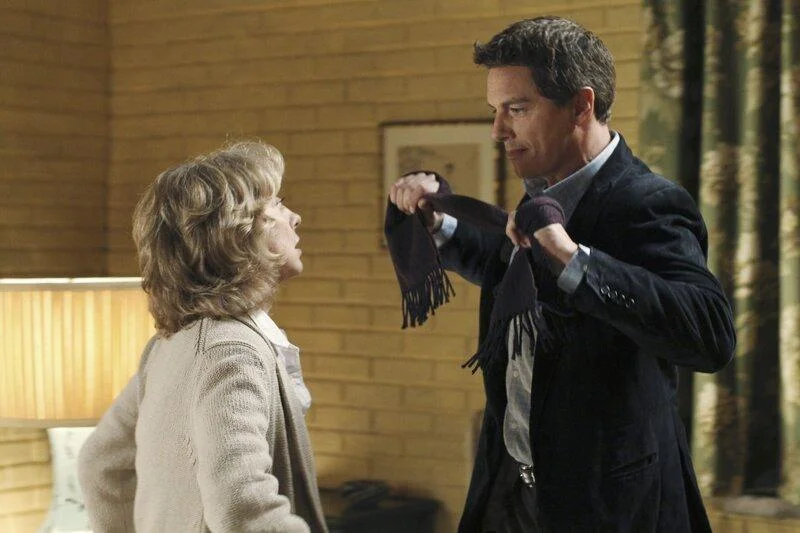
The burgundy coat was still in Mark’s hands when I realized he intended to make the humiliation permanent.
“It’s 6:15. You’re not in the family picture.”
He pulled it away from my shoulders and carried it toward the open doorway. Behind him, my daughter Claire stood beside the dining-room table, holding a folded napkin. She looked at the floor.
I reached for my coat.
“This is my house, Mark.”
He didn’t turn around.
“Then stop embarrassing everyone.”
I watched him disappear into the garden shed. A moment later, I heard the metal hook rattle as he threw my coat over it.
Nobody laughed.
That was almost worse.
My name is Evelyn Carter. I have lived in this house long enough to recognize the sound of every door, every floorboard and every familiar voice. The wooden sideboard in the dining room belonged to my late husband, Daniel. The family photographs above it showed birthdays, graduations, holidays and ordinary afternoons that had somehow become precious.
I had prepared the Thanksgiving meal because I wanted everyone together.
I had cleaned the dining room, arranged the flowers and made sure there was enough space for the family photograph. Robert, my brother, had brought a pie. Claire had arrived with Mark, carrying a bottle of wine and a smile that disappeared whenever her husband spoke.
The photograph had been Mark’s idea.
He wanted everyone standing together in front of the dining-room fireplace. He had positioned the tripod and asked people to move closer.
I had been standing beside the sideboard when he noticed my coat.
It was cold outside, and I had worn it earlier while bringing food from the car. I had taken it off because the dining room was warm.
Mark picked it up as though he were doing me a favor.
Then he decided I did not belong in the picture.
I could still hear the relatives shifting their feet. Someone cleared a throat. A chair scraped the floor.
Robert came toward the doorway.
“Mark, what exactly are you doing?”
Mark returned from the shed without the coat.
“Taking care of something that doesn’t belong in the picture.”
Robert looked at me.
“Your sister invited everyone into her home.”
“I know where I am,” Mark replied.
Claire finally spoke.
“Can we please just take the picture?”
I looked at her. I wasn’t angry that she wanted the photograph. I was hurt that she could watch her husband remove her mother’s coat and still ask everyone to smile.
“Claire, do you think I should be in it?”
Her lips parted, but Mark answered first.
“Let’s not turn this into a scene.”
There it was again. The suggestion that my response, rather than his behavior, was the problem.
I had heard that argument before.
Over the years, Mark had developed a habit of making decisions and presenting them as things everyone had already agreed upon. He rearranged furniture, invited people without asking and spoke about the house as though he had a claim to it.
When I objected, he called me sensitive.
When I stayed quiet, he called me agreeable.
Claire had learned to avoid arguments by agreeing with him.
I had spent too long confusing peace with silence.
Robert moved closer to me.
“Ev, should I get your coat?”
“No,” I said.
My voice was steady.
Mark smiled faintly, apparently satisfied that I wasn’t going to challenge him.
He returned to the fireplace and began arranging the family for the photograph.
I watched Claire move beside him.
There was a place at the end of the row where I had originally planned to stand. It was still empty.
“Everyone ready?” Mark asked.
Nobody answered immediately.
I looked above the sideboard.
A small dark camera was mounted near the corner, almost hidden by the decorative trim. It was easy to overlook unless someone knew it was there.
I knew it was there.
It had been recording for eight months.
Mark had seen it before. He simply didn’t consider it important.
The camera had been installed after several household items went missing. At first, I had wanted nothing more than a way to check the dining room when I was away. I wanted to know whether deliveries had been left inside and whether anyone had entered the house without permission.
But the camera had given me something else.
It had allowed me to stop arguing about things people insisted had never happened.
I had watched Mark move a family photograph and later deny touching it. I had heard him speak about my belongings as though they were obstacles to his plans. I had seen Claire hesitate before following his instructions.
I had not confronted them with every recording.
I had kept the footage.
Now, standing in my own dining room without my coat, I understood that Mark had made a serious mistake.
He thought I was embarrassed enough to retreat.
He thought everyone would remember the photograph and forget how it had been arranged.
He thought I had nothing.
I walked toward the sideboard.
“Mom?” Claire asked.
I didn’t answer.
My fingers reached toward the small recording system.
Mark noticed.
“What are you doing?”
I turned toward him.
“You forgot the camera that’s been recording for eight months.”
His smile disappeared.
For the first time that evening, he looked uncertain.
I opened the small cabinet beneath the sideboard and removed the black recording-storage device.
Robert stepped closer.
Claire put down the napkin.
Mark looked from the device to me.
“What is that?”
I carried it to the dining table and placed it between the serving dishes.
“Before another picture, everyone should hear what you said, right now.”
Mark didn’t move.
And for the first time that evening, nobody asked me to smile.
Movement Two — The Recording He Thought Didn’t Exist
Mark looked at the device as though it might suddenly become something harmless if he refused to acknowledge it.
“You’re making a ridiculous mistake,” he said.
I pulled out a chair.
“Then you won’t mind listening.”
Claire moved closer.
“Mom, what is happening?”
“Something I should have addressed earlier.”
Robert stood beside the table, his hands resting on the back of a chair. He had stopped looking at Mark and was watching me.
I connected the recording device to the small display I kept inside the sideboard cabinet. The screen illuminated.
Mark took a step forward.
“That’s private.”
I looked at him.
“Then why did you say it in my dining room?”
He opened his mouth and closed it again.
The recording system had saved the day’s footage automatically. I selected the section from the photograph.
At first, the screen showed the dining room from above. The camera captured the fireplace, the sideboard and the family members arranging themselves.
Then Mark entered the frame.
He was holding my coat.
His voice came through the speakers.
“She doesn’t need to be in this picture. It makes the whole thing look like we’re still living under her rules.”
Claire’s face changed.
Mark reached toward the display.
“Turn that off.”