
Nathan spent months laughing off his fiancée’s digs, until he read what she said when he wasn’t around. What he did next wasn’t loud, but she never forgot it.
For months, Nathan’s fiancée belittled him in front of family and coworkers, the kind of slow emotional manipulation that’s easy to explain away as “just joking.” When he finally saw what she said about him behind his back, he skipped the shouting match, and what he did instead is why this story is still going around.
“More of a Dreamer Than a Doer”
Nathan is 31, and until a few months ago he thought he was close to the life he’d always wanted. He had a steady job, a small circle of close friends, and a fiancée named Clara who looked, from the outside, like the other half of a picture-perfect couple. There were engagement photos all over social media, weekend trips, and family dinners where she sat at his parents’ table like she’d always belonged there. Behind closed doors he kept noticing small cracks that nobody else seemed to see: a sharp comment here, an eye roll there, a dig she would laugh off as a joke.
The first one he couldn’t brush aside came at a family gathering. His younger brother had just bought his first home, and everyone was clinking glasses and making speeches. When Nathan’s turn came, Clara got there first, leaning across the table with a smirk. “Don’t worry, Nathan will get there someday,” she said. “He’s more of a dreamer than a doer.” The room chuckled politely, and his mother’s eyes flicked toward him with something that looked a lot like pity.
Later that night he asked why she’d said it. She shrugged and told him she was kidding, that he shouldn’t be so sensitive, and that everyone knew he was trying. The way she said “trying” made it sound like failing. After that, the jabs came more often and landed harder. At her office party she introduced him to her coworkers as a guy who was “still figuring out what he wants to be when he grows up,” and on the drive home she acted as if nothing had happened.
At his parents’ barbecue, the conversation turned to who would host the next family event, and Clara answered before he could offer. Definitely not Nathan, she said, because he still hadn’t fixed the old couch in the living room and she’d be embarrassed. She turned to his sister Emily and asked if she was right, and Emily giggled and clinked glasses with her. Nathan stood there holding a paper plate with half a burger on it, trying to look like it didn’t sting. When he finally told his mother how hurtful it all was, she said Clara was just pushing him to be better, and that sometimes love looks like tough love. Nathan thought it looked more like belittling, plain and simple. And whenever he raised it with Clara, she laughed, kissed his cheek, and told him he was overthinking again, which was exactly why she worried about him.
The Phone His Friend Handed Over
One night, watching a game on his best friend Aaron’s couch, Nathan noticed Aaron hesitate. Then Aaron said, “Nate, there’s something you should see.” He opened his phone, scrolled, and handed it over. It was Clara’s private group chat with her friends. Nathan didn’t ask right away how Aaron had gotten access, and the story never fully explains it.
What he read was Clara, in her own words, calling him a pathetic nobody, a man with no future, safe but boring. “At least he’s dependable,” she’d written, “but I can’t imagine bragging about him to anyone important.” Nathan wanted to throw the phone across the room and storm home to demand answers. Instead he sat frozen, hand trembling, and asked Aaron whether he was sure it was real. Aaron’s jaw was tight. He said he wouldn’t have shown him if it weren’t.
That night Nathan lay beside Clara while she scrolled and hummed under her breath, and she kissed his shoulder and said good night. He felt like he was sharing a bed with a stranger. He kept wondering how long he’d been the butt of her jokes while he poured everything he had into the two of them. He didn’t sleep.
By morning he knew that charging at her wouldn’t work. Clara had a talent for bending the truth until it snapped her way, and he could already picture her denying it and talking him into doubting what he’d read. So he called Aaron and asked a question he never thought he’d ask: how did he feel about a little roleplay? Aaron was quiet for a moment, then told him to explain what he was thinking. The idea was simple. Aaron would bump into Clara at her favorite cafe near her office and see how she acted when someone paid her attention. Nathan hated that it had come to this, but he needed to know whether she’d stay loyal or confirm what he already suspected.
Meanwhile, old puzzle pieces started clicking into place. Clara had always been oddly close with his sister Emily, the two of them whispering and laughing at family dinners and glancing his way in a way that made his stomach tighten. He used to write it off as girl talk. Now he couldn’t stop wondering how much Emily knew.
The Cafe, the Black Dress, and the Photo
Aaron’s first run-in happened on an ordinary Wednesday. Nathan knew Clara’s routine like clockwork: the same caramel latte with extra drizzle, the same blueberry muffin she picked apart while scrolling her phone. Within five minutes, Aaron reported, she was laughing, twirling her hair, and leaning in like she’d known him forever. She never mentioned Nathan. When Aaron asked if she was seeing anyone, she smiled and said, “Not seriously.”
For the next few weeks the accidental meetings kept happening, at the cafe, near her office, even at her favorite bookstore, until she offered Aaron her number. He forwarded screenshots and recordings of their public conversations. Nathan listened to Clara describe him as comfortable, say that sometimes it felt like she was babysitting him, and tell Aaron that he was exciting and that he actually listened. It hollowed him out. She didn’t only see him as inadequate. She saw him as disposable.
The night it finally broke was a Friday. Clara told him she was having dinner with coworkers and dressed up for it in a sleek black dress. She kissed his cheek, told him not to wait up, and left. An hour later Aaron texted a photo of Clara across the table from him in a dimly lit restaurant, wine glass in hand, smiling in a way she hadn’t smiled at Nathan in months. The caption said, “This is who she dressed up for.” Nathan stared until his vision blurred. Something snapped, but not loudly, more like a thread tearing after being stretched too thin.
When she came home smelling of perfume and red wine and whispered “love you” before falling asleep, it wasn’t the lie that got to him. It was how easy it was for her, how smoothly she played devoted fiancée at home and flirtatious stranger across a restaurant table. The next morning Aaron called with something more serious. She’d asked whether he’d ever thought about a spontaneous trip, just the two of them. Nathan realized she wasn’t only disloyal. She was planning an escape, a future where he didn’t exist.
Building a File Instead of a Fight
He didn’t fall apart, which surprised him. Slowly and carefully, he began untangling himself from Clara. He opened a bank account in his name only and redirected part of his paycheck. He stopped telling her about his day, which gave her less to twist. And he started documenting everything, the dates and times, the screenshots Aaron forwarded, even the receipts from nights she’d claimed to be with coworkers. At first it was only to remind himself he wasn’t crazy, but the more he gathered, the more it began to look like a record.
Their anniversary was the night something went flat in him. He cooked her favorite meal at home, hoping, just maybe, to find a flicker of the woman he’d loved. Clara looked at the table, sighed, and said she’d told him she didn’t want anything small this year, and didn’t he ever listen? Candles flickered between them, and Nathan realized he wasn’t heartbroken anymore. He was empty. That night he decided he wouldn’t beg her to change, and he wouldn’t confront her either. He’d walk away, just not before she saw how thoroughly she had underestimated him.
The rebuilding was undramatic. He started going to the gym before work, barely lasting twenty minutes at first, and Clara told him not to overdo it because she knew how he got with these little phases. He put his energy into projects at work that mattered instead of volunteering for tasks that drained him, and his boss praised his progress and hinted at a promotion. He picked up his guitar again, filling the apartment with music she used to call childish, and reconnected with friends Clara had quietly pushed away.
At another family gathering, Emily made her usual crack about him not being ambitious. This time Nathan looked her in the eye and said he’d just had a conversation with his boss about his future, but that some people prefer tearing others down to looking at their own reflection. The table went silent, and for once Clara didn’t laugh. The less he gave her, the more restless she became, like a performer losing her audience. Aaron noticed it too. She seemed to need his approval, he said, because Nathan wouldn’t play his old part anymore.
A Brochure with the Dates Circled
One evening Clara came home from “working late” and tossed a glossy brochure on the counter while she changed into her pajamas. Nathan picked it up later. The words “Romantic Paris Getaway” were printed in bold, with the dates circled in pen. She wasn’t daydreaming. She was booking flights and hotel rooms, ready to spend thousands impressing Aaron while telling Nathan she was picking up extra shifts. Aaron mentioned she’d started painting Nathan to others as dead weight, almost as if she were preparing a story in case things blew up.
That helped Nathan decide how this would end. If she wanted to spread the idea that he was a pathetic nobody, the strongest response was to dismantle it in a way she couldn’t wriggle out of. He turned his folder of screenshots and recordings into a timeline of every cruel remark and every business dinner that was really a date with Aaron. Meanwhile the promotion came through. Clara noticed, of course. “Look at you moving up in the world,” she said in a faintly mocking tone. “Guess you’re not as hopeless as I thought.”
The weekend she’d circled arrived sooner than expected. Clara hummed while she packed and checked her phone constantly, smiling at things she thought he couldn’t see. She told Nathan she had a three-day work retreat in another city, all expenses paid. He nodded, kissed her cheek and wished her luck, and she kissed him back absent-mindedly, already halfway out the door. He knew exactly where she was going. Aaron had told him she’d booked two tickets to Paris, and she’d insisted on paying, draining her own savings to impress him.
At the airport, just before boarding, Aaron kept her talking until her phone buzzed. She pulled it out expecting another teasing message. The picture showed Nathan and Aaron side by side on Aaron’s couch, both smiling at the camera, and the caption read, “Guess you’ve been dating us both along.” Aaron told Nathan later that her face drained of color and her hands shook. “What is this?” she stammered. Aaron pocketed his phone and said she might want to talk to Nathan about that. She never got on the plane.
What Slid Under the Door
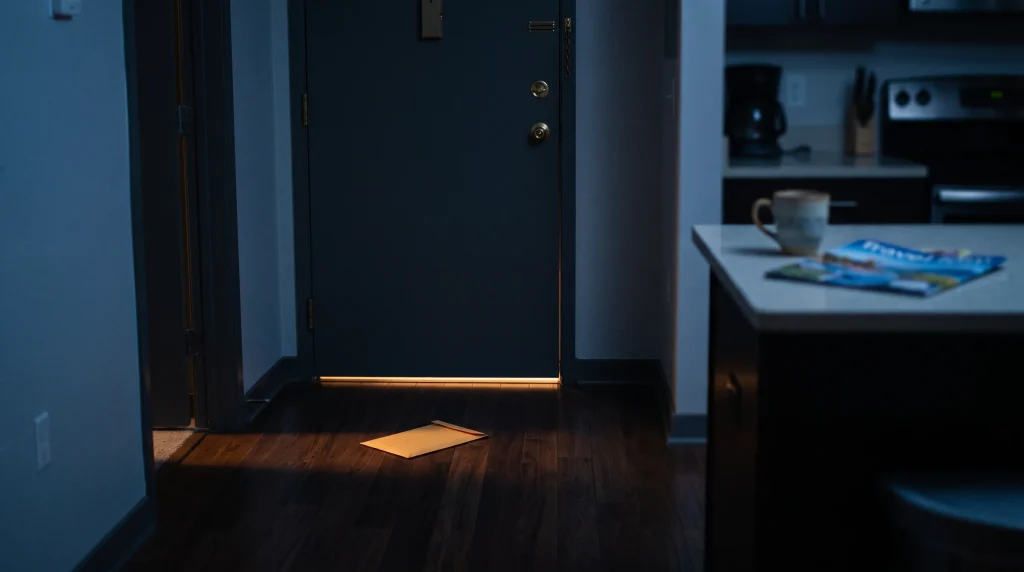
Clara showed up at the apartment around midnight, knocking frantically, mascara streaked and hair frizzed. Through the peephole Nathan watched her plead with him to open up, insisting it wasn’t what he thought. He didn’t open it. Instead he slid an envelope under the door, filled with printed screenshots of her messages to Aaron, her own words calling him a pathetic nobody, her Paris plans, her jokes about safe but boring. On top he’d written one line in his calmest handwriting: “You don’t need to explain. You already did.” She gasped, then sobbed, then knocked harder and said she could fix it. He sat on the couch in the dark until her crying faded away.
The fallout was messy. Clara turned up uninvited at his parents’ house with red-rimmed eyes, telling them he’d misunderstood and it had only been harmless flirting. His mother listened quietly and then said she’d seen the proof, and Clara didn’t get to twist this into Nathan’s fault. It was the last time Clara set foot in that home. Emily could have sided with her, but once the texts, the Paris trip and Aaron’s recordings came out, even she couldn’t spin it. For once she had no sharp remark, just silence.
Word of how Clara had been behaving in public eventually reached her office, and her polished reputation, the thing she prized most, began to slip. About a month later she called him one last time, her voice small and hoarse. She asked him to meet her once so she could explain face to face. “There’s nothing left to explain,” Nathan said. “You made your choice, Clara. Now you live with it.” They never spoke again.
He moved out of the apartment into a place that was entirely his, with no memory of whispered insults or laughter at his expense. He kept the gym routine, threw himself into the new role at work, and stayed close with Aaron, though neither of them gloated. Months later, at another family gathering, his father raised a glass and said, “To Nathan, for proving that patience is stronger than pride.” The room clinked glasses and nobody laughed at his expense. Even Emily lifted hers silently, eyes lowered. Nathan thought about the line he’d left under the door, and for the first time it felt like it belonged to him too. His life, his choices and his dignity no longer needed explaining.
Reflection: People who tear down a partner in front of an audience usually think the audience is on their side. What I find telling here is that Nathan never needed a big scene, only a clear record and enough patience to let her talk. And I’d say the sad part is how long the family told him it was “tough love,” when the thing he needed was someone to say out loud that it wasn’t.