
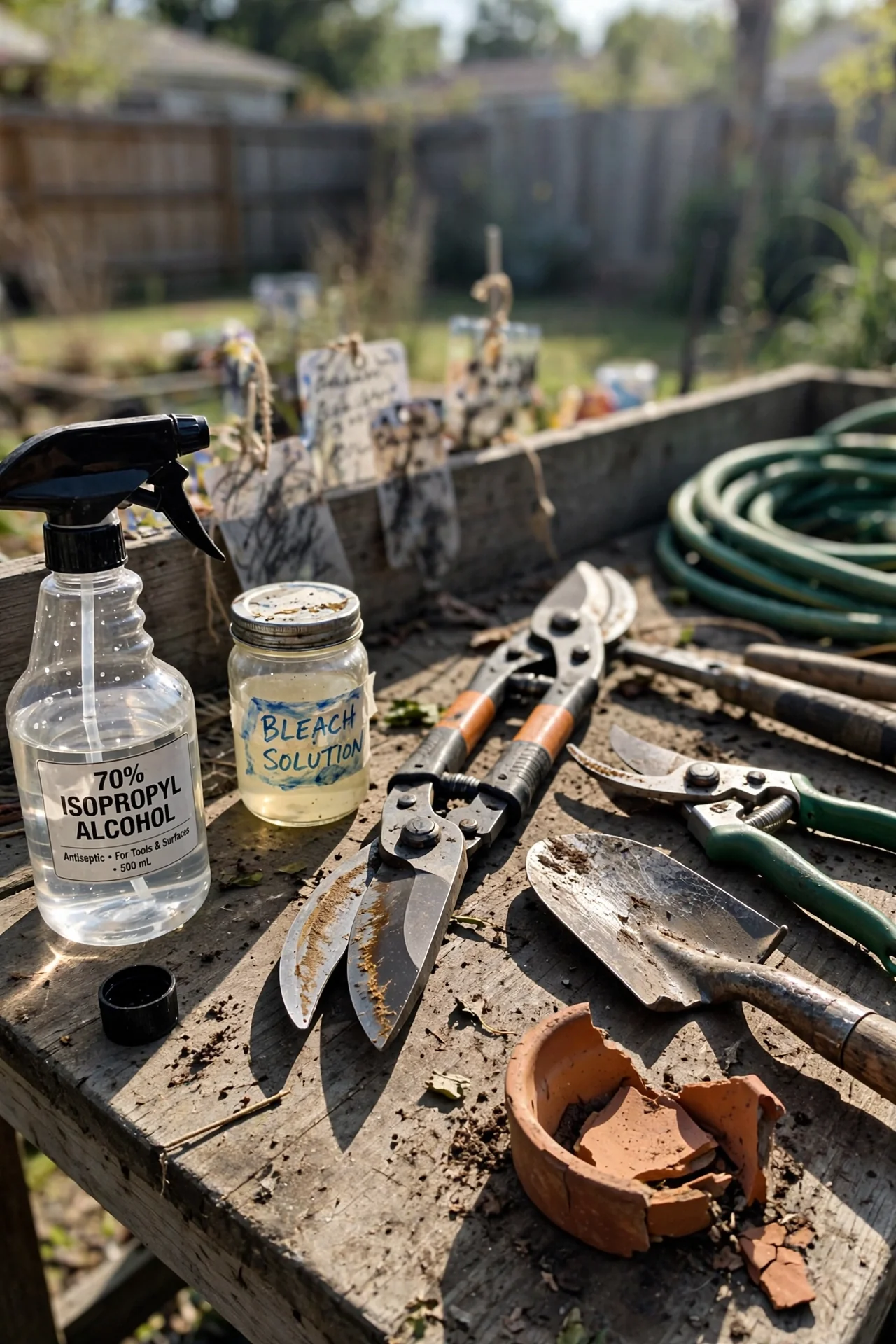
Most disinfecting advice treats all gardens the same. It shouldn't. A gardener pruning healthy roses in a dry climate has different needs than one cutting out fire-blighted apple branches in a humid orchard. The real decision isn't just about bleach versus alcohol. It starts with asking: what pathogen are you trying to control, and how fast do you need the tool back in your hand? This guide works backward from that exact question.
This article covers 10 disinfectant and sterilizing approaches for pruning shears, loppers, grafting knives, shovels, trowels, and other hand tools that contact plant tissue or soil. We exclude mechanical cleaning steps, which must always precede disinfection. We also exclude large power equipment requiring specialized sanitizing protocols.
By the end, you'll be able to match a disinfectant's required contact time, corrosion risk, and mixing complexity to your garden's disease pressure and your own time constraints. You'll know which methods demand rinsing, which can air-dry safely, and which degrade within hours of mixing.
Bottom line: Pick your disinfectant based on contact time and corrosion potential first, not on what's under the kitchen sink.
The Yield Grid Decision Grid
Use these three branches to route yourself to the right table section before you read every option.
Branch 1: Quick Between-Plant Sanitizing. You're pruning healthy plants, moving between varieties, or making routine cuts. No visible disease symptoms. You need a method with a contact time of 30 seconds or less and no water rinse requirement. Recommended: Items 1, 3, 7 below.
Branch 2: Active Disease Intervention. You're cutting out canker, blight, or visibly infected tissue. Pathogen load is high. You need a method proven against bacterial and viral plant pathogens, with documented efficacy at specific concentrations and contact times. Corrosion is a secondary concern because tool longevity takes a back seat to disease containment. Recommended: Items 2, 6, 8 below.
Branch 3: End-of-Season Deep Clean. Tools are going into storage for weeks or months. You have time for soaking, rinsing, drying, and oiling. The goal is to remove all organic residue and kill overwintering spores before tools sit idle. Rust removal and prevention become part of this same workflow. Recommended: Items 4, 5, 9, 10 below.
Quick Comparison Table
| Option | Key Mechanism | Best For | Decision Grid Branch | Effort Score (1–5) |
|---|---|---|---|---|
| 1. Isopropyl Alcohol (70%) | Denatures proteins, dissolves lipid membranes | Rapid between-plant sanitizing | Branch 1 | 1 |
| 2. Bleach Solution (10%) | Oxidizes cell components, broad-spectrum kill | Disease intervention, soak cleaning | Branch 2 | 3 |
| 3. Hydrogen Peroxide (3%) | Oxidizing free radicals disrupt cell walls | Quick wipe with some residual activity | Branch 1 | 2 |
| 4. Household Disinfectant (Lysol-type) | Quaternary ammonium compounds, variable formulation | End-of-season general disinfecting | Branch 3 | 3 |
| 5. Pine Oil Cleaner (25%) | Phenolic compounds disrupt cell membranes | Low-corrosion overnight soak | Branch 3 | 4 |
| 6. Trisodium Phosphate (10%) | Alkaline hydrolysis, strips organic films | Stubborn residue plus pathogen kill | Branch 2 | 5 |
| 7. Boiling Water Dip | Thermal denaturation of proteins | No-chemical quick sanitize | Branch 1 | 2 |
| 8. Quaternary Ammonium (Quats) | Cationic surfactants disrupt cell membranes | Commercial-grade disease control | Branch 2 | 4 |
| 9. White Vinegar (Full Strength) | Acetic acid lowers pH below pathogen tolerance | Rust-prone tools, overnight soak | Branch 3 | 4 |
| 10. Flame/Heat Sterilization | Direct thermal destruction above 160°F (71°C) | Field work where chemicals are unavailable | Branch 3 | 5 |
1. Isopropyl Alcohol (70%): The Zero-Rinse Between-Plant Standard
Best for: Branch 1
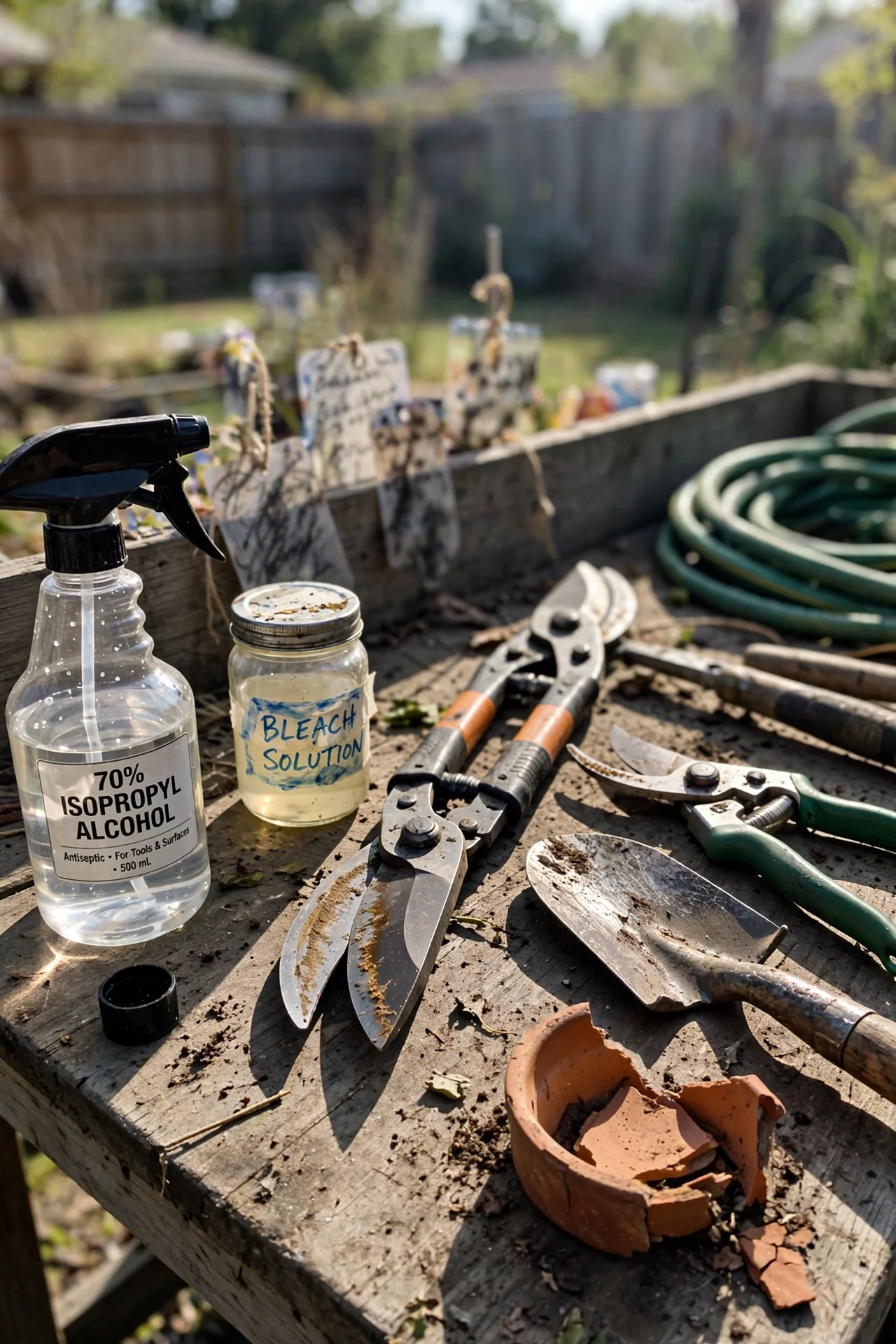
What it is: Rubbing alcohol at 70% concentration (isopropyl or ethanol) is the reference disinfectant for pruning tools in extension service guidance. Unlike bleach, it requires no mixing and no post-application rinse.
Why 70%, not 91% or 99%: Water is the rate-limiting ingredient. Alcohol kills by denaturing proteins, which requires water to facilitate the reaction. At concentrations above 90%, evaporation is so rapid that the contact time drops below the threshold needed for pathogen kill. At 70%, the slower evaporation gives you 15 to 30 seconds of wet contact, which covers most vegetative bacterial cells and many viruses.
Protocol: Fill a small spray bottle or dip cup. Spray or dip blades between plants or between cuts on diseased tissue. Let air-dry. No rinse needed. Replace when visibly contaminated with debris.
Edge case: Alcohol does not kill bacterial spores (e.g., Clostridium) or certain fungal resting structures. If you are cutting out confirmed fire blight (Erwinia amylovora), research shows 70% ethanol requires at least 60 seconds of immersion for reliable disinfection of pruning shears. A quick spray between cuts is insufficient. Switch to a 10% bleach soak or quaternary ammonium product for known bacterial canker pathogens.
Constraint: Highly flammable. Store the spray bottle out of direct sunlight and away from ignition sources. Evaporation in an open container will gradually increase concentration above effective range, so keep capped.
2. Bleach Solution (10%): The Heavy Hitter With a Rust Bill
Best for: Branch 2
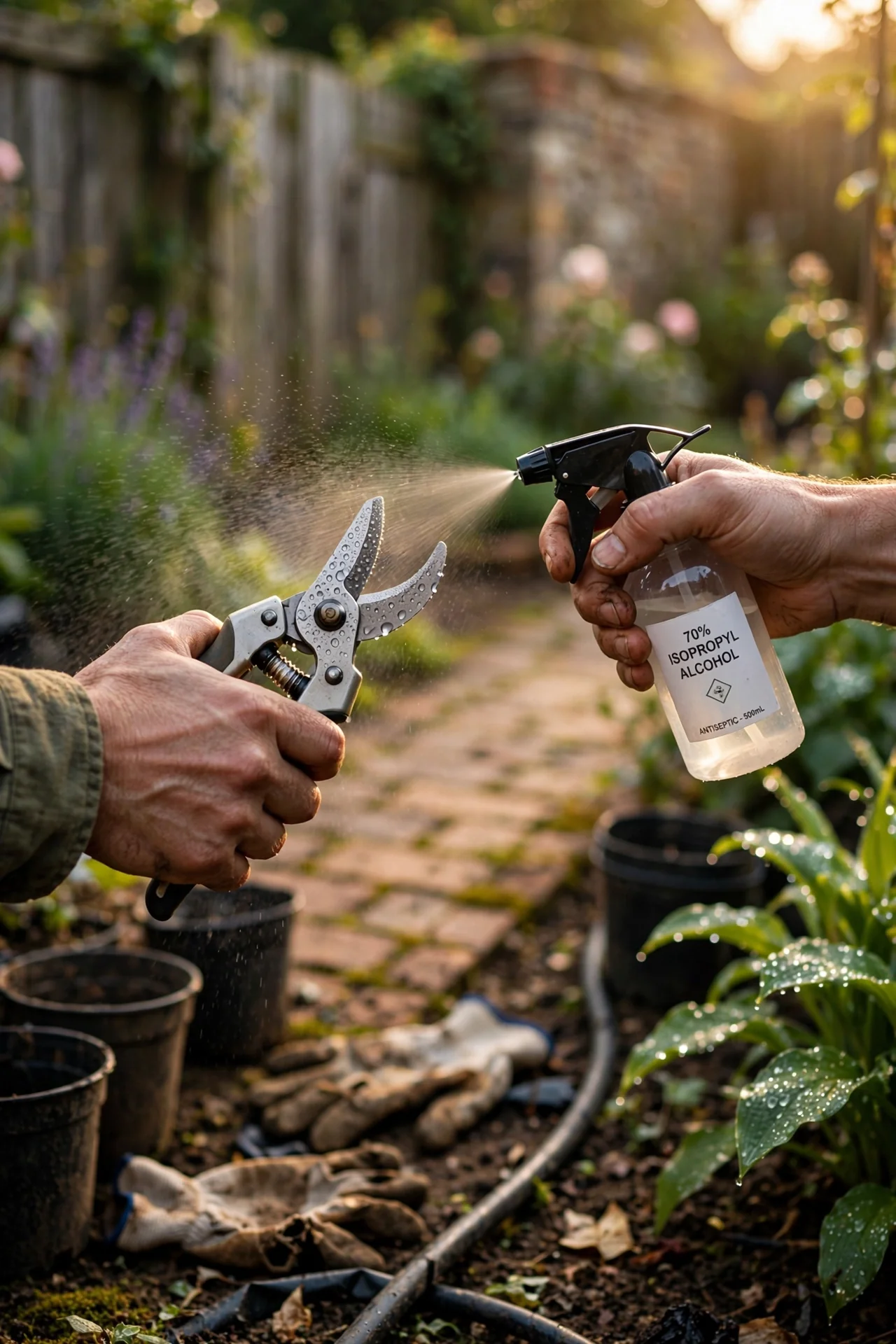
Mix 1 part household bleach (5.25%–6% sodium hypochlorite) with 9 parts water. The solution loses half its disinfecting power within 2 hours of mixing; make it fresh per session. Soak tools for a minimum of 10 minutes. Rinse thoroughly with clean water afterward and apply a light oil coat to all metal surfaces. Never use on wooden handles because the bleach penetrates and degrades the fibers. For tools that will sit unused, this is the most reliable pathogen kill available at household cost, but the corrosion price is real. See rust removal methods if pitting has already started.
3. Hydrogen Peroxide (3%): The Fizz-Only Stops When the Job Is Done
Best for: Branch 1
Mechanism: Three-percent hydrogen peroxide (the brown-bottle first-aid concentration) decomposes into water and reactive oxygen species that oxidize pathogen cell walls. The visible fizzing on contact with organic matter is the decomposition reaction itself; when the fizzing stops, the residual peroxide has been consumed and the surface is largely disinfected. This visual feedback is unique among the options here.
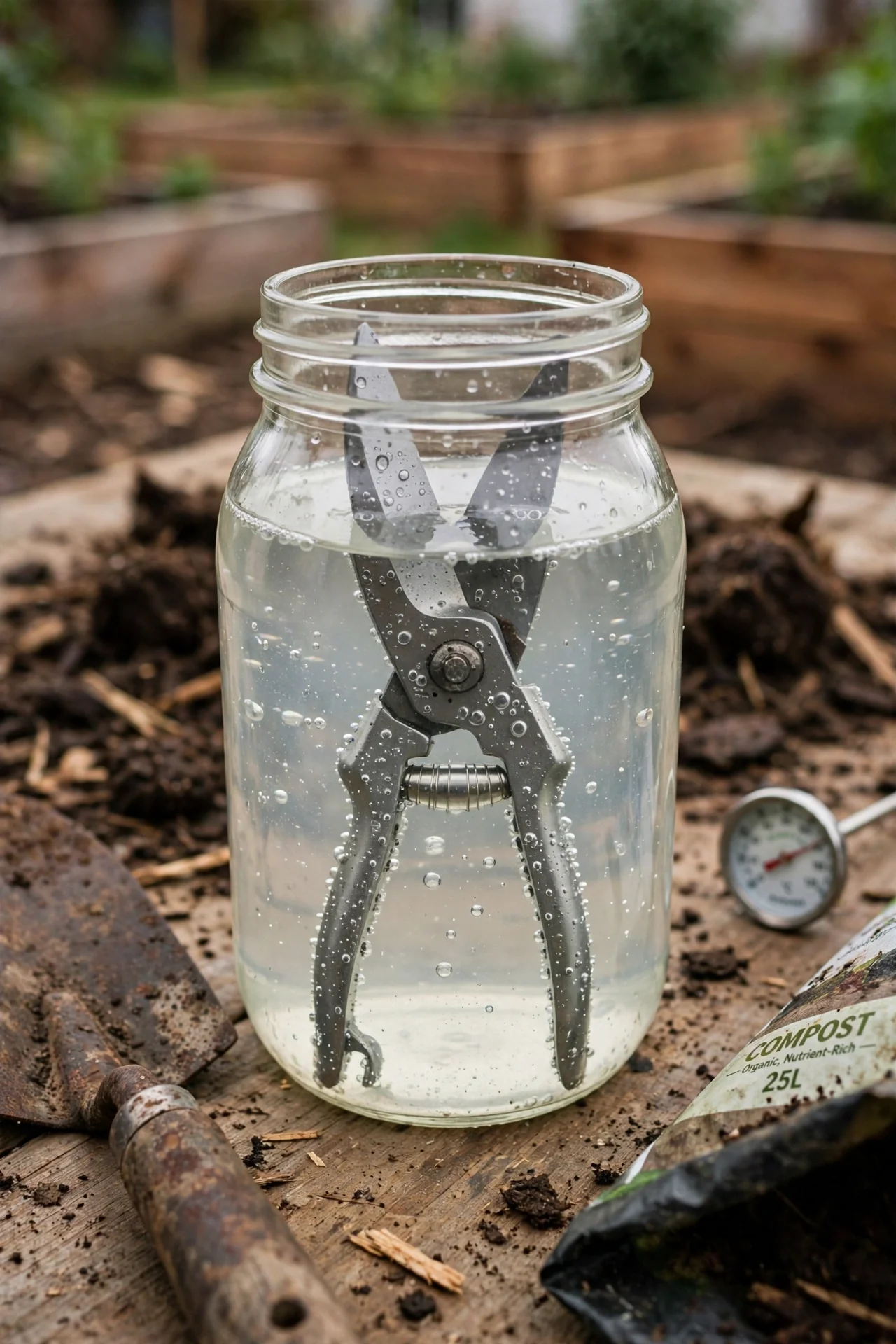
Protocol: Pour a small amount into a shallow container. Dip blades for 30 seconds. No rinse required because the breakdown products are water and oxygen. Wipe dry to prevent any moisture-related spotting on high-carbon steel.
Threshold rule: The 3% household concentration works for most garden pathogens, but hydrogen peroxide degrades in light. Store the bottle in its original opaque container. A bottle that has been opened for longer than 6 months may have lost significant potency. If the solution no longer fizzes on a cut potato, replace it.
Constraint: Hydrogen peroxide at 3% is less effective than bleach against certain viruses and bacterial spores. It is adequate for routine sanitizing between healthy plants. If you are managing a confirmed viral infection (e.g., tobacco mosaic virus on tomatoes), upgrade to a 10% bleach solution or a commercial quaternary ammonium product.
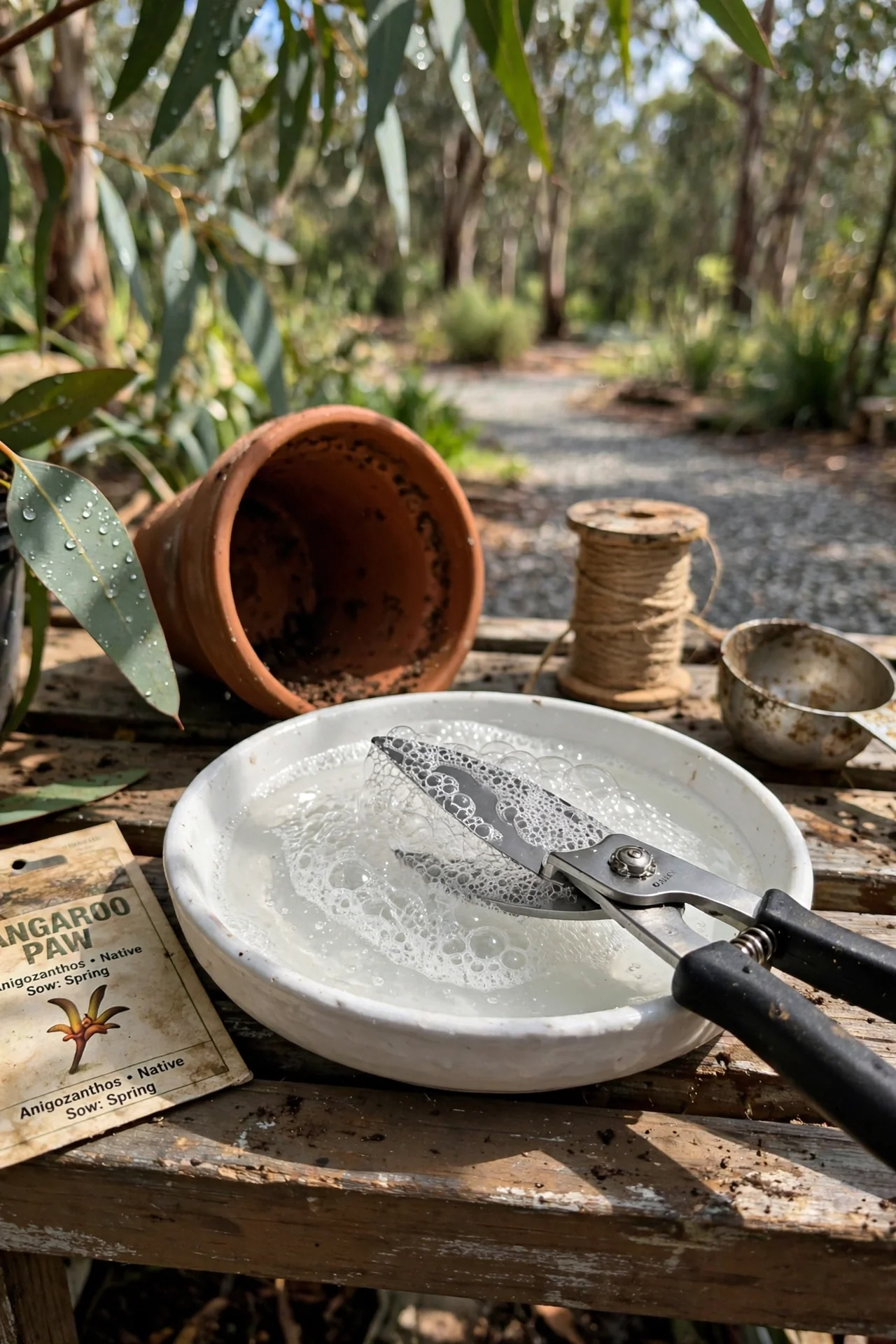
4. Household Disinfectants (Lysol-Type): The Under-Researched Convenience Pick
Best for: Branch 3
What it is: Ready-to-use spray disinfectants containing quaternary ammonium compounds, ethanol, or a combination. Lysol brand products are the most commonly cited in extension literature, but the active ingredient list varies by formulation. This category includes disinfecting wipes.
Use case: End-of-season cleaning when you want a no-mix, spray-and-wipe workflow. Spray the tool surface until wet, let sit for the contact time specified on the product label (often 2 to 10 minutes), then wipe or rinse as directed.
Skip condition: Do not rely on household disinfectants as your sole method if you are managing active bacterial canker or fire blight. Extension sources note that efficacy against plant pathogens has been "minimally evaluated" compared to alcohol and bleach. Use them as a convenient second step after a primary disinfectant, or for tools that did not contact diseased tissue.
Hidden detail: Some formulations contain benzalkonium chloride, a quaternary ammonium compound that leaves a residual antimicrobial film. This is beneficial for tools going into storage. Check the label for "alkyl dimethyl benzyl ammonium chloride" to confirm. Once tools are dry, consider placing them on a pegboard tool wall for organized storage.
5. Pine Oil Cleaner (25%): The Overnight Soak Nobody Talks About
Best for: Branch 3
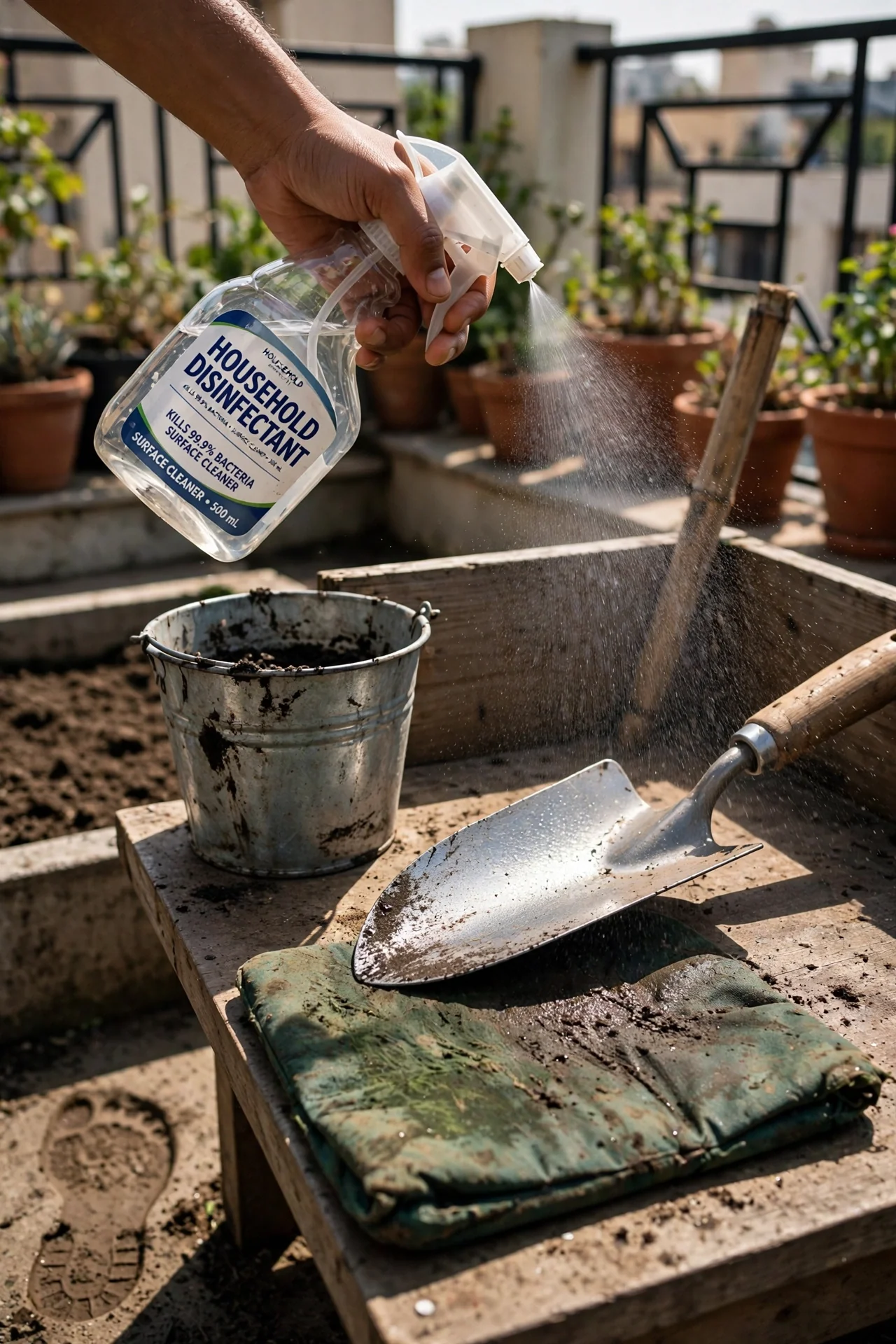
Pine oil at a 25% dilution (1 part pine oil to 3 parts water) provides a low-corrosion alternative for long soaks. Florida extension guidance lists it as effective but less potent than bleach or alcohol. The advantage is that you can leave tools immersed overnight without the pitting risk that bleach carries. Rinse after soaking and dry thoroughly. The pine scent is strong but dissipates. Reserve this for tools that are heavily soiled with greasy plant residues, as the oil-based formulation helps lift sap and resin while disinfecting.
6. Trisodium Phosphate (TSP, 10%): The Stripper That Demands Gloves
Best for: Branch 2
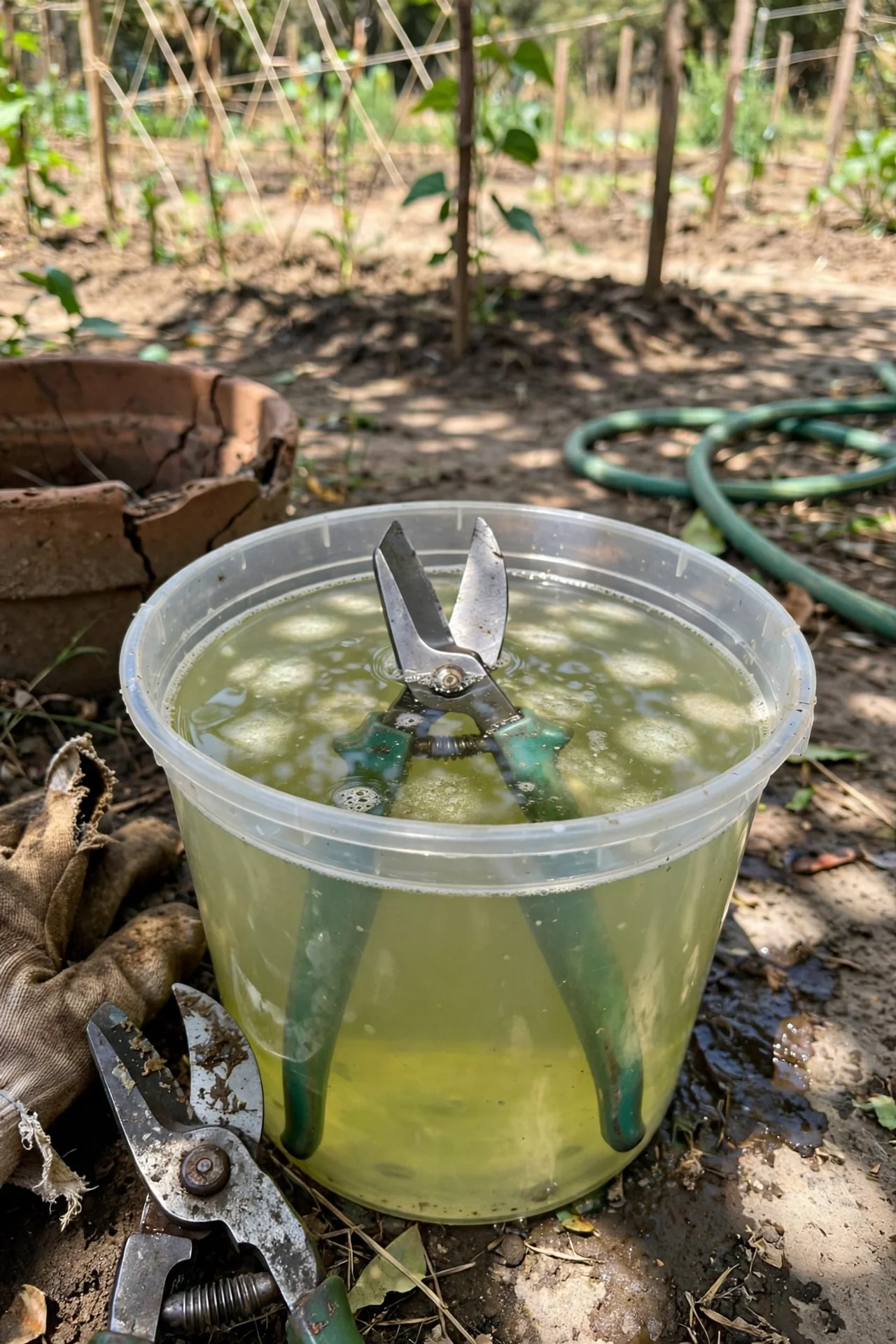
Mechanism: Trisodium phosphate is a strongly alkaline cleaning agent that hydrolyzes fats and proteins. In a 10% solution (1 part TSP to 9 parts water), it strips organic films while simultaneously killing many bacteria and fungi. It is among the few products that combine heavy-duty cleaning and disinfecting in one step.
Protocol: Wear chemical-resistant gloves and eye protection. The dry granules cause chemical burns if they contact wet skin. Mix the solution in a plastic container. Soak tools for at least 3 minutes. Rinse thoroughly. The rinse water should be disposed of according to local regulations; TSP is a phosphate and contributes to algal blooms if poured into storm drains.
Threshold rule: TSP is appropriate when tools have both heavy organic buildup and pathogen exposure. If tools are already clean, the added alkalinity provides no additional disinfecting benefit over bleach and the handling risk is higher. Save TSP for the dirtiest jobs.
Constraint: Do not use on aluminum tools or parts. The high pH corrodes aluminum rapidly. Verify that any synthetic TSP substitute (often labeled "TSP-PF" or similar) is not actually sodium sesquicarbonate, which lacks the disinfecting properties of true trisodium phosphate.
7. Boiling Water Dip: The No-Chemical Option Backed by Research
Best for: Branch 1
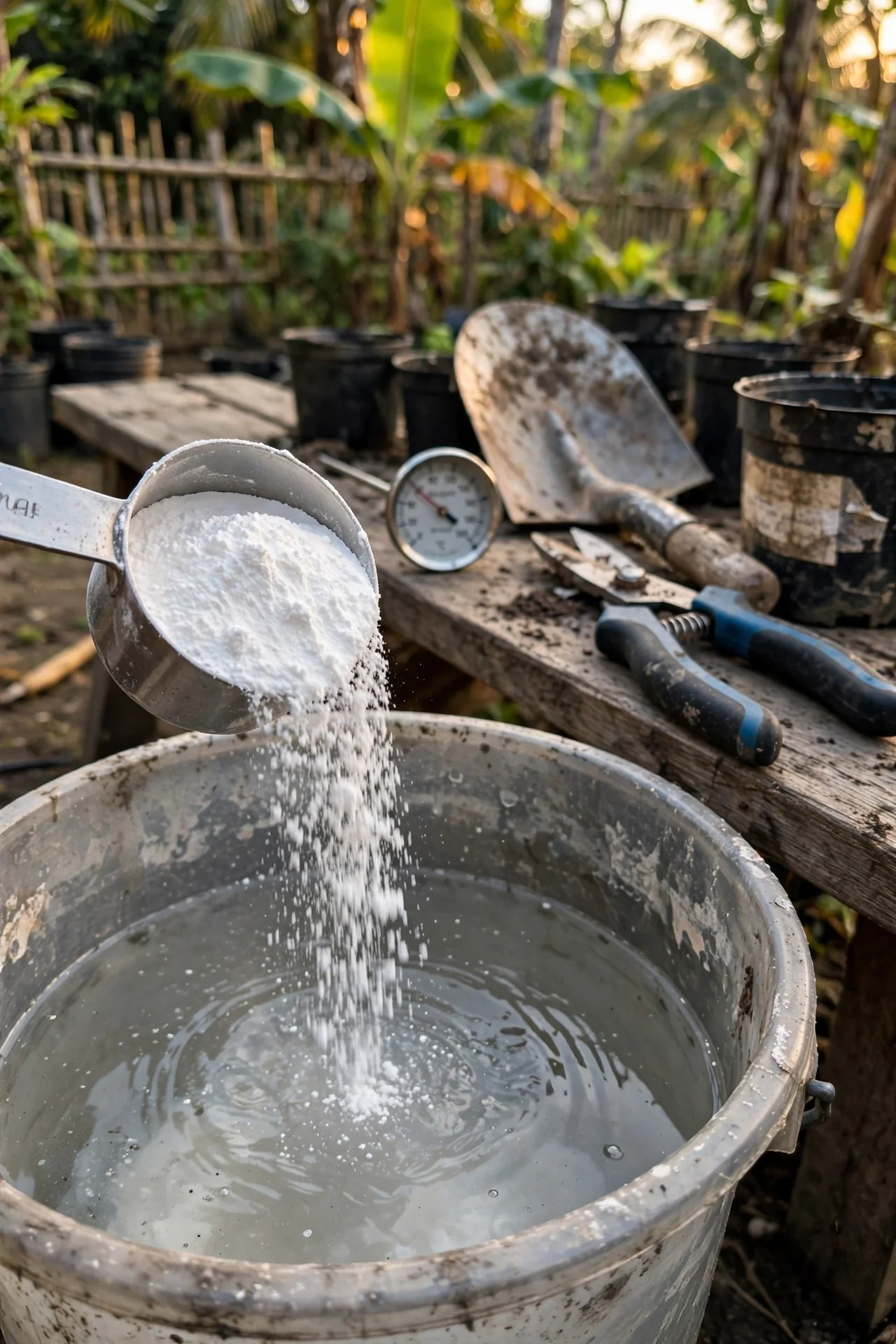
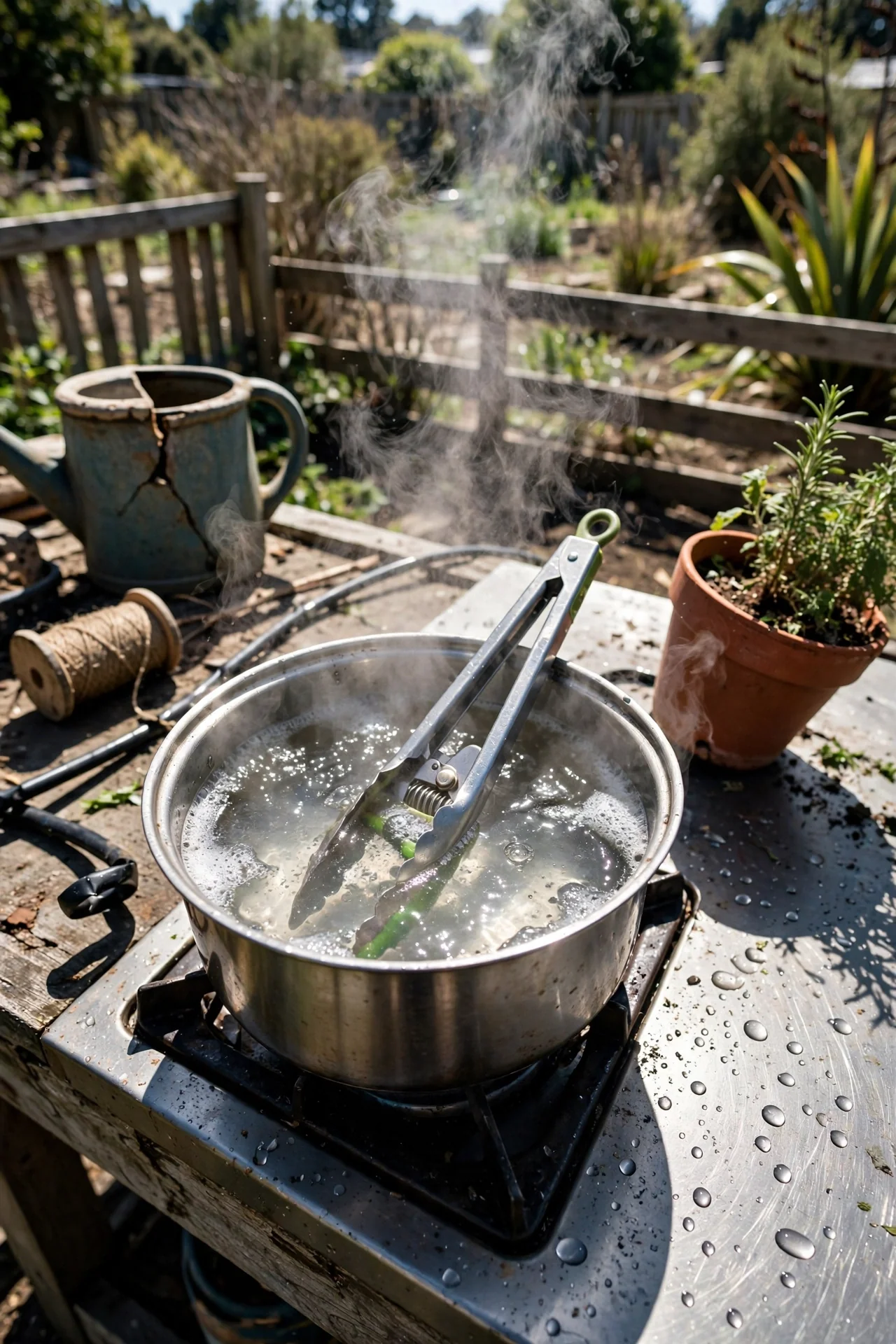
Immerse metal tool blades in boiling water for at least 40 seconds. A 2021 study on farm tool sterilization found that insertion into boiling water was effective from the 40th second onward, making it a viable alternative to chemical disinfectants. Boiling water kills bacteria, fungi, and most viruses through thermal denaturation. No residue, no mixing, no shelf-life concerns. The downside is that it only works for metal blades that can tolerate thermal shock; wooden handles and plastic grips must stay above the water line. This method is especially useful for gardeners who avoid chemical products or work in field settings where carrying disinfectant solutions is impractical.
8. Quaternary Ammonium Compounds (Quats): The Commercial-Grade Option
Best for: Branch 2
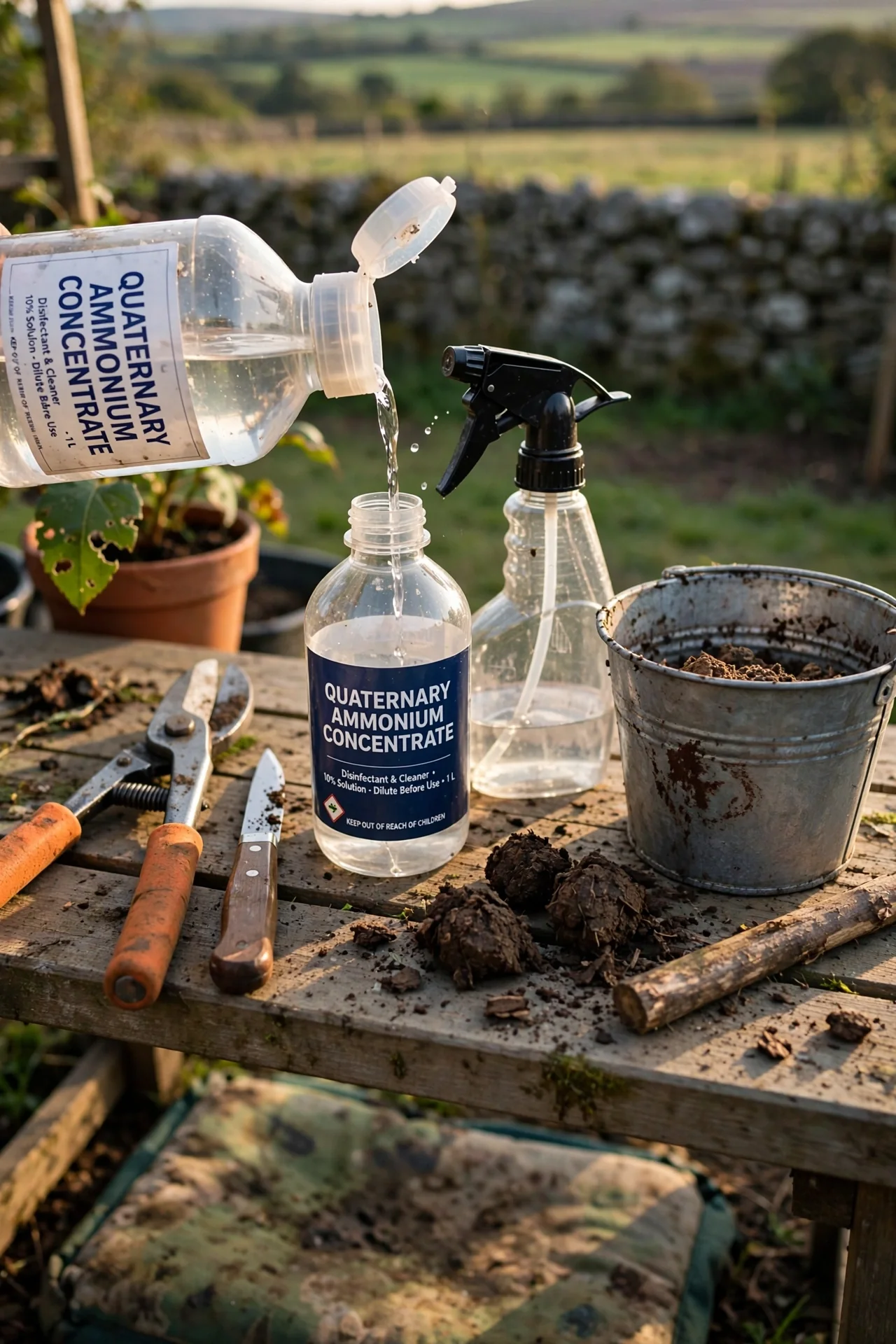
What they are: Quaternary ammonium compounds, often called quats or q-salts, are cationic surfactants used in commercial horticulture for controlling fungal, bacterial, and viral plant pathogens. Examples include Green-Shield and KleenGrow. They are available through horticultural supply vendors, not typically at retail garden centers.
Mechanism: Positively charged quat molecules bind to negatively charged microbial cell membranes, disrupting them and causing cell death. This mode of action is different from bleach or alcohol and is effective against a broader range of pathogens at lower concentrations.
Threshold rule: Use quats when you are managing a known, persistent disease in a high-value planting (orchard, nursery stock, greenhouse collection). The cost is significantly higher than household bleach, and products must be mixed according to label rates that vary by pathogen and crop. Follow the label's specified contact time; it is often 2 to 10 minutes depending on the target organism.
Constraint: Some quat formulations leave a residue that can be phytotoxic to certain plants. Rinse tools with clean water after the required contact time unless the product label explicitly states that no rinse is needed for plant-contact surfaces.
9. White Vinegar (Full Strength): The Slow-Acting, Low-Corrosion Choice
Best for: Branch 3
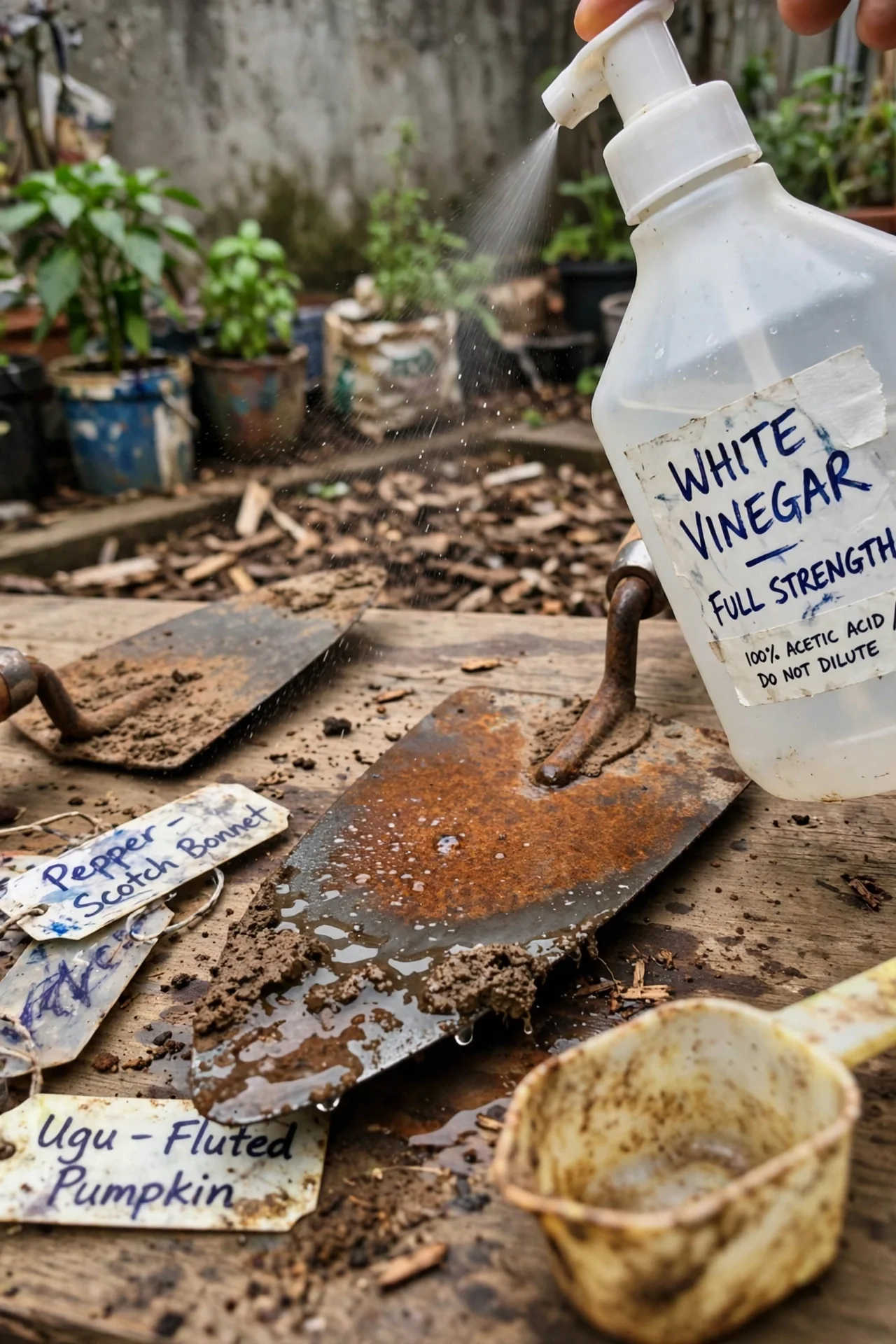
Use case: Full-strength white vinegar (5% acetic acid) applied as a spray or soak is recommended in some extension guidance as a reduced-corrosion alternative to bleach, particularly for tools with wooden handles or sensitive metal alloys.
Contact time: Vinegar requires a longer contact window than alcohol or bleach. University of Florida extension guidance suggests a 30-minute soak for reliable pathogen kill. For overnight soaking of heavily rusted or soiled tools, vinegar is gentler than bleach while still providing antimicrobial action.
Skip condition: Vinegar is not recommended for tools that will be used immediately after cleaning. The acidic residue can affect soil pH around roots if large amounts transfer to the garden. Rinse after soaking and dry thoroughly.
Detailed protocol: Pour undiluted white vinegar into a spray bottle. Saturate tool blades and let the vinegar sit for 30 minutes. Rinse with water and dry. For a 10-minute accelerated workflow, heat the vinegar to approximately 120°F (49°C) before applying; the elevated temperature increases acetic acid's penetration rate. Do not heat above 150°F (65°C), as acetic acid vapors become respiratory irritants at higher temperatures. Once tools are clean and dry, consider storing them on a DIY tool rack to keep blades separated and air-circulated.
10. Flame/Heat Sterilization: The Field Worker's Last Resort
Best for: Branch 3
Blueprint: Direct exposure of metal tool blades to a flame (propane torch, alcohol burner) or placement in hot coals until the metal reaches a temperature that kills pathogens. A 2021 study found that heating tools in fire required up to a full minute to clear all bacteria, and the previously recommended 20 to 40 seconds of heating could be inadequate for complete sterilization.
What it's for: Field conditions in remote locations where carrying liquid disinfectants is impractical. Also used in banana-producing regions for Xanthomonas wilt control as a low-cost alternative to bleach.
Common mistake: Repeated heating weakens metal blades. The study authors explicitly note that fire sterilization degrades machetes, knives, and hoes over time. This is not a routine maintenance method. It is a contingency for disease outbreaks when other options are unavailable.
Steps: Remove all plastic and wooden parts that can be detached. Pass the metal blade through a flame for 60 seconds, ensuring all surfaces reach a temperature above 160°F (71°C). Allow to cool completely before handling. Apply oil after cooling because the heat strips any protective coating. Use only when no other disinfectant is accessible.
Starter Stack (What to Choose First)
Branch 1: Quick Between-Plant Sanitizing
Start with a small spray bottle of 70% isopropyl alcohol (Item 1) and a backup bottle of 3% hydrogen peroxide (Item 3). Alcohol gives you the fastest no-rinse turnaround. Hydrogen peroxide adds visual confirmation of action and handles a slightly broader set of fungi. Total cost: under $10 USD, and both fit in a tool belt or pruning kit. The synergy is speed: alcohol for dry days when you are moving fast, peroxide for wet conditions where alcohol evaporates too quickly to make adequate contact.
Branch 2: Active Disease Intervention
Start with a fresh 10% bleach solution (Item 2) mixed per session, paired with a sealed container of quaternary ammonium product (Item 8) for the highest-consequence cuts. Bleach handles the volume work at low cost; quats cover the fire blight and bacterial canker scenarios where bleach's efficacy is debated. Estimated cost: $15–$30 USD total if purchasing a small quat concentrate. The time investment is 10 to 30 minutes of soak time per session, but that is non-negotiable for disease containment.
Branch 3: End-of-Season Deep Clean
Start with a 10% bleach solution (Item 2) for the initial pathogen kill soak, followed by full-strength white vinegar (Item 9) for an overnight de-rusting soak if needed. The bleach does the heavy disinfecting; the vinegar handles the rust and mineral scale that accumulated during the season. Estimated time: 30 minutes for bleach soak, 30 minutes to overnight for vinegar, plus drying and oiling. Cost: under $5 USD for both solutions. This is the lowest-cost entry point in the entire grid and requires no specialty products.
When This Won't Work
Failure condition 1: Organic load exceeds the disinfectant's capacity. Disinfectants are inactivated by soil, sap, and plant debris. Bleach, alcohol, and hydrogen peroxide all lose effectiveness when mixed with organic matter. If you skip mechanical cleaning before disinfecting, any method in this guide will underperform. The fix is not a longer soak; it is a stiff brush and soapy water first. No disinfectant can penetrate a layer of dried sap to reach the metal surface beneath.
Failure condition 2: The tool cannot be disassembled to expose all pathogen-contact surfaces. Folding saws, multi-tools, and bypass pruners with crevices at the pivot joint can harbor pathogens in spaces that a spray or dip does not reach. If you cannot disassemble the tool, the effective options narrow to heat (boiling water dip, Item 7, for metal heads that can be submerged) or a prolonged soak in a penetrating disinfectant (bleach solution, Item 2). Wiping the exterior is not enough. If neither heat nor soaking is feasible for a particular tool, consider replacing it with a design that allows full disassembly for cleaning.
Alternative: If both conditions above apply and you have confirmed disease in the garden, the safest action is to dedicate a separate set of tools to the affected area and not use them elsewhere. A gardener's tool belt with designated pockets for clean and contaminated tools can help enforce this separation during a pruning session.
Choosing the Right Option for Your Situation
Budget Threshold
If your total disinfectant budget is under $10 USD (£8 GBP, $13 CAD, $15 AUD, €9 EUR, ₹800 INR, R180 ZAR) per season, build your kit around 70% isopropyl alcohol (Item 1) and household bleach (Item 2). These two cover virtually all routine garden scenarios. Skip commercial quats, TSP, and specialty pine oil products. The only recurring cost is replacing alcohol when the spray bottle runs low and mixing a fresh bleach solution each session. This baseline kit has no shelf-life issues beyond the alcohol evaporation rate.
Time Threshold
If you have fewer than 5 minutes total per pruning session for tool cleaning, the only viable options are 70% alcohol spray (Item 1) or hydrogen peroxide dip (Item 3). Both require 30 seconds or less of contact time and zero rinsing. Avoid any method requiring mixing, soaking, or rinsing; those steps will be skipped when you are short on time, and skipping them negates the disinfection. Accept that this rapid approach is adequate for healthy plants but insufficient for known disease. If disease is present, the time threshold must expand to at least 10 minutes for a bleach soak.
Technical Constraint: Tool Material Compatibility
Match your disinfectant to your tool's metal. High-carbon steel blades (common in premium Japanese pruning shears and grafting knives) are more susceptible to corrosion than stainless steel. For high-carbon steel, avoid bleach and TSP entirely. Use alcohol (Item 1), hydrogen peroxide (Item 3), or vinegar (Item 9) instead. Stainless steel tools can handle all methods in this guide, including bleach and TSP, provided they are rinsed and dried afterward. If you are unsure what metal your tool uses, test a small drop of your chosen disinfectant on an inconspicuous area and check for discoloration after 10 minutes before committing to a full soak.
Yes/No Checklist:
- Did you remove all visible soil and sap before applying any disinfectant?
- Does your chosen method meet the minimum contact time for the pathogen you are managing?
- If using bleach, did you mix the solution within the last 2 hours?
- Will the tool be rinsed (if required) and dried before storage or next use?
Expert Q&A
Can I use dish soap to disinfect garden tools?
No. Soap removes soil and some microbes through mechanical action but does not reliably kill plant pathogens. Dish soap is a cleaning step, not a disinfecting step. Always follow soap-and-water cleaning with a true disinfectant from this guide for any tool that contacts plant tissue.
How often should I replace my bleach solution during a long pruning session?
Every 2 hours at minimum. Bleach solutions lose half their disinfecting strength within 2 hours of mixing, and faster in direct sunlight or if contaminated with organic debris. If the solution becomes visibly cloudy or you notice a reduced bleach odor, replace it immediately regardless of time.
Does freezing winter storage kill pathogens on tools?
Not reliably. Many plant-pathogenic bacteria and fungi produce dormant structures (spores, sclerotia) that survive freezing temperatures. Some viruses remain viable through freeze-thaw cycles. Rely on chemical or thermal disinfection before storage, not cold weather alone.
What is the difference between sanitizing, disinfecting, and sterilizing garden tools?
Sanitizing reduces pathogen numbers to a level considered safe for routine plant contact. Disinfecting kills a broader spectrum, including most viruses and fungi. Sterilizing eliminates all microbial life including spores, which is rarely achievable or necessary for garden tools. Most home gardeners need sanitizing or disinfecting, not true sterilization.
Can I disinfect tools with a pressure washer?
A pressure washer removes soil and debris effectively but does not disinfect. The water temperature is too low for thermal kill, and high-pressure spray does not deliver a chemical disinfectant at the required contact time. Use a pressure washer for the cleaning step only, then follow with a disinfectant from this guide.
Conclusion
Matching your disinfectant to your garden's actual disease pressure, rather than defaulting to whatever is under the sink, changes how reliably your tools stay clean. The single most common mistake is applying a disinfectant to a blade still coated with sap or soil; that turns even the strongest solution into weak rinse water. Remove debris first, decide whether you need speed or thoroughness, and pick from the grid above.
Your next step: if your tools are overdue for a full end-to-end maintenance cycle, start with a quality sharpening kit to restore cutting edges before you disinfect, because sharp blades make cleaner cuts that are less prone to disease entry in the first place.