
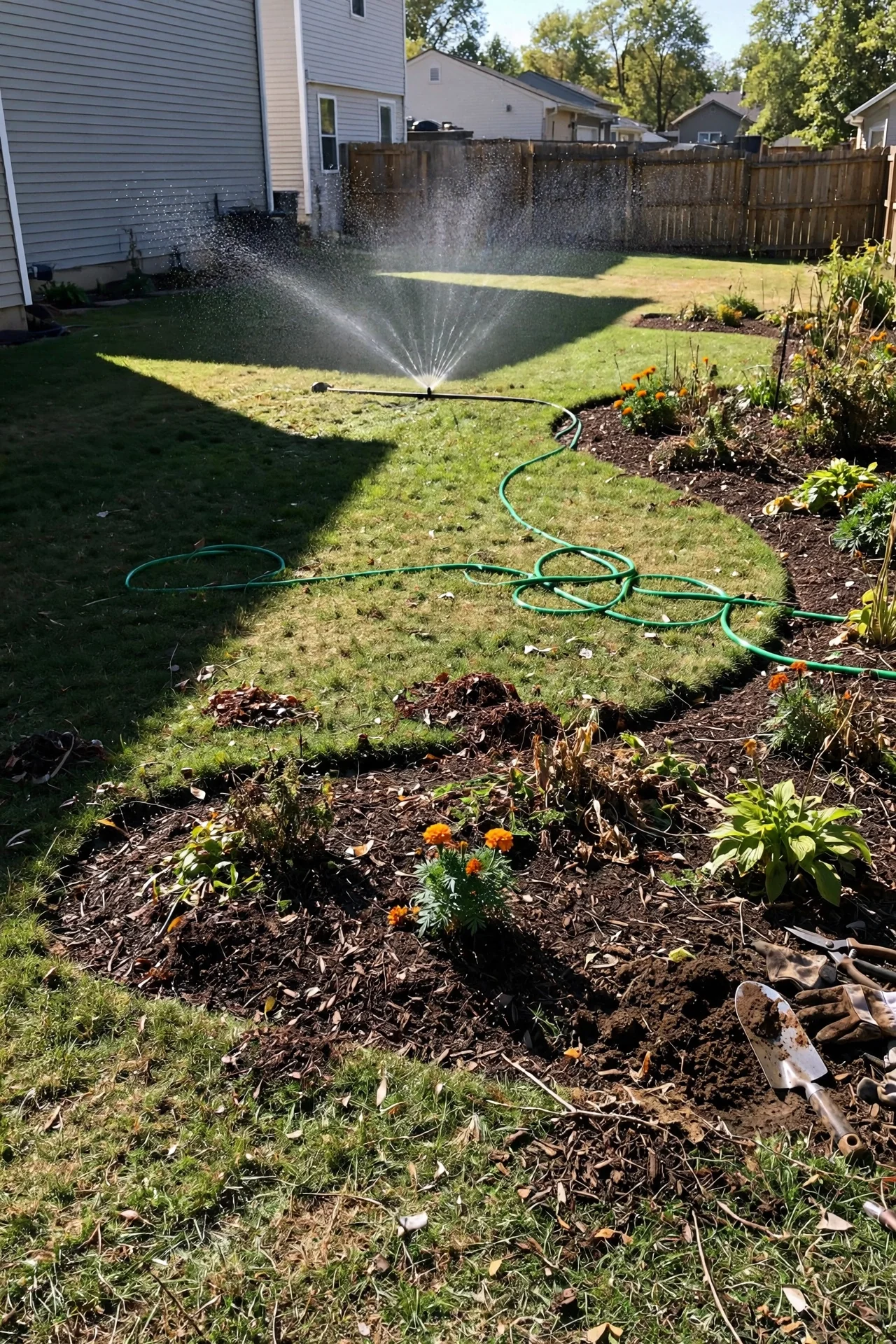
Most lawn sprinkler guides treat every yard like a flat, windless rectangle fed by 60 PSI municipal water. Your yard is probably not that. The gap between a sprinkler that works on paper and one that works on your lawn comes down to three variables most listicles skip: your actual water pressure, your yard’s real shape (edges, slopes, obstructions), and any local watering restrictions that limit when or how you can irrigate.
This guide covers above-ground hose-end sprinklers for residential lawns: oscillating, impact, rotary, stationary, traveling, and multi-pattern turret types. In-ground systems, drip irrigation, and smart robotic units appear only where they clarify a tradeoff. Sprinklers designed for agricultural acreage or specialized sports turf fall outside this scope.
By the end, you will know which sprinkler mechanism matches your yard geometry, how to adjust for low or high water pressure before buying, and which models fit the watering window your municipality allows. Every recommendation ties back to measurable yard conditions, not brand preference.
Bottom line: Choose the sprinkler type first based on your yard shape and water pressure; pick a specific model second based on durability and adjustability.
The Yield Grid Decision Grid
Start here. Pick the branch that fits your lawn reality. Most yards fit one branch; complex properties may need two different sprinklers for different zones.
Branch 1: Rectangular or Square Lawn, Pressure Above 40 PSI. Your yard has four relatively straight sides. Water pressure at the spigot (measured with a $10 gauge) reads 40 PSI or higher. You want predictable, back-and-forth coverage with minimal manual repositioning. Recommended: Items 1, 4, 7 below.
Branch 2: Irregular, Round, or Odd-Shaped Lawn, Any Pressure. Your lawn has curved edges, awkward corners, islands, or no straight lines. Or you are dealing with low pressure (below 40 PSI) regardless of shape. You need adjustable arcs, circular patterns, or targeted spray that avoids sidewalks and driveways. Recommended: Items 2, 5, 8, 10 below.
Branch 3: Large Open Lawn Over 4,000 Square Feet. Your lawn is expansive and relatively unobstructed. You are tired of moving a single sprinkler six times per session. You need either a traveling unit that follows the hose path or a high-volume impact/rotary that covers wide diameters from one position. Recommended: Items 3, 6, 9, 11 below.
For further reading on how sprinkler choices fit into a broader watering strategy, see our guide on building a lawn watering schedule that adapts to seasonal changes.
Quick Comparison Table
| Option | Key Mechanism | Best For | Decision Grid Branch | Effort Score |
|---|---|---|---|---|
| 1. Melnor XT Turbo Oscillating | Oscillating (turbo motor) | Medium-large rectangles | Branch 1 | 2 |
| 2. Orbit Brass Impact Sprinkler | Impact (brass head) | Irregular shapes, well water | Branch 2 | 2 |
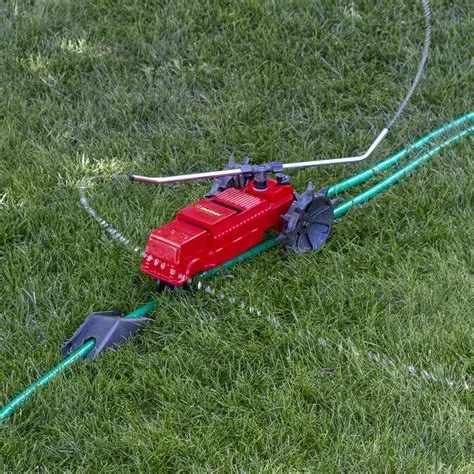
| 3. Nelson RainTrain Traveling | Traveling (water-driven wheels) | Large open lawns 4,000+ sq ft | Branch 3 | 1 |
| 4. Gardena AquaZoom Compact | Oscillating (precision nozzles) | Small-medium rectangles, UK/EU | Branch 1 | 2 |
| 5. Dramm 9-Pattern Turret | Stationary multi-pattern | Odd shapes, small lawns | Branch 2 | 3 |
| 6. Orbit Gear Drive Rotary | Gear-driven rotary | Large circles, wind-prone areas | Branch 3 | 2 |
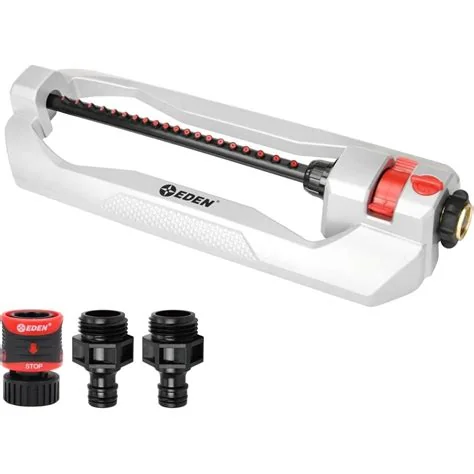
| 7. Eden 96213 Oscillating | Oscillating (16 precision nozzles) | Budget-minded rectangles | Branch 1 | 2 |
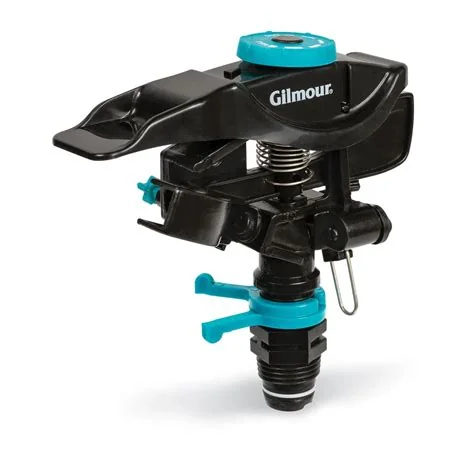
| 8. Gilmour Circular Spot Sprinkler | Stationary circular spray | Small circles, low pressure | Branch 2 | 3 |
| 9. Melnor 4501 Traveling | Traveling (adjustable speed) | Large rectangles, hands-off watering | Branch 3 | 1 |
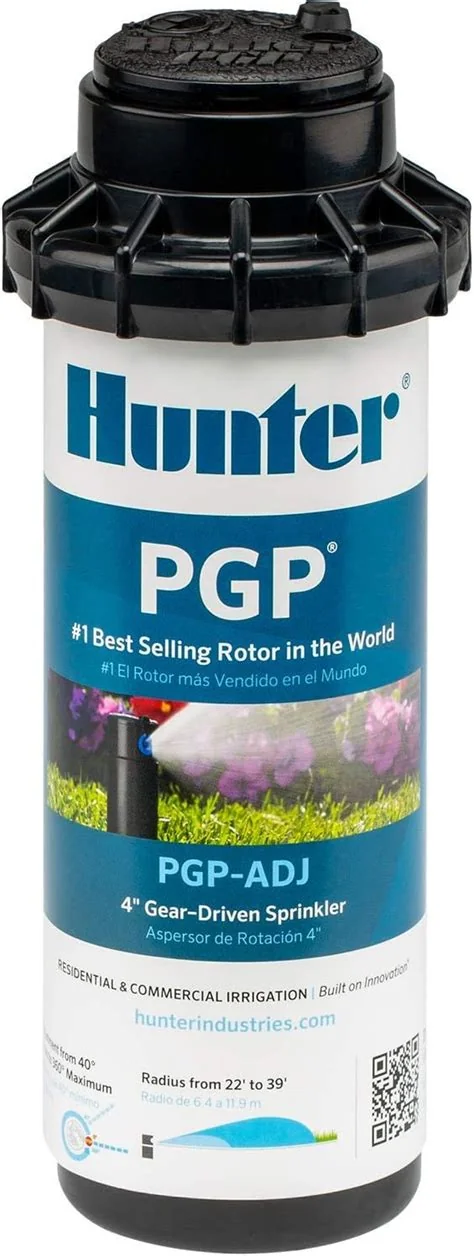
| 10. Hunter PGP-ADJ Rotary | Gear-driven rotor (in-ground) | Irregular lawns, permanent setup | Branch 2 | 1 |
| 11. Rain Bird Brass Impact | Impact (brass, high-volume) | Large open lawns, hard water | Branch 3 | 2 |
1. Melnor XT Turbo Oscillating Sprinkler
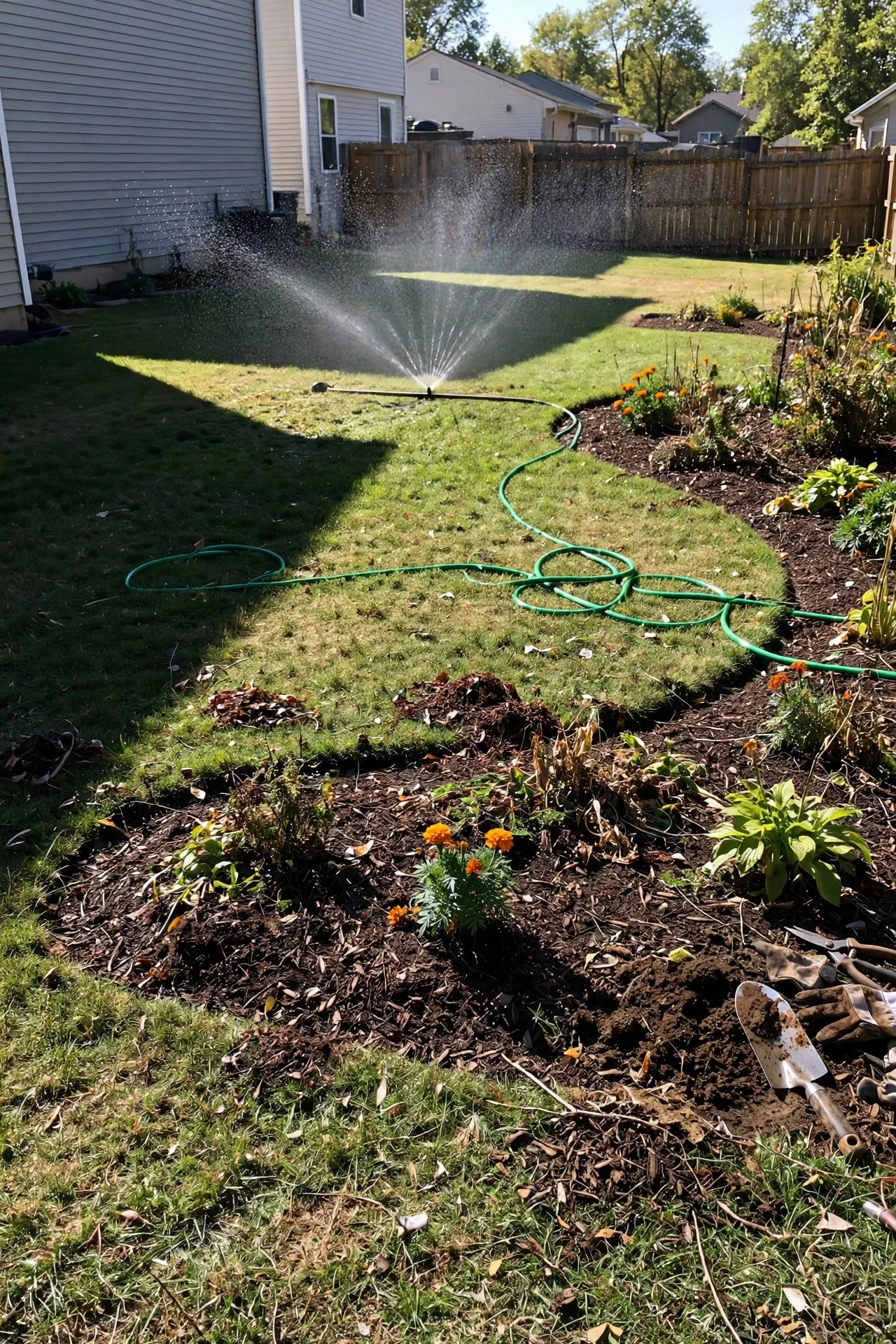
Best for: Branch 1 (rectangular or square lawns, pressure above 40 PSI).
What it is: An oscillating sprinkler with a sealed turbo motor that drives the spray bar back and forth across a rectangular pattern. The XT model uses a metal sled base for stability and brass nozzles for longevity.
Why it fits Branch 1: Oscillating sprinklers produce a rectangular or square spray footprint that maps naturally onto straight-edged lawns. The Melnor XT covers up to 4,500 square feet at residential pressures, with adjustable width and range controls that let you dial the rectangle to match your yard dimensions rather than watering the sidewalk. Unlike cheaper oscillators, the turbo motor maintains consistent speed at lower flow rates, reducing the stalling that plagues plastic-gear models when pressure dips toward 40 PSI.
The detail most buyers miss: Oscillating sprinklers apply water faster at the center of the pattern than at the edges. To compensate, overlap each pass by roughly 20 inches when repositioning. A quick way to validate coverage: run the sprinkler for 15 minutes with five tuna cans spaced evenly across the spray path; if the center can collects noticeably more water than the outer cans, tighten the width setting slightly and rerun the test.
Water source compatibility: Works best with municipal water at 40 to 60 PSI. If you are on well water with sediment, install a mesh filter at the hose connection, those brass nozzles resist corrosion but can clog just like any small-orifice spray head. For more on filtration, see how irrigation filters protect sprinkler nozzles from sediment damage.
2. Orbit Brass Impact Sprinkler
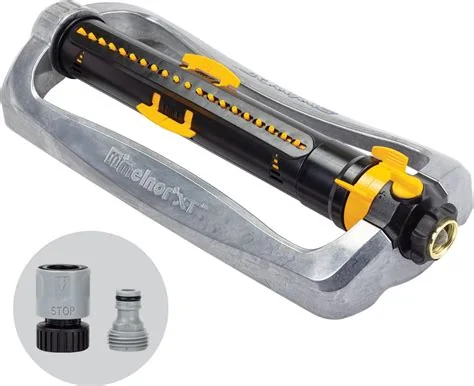
Best for: Branch 2 (irregular shapes, any pressure, well water).
Impact sprinklers use a spring-loaded arm that interrupts the water stream, rotating the head in adjustable arcs up to 360 degrees. The brass construction on the Orbit model tolerates well water sediment and UV exposure better than plastic alternatives. You can set the trip collar to water a precise wedge of lawn, making it the most adjustable option for yards with curved borders or flower bed islands. One constraint: impact heads are tall; position them above mature grass height to avoid blade interference that can stall rotation.
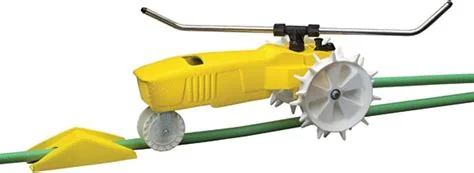
3. Nelson RainTrain Traveling Sprinkler
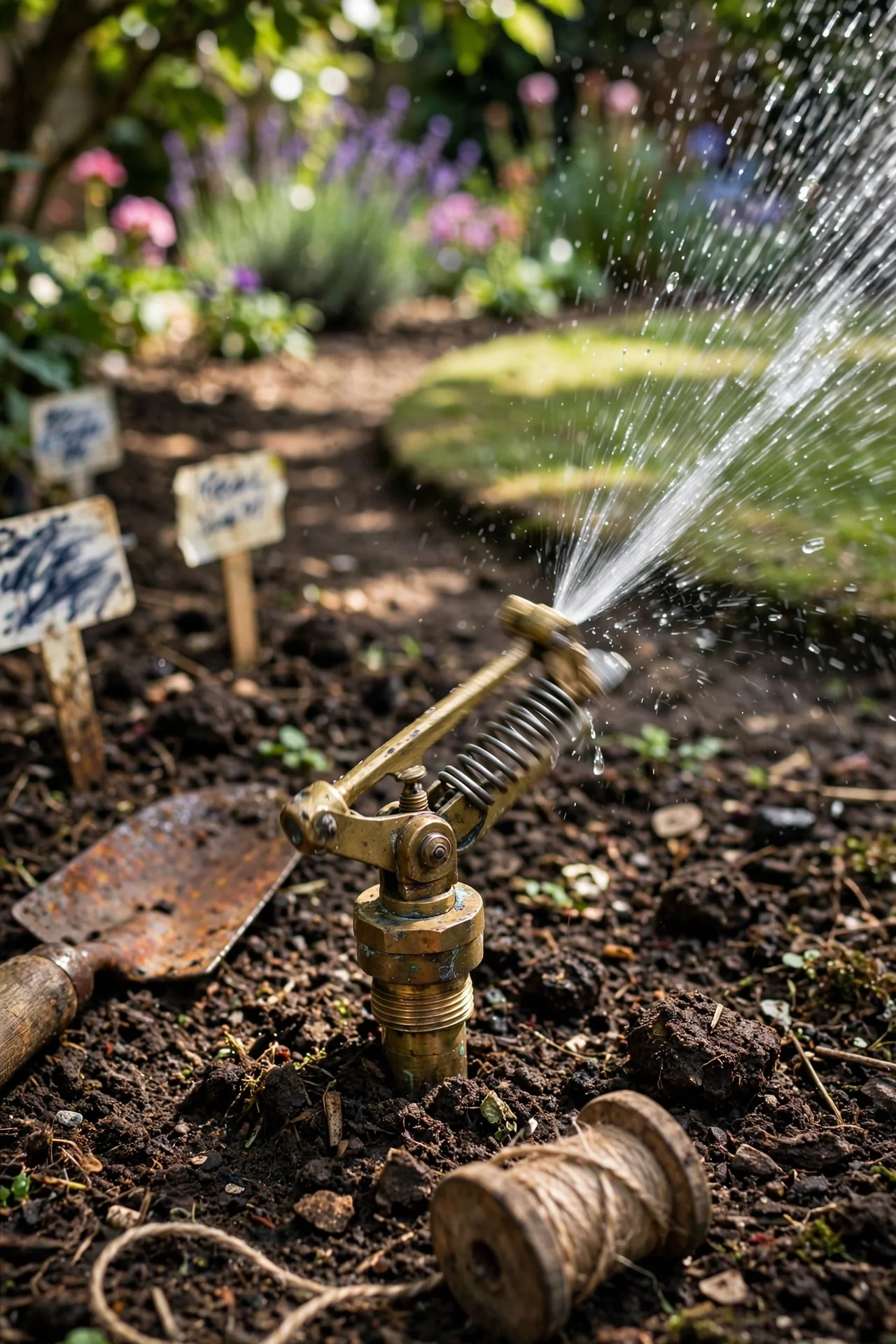
Best for: Branch 3 (large open lawns over 4,000 square feet).
What it is: A self-propelled sprinkler that uses water pressure to drive two cast-iron wheels along a hose path you lay out. The RainTrain covers up to 13,500 square feet in a single run by following the hose like a track.
Why it fits Branch 3: Large lawns defeat stationary sprinklers because repositioning becomes a part-time job. A traveling sprinkler automates the coverage: set the hose path around the perimeter or in a serpentine pattern, turn on the water, and the unit walks itself along the line. The RainTrain uses an adjustable spray arm that can cover a diameter from 15 to 50 feet, so you can match the swath width to your hose path spacing. High gear travels faster with lighter watering; low gear moves slowly for deeper soaking.
The edge case that trips people up: Traveling sprinklers need a relatively flat, obstacle-free lawn. If your yard has tree roots, embedded rocks, or steep grades, the unit can tip or stall. Also, the hose itself becomes a trip hazard while in use. The drive mechanism relies on clean water; sediment from well systems can clog the internal gear drive over time. If you are winterizing a system that includes a traveling sprinkler, follow the same drain-down procedure described in our winterization guide for irrigation systems.
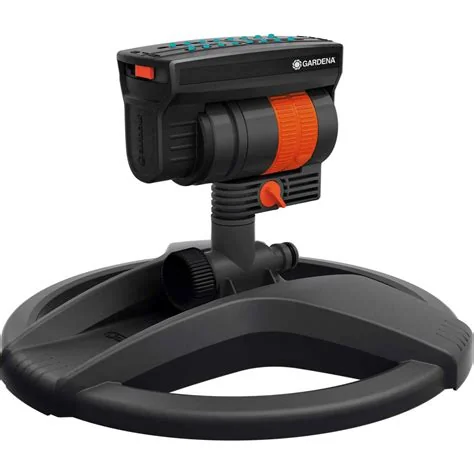
4. Gardena AquaZoom Compact
Best for: Branch 1 (rectangular lawns, particularly in UK and EU markets where Gardena fittings are standard).
The use case: This oscillating sprinkler excels on small to medium rectangular lawns up to 250 square meters. Unlike bulkier oscillators, the AquaZoom Compact has a narrow profile that stores easily and resists tipping. The key differentiator is the fine adjustment: you can independently set the spray width (the throw distance from the unit) and the range (the left-to-right sweep), so a rectangular lawn that is short but wide, or long but narrow, gets an exact match without overspray. One edge constraint: the plastic base is lighter than metal sled alternatives; on uneven ground or slopes, it can shift during operation unless weighted down.
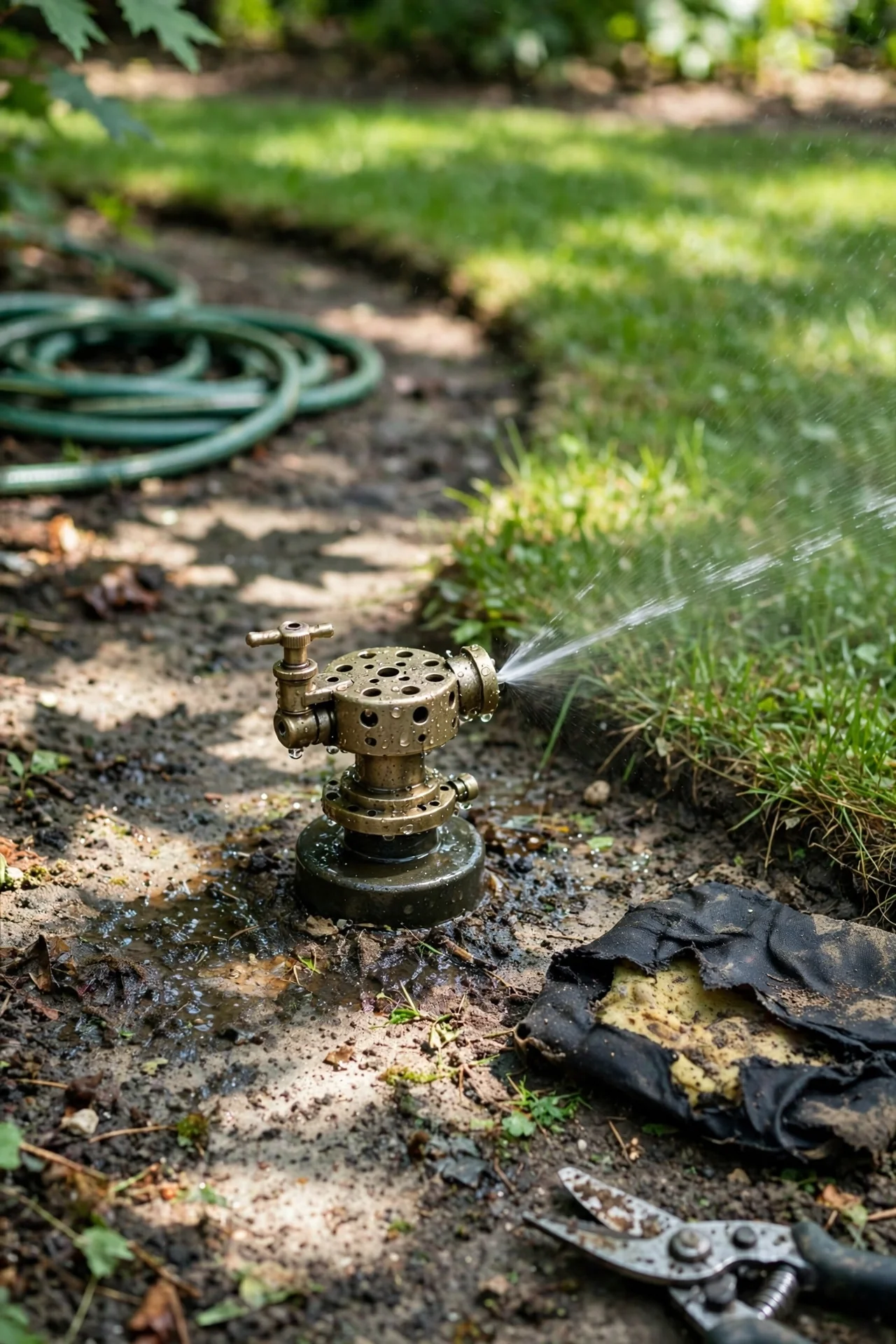
5. Dramm 9-Pattern Turret Sprinkler
Best for: Branch 2 (odd-shaped lawns, small yards, gardeners who water multiple zone types).
What it is: A stationary sprinkler with a rotating turret that offers nine distinct spray patterns: circle, square, rectangle, half-circle, strip, mist, and variations. The heavy metal base keeps it planted on slopes and uneven ground.
Why it solves the odd-shape problem: Most sprinklers are locked into one spray geometry. If your lawn is L-shaped, has a narrow side passage, or wraps around a patio, a single-pattern sprinkler either wastes water on pavement or leaves corners dry. The turret lets you dial the pattern to each zone individually. The mist setting doubles as a seed-starting spray that will not wash out new grass. A limitation to know: stationary sprinklers have a shorter maximum throw distance, typically 30 feet in diameter, so you will reposition more often on anything beyond a small yard.
Pro tip: When using this sprinkler on newly seeded lawns, combine it with the guidance in our article on watering newly seeded lawns to avoid overwatering during the germination window.
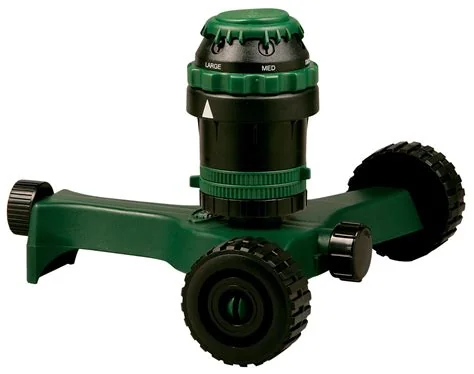
6. Orbit Gear Drive Rotary Sprinkler
Best for: Branch 3 (large lawns, windy areas).
Rotary sprinklers use a gear-driven mechanism that spins the head more slowly than impact models, producing larger water droplets that resist wind drift. The Orbit Gear Drive covers up to 5,000 square feet with six adjustable spray patterns. Slow rotation means lower precipitation rates, roughly 0.3 to 0.5 inches per hour, which gives heavy clay soils time to absorb water without runoff. The metal spike base pushes into firm ground securely. In high-wind regions where oscillating mist blows sideways, a gear drive rotary keeps more water on target.
7. Eden 96213 Oscillating Sprinkler
Best for: Branch 1 (budget-oriented rectangular coverage).
What it is: A 16-nozzle oscillating sprinkler with a weighted plastic base, covering up to 3,600 square feet at typical residential pressures. The Eden 96213 uses precision nozzles for even distribution, with a sliding tab to adjust the spray width.
How it differs from pricier oscillators: The Eden delivers comparable coverage area to models costing twice as much. The tradeoff is in the base material and motor: the plastic construction will not survive being dragged across concrete repeatedly, and the motor is less sealed against debris than the Melnor XT’s turbo drive. For a stationary setup on a lawn where the sprinkler stays put all season, those compromises matter less. One detail that extends its life: store it indoors during freezing months; residual water in the oscillator bar can crack plastic components if left out when temperatures drop below 32 degrees Fahrenheit.
Pairing suggestion: If you plan to run this sprinkler on an automated schedule, a smart controller can prevent watering during rain events. See how a smart irrigation controller reduces waste without manual intervention.
8. Gilmour Circular Spot Sprinkler
Best for: Branch 2 (small circular areas, low water pressure).
This stationary sprinkler produces a consistent circular spray pattern with a 30-foot radius from a low-profile metal head. The simple design has no moving parts except the water flow itself, which makes it one of the few sprinklers that functions reliably at pressures as low as 20 PSI. It is also quiet, no clicking, no motor whir. The limitation is coverage shape: you get a circle, full stop. For a small round lawn, a tree well, or a low-pressure zone where an impact sprinkler would stall, this fills a narrow but real gap that flashier sprinklers cannot touch.
9. Melnor 4501 Traveling Sprinkler
Best for: Branch 3 (large lawns, hands-off watering).
What it is: A traveling sprinkler with adjustable spray arms (15 to 50 feet diameter) and variable speed control: high gear for a light pass, low gear for deep watering, neutral for stationary use. Covers up to 13,500 square feet per run.
The mechanism advantage: Unlike a stationary sprinkler that requires you to calculate overlap and reposition multiple times, the Melnor 4501 automates the entire walk. The adjustable spray arms let you control the swath width independently of the travel speed. In neutral gear, it functions as a stationary rotary sprinkler, which is useful for spot-watering a dry patch without resetting the hose path. A constraint: the drive wheels need a textured surface to grip. On very smooth, wet grass or plastic landscaping fabric, wheel slip can reduce travel distance. For lawns with multiple zones that include shrubs or garden beds alongside turf, consider whether a dual-purpose approach makes sense; our comparison of soaker hose versus drip irrigation may help with non-turf areas.
10. Hunter PGP-ADJ Rotary Sprinkler
Best for: Branch 2 (irregular lawns suited to a permanent in-ground setup).
The scope: This is an in-ground gear-driven rotor head, not a hose-end sprinkler, included here because some irregular-lawn scenarios are best solved with a permanent pop-up system. The PGP-ADJ offers an adjustable arc from 40 to 360 degrees and a spray distance of 22 to 52 feet depending on nozzle choice and pressure.
When an in-ground option makes more sense: If your lawn has complex borders, multiple planting islands, or tight corners that require precise arc control across several zones, a single hose-end sprinkler will never cover everything efficiently. The PGP-ADJ installs in a grid pattern with overlapping coverage, which is the standard method for achieving uniform water distribution on irregularly shaped turf. The tradeoff is installation labor: trenching pipe, assembling manifolds, and dialing in each zone takes a weekend. For those considering a full garden irrigation system, our guide to drip irrigation for gardens covers the non-lawn portions of the landscape.
One technical detail: The PGP-ADJ has a non-strippable drive mechanism, meaning you can turn the turret by hand without damaging the internal gears. This is useful during installation when fine-tuning arc direction. Once set, the automatic arc return brings the rotor back to the correct starting point after each rotation cycle.
11. Rain Bird Brass Impact Sprinkler
Best for: Branch 3 (large open lawns, hard water, or reclaimed water systems).
The Rain Bird brass impact head is built for longevity under conditions that destroy plastic components. The double-weighted arm maintains consistent rotation even when water pressure fluctuates, and the brass spray guide arm minimizes side splash. Coverage reaches up to a 41-foot radius at 60 PSI, with full 360-degree or partial arc adjustment. The brass construction handles hard water mineral buildup and UV exposure far longer than plastic. For lawns serviced by well water with high iron content or reclaimed water systems, brass is not a luxury, it is a durability requirement. For more on protecting downstream components, read why an irrigation backflow preventer matters for any hose-connected system.
Starter Stack (What to Choose First)
Branch 1 Starter Kit: Rectangular Lawn, Good Pressure
Start with the Melnor XT Turbo (Item 1) and the Eden 96213 (Item 7). Use the Melnor as your primary sprinkler for zone one; deploy the Eden on a second hose line for zone two or as a backup during overseeding season. Together they cover up to 8,100 square feet in two zones. Budget range: $40 to $70. Time to set up both zones: roughly 20 minutes including hose routing.
Branch 2 Starter Kit: Irregular Lawn or Low Pressure
Start with the Orbit Brass Impact (Item 2) and the Dramm 9-Pattern Turret (Item 5). The Orbit handles large-radius curved areas; the Dramm tackles tight corners, narrow strips, and newly seeded patches where gentle mist is needed. Budget range: $35 to $55. These two mechanisms together cover virtually any shape you can throw at them.
Branch 3 Starter Kit: Large Open Lawn
Start with the Nelson RainTrain (Item 3) and the Orbit Gear Drive Rotary (Item 6). The RainTrain automates the bulk watering; the Orbit serves as a stationary option for days when you only need to spot-water or when wind makes traveling sprinkler use impractical. Budget range: $55 to $100. A single RainTrain run replaces roughly six to eight repositionings of a stationary sprinkler.
When This Won’t Work
Failure condition 1: Your water pressure is below 20 PSI at the spigot. Most hose-end sprinklers require a minimum of 20 to 25 PSI to produce a usable spray pattern. Below that threshold, even impact sprinklers struggle to rotate fully, and oscillating models may not move at all. Test your pressure with a gauge before buying. If you measure under 20 PSI, the alternative is a drip irrigation system or a soaker hose, both of which function effectively at low flow rates without relying on spray distance.
Failure condition 2: Your municipality has banned sprinkler use entirely. In some regions, drought-triggered Stage 3 or Stage 4 water restrictions prohibit any sprinkler use, regardless of type. This is not a sprinkler selection problem; it is a compliance problem. During a full ban, the only legal irrigation option is hand-watering with a shutoff nozzle, typically during designated hours. Check your local water utility website before purchasing equipment. For background on what triggers these restrictions and how to prepare, see our article on the best time to water plants in relation to local watering rules.
Choosing the Right Option for Your Situation
Budget Threshold
Hose-end sprinklers range from $5 to $60. The jump from $5 to $20 buys you metal construction instead of plastic, which matters for durability. The jump from $20 to $40 buys adjustability, brass nozzles, and better spray uniformity. Above $40, you are paying for capacity (traveling mechanisms, larger coverage area). Spending more than $60 on a single hose-end sprinkler rarely yields proportional value unless you need a specific mechanism type like traveling.
Time Threshold
If you have less than 15 minutes to spend watering per session, choose a sprinkler with a large coverage footprint (traveling or high-volume impact) and pair it with a hose timer. If you have 30 minutes or more and a complex yard, the Dramm turret or Orbit impact with manual repositioning gives you more control at a lower cost.
Technical Constraint: Wind Speed
Wind above 10 mph seriously degrades oscillating sprinkler performance. The fine spray droplets drift off target, reducing uniformity. In consistently windy areas, choose a gear-driven rotary or impact sprinkler; both produce larger droplets that hold their trajectory better. If you must use an oscillator in wind, run it during early morning when wind speeds are typically lowest.
Quick Yes/No Checklist:
- Do you know your water pressure in PSI at the spigot? If no, buy a $10 gauge first.
- Is your lawn shape roughly rectangular? If yes, start with Branch 1. If no, start with Branch 2.
- Is your lawn over 4,000 square feet with few obstacles? If yes, consider Branch 3.
- Are there active water restrictions in your area? If yes, check allowable watering days and times before choosing a sprinkler.
Expert Q&A
Why does my oscillating sprinkler stop moving mid-cycle?
The most common cause is debris in the gear mechanism, a single grain of sand can jam the oscillator. Flush the sprinkler by running water through it upside down. If that does not work, the internal cam may have worn down, which happens faster on models with plastic gears than brass gears. Hard water mineral deposits can also build up on the spray bar pivot points, slowing or stopping movement.
Can I connect two sprinklers in series on one hose?
Yes, but only if your water pressure and flow rate support both. Each sprinkler has a flow rate measured in gallons per minute (GPM). Add the GPM of both sprinklers, then measure your spigot’s actual GPM using a 5-gallon bucket and a stopwatch. If your supply exceeds the combined demand by roughly 10 percent, daisy-chaining works. Otherwise, the second sprinkler will produce a weak, uneven pattern.
Which sprinkler type wastes the least water to evaporation?
Gear-driven rotary sprinklers and impact sprinklers produce larger water droplets that lose less to evaporation than the fine mist from oscillating or stationary spray heads. For maximum water efficiency, pair any sprinkler with a timer that waters between 4 AM and 8 AM, when wind speeds and temperatures are lowest, and use a rain sensor to skip scheduled runs after rainfall.
Does a heavier sprinkler base actually matter?
Yes, particularly on slopes, uneven ground, or when the hose tugs as it pressurizes. A metal base with a low center of gravity prevents the sprinkler from flipping over mid-cycle, which can happen with lightweight plastic models when the hose contracts in cold weather or catches on an obstacle. If your lawn is flat and the hose is secured, base weight matters less.
How do I water under a full hosepipe ban?
During a full ban, sprinklers and hosepipes are prohibited. The only legal method is hand-watering with a watering can or bucket, typically sourced from stored rainwater, greywater, or a tap with a shutoff nozzle during designated hours. Some jurisdictions exempt drip irrigation systems from bans because they deliver water directly to the root zone with minimal waste. Check your local water company’s fine print for exemptions.
Conclusion
The most common sprinkler mistake is buying by brand or price before understanding your yard’s shape and water pressure. A $50 oscillating sprinkler on a kidney-shaped lawn with 30 PSI pressure will frustrate you; a $12 stationary circle sprinkler on that same lawn may work perfectly. Match the mechanism to the yard first.
The single most useful step after choosing a sprinkler is calibrating it. Run a catch-can test with five to seven straight-sided cans placed across the spray zone, measure after 15 minutes, and adjust your run time so you are applying roughly half to three-quarters of an inch per session. Your grass cares about inches of water received, not minutes the sprinkler ran. For a deeper look at building a routine, read our complete lawn watering schedule guide.