
Most advice on bacterial leaf scorch lumps every infected tree into the same bucket: water more, prune dead branches, and hope. That approach ignores the single most important variable, which is the tree’s current value to your landscape relative to the stage of infection. A 40-year-old specimen pin oak with early scorch on two branches deserves a fundamentally different strategy than a suppressed sweetgum with canopy-wide dieback. Treating them identically wastes money on the first and prolongs suffering on the second.
This guide covers shade tree bacterial leaf scorch caused by Xylella fastidiosa, the xylem-clogging bacterium that affects oaks, elms, sycamores, maples, sweetgum, and mulberry across the eastern and southern United States, parts of the UK, Canada, and increasingly temperate regions worldwide. We do not cover bacterial leaf scorch of agricultural crops (Pierce’s disease on grapes, almond leaf scorch, citrus variegated chlorosis) or bacterial leaf spots caused by Pseudomonas or Xanthomonas species on vegetables and ornamentals. Those are different pathogens with different management protocols.
By the end of this article, you will know which of three decision branches your tree falls into, what each option actually costs in time and money, and which actions are worth pursuing versus which are, as university extension offices quietly admit, not practical for most homeowners.
Bottom line: Bacterial leaf scorch has no cure, but the right triage decision, made early and based on tree value plus infection stage, can extend a specimen tree’s useful life by years or save you from pouring money into a tree that should be removed.
The Yield Grid Decision Grid
Start here. Identify which branch matches your situation before reading individual options. Each branch reflects a different balance of tree value, infection stage, and budget tolerance.
Branch 1: Preserve a High-Value Specimen
Measurable conditions: The tree is a mature specimen with significant landscape, shade, or property value. Symptoms are limited to one or two branches or less than roughly one-third of the canopy. You are willing to hire a licensed arborist and commit to annual treatment costs. Laboratory confirmation of Xylella fastidiosa has been obtained or is in process.
Recommended: Items 1, 2, 3, 4, 6 below.
Branch 2: Manage a Moderate Infection
Measurable conditions: The tree has sentimental or moderate landscape value. Symptoms affect between one-third and two-thirds of the canopy. Dieback is present but not severe. You want to extend the tree’s life without the expense of annual trunk injections. You can commit to consistent cultural care including pruning, mulching, and watering.
Recommended: Items 1, 3, 4, 5, 8 below.
Branch 3: Remove and Replace
Measurable conditions: The tree has low landscape value, is in decline with more than two-thirds canopy scorch, shows extensive dieback, or is a species highly susceptible to BLS (pin oak, red oak, American sycamore) in an area with known widespread infection. Alternatively, the cost of ongoing treatment exceeds the tree’s value to you.
Recommended: Items 1, 7, 9 below.
For a parallel example of how bacterial diseases require decision-based management in fruit trees, see our guide on fire blight in apples, where the same triage logic applies.
Quick Comparison Table
| Option | Key Mechanism | Best For | Decision Grid Branch | Effort Score |
|---|---|---|---|---|
| Lab Diagnosis | ELISA or PCR test confirms X. fastidiosa | Every suspected case before any treatment | Branch 1, 2, 3 | 2 |
| Antibiotic Injection | Oxytetracycline suppresses bacterial populations in xylem | High-value specimen trees with early infection | Branch 1 | 5 |
| Pruning and Sanitation | Removes infected tissue; reduces bacterial load | All infected trees with dieback | Branch 1, 2 | 3 |
| Mulching and Deep Watering | Reduces drought stress that amplifies symptoms | All infected trees; also preventive | Branch 1, 2 | 2 |
| Balanced Fertilization | Supports overall vigor without encouraging susceptible growth | Trees with nutrient deficiencies confirmed by soil test | Branch 2 | 2 |
| Growth Regulator Treatments | Paclobutrazol reduces canopy water demand | Specimen oaks with confirmed BLS; arborist-applied | Branch 1 | 5 |
| Tree Removal | Eliminates inoculum source; prevents hazard | Advanced infection with structural decline | Branch 3 | 4 |
| Vector Monitoring | Observes leafhopper and spittlebug activity | Areas with known BLS and valuable neighboring trees | Branch 2 | 4 |
| Resistant Replacement | Plants species less susceptible to X. fastidiosa | Post-removal replanting; new landscape installations | Branch 3 | 2 |
1. Confirm With Lab Diagnosis Before You Act
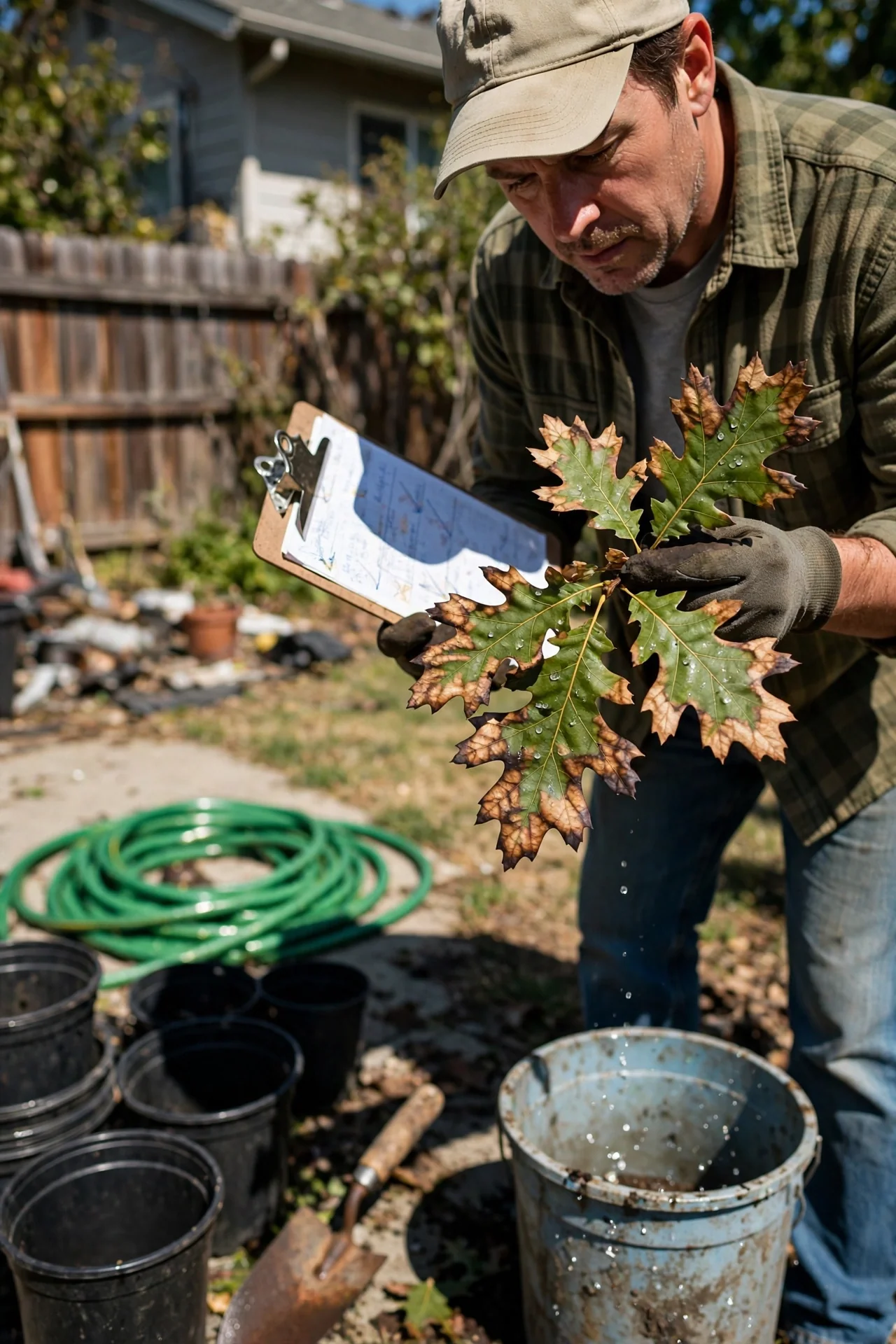
Best for: Branch 1, 2, 3
What it is: Submitting leaf petiole samples to a university plant diagnostic lab for ELISA (enzyme-linked immunosorbent assay) or PCR (polymerase chain reaction) testing to confirm the presence of Xylella fastidiosa. This is the only way to distinguish bacterial leaf scorch from drought stress, salt injury, root damage, or verticillium wilt, all of which produce nearly identical marginal leaf scorch.
Why it matters first: Every management decision downstream depends on an accurate diagnosis. Antibiotic trunk injections cost hundreds of dollars per tree annually and are useless against abiotic stress. Conversely, dismissing true BLS as drought damage delays interventions that could extend the tree’s useful life. The Missouri Botanical Garden notes that BLS can easily be mistaken for oak wilt or Dutch elm disease, except that BLS progresses over years rather than months and lacks sapwood streaking.
Key timing constraint: Submit samples in late summer or early fall (August through October in most of the US), when bacterial populations in the petiole tissue peak. Samples taken in spring or early summer frequently yield false negatives because bacterial concentrations are too low for detection. Collect five to seven 2-cm petiole sections from symptomatic leaves still attached to branches representing at least three different affected limbs.
Common mistake: Sending fully dead, dried, or fallen leaves. Bacteria degrade rapidly in detached, desiccated tissue. Use only freshly collected symptomatic leaves with visible green tissue remaining alongside the brown margin. Package in a sealed plastic bag with a dry paper towel, not wet, and ship overnight if possible.
Confusing BLS with other leaf symptoms is common. Our guide to overwatering symptoms covers another frequent misdiagnosis that produces leaf margin damage from root oxygen deprivation rather than xylem blockage.
2. Antibiotic Trunk Injection (Oxytetracycline)
Best for: Branch 1
Use it when: You have a high-value specimen tree with lab-confirmed BLS at an early stage, typically with scorch affecting less than roughly one-third of the canopy. Research published in Arboriculture & Urban Forestry demonstrated that oxytetracycline injections delayed symptom onset and suppressed symptom development in American elms, with the best results observed in trees that had limited canopy involvement before treatment.
Skip it when: The tree is already in advanced decline with extensive dieback. Antibiotics suppress bacterial populations temporarily but cannot eradicate the pathogen from the xylem. Injections must be repeated annually, and missing a year results in symptom return. Spring applications (April to May) suppress current-year symptoms, while late summer or early fall applications target the following season.
Edge case: Trunk injection creates wounds that can serve as entry points for other pathogens. Only licensed arborists using closed-system injection equipment should perform this procedure. DIY injection attempts risk mechanical damage to the trunk and improper dosing. Our article on tomato bacterial speck illustrates why bacterial diseases in general require precise chemical timing, though the specific products differ.
3. Strategic Pruning and Tool Sanitation
Best for: Branch 1, 2
The threshold that matters: Prune when individual branches show complete leaf scorch or dieback. The pathogen resides in the xylem, and removing infected branches reduces the total bacterial load within the tree. University of Maryland Extension recommends pruning symptomatic branches and dead wood promptly. The key constraint: disinfect pruning tools between every cut using a 10% bleach solution (one part household bleach to nine parts water) or a commercial disinfectant labeled for bacterial pathogens. Skipping this step turns your pruners into an inoculation tool, spreading bacteria from infected to healthy wood on the same tree.
Adjustment for species: Oaks have determinate growth, meaning all leaves on a given branch are the same age and show symptoms simultaneously. Elms and sycamores have indeterminate growth, so scorch appears on older interior leaves first and progresses outward. On indeterminate species, prune when scorch has progressed roughly two-thirds of the way toward the branch tip. Pruning too early removes photosynthetically functional tissue the tree still needs.
For proper disinfection technique, see our detailed guide on how to sanitize garden tools, which covers bleach solution ratios, contact time requirements, and tool maintenance.
4. Mulching and Deep Watering to Reduce Symptom Severity
Best for: Branch 1, 2
The 10-minute workflow: Apply a 2- to 4-inch layer of organic mulch (wood chips or shredded bark) from the trunk out to the dripline, keeping mulch 4 to 6 inches away from the trunk flare. This retains soil moisture, moderates soil temperature, and reduces competition from turf roots. During dry periods when rainfall is less than 1 inch per week, water deeply at the dripline using a soaker hose or slow-drip method for 30 to 60 minutes, delivering water to a depth of 12 to 18 inches where the majority of absorbing roots are located. Avoid frequent, light watering, which encourages shallow rooting and increases vulnerability to drought stress.
Why this works: The mechanism is indirect but well-documented. Xylella fastidiosa clogs xylem vessels, restricting water flow from roots to leaves. A greenhouse study verified that bacterial leaf scorch symptoms are enhanced during drought stress. Maintaining consistent soil moisture reduces the water transport burden on the compromised xylem, so leaves receive more water despite the bacterial blockage. This does not cure the infection but can meaningfully reduce the severity of annual scorch symptoms.
Upgrade option: If soil compaction is present, which is common in urban and suburban landscapes, consider hiring an arborist to perform radial trenching or air spading to decompact the root zone before mulching. Compacted soil restricts root growth and water infiltration, compounding the water stress that BLS-infected trees already experience. Decompaction plus mulching addresses both the biological and physical limitations on water uptake.
Root zone health is foundational. Our article on phytophthora root rot covers another below-ground threat that compromises water uptake and produces above-ground symptoms easily confused with bacterial leaf scorch.
5. Balanced Fertilization Based on Soil Test Results
Best for: Branch 2
What to apply: Use a slow-release, balanced fertilizer only if a soil test confirms specific nutrient deficiencies. Avoid high-nitrogen formulations, which push lush, succulent growth that is more attractive to xylem-feeding insect vectors and more vulnerable to water stress. Extension services recommend maintaining a moderate nitrogen-to-potassium ratio rather than boosting nitrogen alone.
Common oversight: Applying fertilizer without a soil test is a frequent mistake. Excess phosphorus can bind with soil micronutrients, and high nitrogen worsens the tree’s water demand at exactly the time when compromised xylem tissue cannot meet it. Soil tests cost approximately $15 to $30 through university extension services and provide baseline data that prevents counterproductive applications.
6. Growth Regulator Treatments (Paclobutrazol)
Best for: Branch 1
Use it when: You are already committed to antibiotic injections and want to complement them with a treatment that reduces the tree’s water demand. Paclobutrazol is a growth regulator applied as a soil drench around the root flare. It reduces canopy growth and leaf area, which lowers total transpirational water demand, potentially offsetting some of the water stress caused by xylem blockage.
Skip it when: The tree shows more than half canopy dieback. Research on growth regulator effects suggests that paclobutrazol may also have direct inhibitory effects on Xylella fastidiosa itself, but this data comes from in-vitro studies, and field results remain inconsistent. The treatment requires professional application and is typically bundled with antibiotic injection programs by arborist services.
Technical constraint: Paclobutrazol persists in soil and can affect nearby plants. Do not apply it where roots of desirable ornamentals or vegetable gardens extend into the treatment zone. For a broader understanding of how vascular wilt diseases affect plant physiology, read our guide on verticillium wilt in tomatoes, which shares the water-stress symptom pattern.
7. Tree Removal and Safe Disposal
Best for: Branch 3
The threshold rule: Remove the tree when more than two-thirds of the canopy shows scorch symptoms for two consecutive growing seasons, or when dieback affects major scaffold branches, creating a structural hazard. Trees with advanced BLS become susceptible to secondary pests including borers and Armillaria root rot, which accelerate decline and increase the risk of limb failure. The decision to remove is not an admission of failure; it is a recognition that BLS is, by all current scientific consensus, incurable once systemic infection is established.
What changes with timing: Removal in late fall or winter, when insect vectors are inactive, reduces the chance that xylem-feeding leafhoppers will acquire the bacterium from cut wood and transmit it to neighboring trees. If removal during the growing season is unavoidable for safety reasons, cover cut wood with a tarp and remove it from the site promptly. Do not chip infected wood and use it as mulch near susceptible species unless the chips are composted at temperatures exceeding 140 degrees Fahrenheit for several weeks, a condition difficult to achieve in home compost piles.
The disposal constraint that matters: The bacterium does not survive in dead, dry wood indefinitely, but it can persist in living tissue at the base of the trunk and in large roots for some time after the canopy is removed. Stump grinding to below the soil surface eliminates potential reservoirs. Infected leaves should be bagged and disposed of in municipal waste, not added to home compost systems where incomplete heat treatment may fail to kill the pathogen.
Knowing when to remove a plant is a core disease management skill. Our article on fusarium wilt in tomatoes covers similar removal-and-disposal protocols for another vascular pathogen with no curative treatment.
8. Vector Monitoring in Mixed Landscapes
Best for: Branch 2
What to watch for: Sharpshooters, leafhoppers, and spittlebugs are the primary vectors. They are most active from late spring through early fall. Monitor for their presence on the undersides of leaves, particularly on succulent new growth. Insecticidal control of vectors is not practical on landscape trees because leafhoppers are mobile, arrive unpredictably on wind currents, and reinvade rapidly after spraying.
What you can actually do: If you manage multiple trees, prioritize removing the most heavily infected specimens first, as these serve as the primary inoculum reservoir. Reducing pathogen sources in the immediate landscape lowers vector transmission pressure on remaining healthy trees.
9. Resistant Replacement Species for Replanting
Best for: Branch 3
What to plant: After removing a BLS-infected tree, select species with demonstrated resistance or low susceptibility to Xylella fastidiosa. White oak group species (Quercus alba, Quercus bicolor, Quercus macrocarpa) are less commonly infected than red oak group species (Quercus rubra, Quercus palustris). European beech, Kentucky coffeetree, shagbark hickory, and common sassafras have shown resistance in landscape settings and are recommended by several extension services as alternatives.
The constraint: No species is completely immune. The pathogen has an exceptionally broad host range, with over 100 plant species in 30 families reported as hosts, though many remain asymptomatic. Selecting a white oak over a pin oak reduces risk but does not guarantee permanent protection, especially in regions with high disease pressure. Native species adapted to your local soil and climate conditions will generally establish faster and tolerate environmental stress better than non-native alternatives.
Starter Stack (What to Choose First)
Branch 1: Preserve a High-Value Specimen
Start with lab diagnosis (Item 1) plus mulching and deep watering (Item 4). These two actions cost little and provide immediate benefit while you arrange professional consultation. Once BLS is confirmed, add antibiotic trunk injection (Item 2) administered by a licensed arborist. The synergy: mulching and watering reduce the tree’s water stress baseline, which may allow the antibiotic suppression to be more effective since the compromised xylem faces less demand. Expect to spend approximately $75 to $150 for lab testing, $50 to $100 for mulch materials and a soaker hose, and $200 to $500 annually per tree for injection services, depending on tree diameter and local arborist rates.
Branch 2: Manage a Moderate Infection
Start with lab diagnosis (Item 1) plus strategic pruning (Item 3). Confirm the pathogen is present, then remove the most heavily affected branches using sanitized tools. Add mulching and deep watering (Item 4) to reduce environmental stress. These three actions form the core cultural management program recommended by university extension services and require no professional licensing. Expect to spend approximately $75 to $150 for lab testing, plus $30 to $80 for mulch, and a one-time investment of $25 to $50 for quality bypass pruners and a pruning saw.
Branch 3: Remove and Replace
Confirm with lab diagnosis (Item 1) before removal, especially if the tree has significant timber or sentimental value, to ensure you are not removing a tree with a treatable abiotic condition. Once confirmed, proceed with professional tree removal (Item 7), then plant a resistant replacement species (Item 9) in the same season or the following spring. Professional removal costs for a medium to large shade tree typically range from $500 to $2,500 depending on size, location, and accessibility. Replacement saplings cost $50 to $200 depending on species and size.
When This Won’t Work
Failure condition one: the tree was never properly diagnosed. If marginal leaf scorch is caused by drought stress, salt injury, root girdling, or construction damage rather than Xylella fastidiosa, none of the BLS-specific interventions, antibiotics, growth regulators, or specialized pruning protocols, will address the actual problem. Worse, they waste time during which the real issue continues to damage the tree. The alternative action: submit a sample to a diagnostic lab before spending money on any treatment. If the lab returns a negative result for X. fastidiosa, investigate root zone issues, soil compaction, recent grade changes, or de-icing salt exposure as alternative causes.
Failure condition two: the tree’s root system is already severely compromised independent of BLS. Trees growing in restricted root zones, such as street trees in narrow planting strips or trees with construction-damaged roots, face chronic water stress even without a xylem-blocking pathogen. Adding BLS on top of a pre-existing root limitation means that cultural practices like mulching and watering, while still beneficial, cannot overcome the combined stress of bacterial blockage plus inadequate root volume. In these cases, the tree will continue to decline regardless of intervention. The alternative action: if a tree with BLS also has a severely restricted root zone (less than approximately 200 square feet of open soil for a mature tree), prioritize removal and replacement with a species tolerant of both the site conditions and the regional disease pressure.
For a broader understanding of how underlying plant stress amplifies disease severity, see our article on fusarium wilt in tomatoes, where the same interaction between pathogen load and environmental stress determines outcomes.
Choosing the Right Option for Your Situation
Budget Threshold
If your annual budget for tree care is under $150, focus exclusively on cultural practices: mulching once per year, deep watering during drought, and pruning with sanitized tools. Do not pursue antibiotic injections, which cost $200 to $500 per tree annually and require indefinite repetition. Trees in this budget tier are best managed under Branch 2 or, if infection is advanced, removed under Branch 3.
Time Threshold
If you cannot commit to at least two deep-watering sessions per month during the growing season (June through September in most regions), the mulching and watering strategy will be inconsistently applied and less effective. Inconsistent care produces inconsistent results. If your schedule does not allow this commitment, and the tree is a high-value specimen, budget for professional irrigation management or accept that the tree will decline faster than it would with consistent care.
Technical Constraint: Trunk Diameter and Injection Feasibility
Antibiotic trunk injection requires a minimum trunk diameter of approximately 4 inches at breast height (DBH) for most injection systems to seat properly without excessive wounding. Trees smaller than this are generally not candidates for injection. Additionally, trees with extensive trunk decay, cavities, or previous injection damage may not have sufficient sound wood to accept new injection sites without creating more harm than benefit.
Yes/No Checklist:
Has a diagnostic lab confirmed Xylella fastidiosa? If no, do not proceed with any BLS-specific treatment.
Is the tree’s landscape value high enough to justify annual treatment costs? If no, focus on cultural care or removal.
Is more than two-thirds of the canopy showing scorch? If yes, removal is likely the most responsible choice.
Can you commit to consistent watering during dry periods? If no, expect faster decline regardless of other actions.
Expert Q&A
Can bacterial leaf scorch spread through root grafts between adjacent trees?
Root graft transmission has been reported in the scientific literature and is a concern for trees of the same species growing within close proximity, particularly oaks. Unlike insect vector transmission, which is unpredictable, root graft transmission creates a direct vascular connection between an infected and healthy tree. If you have multiple oaks growing within 20 to 30 feet of each other and one is confirmed infected, monitor the neighboring trees for early symptoms and consider preemptive removal of the infected tree to sever the graft pathway.
Can I compost leaves from a BLS-infected tree?
Home composting is not recommended for BLS-infected leaves. The bacterium can survive in plant tissue until it fully desiccates, and most home compost piles do not reach or sustain the temperatures above 140 degrees Fahrenheit needed to reliably kill Xylella fastidiosa. Bag infected leaves and dispose of them through municipal waste collection. Commercial composting facilities that meet regulatory time-and-temperature standards may achieve pathogen kill, but verify their protocols before dropping off material.
Does bacterial leaf scorch affect all oak species equally?
No. Red oak group species (pin oak, northern red oak, scarlet oak, shingle oak, southern red oak) are highly susceptible and frequently infected. White oak group species (white oak, bur oak, swamp white oak) are less commonly infected and, when infected, tend to show less severe symptoms and slower decline. Bur oak is susceptible but infrequently infected in landscape surveys. This difference in susceptibility is the basis for recommending white oak species as replacement trees in areas with high disease pressure.
Can a tree recover from bacterial leaf scorch on its own?
No documented case of spontaneous recovery exists in the peer-reviewed literature. The bacterium is systemic once established, residing in the xylem tissue throughout the tree. Symptom severity can fluctuate from year to year, with wet, cool summers producing milder symptoms and hot, dry summers producing severe scorch, but the underlying infection is permanent. A tree that appears to improve after a mild growing season will show symptoms again the following year, and the long-term trajectory is progressive decline.
Is there any risk of BLS spreading from landscape trees to vegetable gardens?
The subspecies of Xylella fastidiosa that causes bacterial leaf scorch in shade trees (X. fastidiosa subsp. multiplex) is generally distinct from the subspecies that causes disease in agricultural crops. However, the pathogen’s host range is broad, and some landscape hosts can serve as reservoirs for strains that affect nearby commercial plantings. In regions where Pierce’s disease of grapes is a concern, controlling BLS in landscape trees near vineyards is a recommended practice. For home gardeners, the risk of transmission from a shade tree to tomato plants or other vegetables is low but not zero. Monitor garden plants for unusual leaf scorch symptoms and submit samples for testing if concerns arise.
Conclusion
Bacterial leaf scorch forces a decision that no gardener wants to make: invest in a tree you cannot cure, or remove a tree you have watched grow for years. The single biggest mistake is delaying the triage decision. Trees in Branch 1 decline into Branch 3 while the owner tries one more home remedy, and the window for effective antibiotic suppression narrows each season.
Your next step depends on your branch. If you have a high-value tree with limited symptoms, contact a licensed arborist for a diagnostic lab submission and treatment consultation. If you are managing a moderate infection, begin the mulching and pruning protocol this season. For practical guidance on distinguishing plant symptoms caused by pathogens versus environmental stress, read our powdery mildew treatment guide, which covers another common disease where correct identification determines the entire management approach.