
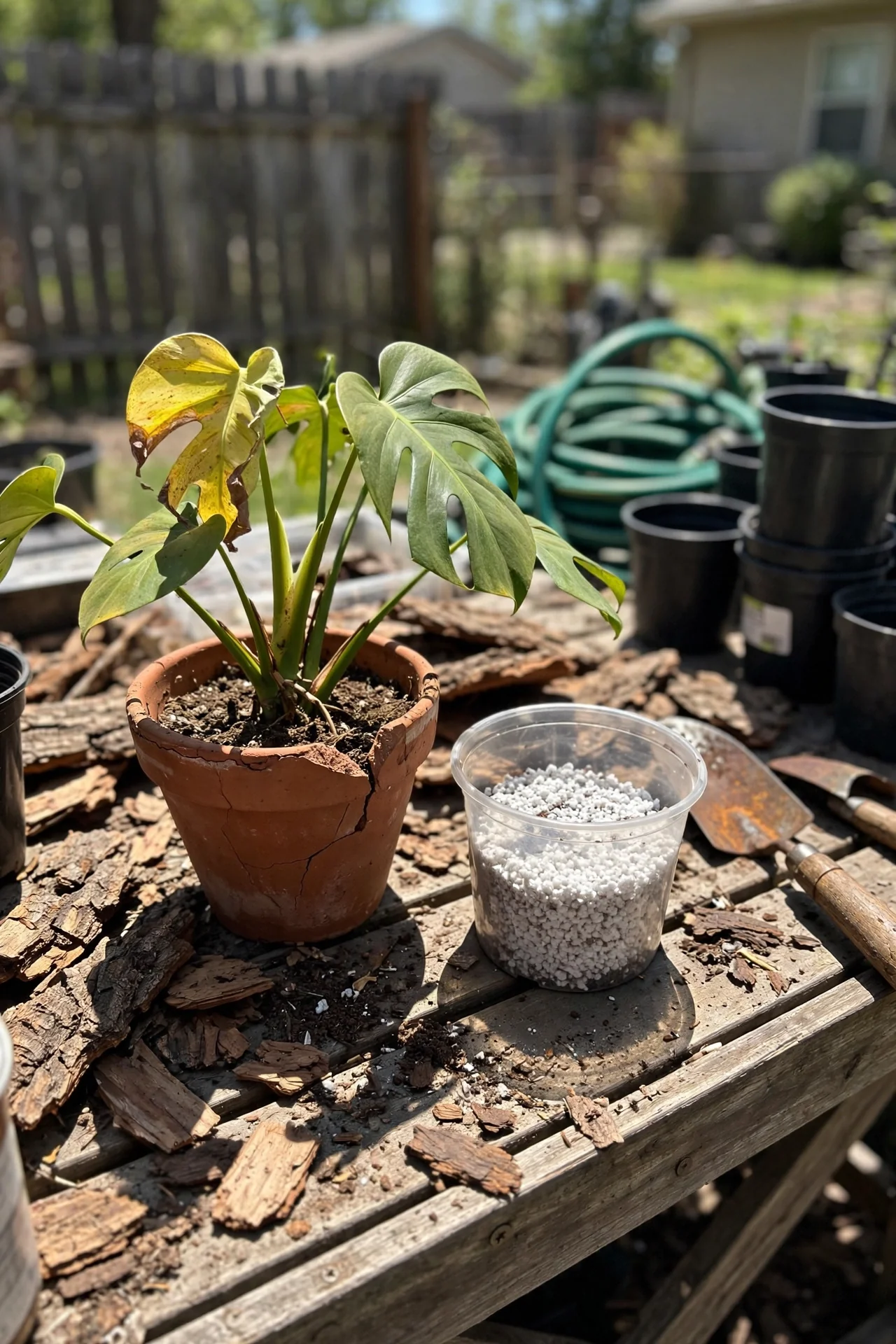
Most aroid soil mix recipes hand you a ratio and walk away. That approach assumes all growing environments are identical. They are not. A mix that drains perfectly in humid Atlanta can desiccate roots in arid Denver within 48 hours. The missing piece in almost every recipe is a diagnosis step: what is your plant actually telling you, and which mix adjustment does that signal demand.
This guide covers soil mixes for plants in the Araceae family: Monstera, Philodendron, Anthurium, Alocasia, Syngonium, Pothos, and similar genera. It excludes semi-hydroponic setups and pure sphagnum moss propagation, which operate under different moisture dynamics. Every recipe below is a starting point, not a universal prescription.
By the end, you will be able to read three common distress signals, identify which branch of the Decision Grid matches your situation, and select a specific mix with clear trade-offs. You will also know when the problem is not the soil at all.
Bottom line: Pick your mix based on the failure mode you are currently experiencing, not the recipe that worked for someone else’s humidity level.
The Yield Grid Decision Grid
Start here. Each branch corresponds to a measurable condition in your home or your plant’s behavior. Choose the branch that fits, then jump to the recommended items.
Branch 1: “My soil stays wet for more than 5 days after watering.” This is a drainage failure. Your mix needs larger particle sizes and fewer water-holding components. In cool or low-light rooms, water evaporation slows further, compounding the problem. Recommended: Items 1, 4, 7, 10 below.
Branch 2: “My plant needs water every 2 days or leaves curl by day 3.” This is a moisture-retention failure. Your mix is too porous for your humidity level or pot material. Terracotta pots and forced-air heating both accelerate drying. Recommended: Items 2, 5, 8, 11 below.
Branch 3: “Growth has stalled but roots look healthy and watering seems fine.” This is often a nutrient-access or pH problem, not a watering problem. The mix may be structurally sound but biologically inert, or the pH may be locking out nutrients. For a deeper dive into how soil structure influences nutrient availability, see our guide to potting soil ingredients. Recommended: Items 3, 6, 9, 12 below.
Quick Comparison Table
| Option | Key Mechanism | Best For | Decision Grid Branch | Reapply Class |
|---|---|---|---|---|
| 1. Maximum Drainage Chunky Mix | Large-particle air gaps prevent perched water | Chronic overwaterers, low-light rooms | Branch 1 | Monthly (fertilizer) |
| 2. Balanced 5-Ingredient Starter | Equal-part simplicity with moderate water holding | First-time mixers, average indoor humidity | Branch 2 | Monthly (fertilizer) |
| 3. Worm Casting-Enriched Living Mix | Microbial activity releases nutrients slowly | Plants showing stalled growth with healthy roots | Branch 3 | Once-per-season (top-dress) |
| 4. Bark-Free Mineral Mix | Inert minerals eliminate decomposition variables | Humidity above 60%, cabinets, terrariums | Branch 1 | Weekly (liquid fertilizer) |
| 5. Coco Coir Heavy Retention Mix | High cation exchange capacity holds water and nutrients | Arid climates, terracotta pots, forced-air rooms | Branch 2 | Biweekly (fertilizer) |
| 6. Acidic Peat-Based Mix | Low pH (5.0–5.8) improves micronutrient uptake | Alocasia, Anthurium with chlorosis symptoms | Branch 3 | Monthly (pH check) |
| 7. Pumice-Forward Gritty Mix | Angular pumice resists compaction for years | Large pots, infrequent repotters | Branch 1 | Monthly (fertilizer) |
| 8. Sphagnum Moss Hybrid | Fibrous moss bridges drainage and moisture retention | Fine-rooted aroids, recovery mixes | Branch 2 | Biweekly (monitoring) |
| 9. Biochar-Amended Structured Mix | Biochar houses beneficial microbes long-term | Collectors seeking long-term soil stability | Branch 3 | Once-per-season (top-dress) |
| 10. Pre-Mixed Commercial Option | Professionally blended, consistent particle sizing | Limited storage space, beginners | Branch 1 | Monthly (fertilizer) |
1. Maximum Drainage Chunky Mix
Best for: Branch 1 (soil staying wet beyond 5 days).
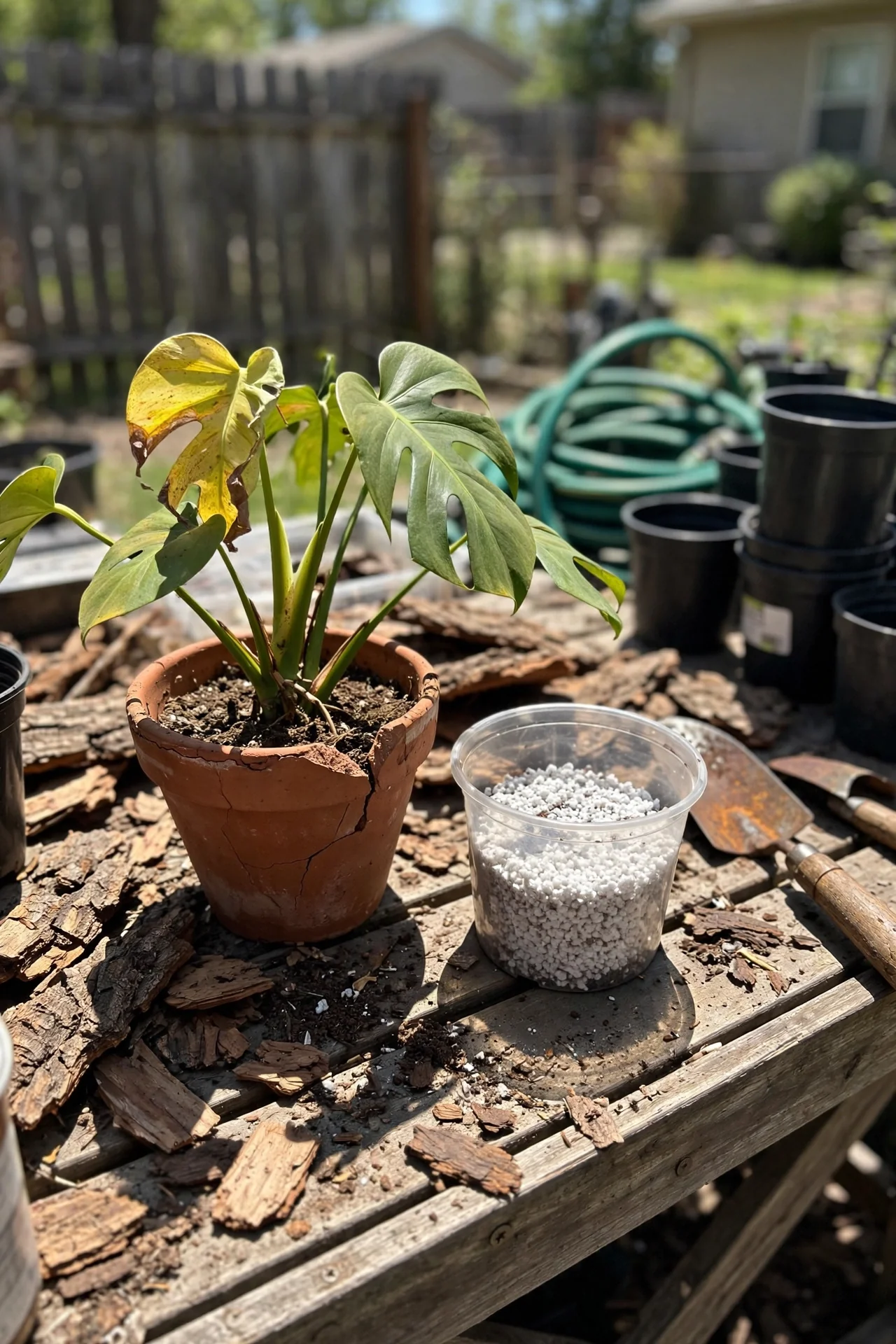
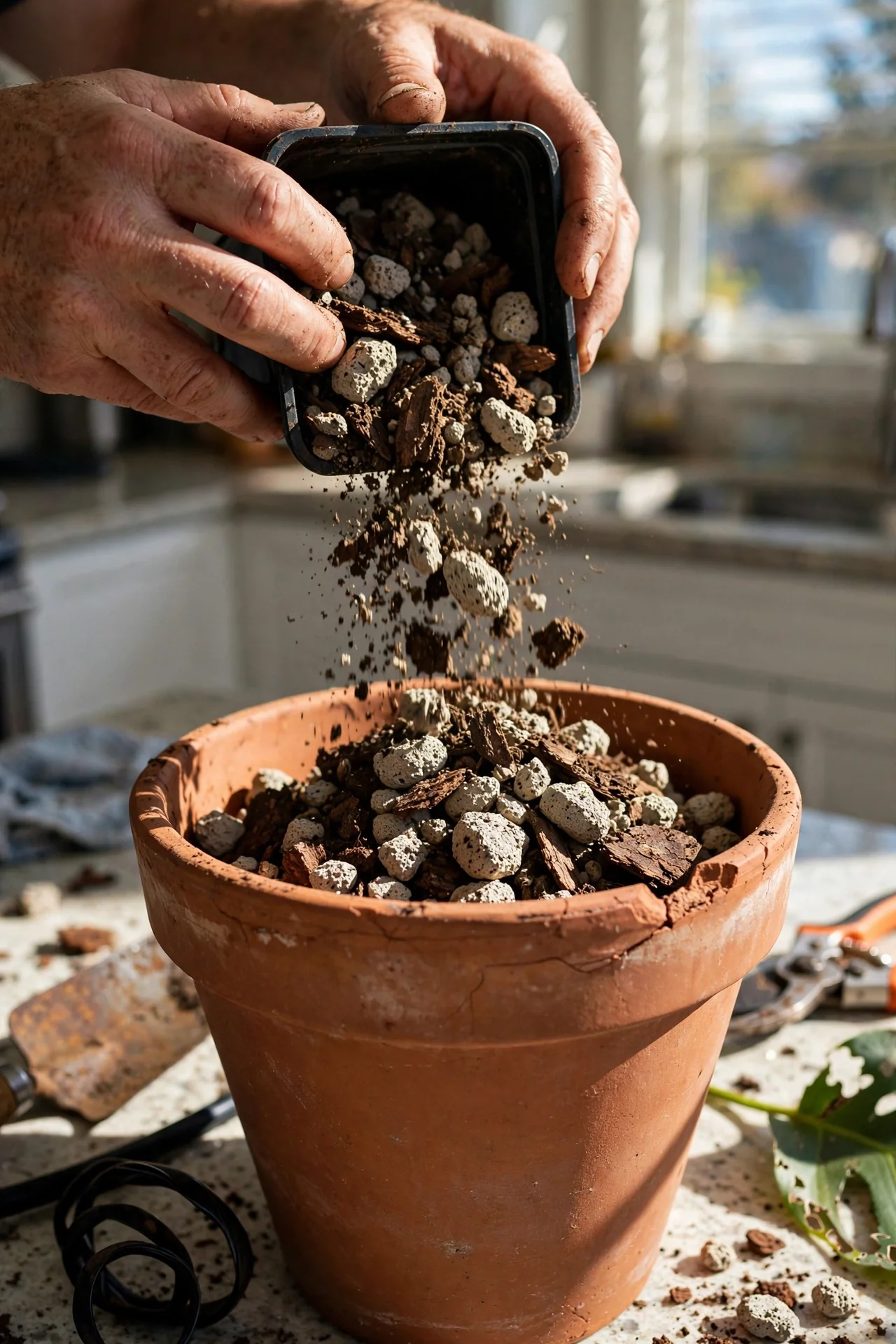
Blueprint. What: A mix where drainage components dominate, minimizing the capillary action that keeps water suspended in finer particles. For: Growers battling persistently damp soil, especially in low-light winter conditions when evaporation rates drop. Steps: Combine 5 parts orchid bark (15–25 mm pieces), 3 parts pumice or coarse perlite (grade 3 or larger), 1 part horticultural charcoal, and 1 part coco chips. Skip coco coir entirely. Common mistake: Using fine-grade perlite instead of coarse; fine perlite compacts within 6 months and defeats the purpose. This mix dries from edge to center in roughly 3–4 days under average indoor conditions. If you are deciding between drainage materials, our comparison of perlite versus pumice breaks down the structural differences.
2. Balanced 5-Ingredient Starter
Best for: Branch 2 (plant drying out too quickly).
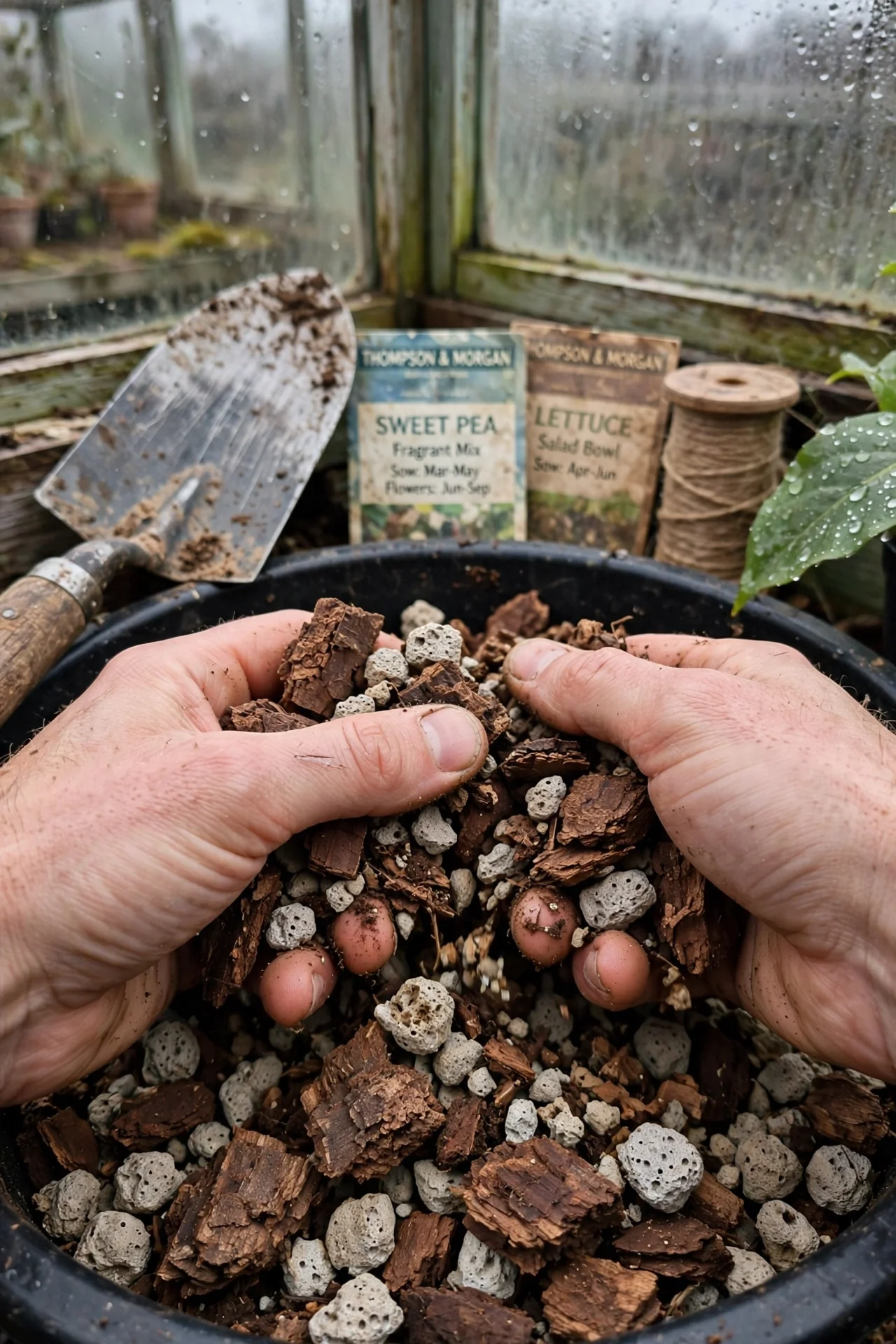
Threshold rule. This recipe uses a 2:1:1:0.5:0.5 ratio by volume: orchid bark, coco coir, perlite, worm castings, charcoal. If your indoor humidity stays below 35% for more than half the year, increase coco coir by half a part. If humidity exceeds 55%, reduce it by the same amount. The mix holds structure for roughly 10–14 months before bark begins breaking down.
3. Worm Casting-Enriched Living Mix
Best for: Branch 3 (stalled growth with healthy roots).
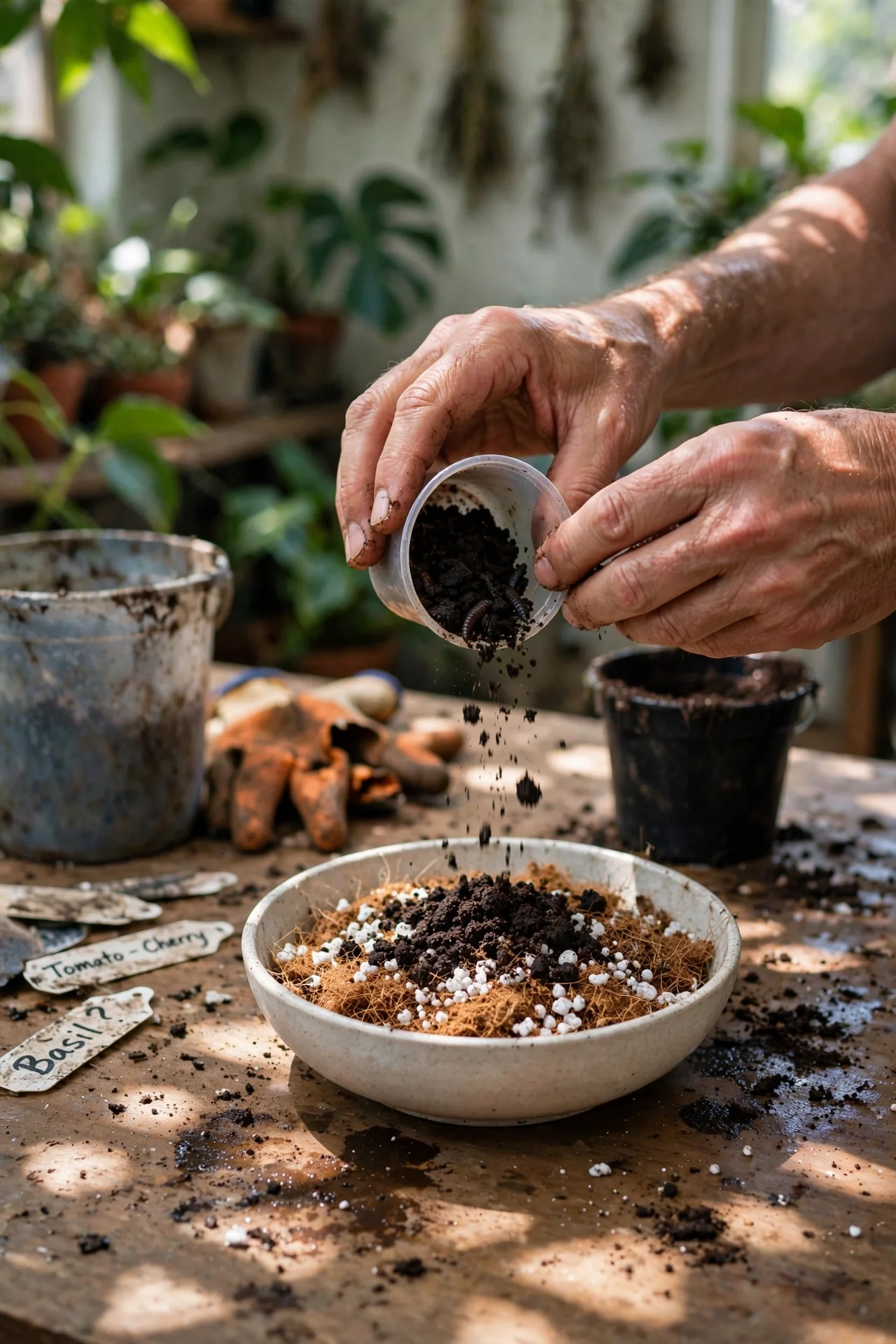
Use vs skip. Use when: Your plant pushes new leaves but they emerge small or pale, and you have ruled out light deficiency. Worm castings introduce a microbial community that mineralizes organic matter into plant-available nutrients over weeks, not hours. Skip when: You rely on liquid synthetic fertilizers; the salt buildup from synthetics can suppress the microbial activity you are paying for with castings. The base recipe is 3 parts orchid bark, 2 parts coco coir, 2 parts pumice, and up to 2 parts worm castings. Edge case: in pots smaller than 10 cm diameter, cut castings to 1 part to avoid water-holding overload. For more on building biologically active substrates, read our terrarium potting mix guide, which covers closed-system soil biology.
4. Bark-Free Mineral Mix
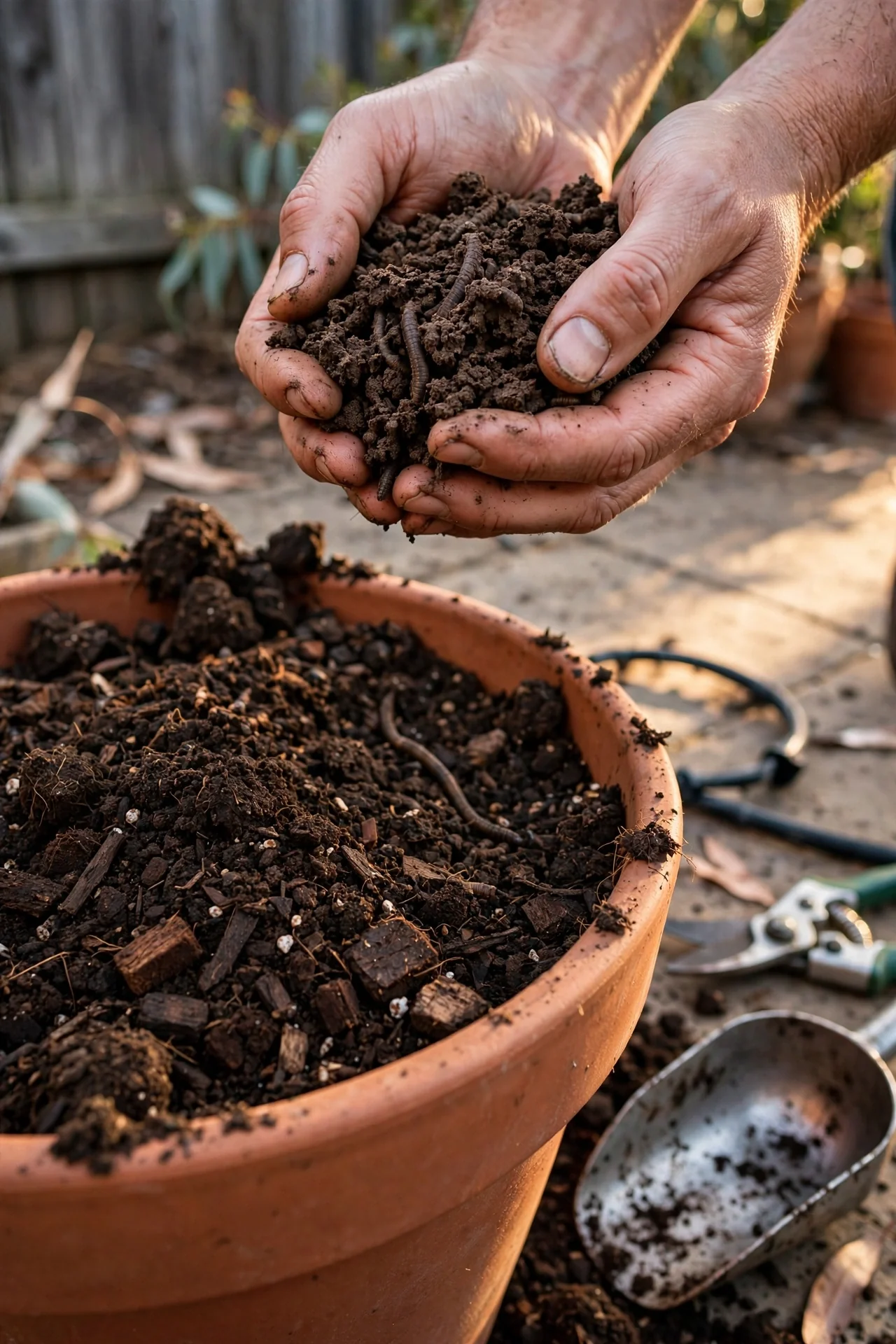
Best for: Branch 1 (high-humidity environments).
10-minute workflow. Step 1: Rinse pumice and LECA until runoff runs clear (2 minutes). Step 2: Combine 4 parts pumice, 3 parts LECA (8–12 mm), 2 parts coarse perlite, and 1 part zeolite in a dry bucket (3 minutes). Step 3: Pre-soak the blend for 10 minutes before potting to saturate the zeolite, which then releases moisture slowly (5 minutes prep). Upgrade option: add 0.5 parts crushed oyster shell if your water source has a pH below 6.0; the calcium carbonate buffers against acidification over time.
5. Coco Coir Heavy Retention Mix
Best for: Branch 2 (arid climates, terracotta pots).
Threshold rule. Use 4 parts coco coir, 3 parts orchid bark, 1 part perlite, and 1 part worm castings. The critical number: after watering, the top 2.5 cm of this mix should feel dry to the touch within 48–72 hours. If it stays wet longer, reduce coir by 1 part and replace with bark. If it dries in under 24 hours, increase coir by 0.5 parts. Coco coir’s cation exchange capacity (roughly 40–100 meq/100g) means it also holds fertilizer ions; reduce liquid feed concentration by roughly one-third compared to what you would use in a bark-heavy mix.
6. Acidic Peat-Based Mix
Best for: Branch 3 (Alocasia, Anthurium with chlorosis).
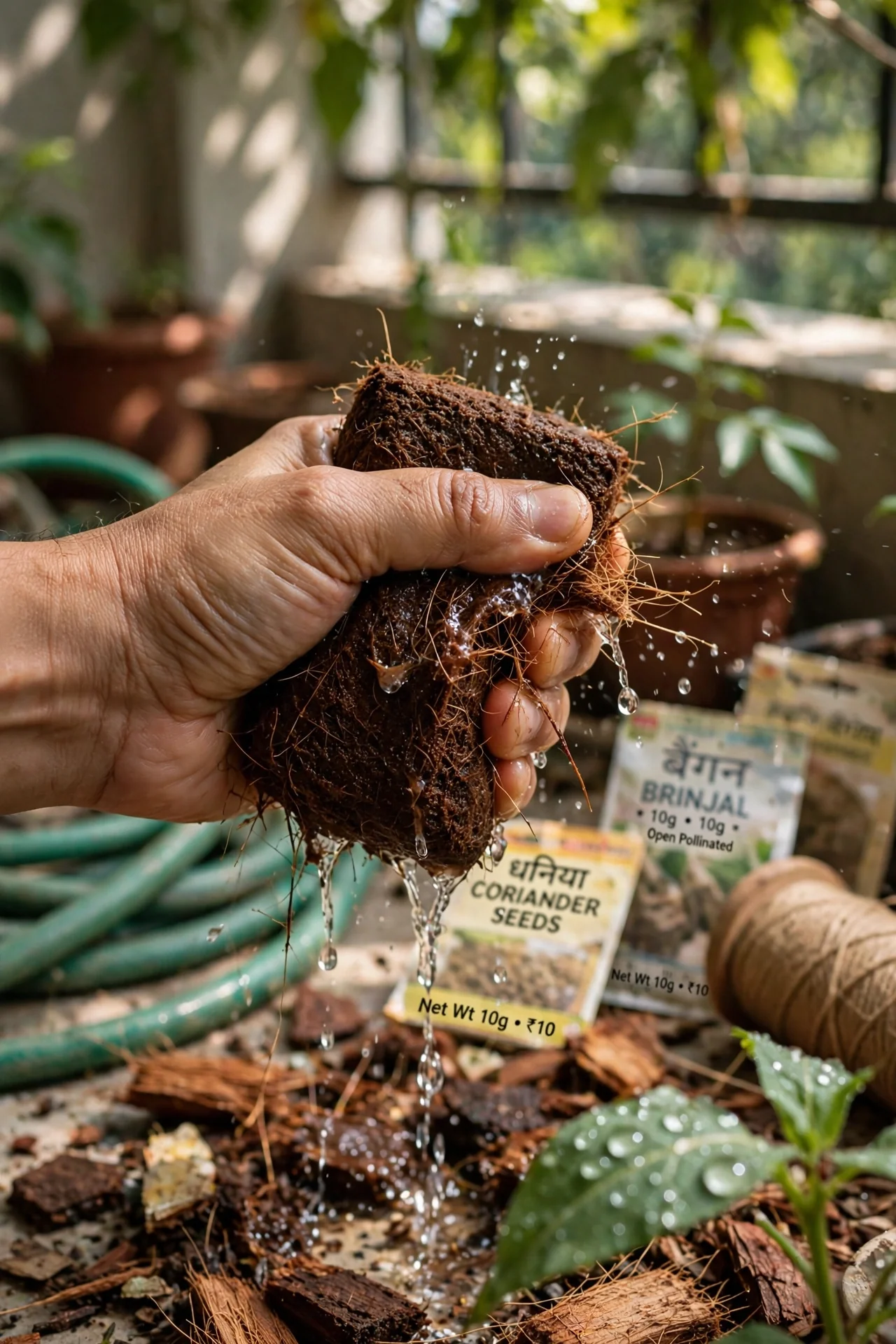
Use vs skip. Use when: Interveinal chlorosis appears on new growth despite regular fertilizing, which suggests micronutrient lockout from high pH. Sphagnum peat moss naturally buffers between pH 5.0 and 5.8, improving iron and manganese availability. Skip when: You water with already-soft or low-pH rainwater; the combination can push pH below 4.8, at which point aluminum toxicity becomes possible. Recipe: 3 parts peat moss, 3 parts orchid bark, 2 parts perlite, 1 part charcoal. Edge case: rinse peat briefly before mixing to remove fines that can form a hydrophobic crust. For related species-specific guidance, see our Syngonium soil mix recipe.
7. Pumice-Forward Gritty Mix
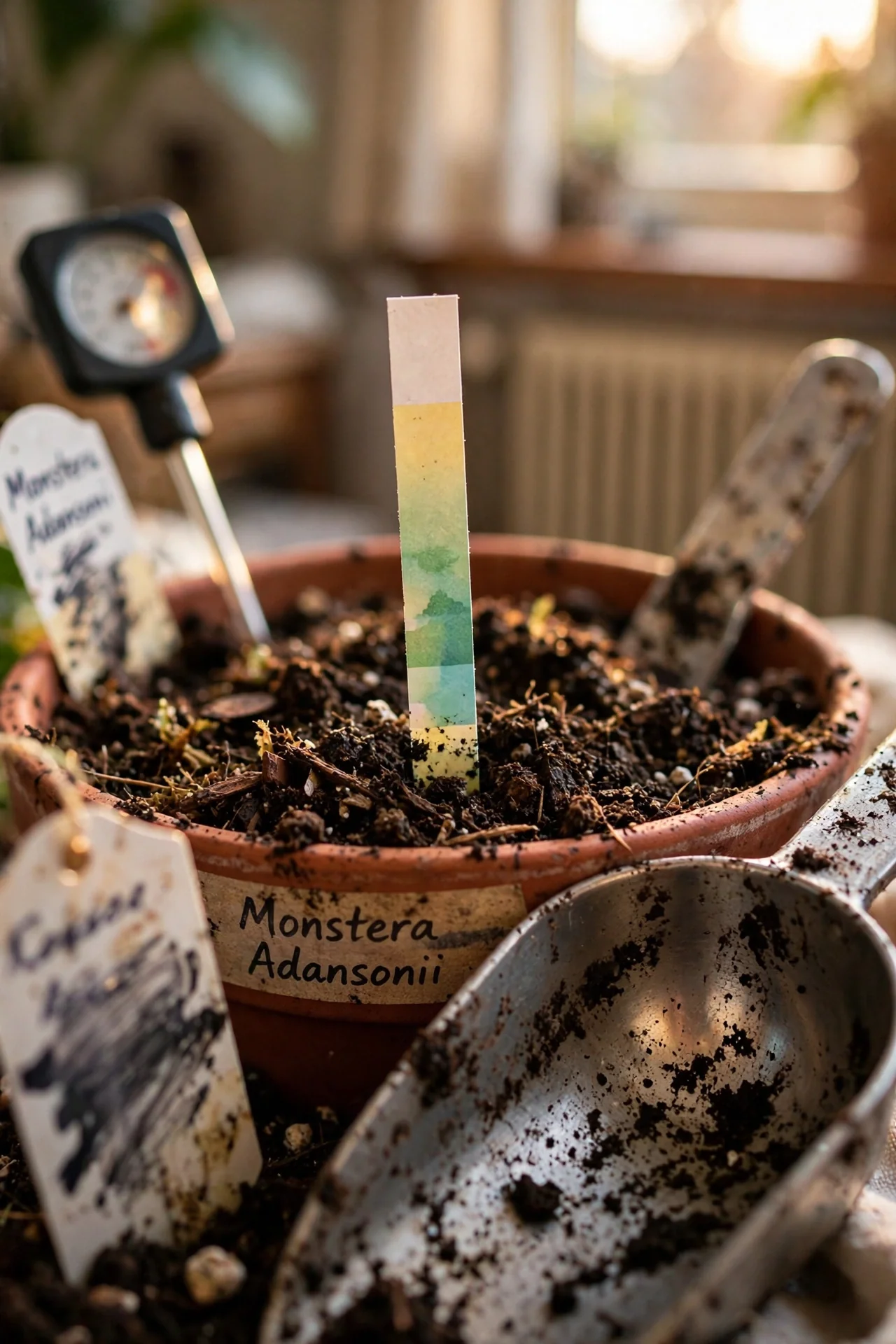
Best for: Branch 1 (large pots, infrequent repotting).
Blueprint. What: A mineral-heavy mix where angular pumice particles resist the compaction that rounds perlite particles. For: Pots larger than 25 cm diameter, where the weight of the soil column compresses lower layers over time. Steps: Mix 4 parts pumice (5–8 mm), 3 parts orchid bark, 2 parts coco chips, and 1 part charcoal. Common mistake: Substituting all pumice with perlite; perlite crushes under its own weight in deep pots, collapsing air channels within 8–12 months. Pumice maintains structure for 3–5 years. The trade-off is weight: a filled 30 cm pot may weigh 3–5 kg more than a perlite equivalent.
8. Sphagnum Moss Hybrid
Best for: Branch 2 (fine-rooted aroids, stressed plants).
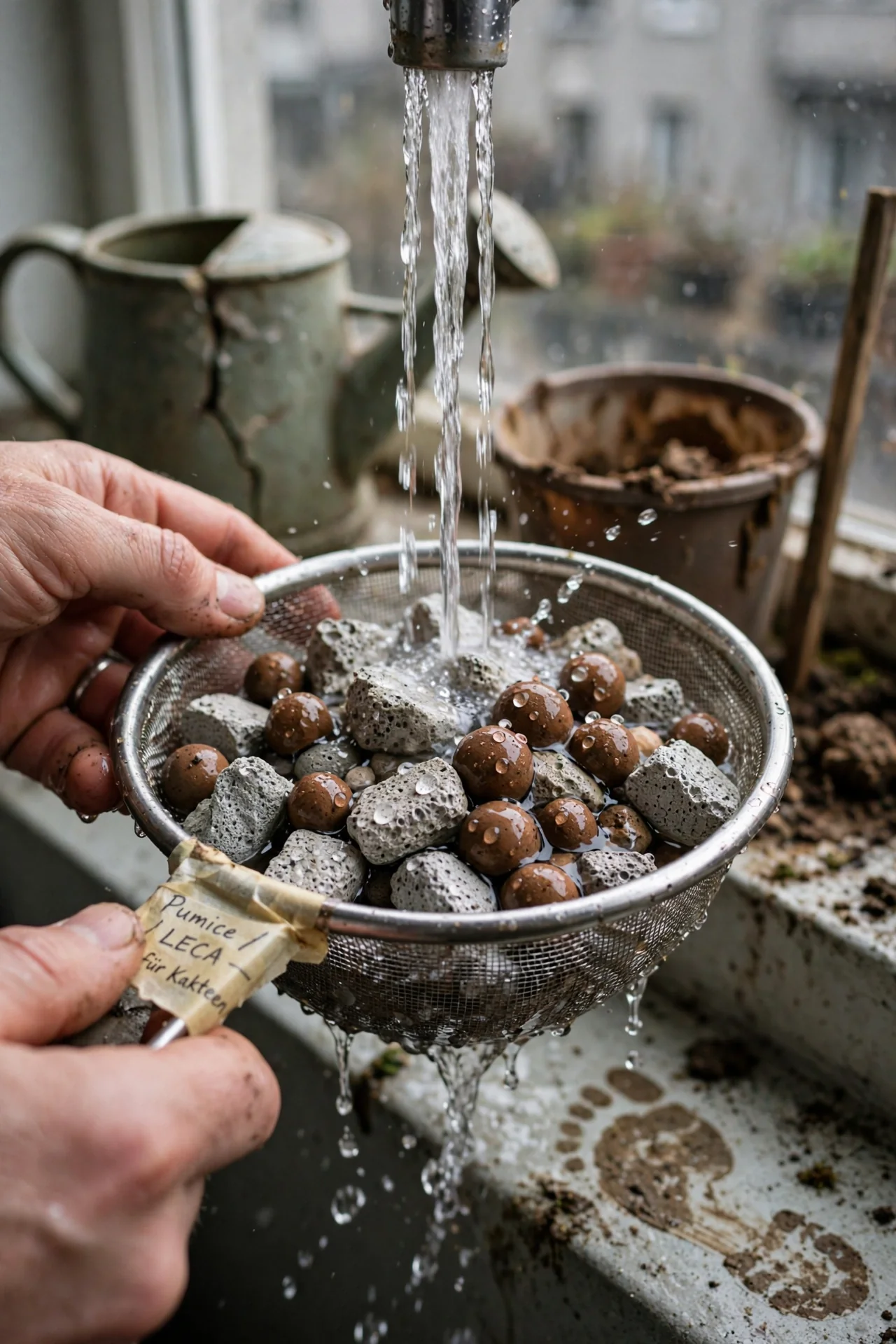
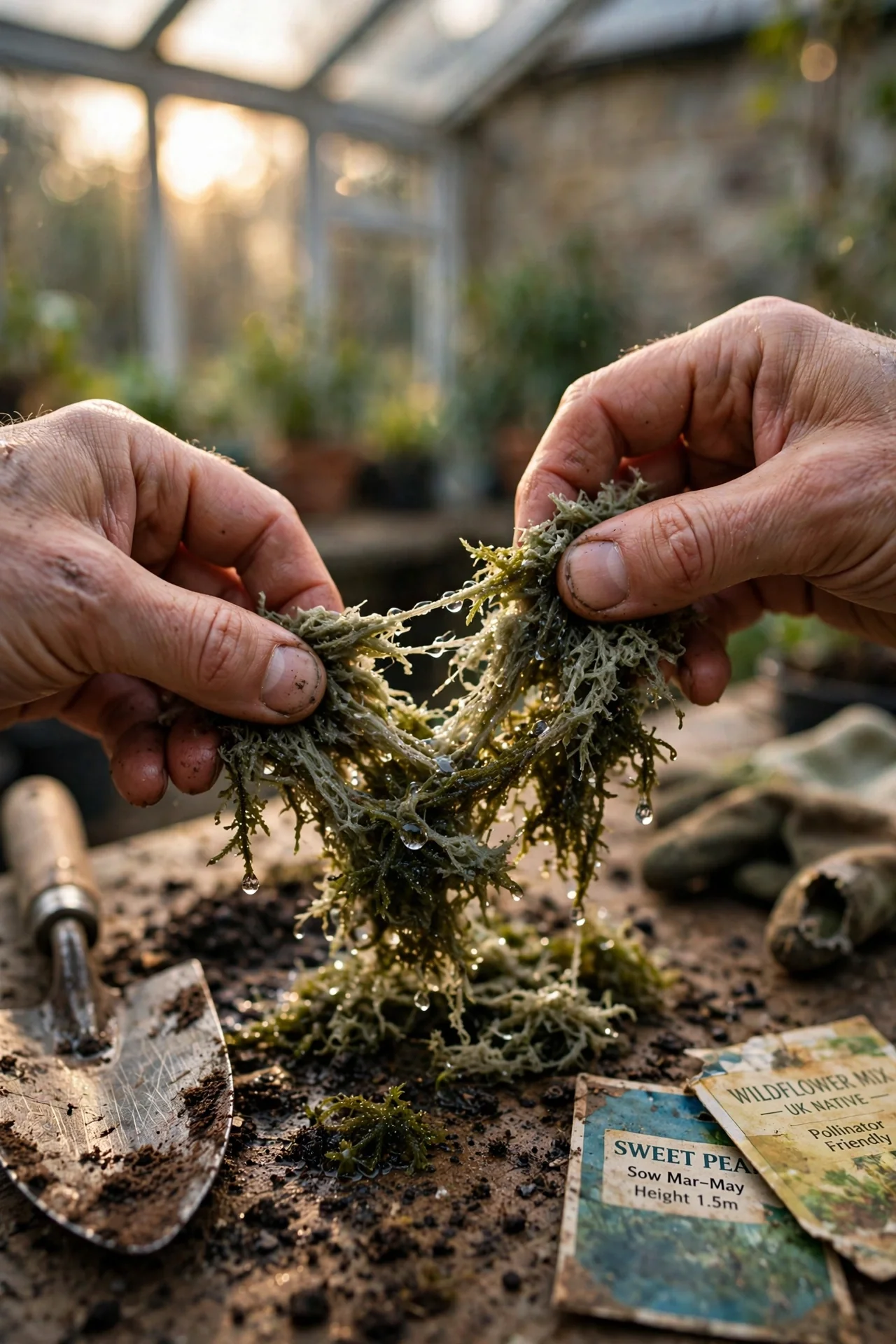
10-minute workflow. Step 1: Soak compressed sphagnum moss in water for 15 minutes, then squeeze to the consistency of a damp sponge (parallel task). Step 2: Combine 3 parts soaked moss, 2 parts orchid bark, and 1 part perlite (3 minutes). Step 3: Fluff the mixture by hand until moss strands are evenly distributed, not clumped (2 minutes). Upgrade option: dust the moss layer with a pinch of mycorrhizal inoculant before potting; sphagnum’s high surface area gives fungal hyphae an ideal colonization substrate.
9. Biochar-Amended Structured Mix
Best for: Branch 3 (collectors seeking long-term stability).
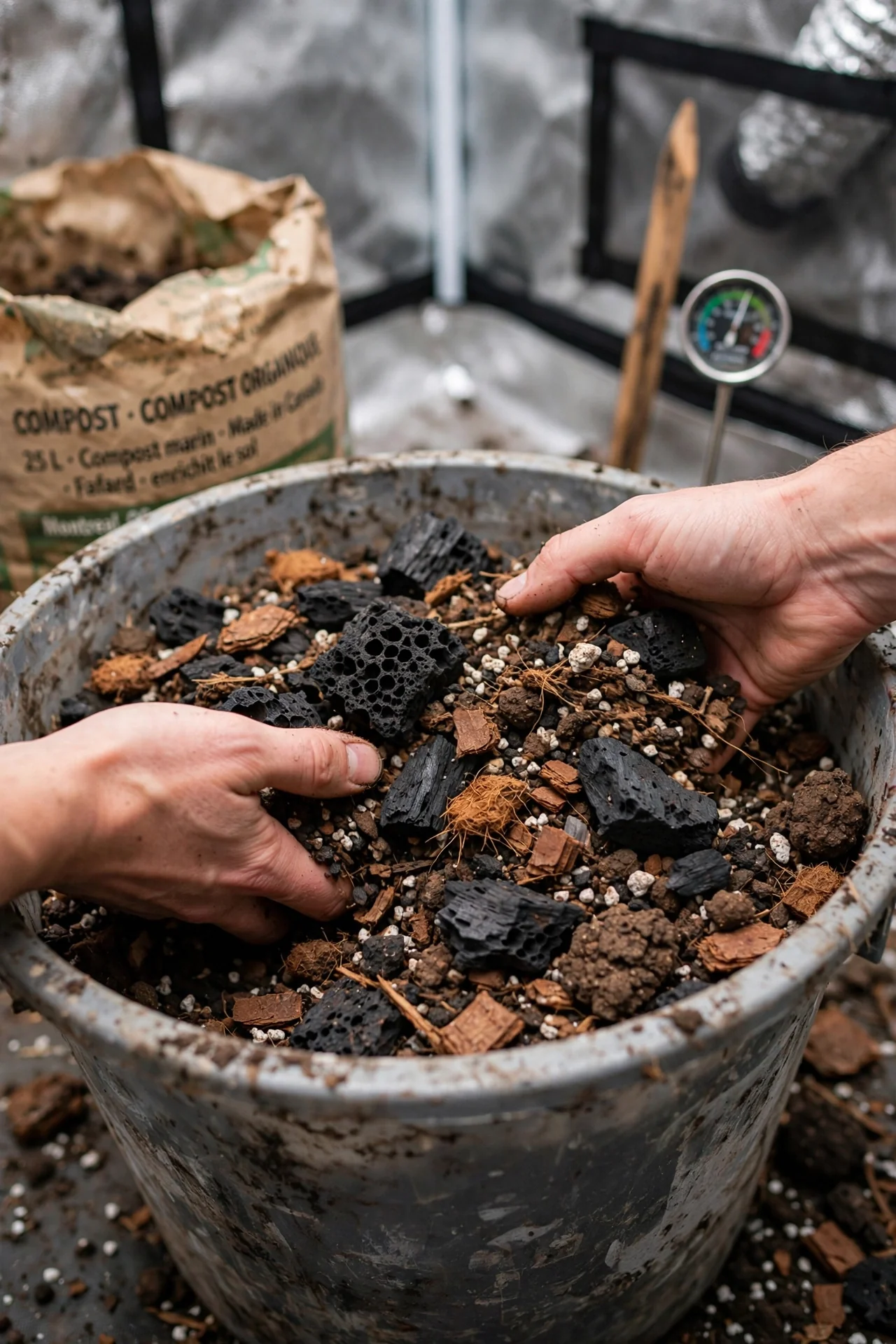
Threshold rule. The number that matters: biochar should make up no more than 5–7 parts per 100 of total mix volume. Above this, biochar’s high surface area can adsorb and temporarily immobilize nitrogen, creating a deficiency that resolves only after the char reaches saturation (typically 4–6 weeks). Pre-charge biochar by soaking it in compost tea or a diluted fish emulsion for 24 hours before mixing. Base recipe: 3 parts orchid bark, 3 parts coco coir, 2 parts pumice, 1 part pre-charged biochar, 1 part worm castings. This mix improves with age as microbial films coat the char surfaces. For plants that prefer a different structural approach, our Philodendron soil recipe offers an alternative framework.
10. Pre-Mixed Commercial Option
Best for: Branch 1 (limited storage, beginners wanting consistency).
Use vs skip. Use when: You lack storage for bulk ingredients or want a professionally blended mix with consistent particle sizing, which is difficult to achieve when hand-mixing small batches. Commercial aroid mixes from reputable suppliers typically contain bark, coir, perlite, charcoal, and castings in pre-optimized ratios. Skip when: You need to adjust a single component for a specific plant; opening a pre-mixed bag gives you no control over individual ingredient proportions. Most commercial options cost roughly $15–$30 USD per 8–10 dry quarts, compared to roughly $4–$8 per quart for equivalent DIY ingredients bought in bulk. Storing leftover mix correctly matters; our potting soil storage guide covers how to keep opened bags viable for 12 months or longer.
Starter Stack (What to Choose First)
Branch 1 Starter: Drainage Priority
Start with Item 1 (Maximum Drainage Chunky Mix) as your base and keep Item 10 (Pre-Mixed Commercial Option) as a backup for weeks when you lack mixing time. Together they guarantee you always have a fast-draining option available. The chunky mix gives you control over particle size; the commercial bag ensures consistency. Estimated cost for both: $25–$55 USD for enough material to pot 4–6 medium plants. Time investment: 30 minutes for the DIY mix, zero for the commercial option.
Branch 2 Starter: Retention Priority
Start with Item 2 (Balanced 5-Ingredient Starter) and add Item 5 (Coco Coir Heavy Retention Mix) for plants in terracotta or dry rooms. The balanced mix covers most plants; the coir-heavy variant solves the specific problem of pots that dry out in under 48 hours. Estimated cost: $20–$40 USD for ingredients covering roughly 8–12 liters of finished mix. If you use soil moisture meters to decide when to water, our soil moisture meter guide can help you calibrate readings to your new mix’s drying curve.
Branch 3 Starter: Biology Priority
Start with Item 3 (Worm Casting-Enriched Living Mix) and pair it with Item 9 (Biochar-Amended Structured Mix). The casting mix delivers short-term microbial activity; the biochar mix builds long-term soil structure that improves for multiple growing seasons. Together they address both immediate nutrient access and multi-year substrate stability. Estimated cost: $30–$50 USD for ingredients. Time investment: 45 minutes for initial mixing, then top-dressing once per season.
When This Won’t Work
Failure condition 1: Your water source has extreme chemistry. If your tap water measures above pH 8.0 or below pH 5.0, no soil mix alone will compensate. Highly alkaline water will gradually raise the pH of any peat- or bark-based mix, while extremely acidic water (common with some well systems) can strip cations from coir and castings. The alternative: test your water pH and, if outside the 6.0–7.5 range, use filtered or adjusted water before blaming the soil mix. A digital pH meter gives you this number in seconds.
Failure condition 2: The plant’s root system is already compromised. Repotting a plant with active root rot into a fresh aroid mix will not save it if more than roughly 60 percent of the root mass is brown or mushy. The new mix cannot reverse tissue death. The alternative: trim away all rotting roots, rinse the remaining healthy roots in a dilute hydrogen peroxide solution (1 part 3% peroxide to 3 parts water), and root the plant in damp sphagnum moss until new root growth appears. Only then transition to an aroid mix. For plants recovering from root loss, see our potting mix for cuttings guide, which covers low-nutrient, high-aeration substrates suited to root regeneration.
Choosing the Right Option for Your Situation
Budget Threshold
If your total budget for soil ingredients is under $25 USD, prioritize Items 2 and 5. Both use widely available, lower-cost materials: coco coir, perlite, and basic orchid bark. Avoid Items 4, 7, and 9, which require specialty materials (zeolite, pumice in bulk, pre-charged biochar) that are harder to source in small quantities. Buying ingredients in larger bags (8–10 quarts or more) typically drops the per-quart cost noticeably compared to small retail packages.
Time Threshold
If you can dedicate at most 20 minutes per month to soil maintenance, choose Items 3, 9, or 10. Items 3 and 9 require only a once-per-season top-dress with worm castings or compost. Item 10 requires zero mixing time. Avoid Items 4 and 8: the mineral mix needs weekly liquid fertilization, and the sphagnum hybrid needs biweekly moisture monitoring because moss dries unevenly.
Technical Constraint: Pot Material
Terracotta pots wick moisture through their walls, effectively increasing evaporation by an estimated 20–40% compared to glazed ceramic or plastic. If you use terracotta, shift one branch toward retention: if you would otherwise choose a Branch 1 mix, use a Branch 2 mix instead. Conversely, plastic and glazed pots retain moisture; if you use them and already struggle with wet soil, Branch 1 mixes are non-negotiable.
Yes/No Checklist:
☐ My plant shows a clear distress signal that matches one of the three Decision Grid branches.
☐ I know my indoor humidity range (hygrometer reading from the room where the plant lives).
☐ I have checked my water pH at least once in the past 6 months.
☐ I am willing to adjust the recipe by half a part if the first result is not right.
Expert Q&A
Can I use garden soil instead of potting mix for aroids?
Garden soil compacts in containers because it lacks the aggregate structure needed for drainage in a confined volume. Field soil depends on earthworms and freeze-thaw cycles to maintain aeration, neither of which exist indoors. Use it only as a minor amendment (less than 10 parts per 100 of total mix) if at all.
Why does my aroid mix become hydrophobic after a few months?
Peat and finely ground coco coir can develop a waxy, water-repellent crust when they dry completely. The fix is to bottom-water the pot for 20–30 minutes or add a drop of unscented liquid soap per liter of water as a surfactant. Prevention requires never letting the mix become bone-dry between waterings.
Should I sterilize my DIY aroid mix before use?
Sterilization is unnecessary for most indoor applications and counterproductive if you want microbial activity. The exception: if you are mixing in outdoor compost or garden soil that may contain fungus gnat eggs, pasteurize it in an oven at 82°C (180°F) for 30 minutes. Do not exceed this temperature; higher heat can produce phytotoxic compounds from organic matter.
How does pot size affect which mix I should choose?
In pots under 10 cm diameter, fine-grade bark and smaller perlite particles work better because the small soil volume dries quickly regardless. In pots over 25 cm, the weight of the soil column compresses the lower third; pumice-based mixes resist this compression far longer than perlite-based ones.
Is it possible to over-fertilize an aroid in a chunky mix?
Yes. Chunky mixes drain quickly, which tempts growers to fertilize more often. But the low cation exchange capacity of bark-heavy mixes means excess fertilizer salts are not buffered; they concentrate in the remaining moisture and can burn root tips. Flush the pot with plain water every fourth watering to prevent salt accumulation.
Conclusion
The single most common mistake with aroid soil mixes is copying a recipe designed for someone else’s humidity level, watering frequency, and pot material. A ratio that works in a humid greenhouse with plastic pots will fail in a dry apartment with terracotta. The Decision Grid above exists to short-circuit that mismatch.
If you take one action after reading, identify your plant’s primary distress signal and pick exactly one mix from the corresponding branch. For a broader understanding of how commercial and homemade soils compare across plant types, read our guide to the best potting soil for indoor plants.