

Movement One — The Door They Locked
At 6:15 p.m., Vanessa Whitmore slammed the dining room door in my face.
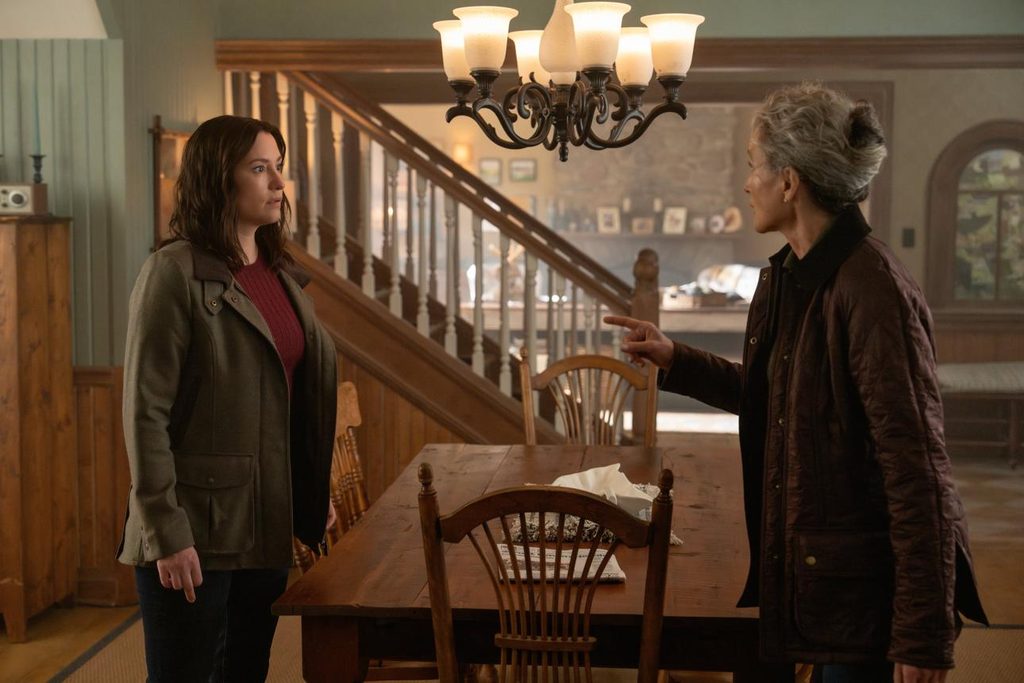
“You can’t come in, Eleanor. This room is ours now.”
I caught the edge of the door before it closed completely. My fingers pressed against the white wooden frame, and for a moment, I couldn’t understand what I was looking at.
The lock was new.
A polished silver deadbolt had replaced the old brass handle I had used for more than thirty years.
Behind Vanessa, I could see my dining room. My dining table. My late husband’s favorite wooden cabinet. The crystal glasses we had received as a wedding anniversary present.
And beyond the glass doors, at least a dozen neighbors were watching.
I looked at my daughter-in-law.
“Who changed the lock?”
She didn’t move.
“Daniel and I did. You should have called before coming.”
I stared at her.
“This is my house.”
My son appeared behind her, holding a glass of red wine. Daniel was forty-one years old, but suddenly he looked like the frightened teenager who used to hide behind me whenever his father became angry.
“Mom, please,” he said. “The neighbors are watching.”
I looked past him.
“Then perhaps you should explain to them why I need permission to enter my own dining room.”
Vanessa gave a small, humorless laugh.
“We built this dining room. You signed it over. Remember?”
I hadn’t forgotten anything.
Three years earlier, Daniel and Vanessa had approached me with an idea. They wanted to expand the old dining room, replace the cramped kitchen entrance, and create a larger space for family gatherings.
Daniel had lost his job at the time. Vanessa had recently started a small event-planning business, and they were struggling to keep up with their mortgage payments.
They asked whether they could live in the house while the renovations were completed.
I agreed.
The house had been my husband’s and mine. We had bought it when Daniel was still in elementary school. After my husband died, I couldn’t bring myself to leave the place where so many memories remained.
I had told Daniel that he could stay as long as he needed.
I had also agreed that they could improve the property.
But I had never signed away the land.
That distinction apparently meant nothing to Vanessa.
She folded her arms.
“You’ve had years to get used to the new arrangement. Why are you making this difficult now?”
I glanced toward the garden.
My neighbors were standing near the patio, holding plates and glasses. Robert Hayes, who had lived across the street for nearly twenty years, was among them.
He had watched Daniel grow up.
He had also helped my husband repair the original garden fence.
Robert looked uncomfortable.
“Everything all right, Eleanor?” he asked.
Vanessa answered before I could.
“Just a family misunderstanding.”
I turned toward her.
“No. A family misunderstanding is when somebody forgets a birthday. Changing the lock on somebody else’s house is something different.”
Daniel put his glass down on a nearby table.
“Mom, this isn’t the time.”
“When would be a good time, Daniel? After you’ve finished moving my belongings out?”
He rubbed his forehead.
“Nobody is moving your belongings.”
“Then why am I standing outside a locked door?”
Vanessa stepped forward.
“Because we need boundaries. You can’t keep treating this place like you control everything.”
I almost laughed.
Everything.
The house. The garden. The old driveway. The land beneath the new dining room.
I had spent most of my adult life paying the bills on this property. My husband had worked overtime for years to make the mortgage payments. We had planted the trees ourselves and built the original patio one summer weekend at a time.
When he died, I kept the property because it was the last substantial thing we had built together.
Daniel knew all of that.
He knew how much the house meant to me.
Yet he was standing behind his wife, allowing her to tell our neighbors that I had given it away.
“Daniel,” I said quietly, “look at me.”
He finally did.
“Did I sign a deed transferring that land to you?”
He opened his mouth.
Vanessa interrupted.
“We don’t need to discuss paperwork with the neighbors.”
“That’s interesting,” I replied. “You were perfectly comfortable discussing my ownership in front of them.”
She stepped closer.
“You are embarrassing us.”
I looked around at the people watching.
“No, Vanessa. I’m asking a simple question.”
Daniel lowered his voice.
“Mom, we invested a lot of money in this place.”
“I know.”
“We paid contractors. We bought materials. We spent months dealing with permits.”
“I know that too.”
“Then why can’t you just let us enjoy what we built?”
For the first time that evening, I felt the full weight of his words.
He genuinely believed that spending money on something had made it his.
Or perhaps he had simply repeated Vanessa’s version of events so many times that he had stopped questioning it.
I looked at the new dining room extension.
The walls were painted a soft cream. The windows were larger than the originals, and the roofline extended beyond the old structure.
I had noticed the extension’s position several months earlier.
At first, I assumed the contractor had followed the approved plans.
Then I found an old boundary marker near the garden fence.
It was partly buried beneath fresh soil.
I remembered my husband showing me that marker years earlier. He had explained exactly where our property ended.
The new dining room appeared to cross that line.
I didn’t accuse anybody immediately.
Instead, I began looking for the original property documents.
My husband had always kept important papers in a locked cabinet in his study. After his death, I had left most of those files untouched.
Among them was the original county-recorded deed.
It identified the parcel boundaries and showed that the narrow strip beside the house had never been transferred to Daniel or Vanessa.
I took the deed to an attorney.
He recommended an independent survey before I confronted anyone.
Three weeks earlier, I commissioned that survey.
The surveyor visited the property, measured the boundaries, located the original markers, and compared the measurements with the recorded description.
When he finished, he gave me a certified report.
I placed the report and the original deed in a cream-colored legal envelope.
Then I waited.
Not because I was afraid.
Because I wanted facts instead of another argument.
Now, standing outside my own dining room, I understood that the argument had arrived whether I wanted it or not.
Vanessa pointed toward the garden.
“Perhaps you should go home and calm down.”
I looked at her.
“Home?”
She nodded toward the driveway.
“You heard me.”
I reached into my handbag.
Daniel watched my hand.
“What are you doing?”
I removed the cream envelope.
Vanessa’s expression changed slightly.
“What is that?”
I didn’t answer immediately.
I simply held it between us.
Robert took one step closer.
Daniel looked at the envelope, then at his wife.
And Vanessa, who had been smiling less than a minute earlier, suddenly stopped smiling.
Movement Two — The Envelope Nobody Wanted Opened
“Put that away,” Vanessa said.
Her voice was quieter now.
I looked at the envelope.
“Why?”
“Because whatever you think you have, it doesn’t change anything.”
Daniel moved closer.
“Mom, let’s not do this in front of everyone.”
I almost wished he had said those words three years earlier, when Vanessa first started referring to my house as their property.
Instead, I had spent months hearing small comments.
Their renovation.
Their dining room.
Their new entrance.
Their property.
At first, I corrected them gently.
“It’s still my house,” I would say.
Vanessa would smile and respond, “Of course, Eleanor. We’re just speaking casually.”
Eventually, the corrections became arguments.
Then the arguments became accusations.
She began telling Daniel that I was interfering with their independence.
Daniel started avoiding conversations about the house altogether.
I had noticed something else, too.
The contractors had begun treating me like a visitor.
One afternoon, I asked a worker why he was digging near the old garden boundary. He told me Vanessa had instructed him to extend the dining room foundation.
I asked whether he had seen the property survey.
He shrugged.
“Your daughter-in-law handled the paperwork.”
That answer stayed with me.
I didn’t want to believe Daniel was deliberately allowing his wife to take advantage of me.
But I also couldn’t pretend the situation was normal.
A few days later, I called the contractor’s office.
I explained that I was the recorded property owner and asked for the approved construction plans.
The receptionist said she would need to check with the project manager.
The project manager called me the next day.
He explained that the company had been given a set of plans and written authorization by Daniel.
I asked whether they had independently verified the boundary.
He said they had relied on the information provided by the clients.
That was when I realized the problem was bigger than a disagreement between relatives.
The extension might physically occupy land that Daniel and Vanessa did not own.
My attorney advised me not to make assumptions.