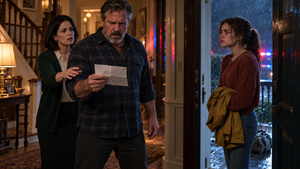
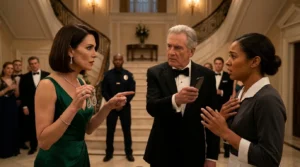
Richard insisted they had honored June’s wishes to the letter. “Did you?” Evelyn asked, gentle but with a spine in it. Caleb felt the old heat rise, the kind that used to tighten his throat, but it didn’t come. “You told me I wouldn’t know what to do with it,” he said. “Then you made sure I couldn’t.”
The Video, the Key and One Phone Call
Inside the box, nested in tissue paper, were a USB drive labeled “Play me together” and a sealed envelope addressed to “my steady.” Richard suggested it might be private. “It says together,” Caleb said. The only file was a video, and when it loaded, June sat at her kitchen table, the one with the burn mark from when Caleb once set down a hot pan. She said their family had always praised manners when it should have practiced honesty, and that she’d given Caleb the house because he listens to wood, hears where a squeak comes from and why.
She told Richard he was a good man who had mistaken decisiveness for wisdom, which worked at the office and made him confusing to love at home. She told Mara she respected the hustle, but hustling your brother isn’t the same as building a life, and there’s a difference between strategy and theft. There are two kinds of belonging, she said: the kind you inherit, which greedy or scared people can take, and the kind you build, which only you can give away. If anyone had sold the house, the envelope held something that needed doing. It would be inconvenient, and it would be right.
When the screen went dark, Richard called it a touching message from an old woman and suggested nobody dig up the past. “I’m opening it,” Caleb said. Inside were copies of the original will pages, a handwritten addendum stamped received by another attorney but never filed, a list of dates and names, and a small brass key taped to cardboard with one word on it: “pantry.” Evelyn smiled through wet eyes and said June always hid important things in unimportant places.
Mara pointed out that the house was sold and there was no pantry, and asked if he planned to go through a stranger’s spice rack. Behind the key, Caleb found a letter to the house’s current owner asking her to call June’s grandson, with the shop’s number, and a line from Evelyn underneath: “We spoke. She is kind.” “I’m not reopening a case,” he told his father. “I’m opening a door.” Evelyn added quietly that when people say something no longer exists, they often mean it’s no longer under their control.
Caleb pocketed the key, picked up the phone by the panel, and dialed the number on speaker. Mara said “Caleb, don’t” in a voice he hadn’t heard since they were kids. A woman answered, and he explained who he was and what he thought his grandmother had left in her pantry. She said she’d been told he might call one day, that she’d never opened what she found because the note said it was for Caleb when he was ready, and that it was heavier than it looked.
Then his mother stepped out from the crowd by the door, the first time she’d spoken to him since the will reading, when she’d stood silent behind Richard and Mara. “I hear we’re going on a little drive,” she said. Caleb said anyone who wanted to see what June left was welcome. Aunt Lily went first, saying June was her sister, and Evelyn and two cousins followed. Mara called it a scavenger hunt, and Caleb said, “Maybe. But it’s mine to waste.”
The woman in the blue house, Nora, was waiting on the porch with a mug of tea. In the pantry, behind a board that had looked out of place when she moved in, was a small safe with a note taped to it: “Only one person should open it, Caleb Hart.” The brass key turned like it had been waiting years. Inside was a second wooden box holding bundles of cash, savings bonds and a thick folder, with a letter on top. June had written that she hadn’t hidden it because she didn’t trust him. She’d hidden it because she didn’t trust them.
She called it the part of her savings she refused to let slip through the cracks of paperwork, meant not for houses or cars but for freedom, so he could build a life that couldn’t be stolen. Of all her grandchildren, she wrote, he was the one who listens, and listening is rarer than people think. Richard muttered that she’d concealed assets, and Evelyn said she’d protected them. Mara urged Caleb to split it for the family’s sake, and his mother warned he’d regret making enemies.
“I don’t need enemies, Mom. I need honesty,” Caleb said. “You made your choice the day you stood silent while they took what wasn’t theirs.” He locked the safe and pocketed the key, and outside the sunlight felt like it had been filtered through the truth. Before he started the engine he told them it had never been about money. It was about respect, and he was done asking for it. From then on they could give it freely or not get him at all.
Nobody argued. As the rig pulled away, Mara was pale in the mirror, Richard stared out the window, and his mother twisted the hem of her blouse. Caleb felt lighter than he had in years. June had been right that listening is rare, and he’d finally listened, not to them, but to her and to himself. That was the day he stopped being the family’s afterthought, and no one was ever going to steal his inheritance again.
Reflection: What stays with me is how little force any of this took. Nobody kicked a door in. They just kept saying “temporary” and “efficient” until a trusting person signed. People who’ve been underestimated their whole lives tend to over-explain themselves to the ones doing the underestimating, and Caleb’s real win wasn’t the safe. It was the moment he stopped asking permission to be taken seriously.