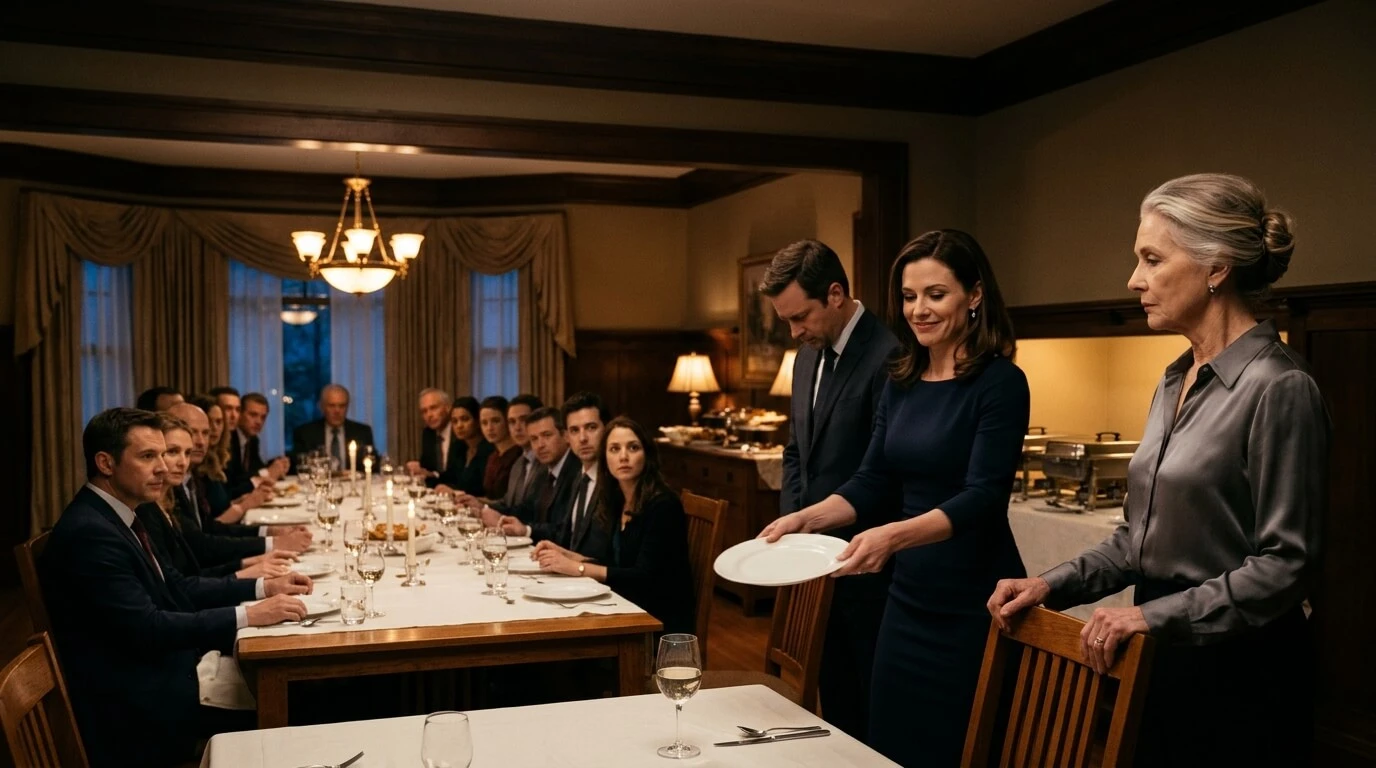
WHAT VANESSA DID
Vanessa stood alone with her place card.
“I was protecting this family,” she said. “That house costs more than two people can carry.”
“You were protecting a Friday,” Margaret said.
“Walter would have understood —”
“Walter wrote paragraph six,” Margaret said. “He understood perfectly.”
Vanessa looked down the table for someone to say she was right. Her brother studied his napkin. A church couple excused themselves toward the coat rack with the dignity of people leaving a courtroom.
The smile did not return.
“Gail,” Margaret said, “I’m sorry you drove out for nothing. Ruth has told Lakeshore the closing is cancelled, and there’s no buyer, no listing, and no sale.”
Gail nodded. “I’ll pull it first thing.”
Then Margaret turned to her daughter-in-law.
She was not angry anymore. That was what Vanessa could not stand.
“You moved my plate,” Margaret said. “In front of twenty-three people. You can put it back.”
“I will not —”
“In front of the same twenty-three.”
The dining room was so quiet the refrigerator hummed through the wall.
Daniel stood with the plate in his hands and did not offer it.
It took Vanessa almost a full minute.
She walked to the head of the table, took the plate from her husband, and set it down where Walter’s “M” was carved underneath. Her hands were shaking. She squared the fork and the knife, the way she squared everything.
“There,” she said, to no one.
“Thank you,” said Margaret.
She did not say it kindly. She did not say it coldly either. She said it the way you thank someone for returning something that was always yours.
THE SEAT
Margaret sat down.
The oak was cool under her palms. She felt for the small carved “M” under the edge, and found it.
“Please,” she said to the room. “The food is getting cold. Daniel made partner of the regional office, or whatever they call it. Let’s eat.”
Slowly, people picked up their forks.
Vanessa stayed standing for a moment. Then she took the chair at the far end, beside her brother, and ate nothing. Nobody asked her to.
At the end of the evening, Daniel carried the rented glasses to the kitchen himself. When he came back, Margaret was still at the table, with her tea.
“Mom,” he said. “I’ll go to Ruth’s with you Friday. I want to sign whatever you need.”
“I only need one thing signed,” Margaret said. “A page that says you were always going to have this house. Later. When I’m done with it.”
“Mom, I don’t deserve —”
“You don’t need to deserve it, Daniel. You need to read it first.”
He laughed, wetly, for the first time that night.
On Friday at ten, the hour of the cancelled closing, they sat in Ruth Okafor’s brick office on Elm Street. Margaret signed nothing but a single line in paragraph six, in blue ink, confirming herself as trustee for life.
Daniel read every page twice before he put his name beside hers as witness.
That evening, the oak table was set for two.
Margaret’s plate at the head. Her son’s at her right hand.
Under the edge, where nobody could see it, Walter’s “M” was still there. And over it sat the plate that had gone to the kitchen and come back, with nothing missing, and no one left to tell her where to eat.