

At 4:30 p.m., Linda pulled my chair away from the dining table.
I caught the edge of the table before I fell. A fork rattled against a plate, and the conversations around us stopped so abruptly that I could hear the wind moving through the trees outside.
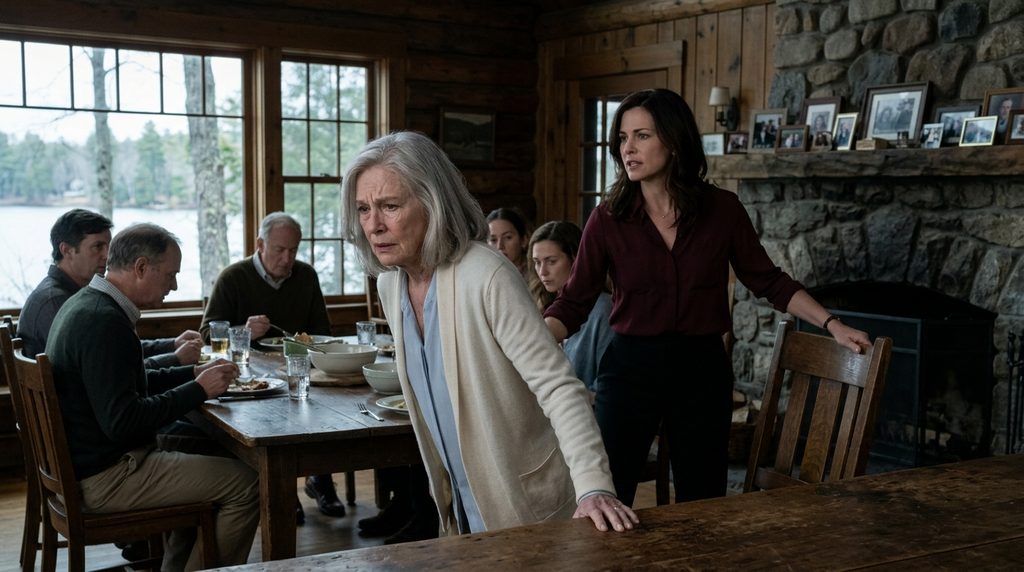
Linda stood behind the chair, holding its wooden back with both hands.
“You’re my husband’s old mother. You decide nothing here!”
Every cousin in the room heard her.
I looked at the empty space where I had been sitting. Then I looked at Linda.
For a moment, I considered asking her to repeat what she had said. Not because I hadn’t heard her, but because I wanted her to understand that everyone else had.
Instead, I straightened my cardigan.
“We owned this cottage 18 years,” I said.
Linda laughed.
“At 4:30, it’s worth $240,000!”
She threw a folder onto the table.
My nephew David lowered his eyes. Across from him, my cousin Helen stopped pouring tea. Nobody moved to help me retrieve my chair.
Linda interpreted their silence as agreement.
That was one of her greatest talents. She could turn a room full of uncomfortable people into an imaginary audience applauding her.
I reached into my handbag and removed a cream-colored envelope.
“Then explain what you signed.”
Linda’s expression changed.
I placed the envelope beside her folder.
“Tell everyone before you touch that envelope, right here, right now.”
She stared at it.
And suddenly, the woman who had spent the afternoon explaining who belonged in the cottage seemed unsure of where she stood.
But I need to explain how we arrived at that table.
The cottage had never been an ordinary holiday property to me.
My husband, Robert, found it after a particularly difficult year at work. It was an old wooden building overlooking a quiet Vermont lake, with uneven floors, narrow stairs and windows that rattled whenever the winter wind arrived.
The first time we visited, I disliked almost everything about it.
The kitchen cupboards were crooked. The fireplace smoked. The bathroom needed renovating, and the wooden porch had a loose railing.
Robert loved it immediately.
“Imagine having breakfast here every morning,” he said.
“We don’t live here.”
“Not yet.”
He smiled as if he had already won an argument I hadn’t agreed to have.
We eventually bought the cottage. Over the following years, we repaired the roof, replaced the kitchen, strengthened the porch and planted two maple trees near the driveway.
Our marriage was not perfect, but the cottage gave us somewhere to return when life became difficult.
We spent eighteen years making it ours.
Robert kept a small notebook in the kitchen drawer. He recorded repairs, paint colors, contractor details and the names of people who had helped us.
He also kept a habit of writing down family memories.
One entry described the summer when the entire family arrived unexpectedly and ate dinner outside because the dining room was too small.
Another mentioned the year our nephew David learned to swim.
Linda entered our family much later.
She married my younger brother’s son, Michael, and became part of the extended family. She was intelligent, ambitious and very interested in property.
When Michael died, the family naturally tried to support her.
I never expected her to remain alone or to stop making plans for her future. I understood grief, and I understood how difficult it could be to rebuild a life after losing a husband.
But Linda gradually began treating the cottage as though it were an inheritance waiting for her.
At first, the comments were small.
She suggested replacing the old furniture.
She asked whether the cottage could accommodate more guests.
She discussed renting it during the summer.
I explained that Robert and I had never purchased it as an investment property.
It was our family home away from home.
Linda smiled whenever I said this.
“Of course,” she would reply.
But she continued making plans.
Then, three weeks before the gathering, she called me about the property.
She said she had found someone interested in purchasing it.
I asked whether she had spoken to the trustees.
She became quiet.
“Margaret, we don’t need to make everything complicated.”
I told her there was nothing complicated about asking the person legally responsible for a property before arranging its sale.
She ended the call.
A few days later, David contacted me.
He sounded nervous.
“Did you know Linda has been discussing the cottage with people?”
“I know.”
“She says the family has agreed.”
“Which family?”
He didn’t answer.
I asked him whether he had seen any signed documents.
He said he had seen a folder but didn’t understand what it contained.
That conversation stayed with me.
Robert had been careful about the cottage. We had discussed what should happen to it long before his health deteriorated.
We had decided that the property should remain protected within a family trust rather than pass automatically to whichever relative made the strongest claim.
After Robert died, I continued managing the trust.
I was responsible for maintaining the cottage, paying its expenses from the appropriate accounts and ensuring that any proposed transfer followed the trust’s terms.
Linda knew I had responsibilities.
She simply believed those responsibilities were temporary.
The invitation to the family gathering arrived shortly afterward.
Linda wanted everyone together to discuss the cottage’s future.
I accepted.
I thought perhaps she wanted to clear up the misunderstandings.
Instead, I arrived to find a folder placed at the center of the dining table, my usual chair moved away from its position and a printed document showing a proposed property valuation.
The document contained the figure $240,000.
Linda greeted everyone enthusiastically.
She explained that the cottage was becoming expensive to maintain and that selling it would benefit the family.
She spoke about repairs, taxes and the inconvenience of keeping an old building.
Some of her concerns were reasonable.
But the conclusion she presented was not.
She spoke as though the sale had already been decided.
When I reminded her that the trust controlled the property, she rolled her eyes.
“You’re making this personal.”
“It is personal,” I replied. “It’s our home.”
She then moved my chair.
And the confrontation began.
MOVEMENT TWO · THE ENVELOPE
Linda looked around the room.
“Why are you all staring? We’re trying to make a sensible decision.”
My cousin Helen finally spoke.
“Maybe we should look at the paperwork first.”
Linda tapped the folder.
“It’s all there.”
I pointed toward the folder.
“Is that a completed transfer?”
“It’s an agreement.”
“Signed by whom?”
She ignored the question.
David shifted in his seat.
“Linda, I thought you said the trustees had approved it.”
“They don’t need to approve every little thing.”
I looked at him.
“David, who told you that?”
He looked toward Linda, then back at me.
“I don’t know. I thought she had spoken to someone.”
Linda folded her arms.