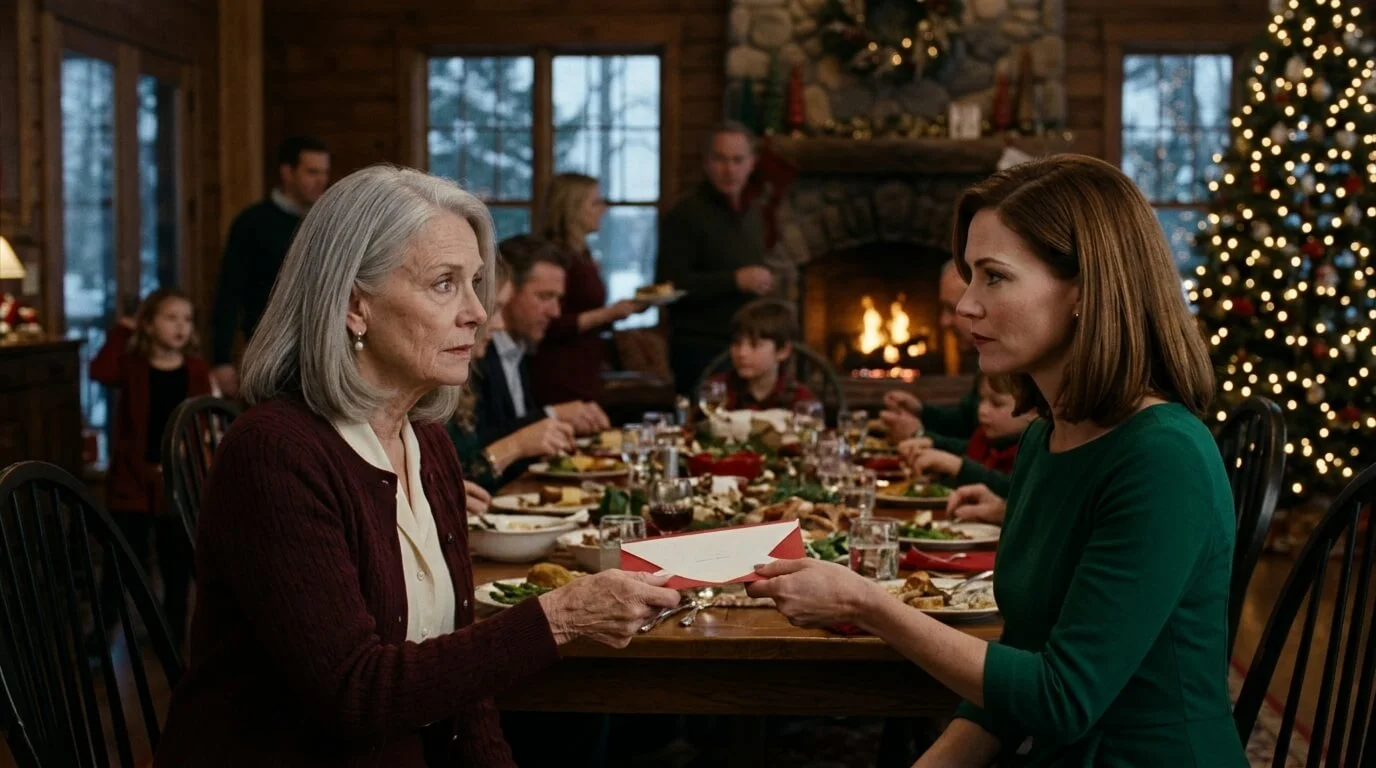
“Dad really did this.”
“Yes.”
“He never told me.”
“He didn’t have to announce every private legal decision. He wanted the transfer completed correctly. He also wanted you to have a relationship with me that wasn’t based on what you might inherit.”
Vanessa let out a short breath. “So that’s it? You get the cabin and we get nothing?”
Evelyn folded her hands. “You get what you build for yourselves. You don’t get to plan with something that belongs to me.”
Vanessa pointed toward the assessment. “You keep saying $240,000 as if that makes you right.”
“It doesn’t make me right,” Evelyn said. “The recorded deed does. The assessment explains the property’s documented value.”
Helen Brooks, the attorney, had not attended the reunion, but Evelyn had already called her before the guests arrived. She had asked Helen to be available if the family questioned the paperwork. Evelyn placed her phone on the table and called her now, putting the call on speaker after Helen answered.
Helen greeted Evelyn and confirmed that the transfer had been prepared at Robert’s request, signed while he was competent to execute it, and properly recorded three weeks before his death. She explained that the cabin was Evelyn’s separate property under the recorded instrument. She also confirmed that no later document had transferred ownership to Daniel or Vanessa.
Vanessa interrupted twice. Helen answered calmly, refusing to speculate about family intentions and returning to the legal record.
When the call ended, the room felt different. The argument had lost its fog. There was no hidden clause waiting to be interpreted, no missing signature and no promise that could be turned into ownership. Robert had made a decision, and he had put it on record.
Daniel sat down.
“I should have asked you,” he said to Evelyn.
“Yes,” she replied.
“I thought Vanessa was handling the card list. I didn’t know she had taken your name off.”
“You watched her do it.”
Daniel looked toward the envelope she had pulled away. “I know.”
Evelyn waited. She did not want an apology made only because the deed had been revealed. She wanted him to understand that the problem had started long before the paperwork appeared.
“I kept telling myself it wasn’t worth an argument,” Daniel said. “Every time she said something about the cabin, I let it go. Every time you looked uncomfortable, I told myself you would speak up if it mattered.”
“It mattered,” Evelyn said. “You just found it easier not to notice.”
His eyes filled, but Evelyn did not reach across the table to comfort him. She loved her son. That did not mean she had to rescue him from the consequences of his choices.
Vanessa gathered her handbag. “I can’t believe you’re doing this to us on Christmas.”
Evelyn glanced at the discarded Christmas-card envelope. “You made the card list a public test of who belongs. I am simply making the ownership clear.”
“I was trying to organize the family.”
“Then organize it without erasing people.”
Vanessa said that she had spent months planning how to improve the cabin. She had already spoken with a contractor about new windows, a larger deck and a small kitchen renovation. She had also contacted a rental manager to ask what weekly bookings might bring during the summer. She claimed she was trying to create an asset for Daniel and their future children.
Evelyn asked whether she had told the contractor that she owned the property.
Vanessa looked away.
That was answer enough.
Evelyn told her that no work was authorized, no bookings could be accepted and no one was to enter the cabin without permission. If Vanessa had shared information with a contractor or rental manager, she was responsible for correcting it. Evelyn would not pay cancellation fees for plans she had never approved.
Daniel offered to contact the contractor the next morning and explain that the work was not authorized. Evelyn agreed, but she made it clear that he was doing it because it was his responsibility, not because she was asking him to choose between his wife and his mother.
The relatives slowly returned to their seats. Margaret helped carry the food back to the table. Evelyn’s cousin placed the Christmas-card envelope beside her plate, not as a grand gesture but as a quiet acknowledgment that it should never have been taken away.
Vanessa did not apologize that evening. She left before dessert, and Daniel followed her after telling Evelyn he would call the next day. Some guests stayed. Others made polite excuses and drove home through the snow.
Evelyn did not chase anyone.
After the last car disappeared down the drive, she gathered the papers and put them back in the envelope. The house was quiet again. She turned off the dining-room lights, leaving the Christmas tree glowing in the front window.
The next morning, Daniel called. He had spoken with the contractor and the rental manager. Both had been told that Vanessa did not own the cabin and had no authority to arrange work or bookings. The contractor confirmed that nothing had been started. The rental manager removed the tentative inquiry from the calendar.
Daniel asked if he could come over alone.
Evelyn said yes.
He arrived late that morning with two coffees and no folder of documents. He apologized again, this time without mentioning the cabin. He told her he had allowed Vanessa to speak for him because disagreeing with her had become exhausting. He admitted that he had enjoyed imagining the cabin as a future gift and had not questioned whether that expectation was fair.
Evelyn listened.
“Your father loved you,” she said. “He wanted you to have a good life. But he also wanted you to become a man who could tell the truth when it was uncomfortable.”
Daniel nodded. “I know I haven’t been that man.”
“You can still become him.”
They did not fix everything in one morning. Evelyn told Daniel that trust would take time. She would welcome him for visits, but the cabin would remain under her control. If he wanted to help maintain the dock or carry supplies, he could ask. He could not make commitments on her behalf.
Daniel accepted that.
A week later, Evelyn received a message from Vanessa. It was brief and defensive. Vanessa said she regretted the way the Christmas-card conversation had happened, but she also said she felt excluded from decisions that affected her future. Evelyn read it twice before replying.
She wrote that she understood wanting security, but security could not be built by taking control of someone else’s property. She would be willing to speak when Vanessa was ready to discuss boundaries honestly. She would not discuss transferring the cabin.
The reply did not arrive immediately. When it did, Vanessa said she understood.
Evelyn did not mistake that sentence for a complete reconciliation. It was a beginning, and beginnings were enough for now.
In January, Evelyn visited the cabin with a local carpenter to inspect the porch and check the windows. The building smelled faintly of cedar and the woodstove Robert had installed. A framed photograph of Robert and Daniel stood on the mantel. Evelyn straightened it, then opened the curtains toward the frozen lake.
She decided the cabin would remain a place for family visits, but visits would happen by invitation. She would keep the old furniture, repair the porch and leave the little kitchen as Robert had designed it. She would not turn the building into a rental business simply because someone else saw a price attached to it.
The next Christmas, Evelyn hosted dinner again. She sent the family-card list around early and asked everyone to check their own addresses. Her name appeared at the top, exactly where it belonged—not because she had demanded a place, but because she was the one sending the cards.
Daniel arrived with Vanessa. They brought a dessert and asked before carrying it into the kitchen. Vanessa greeted Evelyn politely. Their relationship was not suddenly warm, but it was more honest. No one spoke about inheriting the cabin.
After dinner, Evelyn took a photograph beside the Christmas tree. Daniel stood on one side of her. Vanessa stood on the other. Evelyn did not ask anyone to pretend that the past had disappeared. She simply allowed the moment to be what it was: a family trying, imperfectly, to move forward.
Later, when the guests had gone, she walked down the path to the cabin. Snow rested on the roof and gathered along the porch rail. She unlocked the door with her own key, stepped inside and turned on the small lamp beside Robert’s chair.
The sealed envelope was back in her desk at the main house. She no longer needed to keep it within reach. The deed had done what Robert intended: it had made the truth clear before anyone could rewrite it.
Evelyn looked out through the cabin window at the lake. For years she had believed that keeping a family together meant making room for every demand, swallowing every insult and smoothing every disagreement. Now she understood that love did not require her to disappear.
The cabin was hers. The lake house was hers. The Christmas table was hers to set, and the invitations were hers to send.
She had not taken a place away from anyone.
She had simply stopped letting someone else take hers.