
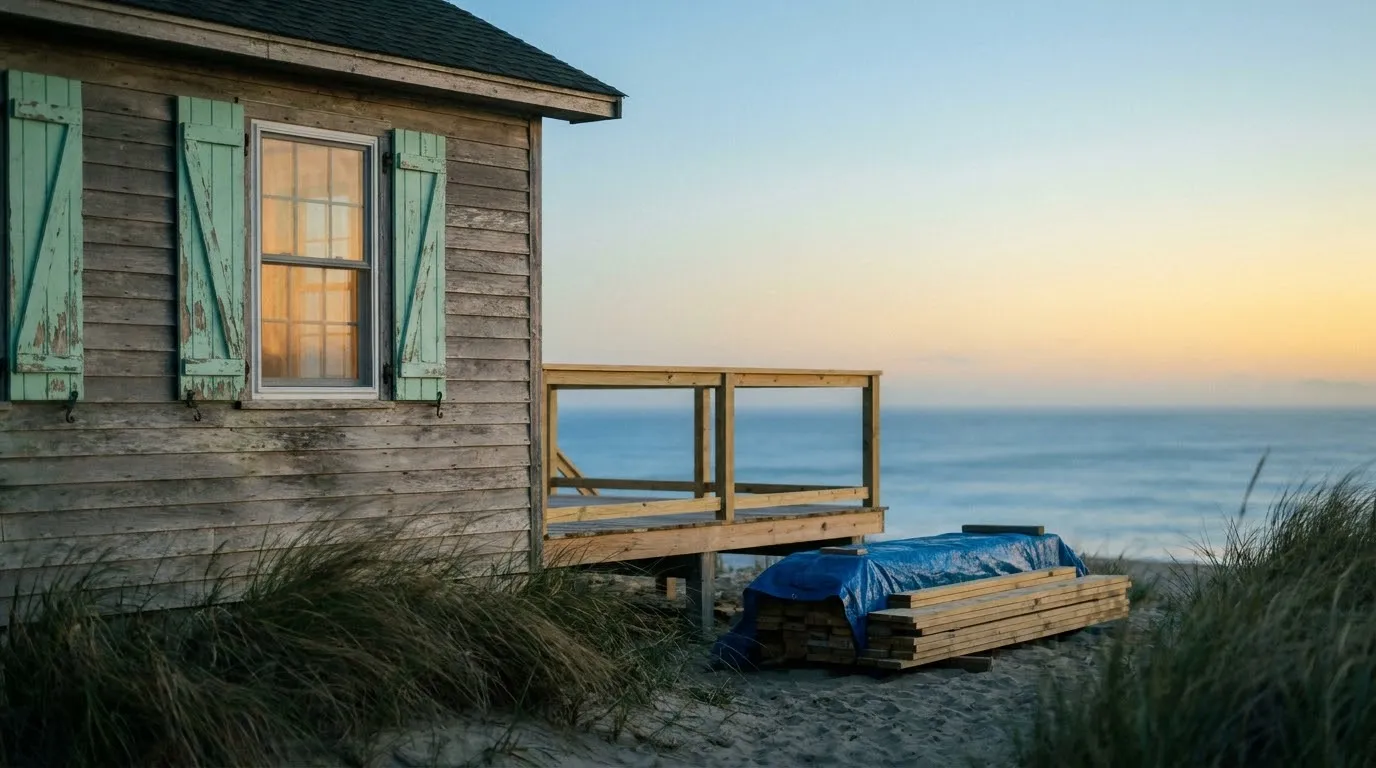
What Blake didn’t know was that Alex had bought that house five years earlier. It had been their grandmother’s, and when she died none of the siblings wanted the maintenance, the memories or the long drive. Alex offered to buy it from the estate at fair market value, hired a real estate attorney named Stephen Park, and closed within six weeks. His brother Ryan had even said it was one less thing to worry about. The county records showed Alex’s name on the deed, and Blake had never owned any part of it.
Blake’s story kept growing. The deck restoration was the expensive part, he said, but he’d talked the contractor down from $23,000 to $18,000. When cousin Jessica asked whether the shutters were still blue, Blake smoothly answered that he was keeping the blue because buyers love classic coastal charm. The shutters were green and had been since 1987, when Alex’s grandmother painted them herself over her husband’s complaints that they looked like mint toothpaste. Blake had clearly never set foot there. He’d seen some photos and built a fantasy around them, and he planned to list it in March at $650,000.
Alex knew the house better than anyone. As a kid he’d spent summers there while his siblings went to sports camps, helping his grandmother fix leaky faucets and paint trim, and she taught him that real wealth isn’t about showing off. It’s about building something solid and making it work for you. He’d done exactly that, with a new roof, updated electrical and a property manager handling seasonal rentals at $3,000 for summer weeks and $1,500 in shoulder season. After expenses it cleared about $35,000 a year. Nobody in the family ever asked who was paying the property taxes, and that lack of curiosity made Blake’s lie easier.
A Text in the Kitchen
In the middle of the celebration, Alex’s phone buzzed with a message from an unknown number asking whether he was the owner of the beach house. He excused himself to the kitchen and wrote back, and the stranger turned out to be a contractor named Tony Morales. Blake had hired him to renovate the property and told him he owned it. Three weeks into the job, Tony said, Blake owed him $15,000 and had stopped returning his calls.
Alex asked for photos and contracts. The pictures showed new deck railings half-installed, bathroom fixtures in boxes, fresh drywall compound on the walls, work Alex had never authorized. The contract carried Blake’s signature, the property address and permit numbers Alex didn’t recognize, so he checked each one in the county system. None of them existed, which meant Blake had forged county documents. Alex told Tony he was the legal owner, had never hired anyone, and urged him to contact the police.
Back in the living room, Alex walked over, stood beside Blake and asked, pleasantly, how the renovation was going. Great, ahead of schedule, Blake said. When Alex asked for the contractor’s name, Blake blinked before coming up with it. Rachel chimed in that Blake had been stressed over the permits, and Blake said they’d finally come through. Alex asked which ones he’d filed, and Blake rattled off building, electrical and plumbing, no structural, since it was only a deck replacement. Alex mentioned that the county usually wants structural review for deck replacements, and Blake’s smile tightened.
Alex slipped into the bathroom, locked the door and called Stephen Park, who said this was criminal fraud and urged him to file a report that night. Alex decided to let Blake keep talking. Blake had announced everything publicly and couldn’t back out without admitting the lie. Later he noticed the “before” photos Blake was showing relatives came from an online listing for a completely different house, since Alex had updated the real kitchen in 2021. Nobody asked how Alex was doing that night, and being invisible turned out to be exactly where he needed to be.
Two Coffees and a Laptop
Two days later he met Tony at a coffee shop in Riverside County. Tony was in his mid-forties with weathered hands, twelve years in construction and a folder six inches thick. Blake had answered a job board posting, he said, claiming he’d inherited a family beach house, and had met Tony at a coffee shop rather than at the property. He’d said his name wasn’t on the deed yet because his grandmother’s estate was still open, and he’d shown what looked like estate papers, probably forged too.
Alex’s grandmother had died six years earlier, and her estate closed five and a half years ago. Blake had used her death to make the con believable. Tony was already into the job for about $15,000, including $7,000 in deck lumber and $4,000 in bathroom fixtures. Alex showed him the deed, the tax records and the rental history, then checked Blake’s permit numbers again, and they were fake. Tony said he’d verified the address but never imagined anyone would forge permit numbers.