
Movement One — The Humiliation
“What did you say?”
Marchetti’s question crossed the enormous dining room, but nobody answered immediately.
His crystal glass had just touched the mahogany table. The small sound seemed louder than the orchestra playing near the staircase.
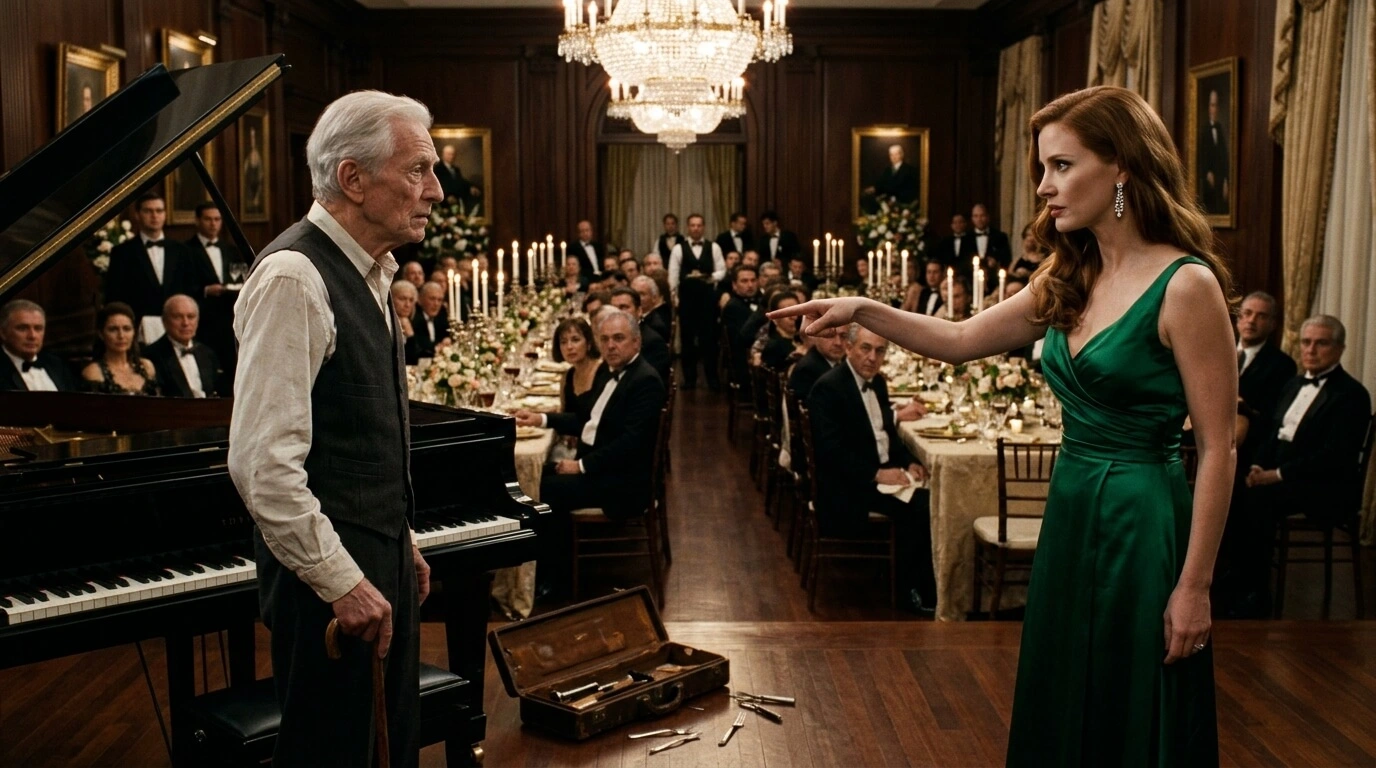
Arthur Bell stood beside the grand piano, his silver head slightly lowered. His leather tuning case remained open on the polished floor. One of his tuning hammers had rolled beneath a chair, and a small screwdriver lay near Vivienne’s emerald evening shoe.
Across the room, eighty dinner guests watched.
Vivienne Marchetti’s expression changed.
Only slightly.
The smile disappeared from one corner of her mouth before she recovered it.
“I think the old man is confused,” she said. “He’s been standing here making accusations because he was caught with something that doesn’t belong to him.”
Marchetti did not look at her.
He looked at Arthur.
“Repeat what you said.”
Arthur swallowed. His fingers found the polished handle of his wooden cane.
“I said I saw her do it.”
A whisper traveled along the dining table.
Vivienne laughed.
“That’s impossible. The man is blind.”
Arthur did not move.
“I know what I am, Mrs. Marchetti.”
The answer was quiet, but something in it made several guests look away.
For twenty-six years, Arthur had tuned the family’s pianos. He had worked in the mansion before the new furniture, before the expensive renovations, and long before Vivienne had entered Marchetti’s life.
He knew the sound of every instrument in the house.
He knew which staircase creaked, which dining-room door stuck in winter, and which guests liked to tap their fingers impatiently while waiting for dinner.
Most importantly, he knew Marchetti.
The boss had never been particularly warm, but he had always treated Arthur with respect. Arthur had been permitted to work without being questioned or watched. When his eyesight deteriorated, Marchetti arranged for better lighting, accessible work surfaces and a permanent place for his tools.
Arthur had never asked for charity.
He had simply continued doing his job.
Tonight was supposed to be another ordinary evening of work.
The family was hosting a formal dinner for business associates and longtime friends. The black grand piano needed its final tuning before the guests arrived, and Arthur had been invited to finish the job.
He had arrived early, as usual.
The trouble began when Vivienne noticed the empty velvet box beside Marchetti’s place setting.
The gold signet ring was missing.
It was not an ordinary piece of jewelry. The ring carried the engraved Marchetti family crest and had belonged to the boss’s father. Marchetti wore it on important occasions, but tonight he had left it in his private office while changing for dinner.
When he returned, the box was empty.
Vivienne immediately announced that something valuable had disappeared.
At first, Marchetti told everyone to continue with dinner preparations.
Then Vivienne suggested that Arthur had been alone near the piano.
It was an easy accusation to make.
Arthur had opened his leather case while working. His hands had been near the piano, and his tools were scattered across the floor. The missing ring could supposedly have been taken without anyone noticing.
Vivienne made sure everybody heard the accusation.
“Search his case,” she had demanded.
Arthur refused to let her touch his belongings.
Not because he had anything to hide, but because he knew the accusation was false.
That refusal made her angrier.
“You expect us to believe you simply walked into this room, tuned a piano and somehow know nothing about a missing family heirloom?”
“I know nothing about your missing ring,” Arthur answered.
“Then why are you so defensive?”
“Because you’re accusing me of stealing.”
Vivienne stepped closer.
The guests watched without intervening.
She picked up Arthur’s tuning case and opened its compartments. When she found nothing, she tipped several tools onto the piano bench.
“Look at this,” she announced. “This is the man we’ve trusted inside our home.”
Arthur reached toward the scattered tools.
“Please put those back.”
“Don’t tell me what to do.”
She swept the remaining tools onto the floor.
That was when the room changed.
Arthur’s case struck the polished floor. Its leather flap fell open, and several small instruments scattered beneath the piano.
Vivienne raised her voice.
“APOLOGIZE TO EVERYONE, RIGHT NOW!”
Arthur stood motionless.
“For what?” he asked.
“For making this entire family look foolish. For bringing your hands into a place where you don’t belong. For behaving as though you’re entitled to question me.”
“I haven’t accused you of anything.”
“You’ve been suggesting it since I mentioned the ring.”
“I told you I didn’t take it.”
Vivienne turned toward the guests.
“He’s trying to make himself the victim.”
A woman near the end of the table lowered her napkin.
One of Marchetti’s business partners shifted uncomfortably.
Nobody defended Arthur.
The old man bent down, carefully searching for his tuning hammer.
He found it by touch.
Vivienne watched him.
“Perhaps you should leave before you embarrass yourself further.”
Arthur straightened.
“I have worked in this house for twenty-six years.”
“And now you’re finished.”
Marchetti finally spoke.
“Vivienne.”
She turned toward him, her expression immediately softening.
“Darling, I know this is unpleasant. But I can’t allow someone to steal from our family and then insult us in front of everyone.”
Marchetti looked at the open leather case.
Then at Arthur.
“Did you take my ring?”
“No.”
“Did you see anyone take it?”
Arthur hesitated.
Vivienne’s eyes narrowed.
“Be careful,” she said.
Arthur turned his face toward Marchetti.
“I can tell you what happened.”
The room became quiet.
Vivienne folded her arms.
“Then tell him.”
Arthur drew a breath.
“I heard something beside the piano. A little metal clasp. Then I heard the case move.”
Vivienne shook her head.
“He’s inventing sounds now.”
Arthur continued.
“I didn’t say anything because I wasn’t certain.”
“Certain about what?” Marchetti asked.
Arthur’s fingers tightened around his cane.
“About what I saw.”
Vivienne’s expression hardened.
“That’s ridiculous.”
But Marchetti had stopped looking at her.
He was listening to Arthur.
And the old piano tuner was finally ready to explain.
Movement Two — What Arthur Saw
Arthur had never liked talking about his eyesight.
People often misunderstood blindness. Some assumed that every blind person saw nothing at all. Others spoke louder, as though raising their voices could restore someone’s vision.
Arthur had learned to let them misunderstand.
His eyesight had deteriorated over decades following an illness in his early adulthood. He could no longer read ordinary print, recognize faces across a room or navigate unfamiliar spaces without assistance.
But he retained limited residual vision.
Close to an object, under certain lighting conditions, he could distinguish strong contrasts, movement and silhouettes.
It was unreliable.
He never depended on it for his work.
He depended on his ears.
A piano was an extraordinary instrument for someone who listened carefully. Each note carried information. A slight vibration could reveal a problem with a string. A change in resonance could expose a loose component.
Arthur had spent decades developing that sensitivity.
He knew when someone approached a piano even before they touched it.
And he knew when Vivienne had approached him that afternoon.
She had been in the music room while Arthur was packing his tools.
“You’re finished already?” she asked.
“Almost, Mrs. Marchetti.”
She walked toward the instrument.
“Does my husband still insist that you do everything yourself?”
Arthur smiled politely.
“Mr. Marchetti likes things done properly.”
“Of course he does.”
She had stood near the piano for several seconds.
Arthur heard the faint metallic click of something being opened.
He assumed she was checking a drawer.