
Movement One — The Daughter Nobody Thanked
The envelope was still sealed when Victor Romano looked across the dinner table.
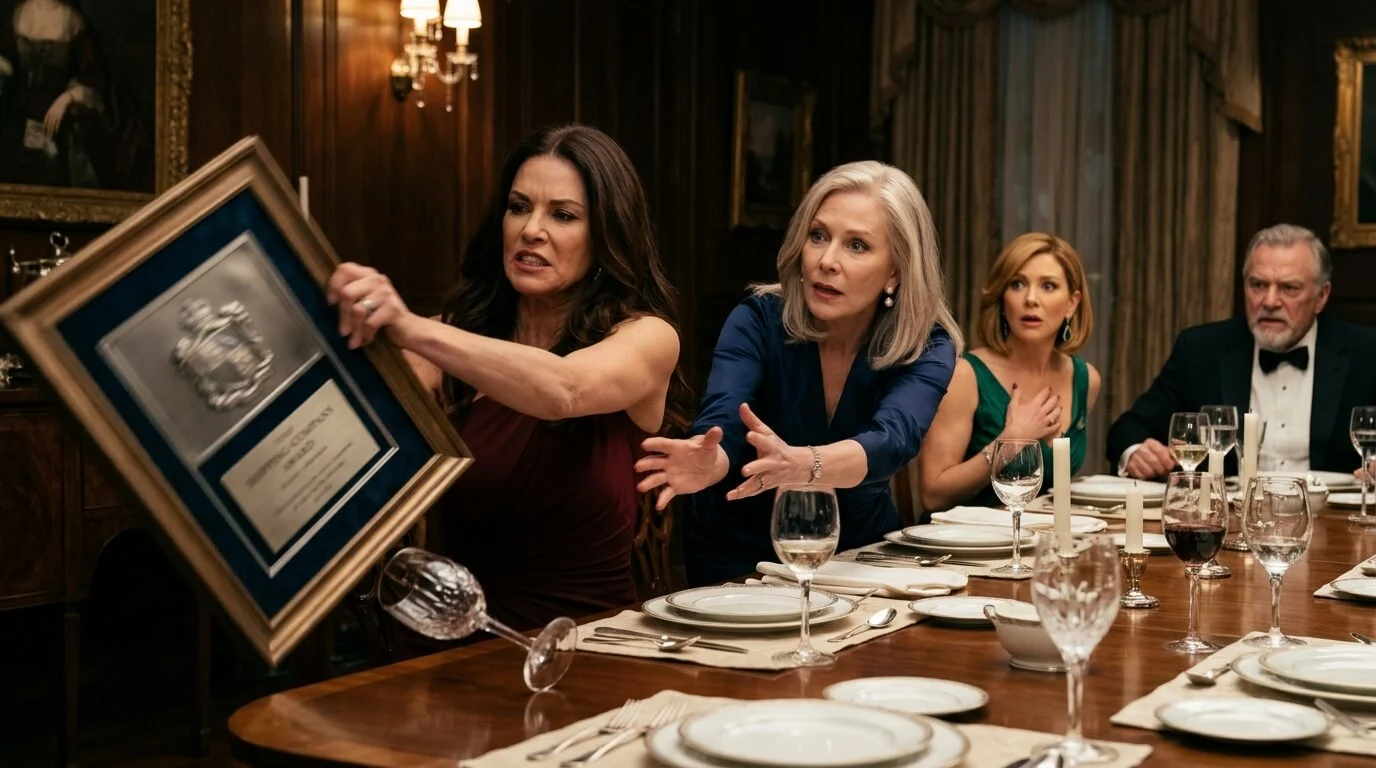
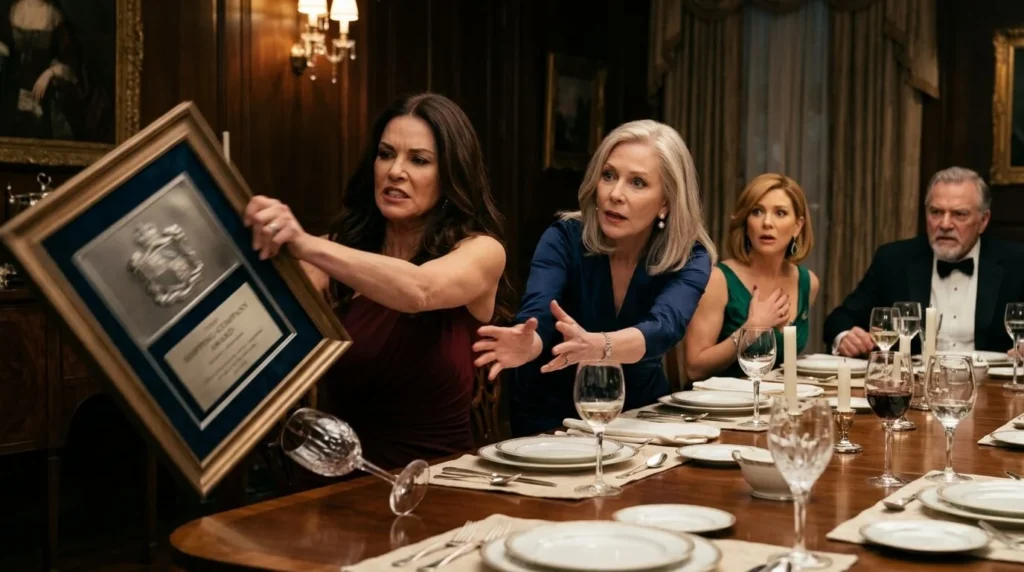
Victoria’s hand was resting on her diamond necklace. Caroline had stopped smiling. My father’s old shipping-company award lay broken beside my chair.
And I was the only person at that table who knew what was inside the envelope.
“Tell them who kept the $18.6 million from swallowing everything,” I said.
Nobody moved.
Nine years earlier, I had been the daughter nobody considered important enough to attend the company’s executive meetings.
Tonight, I was the only person who could decide whether Whitmore Shipping would survive another generation.
My name is Eleanor Whitmore. I am sixty-one years old, and for nine years I protected the business my father spent his entire life building.
My sisters took the photographs, accepted the awards, attended the celebrations, and told everyone they were responsible for its success.
I took the phone calls at midnight.
I negotiated with creditors.
I studied shipping manifests, repaired broken contracts, and spent countless nights trying to prevent our family name from becoming another failed business story.
My father, Richard Whitmore, founded Whitmore Shipping with one small cargo vessel and an office above a warehouse in Brooklyn. Over four decades, he expanded it into a multimillion-dollar international shipping company.
He never cared much for expensive cars or impressive parties. He cared about ships arriving on time, employees receiving their salaries, and contracts being honored.
My older sister, Victoria, cared about the photographs.
My younger sister, Caroline, cared about the invitations.
I cared about the company.
That difference became painfully obvious after Father’s health began declining.
Victoria was fifty-six, beautifully dressed, confident, and convinced she had inherited Father’s business instincts. Caroline, fifty-three, was more charming. She could make a room believe almost anything if she smiled at the right moment.
Both believed they deserved equal authority over the company.
I never argued with them publicly.
That silence became their favorite weapon.
At family gatherings, Victoria introduced herself as the woman who had rescued our father’s business. Caroline described herself as the person responsible for its international expansion.
Neither mentioned me.
At first, I thought Father would eventually correct them.
Then, one rainy evening, he called me into his private office.
A large framed photograph of his first cargo vessel hung behind his desk. He was sitting in his leather chair, looking considerably older than I remembered.
“Eleanor, close the door.”
I did.
He pointed toward the chair opposite him.
“Your sisters think running a company means sitting at the head of a table.”
I smiled faintly.
“And what do you think it means?”
He looked at me.
“It means knowing what happens when everyone else goes home.”
He opened a drawer and removed a thick folder.
Inside were financial statements, corporate documents, and an agreement bearing his signature.
The company was in serious trouble.
Several international contracts had become unprofitable. Outstanding obligations were threatening the company’s ability to operate. A major creditor was preparing to demand repayment.
Father had discovered that my sisters were making decisions without understanding their financial consequences.
He needed someone he trusted to oversee a restructuring.
That person was me.
He explained that the agreement would give me authority over the restructuring process and preserve his intended ownership arrangement while the company recovered.
“Why not tell Victoria and Caroline?” I asked.
“Because they would spend more time fighting over who deserved the credit than saving what remains.”
He held my hand.
“I want this company to survive, Eleanor. Not for your sisters. Not for me. For the people whose families depend on it.”
I accepted.
The work began the following Monday.
For the first several months, I hardly slept.
I met financial advisers, reviewed contracts, negotiated revised payment schedules, and traveled to warehouses where employees were worried about losing their jobs.
Some nights, I sat in the kitchen with my laptop until sunrise.
My sisters continued attending charity dinners.
They appeared in business magazines.
They accepted congratulations.
Whenever someone asked how Whitmore Shipping was doing, Victoria would smile and say, “We have everything under control.”
I never corrected her.
I had promised Father that I would protect the company, not compete with my sisters for applause.
Nine years passed.
During that time, I helped eliminate $18.6 million in company debt through restructuring, asset recovery, and renewed commercial agreements.
The business became profitable again.
Its ships returned to reliable schedules. Its major customers renewed their contracts. Employees who had feared losing their jobs began planning for their children’s futures.
But my sisters became increasingly comfortable with their invented version of history.
Victoria began referring to herself as the company’s executive chairwoman.
Caroline described herself as the international operations director.
They had the titles, the public recognition, and the attention.
I had the responsibility.
Then came the invitation that changed everything.
Victoria called me on a Thursday afternoon.
“Eleanor, don’t make other plans for Saturday.”
“What is happening Saturday?”
“An important dinner. Victor Romano is coming.”
I put down my pen.
Victor Romano was not an ordinary business associate.
He had connections across several international shipping networks and a reputation that made even experienced executives choose their words carefully.
He was a powerful and feared figure in New York’s criminal underworld, although his legitimate commercial interests were substantial.
Whitmore Shipping had worked with companies connected to his network for years.
“Why is he coming?” I asked.
Victoria lowered her voice.
“He wants to discuss a major expansion. This could be the biggest agreement Father ever imagined.”
“And what do you need me for?”
She laughed.
“Nothing complicated. Just come looking respectable. Don’t turn the evening into one of your financial lectures.”
I almost laughed.
Instead, I asked what time dinner began.
“Seven-thirty.”
On Saturday evening, I entered the family dining room wearing my navy-blue silk dress and pearl earrings.
The long walnut table was already prepared.
Crystal glasses reflected the warm golden lighting. White porcelain plates were arranged beside silver cutlery.
Victoria wore burgundy.
Caroline wore emerald green.
Victor sat at the far end in a black tuxedo.
He greeted me politely.
“Eleanor. Your father always spoke highly of you.”
Victoria interrupted.
“Father was proud of all three of us.”
Victor looked at her but said nothing.
Dinner began pleasantly enough.
Victoria spoke about expansion plans. Caroline discussed new routes and possible partnerships. They described the company’s recovery as though they had personally negotiated every contract.
I listened.
Then Victoria raised her glass.
“To the Whitmore sisters. Nine years of rebuilding Father’s empire.”
Everyone lifted their glasses.
I did not.
Victoria noticed.
“Something wrong, Eleanor?”
“No.”
“Then why aren’t you celebrating?”
I looked at the award sitting beside her.
It was the same award I had received from the company’s independent trustees after the restructuring.
Victoria had placed it in the dining room as though it belonged to her.
“I was just wondering when you planned to tell everyone the truth.”
Her smile disappeared.
“What truth?”
Before I could answer, she swept the framed award off the table.
It crashed onto the floor.
“Nine years, and you pretend you saved Father’s company!” she snapped.
I looked down at the broken frame.
“I never claimed I did.”
Victor slowly put down his glass.
“Then why did I receive your nine-year financial report?”
Caroline grabbed Victoria’s arm.
“Eleanor, put that away!”
I reached into my handbag.
“You should have asked before taking credit.”
I removed the sealed black envelope.
Victor looked at it.
The silver table clock showed 9:15 p.m.
“Shall I tell them?” he asked.
I placed the envelope beside his plate.
The envelope had not been opened in nine years.