
At 9:15 on Thanksgiving morning, Vanessa pushed a cottage sale agreement across my dining table and demanded that I sign it.
But that wasn’t the first cruel thing she had done that morning.
It started beside the fire pit.
I was standing in my kitchen, watching the Thanksgiving turkey turn slowly in the oven, when I heard the unmistakable crackle of something burning outside.
At first, I assumed Daniel had thrown another armful of fallen branches into the fire pit. He had been complaining about the garden for weeks, and I had stopped arguing with him about things that didn’t matter.
Then I saw the wooden box.
It was an old rectangular box with a brass clasp, darkened around the edges after years of being stored in our attic. I recognized it immediately.
My husband’s Christmas ornaments were inside.
For 32 years, Harold had made one ornament every Christmas. Some were painted wooden stars. Others were little houses, birds, angels and tiny wooden hearts. They weren’t expensive, but each one carried a memory.
The first ornament had been made in the year Daniel was born. Harold had carved a small wooden rocking horse and painted it blue.
The last one was a little cottage with a red roof. He had made it during his final Christmas, when his hands were already shaking from illness.
I hurried through the kitchen doors.
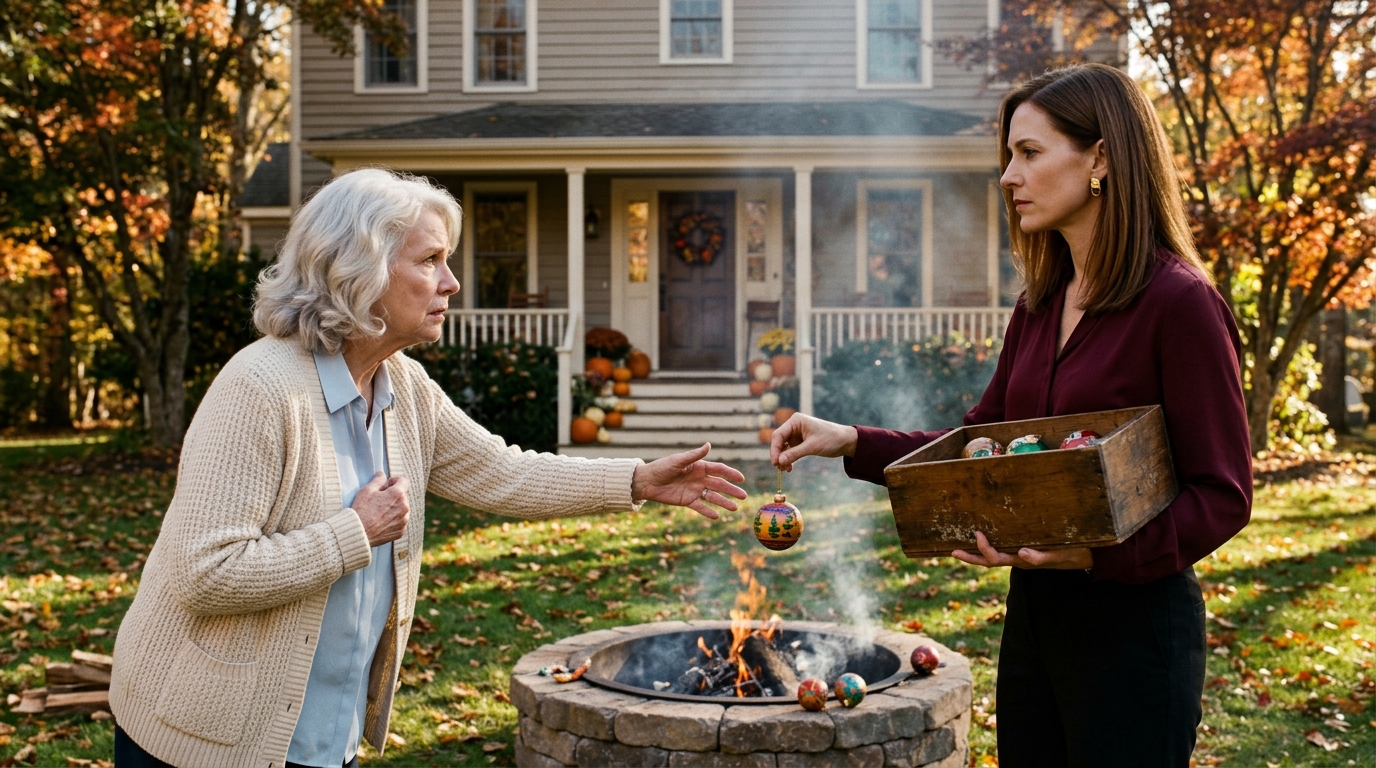
Vanessa was standing beside the fire pit, holding the wooden box.
She was wearing her burgundy blouse, black trousers and gold earrings. Her chestnut hair was perfectly straight, and her expression suggested she was doing something entirely reasonable.
“You said these were precious. They’re dead branches in a box.”
She dropped another ornament into the flames.
I reached for the box.
“Vanessa, stop!”
She pulled it away.
“You’re making a scene, Eleanor.”
I looked down at the ornaments burning between the logs.
One of Harold’s painted birds had already split down the middle.
“Those ornaments were made by your father-in-law, one each year for 32 years.”
Vanessa shrugged.
“And he’s been gone for two years. You can’t keep living in the past.”
I couldn’t answer immediately.
Not because I had nothing to say.
Because I was trying to understand how someone could stand in front of another person’s memories and speak so casually.
Then Daniel came through the kitchen doors.
He looked at the fire, then at his wife.
“What’s happening?”
“Your mother is upset about some old decorations,” Vanessa replied.
I turned toward him.
“Your father made those.”
Daniel rubbed his forehead.
“Mom, let her finish. We need the cottage sold before Friday.”
There it was.
The cottage.
Everything had been about the cottage for months.
Harold and I had bought it thirty years earlier, when Daniel was still in elementary school. It stood beside a quiet lake, surrounded by pine trees and a narrow gravel road.
It wasn’t a mansion or a luxury vacation property.
It was a modest three-bedroom cottage with a wooden porch, a stone fireplace and a little garden Harold had spent years improving.
Daniel had learned to ride a bicycle there.
He had caught his first fish from the wooden dock.
And when he married Vanessa, we had allowed them to spend their honeymoon weekend there.
After Harold died, the cottage became my refuge.
I spent weekends there reading, gardening and remembering the man who had built most of its furniture with his own hands.
Vanessa, however, saw something different.
She saw a property that could be sold.
For months, she had been talking about renovations to her own house, expensive furniture, vacations and paying off debts.
Every conversation eventually returned to the same question.
Why wouldn’t I sell the cottage?
I had explained that I wasn’t ready.
She interpreted that as an invitation to negotiate.
That Thanksgiving, she had brought the matter directly to the entire family.
Inside the house, the dining table was already decorated with autumn leaves, candles and place settings for twelve guests.
My sister Margaret had arrived early. Daniel’s aunt and uncle were expected shortly, along with two cousins and their children.
Vanessa wanted witnesses.
She wanted everyone to hear that the cottage needed to be sold and that I was being unreasonable.
I went back inside and placed the surviving ornament on the kitchen counter.
It was a small wooden angel.
One wing was damaged, but Harold’s handwriting was still visible underneath.
For Eleanor. Always home.
I touched the words with my finger.
Then Vanessa entered carrying a folder.
She dropped it onto the dining table.
“The $18,000 repairs came from us. You can’t keep everything.”
I looked at the folder.
Inside was a proposed sale agreement.
“I never agreed to sell.”
Vanessa pulled a pen from her handbag.
“That’s why we’re here. We need to settle this before everyone arrives.”
Daniel sat down.
He didn’t look at me.
I could see how uncomfortable he was, but discomfort wasn’t the same thing as courage.
“Daniel,” I said quietly, “do you really want me to sell the cottage?”
He glanced at Vanessa.
“We’ve talked about this.”
“No. I’m asking you.”
He sighed.
“Mom, it’s just a building.”
I looked at him for several seconds.
“Your father built the porch himself.”
“That was years ago.”
“And he taught you to fish from the dock.”
“Mom, please.”
Vanessa pushed the agreement closer.
“Nobody is asking you to forget Harold. We’re asking you to be practical.”
I picked up the document.
It listed a proposed sale price, the expected closing date and a place for my signature.
At the bottom, there was another section asking me to confirm that I had no competing interest or arrangement affecting the property.
I put the agreement down.
Something about that sentence bothered me.
Three weeks earlier, I had sat in Margaret Ellis’s law office and signed a very different set of documents.
I hadn’t told Daniel.
I hadn’t told Vanessa.
I had simply followed the advice of the attorney who had helped Harold prepare our original estate documents.
I checked the time.
9:15 a.m.
Vanessa tapped the pen against the table.
“Well?”
I reached for my navy handbag.
Daniel finally looked up.
“What are you doing?”
I removed a sealed cream-colored envelope and placed it between the sale agreement and the Thanksgiving centerpiece.
“Before I sign anything, perhaps everyone should read what your father left behind.”
Vanessa’s expression changed.
And for the first time that morning, she stopped talking.
Movement Two — The Envelope Harold Expected Me to Open
Nobody touched the envelope.
Vanessa stared at it as if it were something dangerous.
Daniel leaned forward.
“What is that?”
“Something I should have told you about earlier,” I replied.
Vanessa gave a short laugh.
“More paperwork? Eleanor, we have an actual sale agreement here.”
I didn’t answer.
I had spent three weeks thinking about that envelope.
Not because I was uncertain about what it contained, but because I knew what opening it would mean for my family.
The documents inside had been prepared by Margaret Ellis, the attorney Harold and I had trusted for years.
Three weeks before Thanksgiving, I had visited her office after receiving another message from Vanessa demanding that I reconsider the cottage.
I had brought Harold’s original estate plan, the property records and a handwritten letter he had left with his personal papers.
Margaret had examined everything carefully.
“Are you certain you want to proceed?” she had asked.
I remember looking through her office window at the rain.
“Harold wanted the cottage to remain in the family. But I don’t want someone deciding where I live because they believe they will inherit it.”
Margaret nodded.
“Then we need to separate your right to live there from the future ownership arrangements.”
That was exactly what we did.
The cottage was transferred into the Whitmore Family Trust through the appropriate recorded property deed.
I retained the right to live there for the rest of my life.
I could use the property, maintain it and enjoy it without needing permission from Daniel or Vanessa.
After my lifetime, the cottage would pass to Lily, my granddaughter.
The arrangement was documented and legally executed.
It wasn’t a verbal promise.
It wasn’t a handwritten note that could be dismissed.
It was an established legal arrangement supported by the recorded property transfer and the trust documents.
Margaret had also prepared a letter from Harold that explained his wishes.
He had written it months before his death.
He knew Daniel and I had been arguing about the cottage, although he never imagined how bitter things would become.
In the letter, Harold had explained that the cottage represented more than its financial value.
It was the place where Daniel had learned to swim, where Lily had spent summers, and where our family had gathered for years.
He wanted it protected.
He wanted me to feel safe living there.
And he wanted Lily to have the opportunity to enjoy it when she was old enough.
The arrangement did not make Daniel a villain or Vanessa a legal outsider with no rights whatsoever. It simply meant they did not own the cottage and could not sell it as though it belonged to them.
That distinction mattered.
Margaret had warned me not to make promises about the $18,000 Vanessa claimed to have spent.
“If they contributed money toward repairs, we should examine the receipts separately,” she had explained. “The trust documents don’t automatically settle every possible reimbursement disagreement.”
I had agreed.
I wanted the property protected, not another family argument about money.
Now, standing in my dining room, I finally understood why Margaret had insisted that I keep a certified copy of everything in a sealed envelope.
Vanessa reached toward it.
“Give it to me.”
I placed my hand over the envelope.
“No.”
“You’re hiding something.”
“I’m keeping something safe.”
Daniel looked between us.
“Mom, can you just tell us what this is?”
I turned the envelope around.
The front carried Margaret’s law-office address and the words:
Whitmore Family Trust — Certified Documents.
Vanessa’s expression changed again.
She recognized the name.
A few weeks earlier, she had asked me whether I had been visiting Margaret.
I had said yes.
She hadn’t asked why.
Now she was looking at the envelope with a different kind of interest.
“Did you change the inheritance?” she asked.
I didn’t answer immediately.
The doorbell rang.
My sister Margaret, who had been waiting in the adjoining room, entered with my brother-in-law.
Behind them came Daniel’s aunt and uncle.
The house was filling with family members, exactly as Vanessa had intended.
She straightened her blouse.
“Good. Everyone is here. Perhaps they can explain to Eleanor why this is ridiculous.”
My sister looked at the burning ornament box visible through the kitchen doors.
“What happened outside?”
Nobody answered.
I sat down.
“Harold’s ornaments were thrown into the fire.”
My sister looked horrified.
Vanessa folded her arms.
“They were damaged and taking up space.”
“They were handmade,” I said.
My brother-in-law glanced at the surviving angel on the counter.
“Harold made that?”
I nodded.
He picked it up carefully.
“I remember these. He gave one to my daughter.”
The room became uncomfortable.
Vanessa tried to redirect the conversation.
“We’re discussing the cottage, not decorations.”
I placed the envelope in the center of the table.
“Then let’s discuss the cottage.”
Daniel finally reached for it.
“Can I open it?”
I nodded.
He broke the seal.
Inside were several neatly organized documents.
The first page carried the trust’s name.
The second showed the property description and the recorded transfer information.
The third identified my lifetime occupancy rights.
The next pages explained the future beneficiary arrangement.
Daniel read silently.
His expression changed as he moved from one page to the next.
Vanessa leaned over his shoulder.
“What does it say?”
He didn’t answer.
She took the pages from him.
Her eyes moved quickly across the document.
Then she stopped.
“That’s impossible.”
I remained seated.
“No, Vanessa. It was completed three weeks ago.”
She turned toward Daniel.
“Your mother can’t just give away the cottage.”
I looked at her.
“It isn’t yours to give away.”
She shook her head.
“But we paid for the repairs!”
“Then show me the invoices. We’ll discuss them properly. But contributing toward repairs doesn’t make you the owner.”
Daniel looked at the recorded transfer page again.
“Mom, why didn’t you tell me?”
I considered the question.
“Because every time I mentioned the cottage, you discussed its sale instead of asking whether I wanted to leave.”
He lowered his eyes.
For a moment, I thought he might apologize.
Instead, he asked the question I had been expecting.
“Does Lily know?”
“No. I haven’t discussed the legal arrangements with her yet. She’s still young, and I didn’t want her caught in the middle.”
Vanessa pushed the papers onto the table.
“This is unbelievable.”
I looked at the ornament in my sister’s hand.
“No, Vanessa. What happened outside was unbelievable.”
The room fell quiet.
Then Daniel picked up Harold’s letter.
He unfolded it carefully.
And when he reached the first line, his hands began to shake.
Movement Three — What Harold Had Really Left Behind
Daniel read the letter twice.
The first time, he read it quickly, as though he were searching for a sentence that would prove Vanessa wrong.
The second time, he slowed down.
Harold’s handwriting was unmistakable.
The letter began:
My dear Eleanor,
If you’re reading this, I probably couldn’t protect the things I loved as long as I wanted to. But I hope you remember that a home isn’t measured by its price.
Daniel stopped.
He swallowed and continued.
Harold had written about the cottage, the summers they had spent there and the little traditions that made it special.
He mentioned the first time Daniel caught a fish.
He mentioned the wooden porch he had repaired after a storm.
He even mentioned the Christmas ornaments.
One paragraph read:
Every ornament has a year attached to it. Some years were difficult, some were wonderful, but we made it through all of them together. If the family ever forgets why the cottage matters, remember that we built those memories there. I don’t want it sold simply because somebody sees a number where we see a lifetime.
Daniel put the letter down.
His eyes were wet.
Vanessa stood beside him, visibly irritated.
“That doesn’t change anything. We still spent money repairing that property.”
I looked at her.
“Then let’s talk about the money.”
She crossed her arms.
“We paid $18,000.”
“All right. Show us the invoices, payment records and agreements.”
She looked toward Daniel.
He didn’t help her.
For the first time, I realized that he was beginning to understand the difference between what Vanessa had told him and what had actually happened.
Over the previous year, Daniel and Vanessa had paid for several cottage repairs.
They had replaced damaged sections of the roof, hired someone to repair part of the plumbing and purchased materials for the kitchen.
I knew about some of the work.
I had even thanked them.
But there had never been an agreement that the money would purchase an ownership interest.
Some of the repairs had been approved by me. Others had been arranged by Vanessa without discussing them first.
I had never promised to sell the cottage or repay an amount without examining the records.
Margaret Ellis had explained that these were separate questions from the trust arrangement.
The property transfer was one matter.
Any legitimate reimbursement claim was another.
I had no intention of pretending that money didn’t matter.
But I also wasn’t going to let someone use an unverified figure to pressure me into signing away my home.
My sister Margaret placed the surviving wooden angel on the table.
“Harold would never have wanted this family fighting over his things.”
Vanessa looked at her.
“Then perhaps everyone should stop treating me like the villain.”
Nobody answered.
I turned to Daniel.
“Son, did you know Vanessa intended to burn those ornaments?”
He looked at his wife.
“No.”
“Did you know she was planning to demand my signature this morning?”
He hesitated.
“I knew she wanted to discuss the sale.”
“Did you know she had already arranged the paperwork?”
He shook his head.
I believed him.
That didn’t excuse his behavior, but it helped me understand how we had reached that morning.
Daniel had become so accustomed to avoiding arguments with Vanessa that he had stopped questioning the decisions she made.
He had convinced himself that staying quiet was the same as staying neutral.
It wasn’t.
“Mom,” he said, “I should have stopped her.”
I looked at him.
“Yes, you should have.”
He nodded.
There was no dramatic embrace.
No instant forgiveness.
Some apologies need to be followed by changed behavior before they mean anything.
Vanessa picked up her handbag.
“So what happens now? You expect us to apologize and pretend this never happened?”
“No,” I replied. “I expect you to respect my home.”
She looked toward the envelope.
“And the cottage?”
“The cottage stays in the trust.”
She shook her head.
“You can’t keep us from ever using it.”
“I haven’t said that. But you will not enter it without permission, and you will not make decisions about its future.”
Daniel asked about the repair expenses.
I told him I would review the invoices with Margaret Ellis and discuss any legitimate reimbursement claim through the proper process.
I would not sign an agreement at the Thanksgiving table.
I would not be pressured.
And I would not let the family gathering become a courtroom.
That afternoon, the guests gradually returned to the dining room.
My sister helped finish preparing the meal.
The turkey was slightly overcooked, the potatoes needed more salt and one of the children had spilled cranberry sauce on the tablecloth.
For the first time that morning, those ordinary problems felt wonderful.
Lily arrived shortly before dinner.
She came through the front door carrying a small paper bag.
“Grandma!”
I hugged her.
She noticed the wooden angel sitting on the kitchen counter.
“Is that Grandpa’s?”
“Yes, sweetheart.”
She picked it up carefully.
“Why is its wing broken?”
I smiled sadly.
“Your grandfather made it during his last Christmas.”
She turned it over and noticed his handwriting.
“For Eleanor. Always home.”
Lily read the words aloud.
Then she looked at me.
“Can we put it on the tree this year?”
I felt something loosen in my chest.
“Of course we can.”
She placed it beside the other decorations and helped me find a safe place for it.
I hadn’t told her about the trust.
I didn’t need to.
The cottage was not a prize she needed to fight for. It was a responsibility I hoped she would one day understand.
Later, Daniel approached me while I was clearing the plates.
“Mom, can we talk?”
I put down the serving spoon.
He looked exhausted.
“I’ve been thinking about what happened.”
I waited.
“I should have defended you. I knew you didn’t want to sell the cottage, and I still stood there while Vanessa burned Dad’s things.”
“Why?”
He rubbed his face.
“I kept telling myself it was easier not to argue. We have debts, the house needs work, and Vanessa thought selling the cottage would solve everything.”
“Did you agree with her?”
He looked down.
“Part of me thought it would help us. But I never thought about what it meant to you.”
I nodded.
“That’s the problem, Daniel. You thought about what the cottage could do for you. You didn’t think about what it meant to me.”
He began to cry.
I didn’t.
Not because I wasn’t hurt, but because I had spent enough years crying over things I couldn’t change.
He asked if I could forgive him.
I told him I loved him.
But love did not mean that everything would return to normal that evening.
He would have to rebuild trust.
Vanessa would have to acknowledge what she had done.
And both of them would have to understand that my home was not an inheritance they could claim before I was gone.
A week later, Margaret Ellis reviewed the repair receipts and payment records.
We separated legitimate expenses from costs that had never been approved.
There was no automatic entitlement to the cottage, and no valid basis for treating the claimed $18,000 as a purchase price.
Where appropriate, we discussed a fair way to address documented contributions without compromising the trust or my lifetime rights.
The family understood that the property would remain protected.
Vanessa eventually sent a short apology.
It wasn’t particularly warm.
She wrote that she regretted destroying the ornaments and that she had acted out of frustration.
I accepted the apology without pretending that it erased the memory.
Daniel began visiting more often.
At first, our conversations were awkward.
Then they became easier.
He helped repair the garden gate and replaced the broken kitchen handle.
He also brought Lily to the cottage one weekend.
We spent the afternoon cleaning the porch and sorting through Harold’s remaining woodworking tools.
Lily asked whether she could make an ornament herself.
I found a small piece of unfinished wood.
We painted it together.
She made a little blue bird.
It wasn’t perfect.
The wings were uneven, and one eye was larger than the other.
But when she finished, she wrote her name on the back.
I placed it beside Harold’s surviving ornaments.
That Christmas, I hung the little wooden angel in the center of our tree.
The damaged wing was still visible.
I could have repaired it, but I decided to leave it exactly as it was.
Some things don’t need to look perfect to be worth keeping.
On Thanksgiving morning, Vanessa had treated a box of handmade ornaments as rubbish because she believed the memories inside it had no value.
She had also mistaken my quietness for helplessness.
She had assumed that because I was an elderly widow, I would eventually surrender the cottage to avoid an argument.
She was wrong about both things.
The cottage remained protected by the trust.
My right to live there remained secure.
And the ornaments that survived became more meaningful than ever.
On the following Christmas morning, Lily and I stood together in the cottage living room.
Snow had begun falling outside.
The little blue bird she had painted hung beside Harold’s wooden angel.
I placed another cup of tea on the table and looked around the room.
For years, I had thought that protecting Harold’s memories meant keeping everything exactly as he had left it.
But I finally understood something.
Protecting his legacy also meant protecting the people and places he had loved.
I had lost a few ornaments that Thanksgiving.
I had nearly lost my son’s respect.
But I had not lost my home, my dignity or the right to decide what happened to the life Harold and I had built together.
Lily reached for my hand.
“Grandma, do you think Grandpa would like our bird?”
I looked at the tree.
“More than anything, sweetheart.”
And for the first time in a long while, the cottage felt completely peaceful again.