
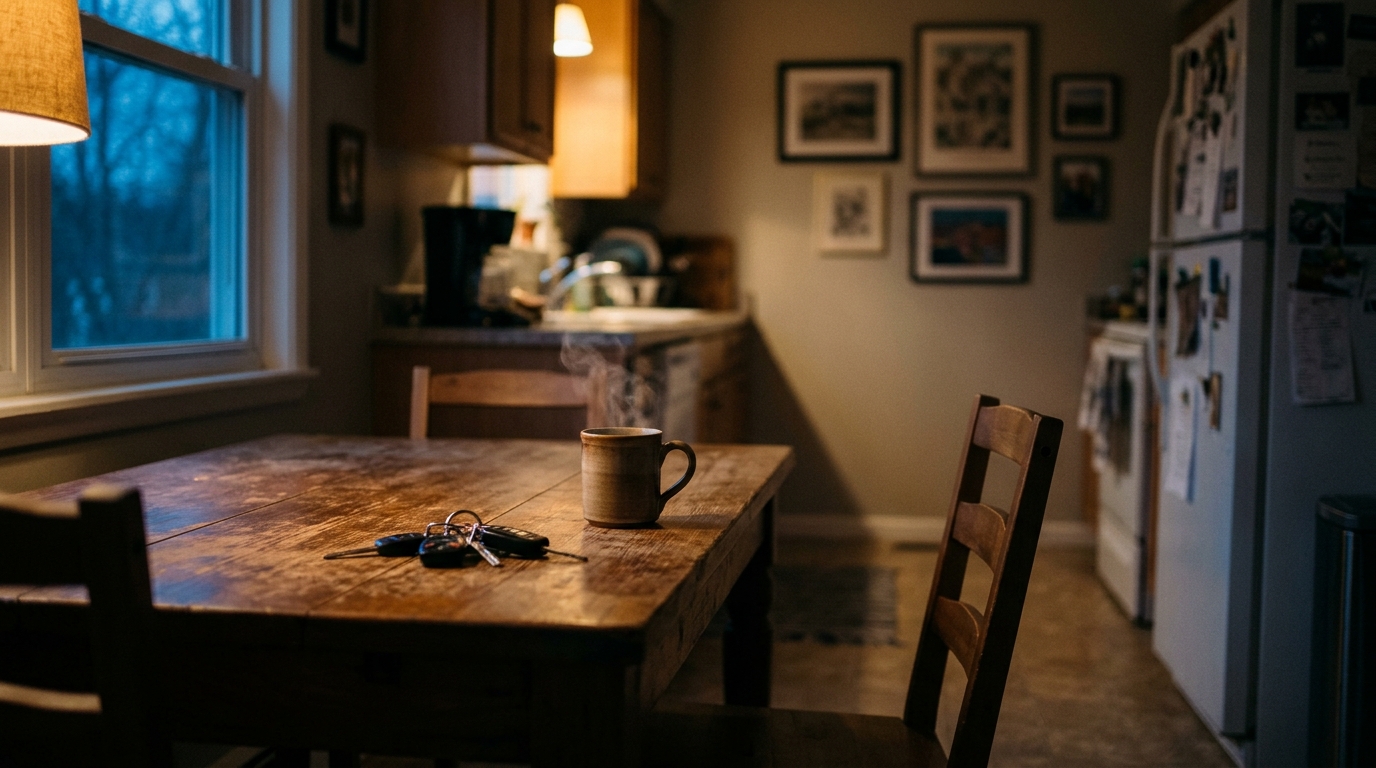
A single mom, a 14-year-old who blamed her for everything, and seven days of silence that finally forced out the truth about her father.
A teenage daughter blaming her single mom for an absent father is one of the most painful kinds of family conflict, and this one ended with the mother walking out for a week. What she’d been hiding about the father all those years is the part that changed everything.
A School Night, a Sleepover, and One Sentence She Couldn’t Take Back
It was the end of a double shift, and Ariana’s mom was waiting on her coffee when her 14-year-old walked into the kitchen dressed for a party. Ariana said she was sleeping over at her friend Mia’s house, that Mia’s mom had already agreed, and that she wasn’t really asking. It was a school night, and she had a test the next morning. Her mother said no, which felt like the most ordinary thing a parent could say.
Ariana’s face twisted into something her mother barely recognized. Mia’s mom trusted her, she snapped, and her mother was controlling. No wonder her dad couldn’t stand living in this house. Her mother set the coffee down and started to answer, but Ariana stepped closer with tears building and said it again, louder.
You drove him away, she said. Everyone knows it. She’d heard Mia’s mom say so herself, that her mother was impossible to live with. A line like that lands hard on a single parent at the end of a double shift, because it goes straight for the thing she’s been quietly afraid of for years.
She knew what she should have done. Stay calm, sit down, explain. But she was exhausted and hurt, and what came out was the worst possible answer: “Fine. You want me gone? I’ll give you some space.” She grabbed her keys and drove to her sister’s house.
She told herself it was only one night. She’d clear her head, go home in the morning, and they’d both feel calmer. Morning came, and Ariana didn’t call or text. Nothing at all. So she waited, and the waiting turned out to be the hard part.
Everything She’d Never Told Her Daughter
Sitting at her sister’s, she kept circling back to what Ariana didn’t know. When Ariana was 10, her father had packed a bag while she was at school and driven to another state, with no warning and no conversation. Before he went, he’d emptied the savings account, so her mother had started over from nothing and taken every double shift she could to keep them in the house. And the real reason he disappeared had nothing to do with her being impossible to live with. He’d found someone younger.
What Ariana got instead was a softer story: her dad just needed space, and sometimes people grow apart. It sounds kind, and it’s the explanation plenty of parents reach for when a child is small. But alone that week, her mother started to wonder who the story was really protecting. Shielding a kid from something painful can quietly turn into dodging a hard conversation, and from the inside the two feel exactly the same.
By day three, Ariana’s Instagram was telling its own story. There were photos from parties, comments about how free she felt, and a boy her mother didn’t recognize with his arm around her shoulder. Nothing in any of it looked like a girl sitting by the phone.
On day five the texts started. Where’s the permission slip for the field trip? Do we have any laundry detergent? The school called about my missed test, can you call them back? Her mother answered every one the same way: you can handle it. She told herself it was a lesson in what it takes to keep a household running, though from the other end of that phone it must have felt like a door closing.
Day Seven, 11 p.m.
On day seven, the phone rang at eleven at night. It was Ariana, crying so hard it took a moment to understand her. The party she’d gone to had gotten out of control, older kids had shown up, and things had turned frightening. She’d locked herself in a bathroom. “Mom, please come get me,” she said. “I’m sorry. Please.”
Every instinct her mother had said run to the car. But she made herself stop and ask a different question: did you try calling your dad? There was a long silence, and then Ariana answered quietly. She’d found his number online.
She’d found more than that. Her father had a new family now, including a little boy, and he’d posted photos from Disneyland the week before. Ariana had never mentioned looking him up, and her mother hadn’t known any of it. He hadn’t picked up when she called, Ariana said, and when she texted, his reply was short. Her voice cracked as she got to the end of it: ask your mother, he’d signed away his rights for a reason.
Her mother was already grabbing her keys. She found Ariana sitting on the curb outside a house she’d never seen, mascara streaked down her face. Ariana climbed into the car without a word, and they drove home in silence.
The Conversation at the Kitchen Table
Back home, Ariana sat at the table staring at her hands. She said she hadn’t known her father had signed away his rights. Her mother sat down across from her and said she’d never told her because Ariana was 10, because she wanted her to believe her father loved her even if he couldn’t show it, and because she’d thought the truth would hurt more than the lie.
You let me blame you for years, Ariana said. You let me think you were the problem. Her mother said she’d thought she was protecting her, and Ariana asked from what. From knowing my dad didn’t want me, her mother said. Ariana started crying again, then said something that rearranged the whole room: she’d already known. She just hadn’t wanted to believe it, and it had been easier to be angry at the parent who was actually there.
Her mother reached across the table and took her hands. She apologized for leaving that week, saying she’d been hurt and had handled it wrong. Ariana squeezed her fingers and said her mom wasn’t the reason her father left. She was the reason Ariana was okay, the reason they still had a house, the reason someone showed up to every volleyball game. “I think I always knew,” Ariana said. She just hadn’t wanted to admit that the parent who stayed was the one who actually loved her.
The next morning her mother woke to noise in the kitchen and found Ariana at the stove making scrambled eggs, toast in the toaster, her mother’s favorite mug waiting on the counter. Ariana didn’t say much. She slid a plate across the table and gave her a small smile that didn’t quite reach her eyes but said enough.
Over the next few days Ariana started asking the questions she’d never asked. Her mother told her about the $15,000 her father took from the savings account three days before he vanished, money meant for college and emergencies. She told her about the overtime and the meals she skipped so Ariana could have new volleyball shoes. She also told her the real story of the divorce, including the months her father spent talking to another woman online while her mother worked doubles, and how he planned his whole exit without a word. Ariana listened without interrupting, tears running down her face. She’d always wondered why he never called and why he forgot her birthday every year, and now she knew it wasn’t something she’d done.
Then she asked to see the budget. One Saturday her mother laid out the rent, the utilities, the groceries, and the volleyball fees, and Ariana stared at the numbers with her mouth open. She offered to get a part-time job. Her mother said no, because school and volleyball were her job right now, but the offer showed how much her daughter had grown up in a few weeks.
How a Broken Week Rebuilt Their Home
The school counselor let Ariana make up the test and began meeting with her on Tuesdays and Thursdays, which gave her somewhere to work through her anger at her father without aiming it at her mother. Ariana also blocked the boy from the party after he kept texting, admitting he’d made her uncomfortable that night. Her mother was proud she’d trusted her gut. When Mia’s mom cornered her in the produce section to ask how Ariana’s “wild phase” was going, she said politely that their family was none of her business. Soon after, Ariana decided to step back from the friendship, saying Mia had encouraged her to sneak out and lie.
New people filled the space. Coach Hendris told her mother that Ariana had become a sharper, more confident player. Ariana brought home a teammate named Lissa Pritchard, who shook her mother’s hand, made eye contact, and talked about math homework instead of gossip. Lissa’s mom, Theo, turned out to be warm and grounded. Three months later the counselor called to say Ariana’s grades had gone from mostly C’s and D’s to A’s and B’s, and that she’d made varsity volleyball as a freshman, which almost never happened at her school.
Her mother took her first full weekend off in over a year. They slept in until nine, tried on clothes in stores they usually walked past, bought a few clearance items and a new lamp, and ended the night on the couch with popcorn and three movies. They didn’t process anything. Around midnight Ariana fell asleep on her shoulder, and her mother stayed perfectly still for a long while so she wouldn’t wake her.
Not everything was easy. When Ariana asked about family therapy, her mother found a sliding-scale clinic across town. In the second session she admitted something she’d never said out loud: the double shifts had been partly about avoiding the tension at home. Ariana admitted she’d been pushing her mother away because it felt safer than risking another abandonment, testing how far she could go before her mom gave up too. Her mother told her she wasn’t going anywhere, and that Ariana could test that for the rest of her life. The therapist pointed out they’d both been protecting themselves in ways that made things worse, and that safety comes from being open rather than from keeping distance.
Her team made it to the regional championships, and her mother rearranged shifts to catch every game. In the final, Ariana waved from the service line before she served. When the last point dropped, she ran across the court and threw her arms around her mother, crying and saying they’d won.
Six months after the party, Ariana asked whether she should try her father one more time. With her mother’s help she wrote him an honest, careful email, asking why he’d left and whether he wanted any kind of relationship. For sixteen days nothing came back. Then he replied in four sentences: he’d moved on and built a new family, looking backward wasn’t healthy for anyone, and it was best if they didn’t have contact. He signed it with just his first name. Ariana cried in her mother’s arms for 20 minutes, then said that at least she had closure, deleted his information, and ate dinner that night lighter than she’d been in years.
The good days kept piling up. For her mother’s birthday, Ariana gave her a framed photo from the championship game, inscribed “To the parent who stayed,” bought with her babysitting money. Her mother got a promotion with better hours and fewer double shifts, and Ariana cooked spaghetti to celebrate, setting the table with real plates. An English essay about the parent who shaped her most moved her teacher enough that she asked to read it to other classes, and it now hangs beside the championship photo on their kitchen wall. At her 16th birthday party, with friends and teammates watching, Ariana told the room that her mom wasn’t the reason her father left. She was the reason Ariana was thriving.
Mia’s mother eventually apologized for spreading gossip, and her mother accepted it, tired of carrying the resentment. The two of them started a yearly check-in at the same kitchen table, a promise to keep having the hard conversations before they pile up. Ariana even said she was grateful for the week her mother walked out, because it forced both of them to face what they’d been avoiding. She compared it to a bone that healed wrong and had to be broken to heal right.
Ariana still rolls her eyes at curfew, and her room is still a disaster. They still argue, but the fights end in hours instead of weeks. Every time she walks out the door, annoyed or not, she says the same three words: love you, Mom. She wants to study psychology now, so she can help families like theirs. In the words of her own essay, her father gave her life, and her mother gave her a home.
Reflection: Kids rarely hand you the real reason they’re angry. They hand you the nearest target, and the parent who stayed is always the nearest one. This mom’s softer story came from love, but it left her daughter fighting the wrong person for four years. What fixed it wasn’t a perfect speech. It was telling the truth at a kitchen table and then showing up again the next day, and the day after that.