
Now I have all the research data I need. Let me compile the article with careful attention to all the rules, the unique angle, word count bands, internal linking, and the percent kill-switch. I’ll now produce the final HTML output.
Fertilizer guides for African violets almost universally lead with NPK numbers. They treat the three digits on the bottle as the entire decision. But growers who follow NPK advice alone still end up with salt-crusted pots, burned roots, or plants that push leaves but refuse to bloom. The missing variable is operational fit: how the fertilizer form interacts with your actual watering routine.
This guide reorders the decision. Instead of starting with brands or ratios, it starts with how water reaches your plant’s roots. A wick-watered violet fed with the wrong fertilizer type will accumulate salts within weeks, regardless of whether the NPK label reads 14-12-14 or 20-20-20. A hand-watered violet on a once-monthly schedule needs a different delivery mechanism than one fed at every watering.
By the end of this article, you will know which fertilizer form matches your specific setup, what to avoid if you use self-watering pots, and how to adjust strength when seasons or light levels shift. No product rankings, no invented outcome claims: just a decision framework built around measurable conditions.
Bottom line: Choose your fertilizer form based on your watering method first, then fine-tune the NPK ratio for bloom support.
The Yield Grid Decision Grid
Start here. Identify the one branch that describes your actual growing setup, not the one you aspire to. Each branch leads to specific fertilizer forms that work with that watering pattern.
Branch 1: Conventional Top-Waterer (Occasional Feeder). You water from above when the soil surface feels dry, typically once or twice a week. You fertilize separately from watering, on a schedule (every 2 to 4 weeks during the growing season). Your risk is underfeeding during active growth or salt buildup between applications. Recommended: Items 1, 6, 7 below.
Branch 2: Constant-Feed or Wick-Watering Grower. You use a self-watering pot, a wicking system, or you add diluted fertilizer to every watering. Roots have continuous access to nutrient solution. Your risk is salt accumulation and root burn from incorrect concentration. This branch demands urea-free formulas and precise dilution. Recommended: Items 3, 4, 8 below.
Branch 3: Organic-Only or Pet-Safe Household. You avoid synthetic fertilizers due to pets, children, or preference for soil biology. You accept slower nutrient availability and are willing to monitor soil condition more closely. This path requires understanding how organic inputs break down in soilless potting mixes. See our full breakdown on synthetic versus organic fertilizer for the trade-offs involved. Recommended: Items 5, 9, 10 below.
Quick Comparison Table
| Option | Key Mechanism | Best For | Decision Grid Branch | Reapply Class |
|---|---|---|---|---|
| 1. Water-Soluble 14-12-14 Powder | Dissolved in water, applied to soil surface | Top-waterers on a biweekly schedule | Branch 1 | Biweekly |
| 2. Concentrated Liquid 8-14-9 Drops | Pre-diluted concentrate, dropper measured | Small collections needing quick feeding | Branch 1 | Weekly |
| 3. Constant-Feed Diluted Liquid (7-9-5) | Low-concentration solution at every watering | Growers who fertilize with each watering | Branch 2 | Weekly |
| 4. Wick-Watering Reservoir Formula | Continuous low-dose nutrient delivery | Self-watering pots and wick systems | Branch 2 | Weekly |
| 5. Organic Liquid Kelp/Seaweed Blend | Slow-release micronutrients via natural sources | Pet-safe households wanting gentle feeding | Branch 3 | Monthly |
| 6. Slow-Release Granular Pellets | Coated granules release nutrients over weeks | Infrequent feeders wanting set-and-forget | Branch 1 | Once-per-season |
| 7. All-Purpose 20-20-20 at Quarter Strength | Standard fertilizer heavily diluted | Multi-plant households using one product | Branch 1 | Biweekly |
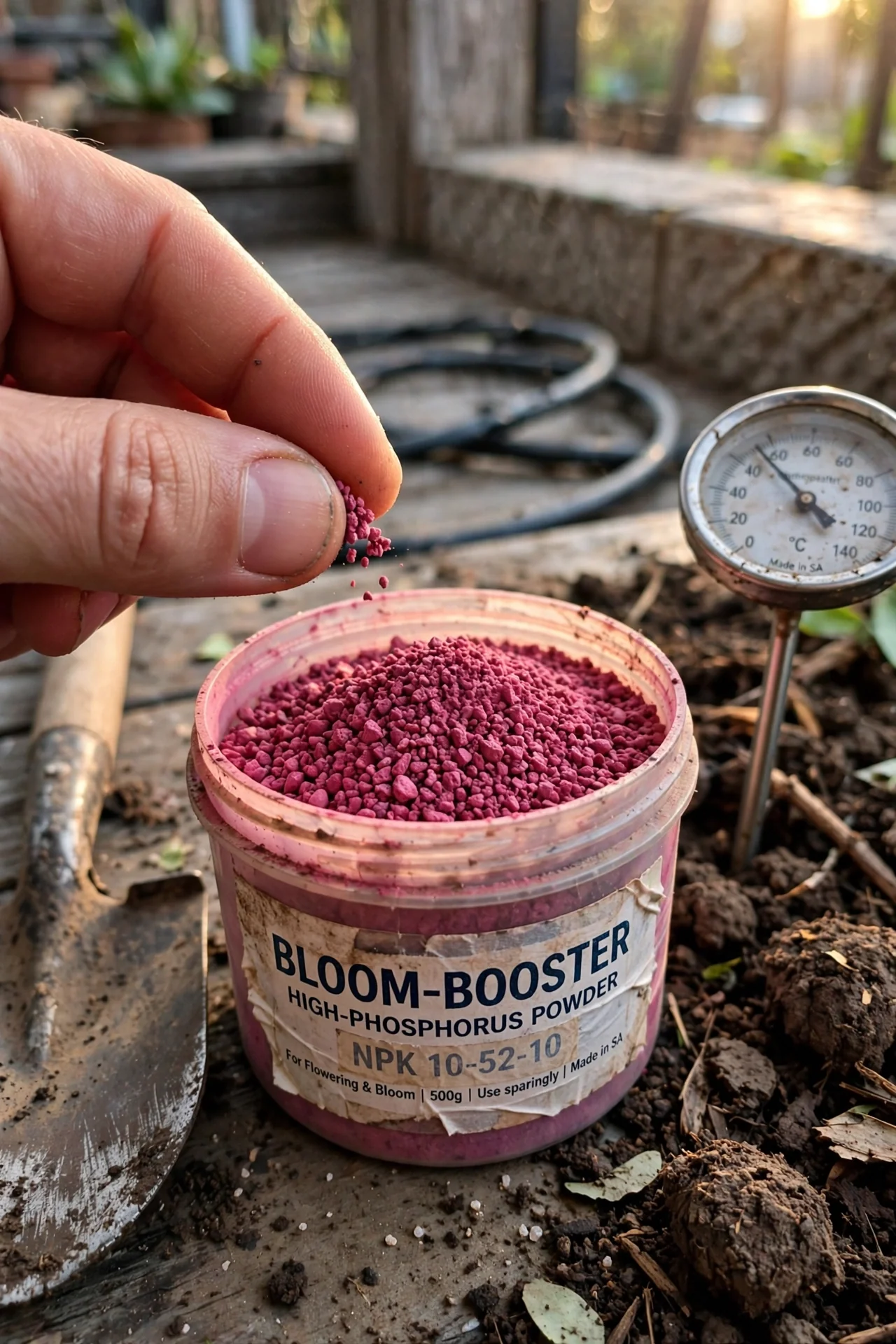
| 8. Bloom-Booster 12-36-14 Powder | High phosphorus triggers flower production | Non-blooming plants needing a bloom push | Branch 2 | Biweekly |
| 9. Espoma Organic Violet! Liquid (4-2-5) | Organic meal-based liquid with soil microbes | Organic-only growers wanting brand convenience | Branch 3 | Monthly |
| 10. DIY Worm Casting Extract | Steeped castings release nutrients slowly | Hands-on growers wanting full input control | Branch 3 | Weekly |
| 11. Fertilizer Spikes | Compressed nutrient sticks inserted in soil | Extremely low-maintenance setups | Branch 1 | Once-per-season |
| 12. pH-Adjusted Hydroponic Formula | Pre-buffered solution for soilless media | Growers using peat-heavy or inert mixes | Branch 2 | Weekly |
1. Standard Water-Soluble 14-12-14 Powder
Best for: Branch 1 (Conventional Top-Waterer)
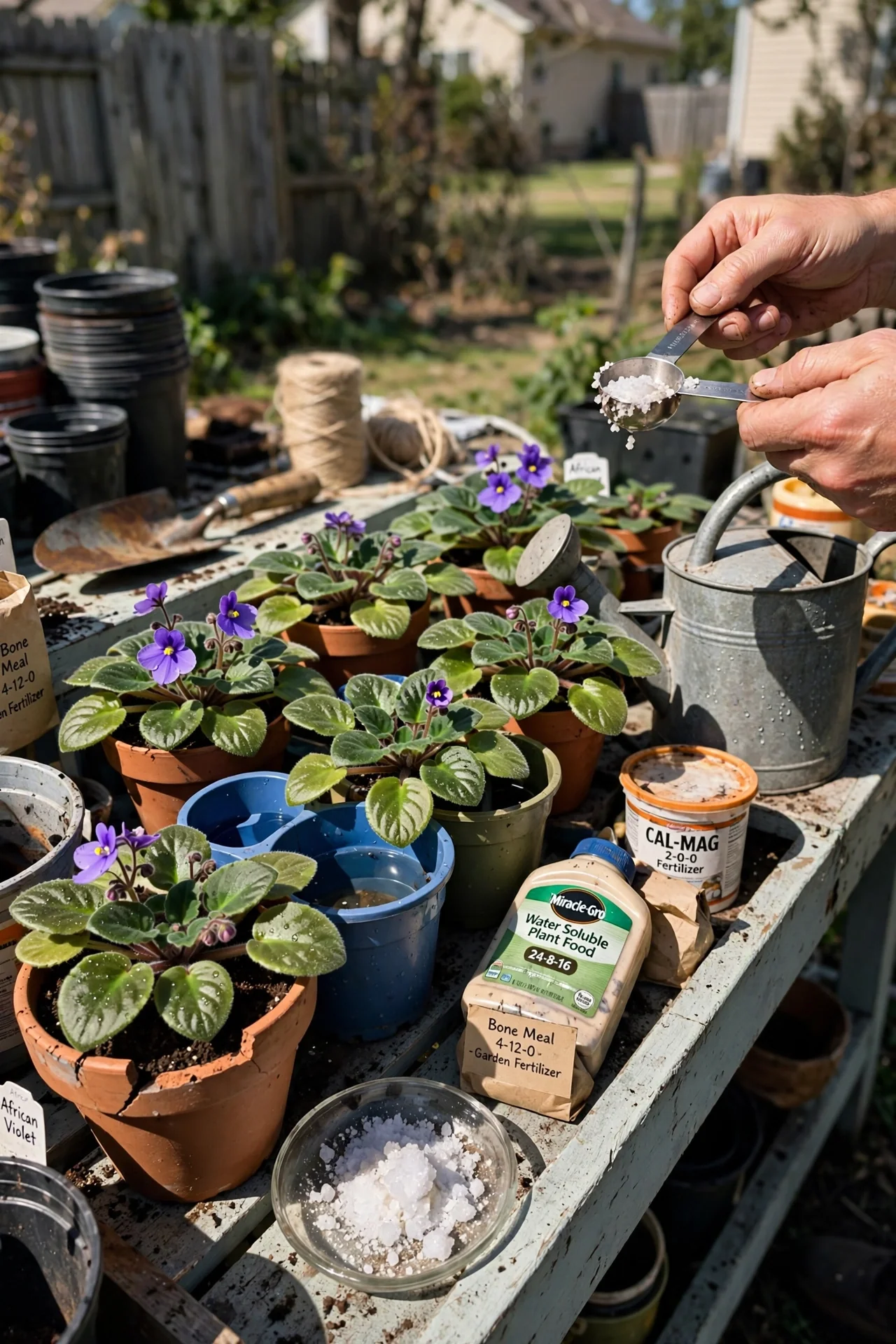
What it is: A dry crystalline powder that dissolves completely in water. The 14-12-14 NPK supplies roughly equal primary nutrients with a slight nitrogen edge for foliage maintenance. Optimara, Jack’s Classic, and Schultz all produce versions of this formulation. This is the reference standard that African violet specialty growers have used for decades.
Why it fits Branch 1: Because you control when and how much fertilizer enters the pot, you avoid the constant-saturation risk that wick-watering setups face. The powder form stores indefinitely without degradation, unlike liquid concentrates that can precipitate or grow mold after opening.
Application workflow: Mix 1/4 teaspoon per gallon of water for biweekly feeding during spring and summer. If you switch to feeding with every watering, drop to 1/8 teaspoon per gallon. Always dissolve in tepid water (around 70°F). Cold water slows dissolution and can shock roots. Apply to moist soil, never to dry soil, to prevent root burn.
Most common mistake: Scooping directly from the container with a wet measuring spoon introduces moisture into the powder, causing clumping and potential mold. Use a dry spoon every time and reseal immediately.
2. Concentrated Liquid 8-14-9 Drops
Best for: Branch 1 (Conventional Top-Waterer)
Use it if: You maintain a small collection of violets and want the fastest mixing routine. Products like Schultz African Violet Plus use a dropper system: 7 drops per quart of water, stirred and applied immediately. The 8-14-9 ratio pushes phosphorus higher for bloom support while keeping nitrogen modest.
Skip it if: You have more than a handful of plants. Dropper-based feeding becomes tedious at scale. A powder concentrate yields far more solution per dollar. Also skip if you water with cold tap water; liquid concentrates disperse poorly in water below 65°F, creating nutrient hot spots in the soil.
Edge case: Ideal for office plants or single-specimen displays where speed and minimal equipment matter more than cost efficiency.
3. Constant-Feed Diluted Liquid (7-9-5 or 3-3-3)
Best for: Branch 2 (Constant-Feed or Wick-Watering)
The threshold that matters: When fertilizer remains in constant contact with roots through a reservoir or wick, the solution concentration must stay below what the plant can absorb continuously without salt buildup. A formula like SUPERthrive Grow 7-9-5 or Houseplant Resource Center’s 3-3-3 is designed for this use pattern. The key number is not the NPK alone but the electrical conductivity (EC) of the final solution. Target an EC between 0.8 and 1.3 mS/cm for constant-feed setups; above 1.8 mS/cm, salt injury risk rises sharply.
Adjustment rule: If you see a white crust forming on the pot rim within two weeks, your concentration is too high for your evaporation rate. Halve the dosage before changing products. The problem is usually dosage, not formulation. This method pairs well with a well-aerated potting mix; see our guide on choosing the best potting soil for indoor plants for mix selection criteria.
4. Wick-Watering Reservoir Formula
Best for: Branch 2 (Constant-Feed or Wick-Watering)
10-minute setup workflow: Start with a clean reservoir. Mix your chosen urea-free liquid fertilizer at half the label rate for standard feeding. For miniature violets in wicking systems, use approximately 1/16 teaspoon of water-soluble powder per quart of water. Fill the reservoir and insert the wick, ensuring it contacts the potting mix directly. Refresh the reservoir solution weekly, not just top it off. Topping off concentrates salts as water evaporates while nutrients remain.
Upgrade option: Add a soil moisture meter to verify that the wick is actually drawing solution. A dry meter reading despite a full reservoir indicates a clogged wick or poor contact between wick and soil. Replace acrylic wicks every 6 months; they degrade and lose capillary action over time.
Critical constraint: Never use a fertilizer containing urea in a wick system. Urea requires soil bacteria to convert into plant-available nitrogen. Most soilless African violet mixes lack these bacteria, so urea accumulates as a salt, causing root burn that mimics drought damage.
5. Organic Liquid Kelp or Seaweed Blend
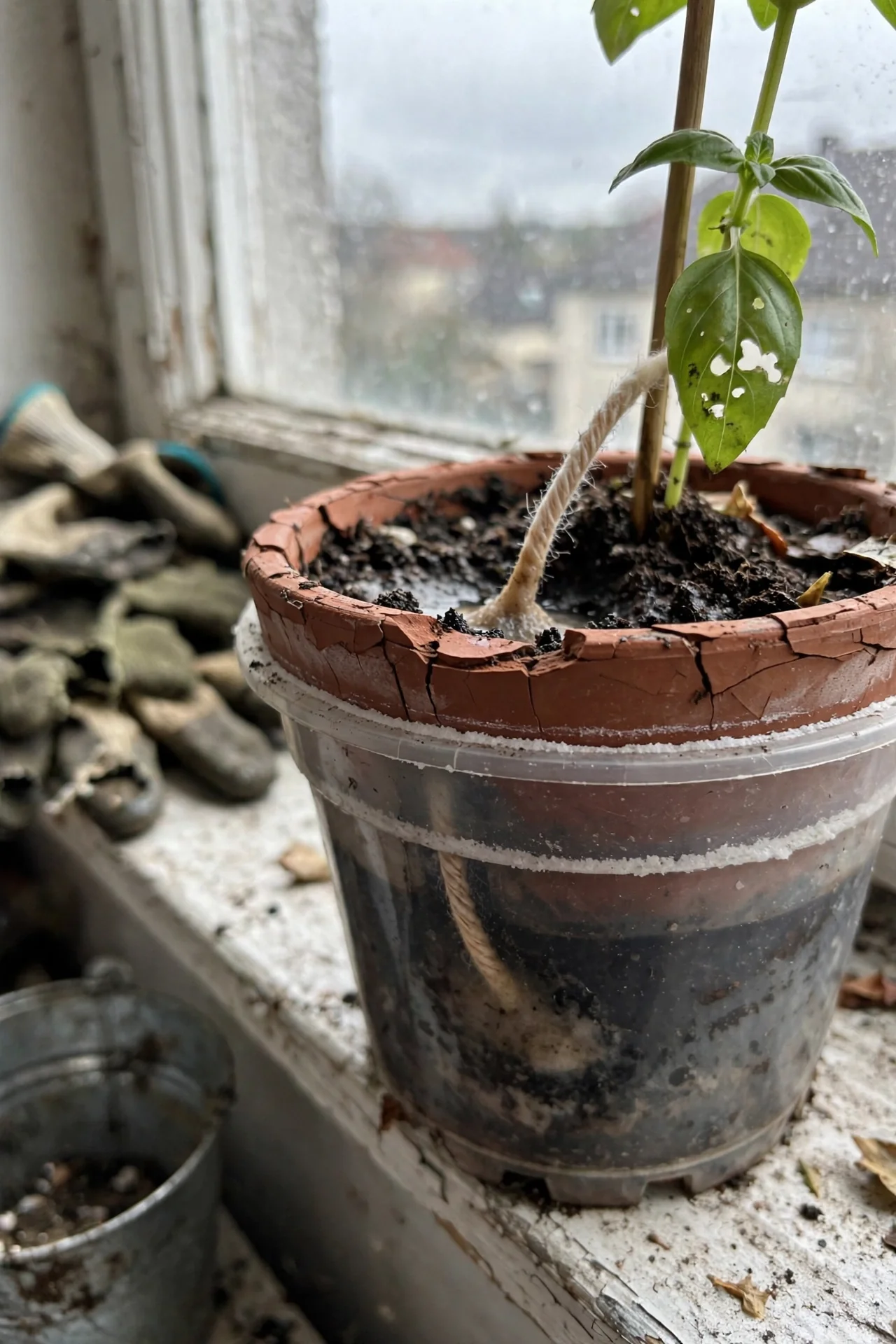
Best for: Branch 3 (Organic-Only or Pet-Safe Household)
Use it if: You share your home with pets that might access plant trays, or you want to avoid synthetic residues. Liquid kelp provides micronutrients (iron, manganese, zinc, boron) and natural growth hormones that support root development. It is gentle enough that over-application rarely causes acute damage.
Skip it if: Your violet is already showing signs of nitrogen deficiency (pale new leaves, slow growth). Kelp-based products are typically low in nitrogen, with NPK values often below 1-0-2. They function as supplements, not complete fertilizers. For a fuller nutrient profile, pair with an organic base fertilizer; see our guide to organic fertilizer for houseplants.
6. Slow-Release Granular Pellets
Best for: Branch 1 (Conventional Top-Waterer)
The threshold rule: Slow-release granules (often polymer-coated) release nutrients based on temperature and moisture. At soil temperatures below 60°F, release nearly stops. At temperatures above 85°F, release accelerates and can dump nutrients faster than roots can absorb them. This makes granules risky in homes with wide temperature swings or near heating vents.
Application constraint: Mix granules into the top inch of potting mix at repotting time only. Surface application leads to uneven release and encourages salt crusting. Do not use in self-watering pots; constant moisture breaks down the coating prematurely. For a broader comparison of delivery forms, read granular versus liquid fertilizer.
7. All-Purpose 20-20-20 at Quarter Strength
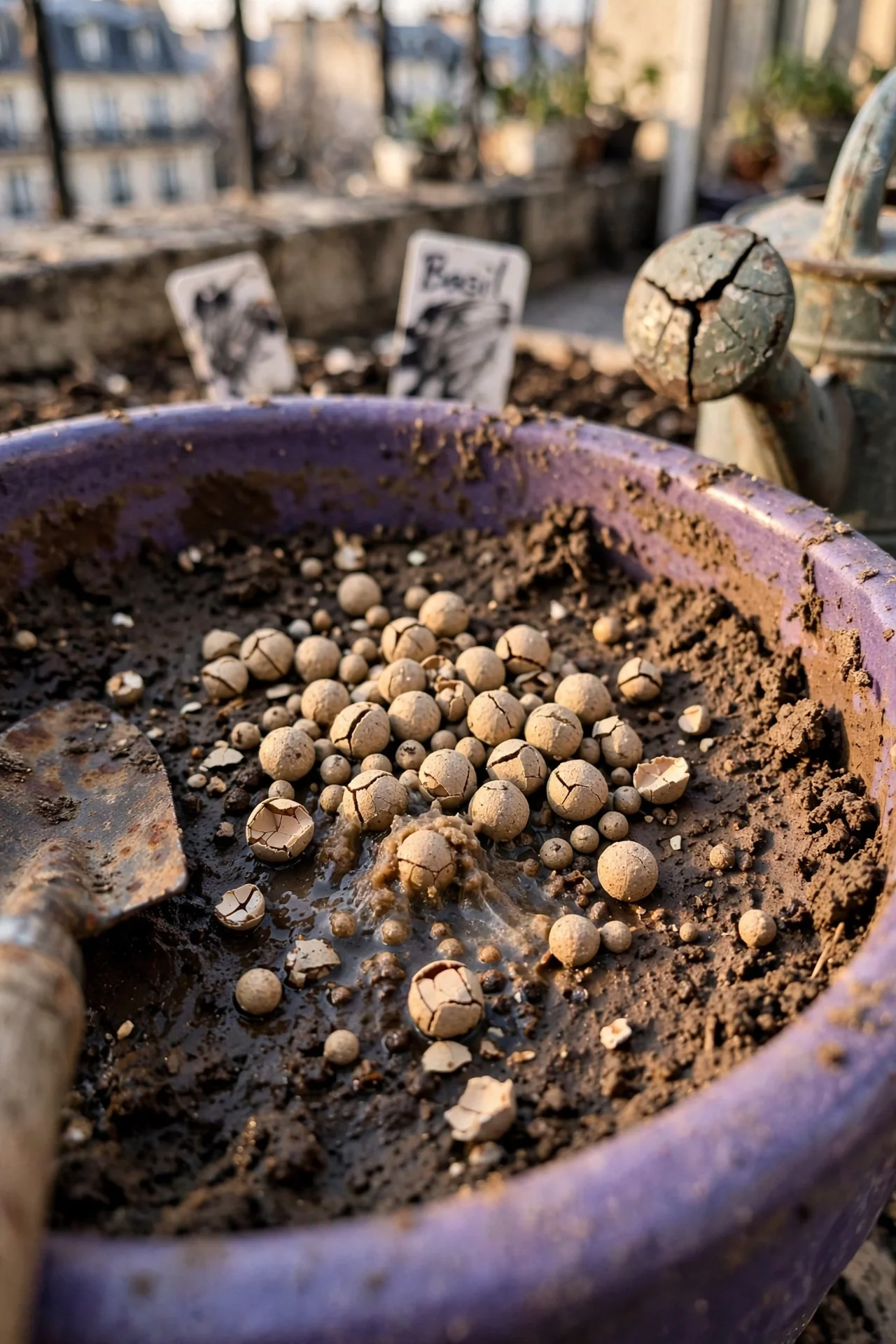
Best for: Branch 1 (Conventional Top-Waterer)
What it is: A standard balanced fertilizer, not formulated specifically for African violets, but usable when heavily diluted. Products like Jack’s Classic All-Purpose 20-20-20 or similar general-purpose powders fall into this category. The high nitrogen number demands aggressive dilution to avoid pushing leaf growth at the expense of flowers.
Why this works for Branch 1: If you already own a general-purpose fertilizer for other houseplants, you can avoid buying a separate product, provided you commit to the dilution discipline. The key is never applying at full label strength to African violets.
Steps: Mix at 1/4 of the label’s recommended rate for indoor plants. For most 20-20-20 powders, this works out to roughly 1/8 teaspoon per gallon of water. Apply biweekly during active growth. Monitor for dark green, overly lush leaves with no flowers: this signals too much nitrogen even at quarter strength, and you should skip the next feeding. For best results, check soil moisture before feeding; consistent moisture management matters more with high-nitrogen formulas. A soil moisture meter helps confirm that soil is evenly moist before applying.
Mistake to avoid: Compensating for dilution by fertilizing more frequently. The 20-20-20 ratio at quarter strength still delivers substantial nitrogen. Stick to the biweekly schedule, not weekly.
8. Bloom-Booster High-Phosphorus 12-36-14 Powder
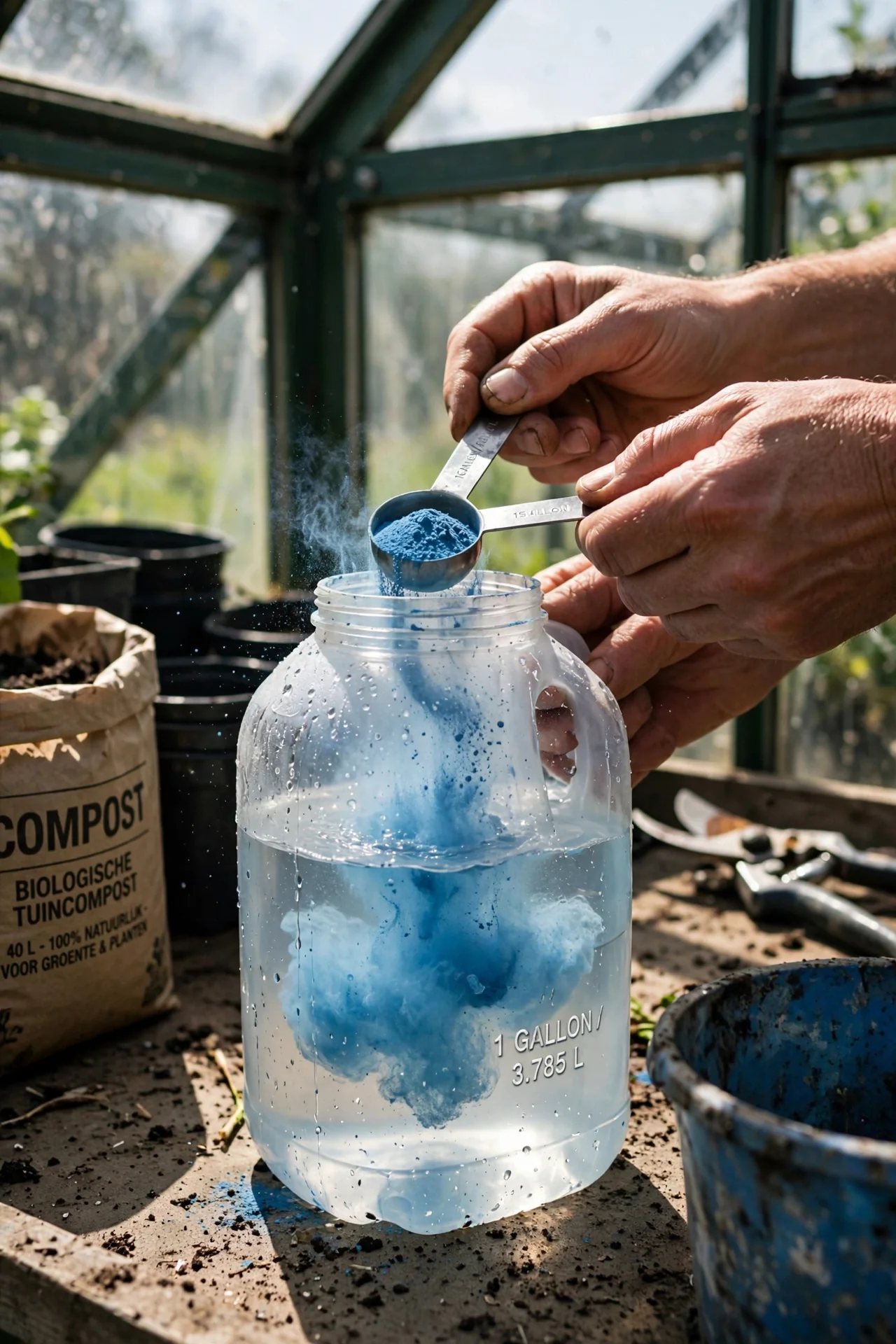
Best for: Branch 2 (Constant-Feed or Wick-Watering)
Use it if: Your violet produces healthy foliage but has stopped blooming for more than 6 weeks during the growing season, and you have already ruled out insufficient light as the cause. The elevated phosphorus (the 36 in 12-36-14) redirects energy toward flower bud formation.
Skip it if: Your plant is already blooming reliably. Continuous high-phosphorus feeding can create nutrient imbalances over time, particularly zinc and iron deficiencies, because excess phosphorus binds with these micronutrients in the soil. Limit bloom-booster use to a 4-to-6-week intervention window, then return to a balanced formula.
Edge case: Variegated varieties may respond to high phosphorus by losing variegation and reverting to solid green. If you value the variegation pattern, avoid phosphorus-heavy formulas entirely.
9. Espoma Organic Violet! Liquid (4-2-5)
Best for: Branch 3 (Organic-Only or Pet-Safe Household)
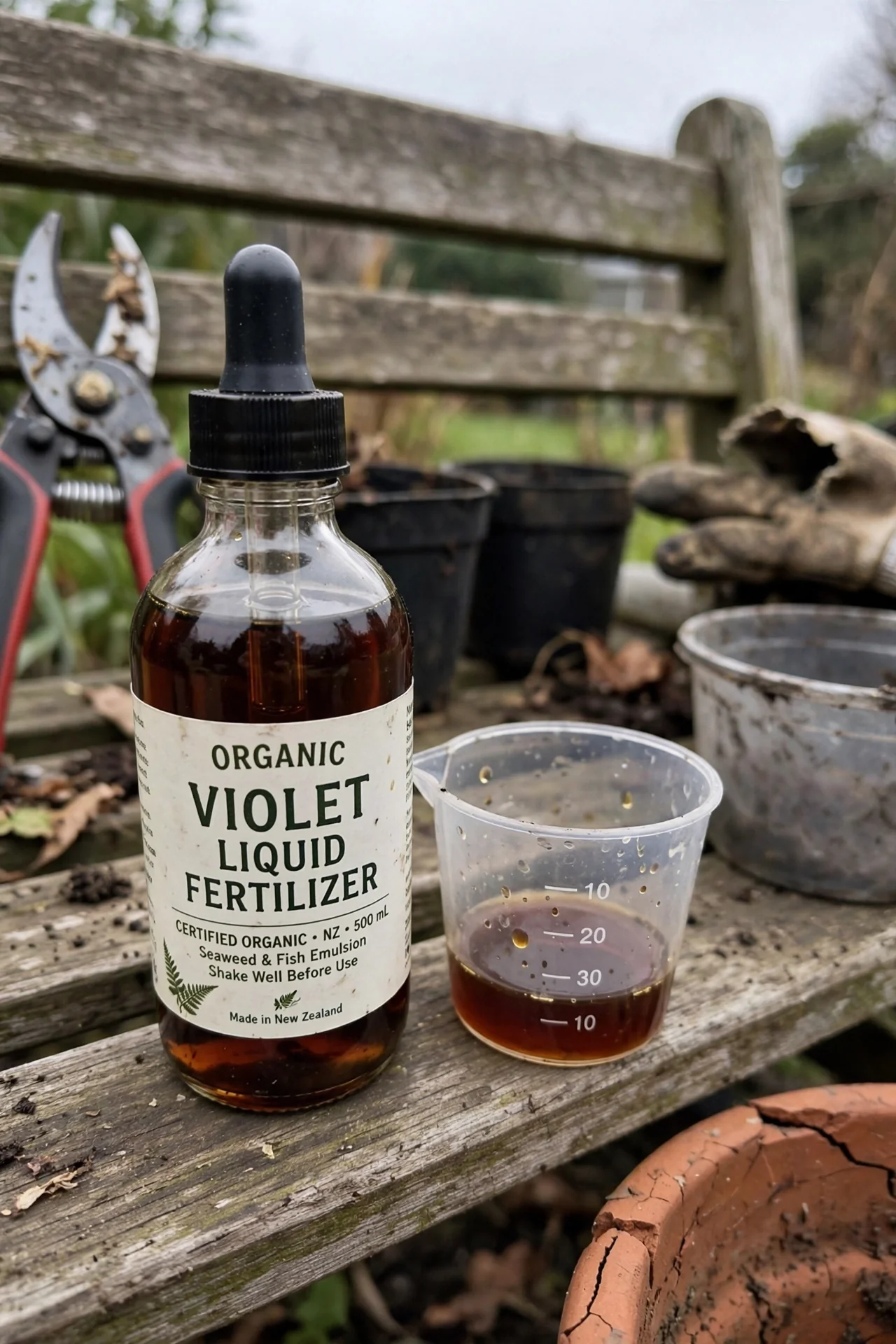
What it is: A ready-to-use organic liquid derived from processed poultry manure, bone meal, and other natural inputs. The 4-2-5 NPK is modest compared to synthetics, which is intentional: organic nutrients must be broken down by soil microbes before roots can absorb them. This product includes beneficial microbes to accelerate that process.
Application workflow: Apply every 2 to 4 weeks during the growing season. Shake the bottle thoroughly before each use; organic suspensions settle. Water the soil lightly before application to activate microbial activity. Do not store diluted solution; mix only what you will use within 24 hours, as microbial blooms in standing solution can alter the nutrient profile.
Constraint: This product works best in potting mixes that contain some compost or worm castings. In sterile peat-perlite mixes, the microbial population may be insufficient to process the organic inputs efficiently. See potting soil ingredients explained for mix components that support microbial life.
10. DIY Worm Casting Extract
Best for: Branch 3 (Organic-Only or Pet-Safe Household)
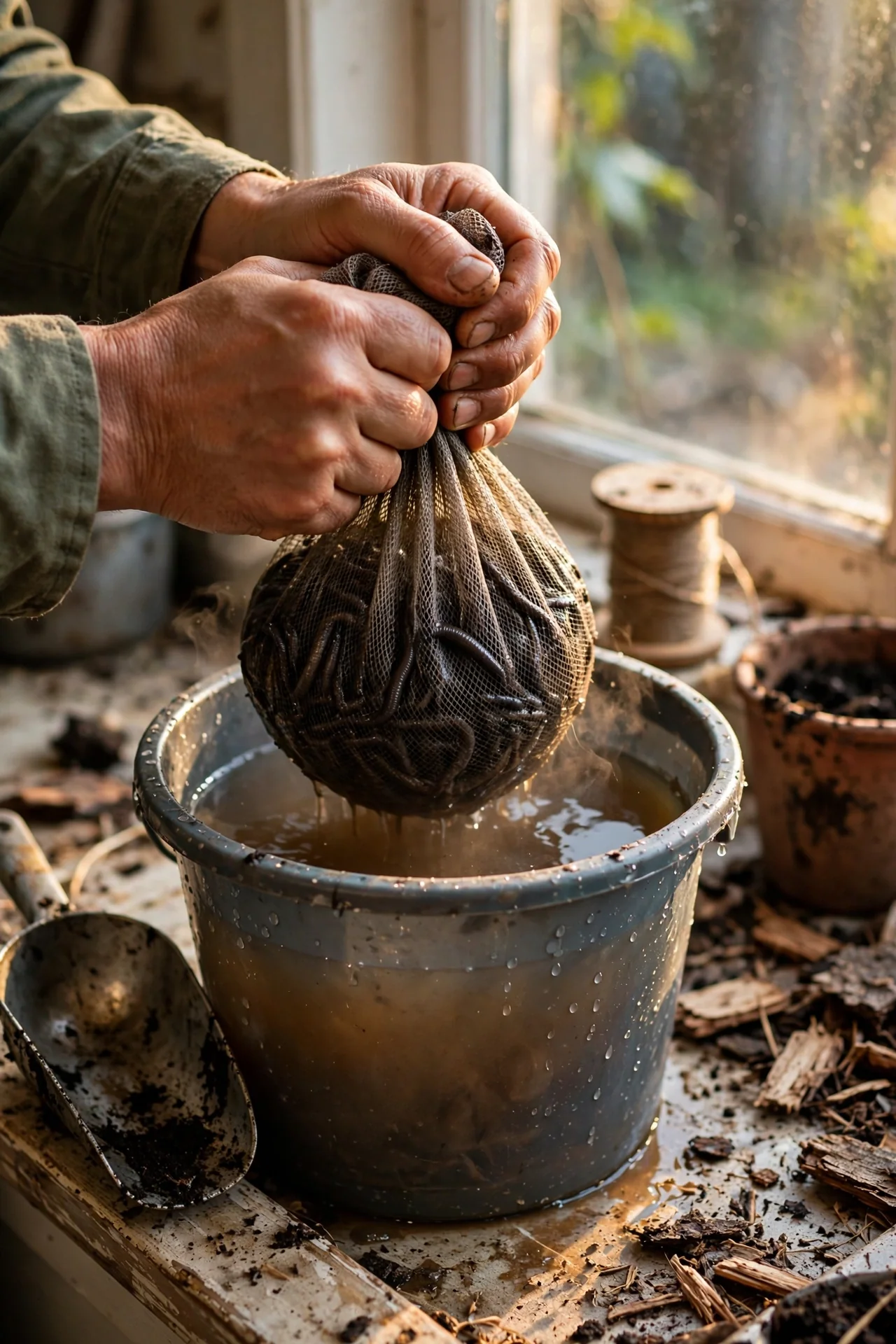
10-minute workflow: Place 1 cup of finished worm castings in a porous bag (cheesecloth or a fine mesh tea strainer). Submerge in 1 gallon of dechlorinated, tepid water. Let steep for 4 to 6 hours, agitating occasionally. Remove the bag, squeeze gently, and use the resulting tea immediately as a soil drench. Apply weekly during active growth. Do not store the extract beyond 24 hours; dissolved oxygen depletes and anaerobic bacteria can multiply.
Upgrade option: Add 1 tablespoon of unsulfured blackstrap molasses per gallon during the steep to feed beneficial bacteria, increasing microbial activity in the final extract. Skip this if your home is prone to fungus gnats; the sugars can attract them.
What this cannot do: Worm casting extract is a microbial inoculant and mild nutrient source. It will not correct a severe nitrogen deficiency. If leaves are uniformly pale and growth is stunted, supplement with a balanced organic liquid or consider a faster-acting option from Branch 1 temporarily.
11. Fertilizer Spikes
Best for: Branch 1 (Conventional Top-Waterer)
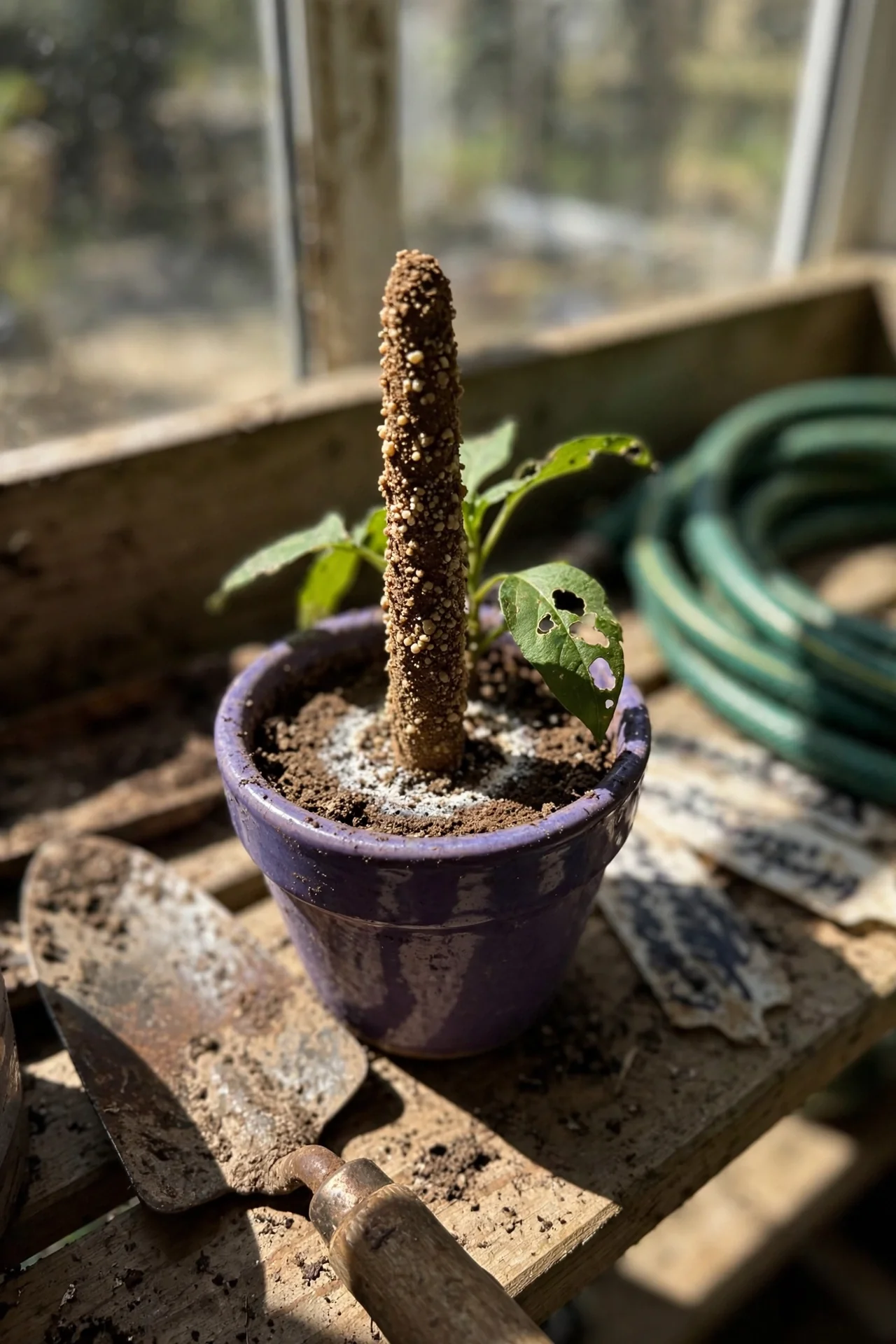
Use it if: You want the lowest possible maintenance routine. Insert one spike per 3-inch pot every 8 to 12 weeks and water normally. No mixing, no measuring, no scheduling beyond the calendar.
Skip it if: You want even nutrient distribution. Spikes concentrate nutrients in a single column of soil. Roots growing on the opposite side of the pot receive nothing, while roots directly beneath the spike may experience localized salt stress. For small pots (under 4 inches in diameter), the concentration gradient is even sharper. Spikes are also incompatible with bottom-watering and wick systems; the nutrients never disperse adequately.
12. pH-Adjusted Hydroponic Formula
Best for: Branch 2 (Constant-Feed or Wick-Watering)
The threshold that matters: African violets absorb nutrients most efficiently when the root zone pH stays between 6.0 and 6.5. In peat-heavy mixes, pH can drift below 5.5 over time as peat decomposes, locking out calcium and magnesium. Hydroponic formulas like Dyna-Gro series include pH buffers that resist this drift. If you are using a soilless, peat-dominant mix and feeding continuously, a pH-adjusted formula prevents the slow decline in nutrient availability that mimics deficiency symptoms.
Adjustment rule: Test the pH of your reservoir solution every 2 weeks with a calibrated meter, not strips. If pH drops below 5.8, flush the pot with plain pH-adjusted water (6.2 target) before resuming feeding. Do not add pH-up chemicals directly to a reservoir with plants attached; the rapid swing can shock roots.
Starter Stack (What to Choose First)
Branch 1: Conventional Top-Waterer Starter
Combine Item 1 (standard 14-12-14 water-soluble powder) with Item 7 (all-purpose 20-20-20 at quarter strength used as your backup). The 14-12-14 is your primary feed during spring and summer. If you run out or want a lower-nitrogen cycle, the diluted 20-20-20 covers you without requiring a separate purchase. Expect to spend between $8 and $15 USD for a powder that lasts 6 to 12 months for a small collection. The synergy is coverage: one specialized, one flexible.
Branch 2: Constant-Feed or Wick-Watering Starter
Combine Item 3 (constant-feed diluted liquid like 7-9-5 or 3-3-3) with Item 4 (wick-watering setup with half-strength urea-free formula). Start with the pre-formulated constant-feed liquid to establish a baseline. Once you confirm your plants respond well over 4 to 6 weeks, transition to the wick-watering setup using the same product at half strength for continuous delivery. Time investment is roughly 20 minutes for initial reservoir setup, then 5 minutes weekly for solution refresh.
Branch 3: Organic-Only Starter
Combine Item 9 (Espoma Organic Violet! liquid) with Item 5 (liquid kelp supplement). The Espoma provides the NPK foundation; the kelp adds micronutrients and growth-supporting compounds that the base fertilizer lacks. Apply the Espoma monthly and the kelp as a supplemental drench every 6 weeks. Budget approximately $18 to $25 USD total for both products. Together they cover macronutrient and micronutrient needs without synthetics.
When This Won’t Work
Failure condition 1: Your potting mix is depleted or compacted. Fertilizer adds dissolved nutrients, but it cannot fix a broken physical structure. If water pools on the surface rather than soaking in, or if roots circle the pot bottom in a dense mat, no fertilizer strategy will help. The plant needs repotting into fresh mix first. Fertilizing a root-bound plant in degraded soil accelerates salt buildup because drainage is impaired and salts cannot leach out.
Failure condition 2: Your light levels are insufficient. African violets need approximately 900 to 1,000 foot-candles of bright indirect light for at least 10 to 12 hours daily to metabolize fertilizer nutrients into growth and blooms. Below this threshold, the plant cannot use the nutrients you supply, and they accumulate as unused salts. If your violet sits in a north-facing window in winter with no supplemental lighting, stop fertilizing entirely until light conditions improve. Adding fertilizer in low light does not compensate; it compounds the problem.
Alternative action: Before troubleshooting your fertilizer, check your potting mix condition. If the soil surface has developed a crust or the pot feels unusually heavy after watering, leach the pot thoroughly with plain tepid water and reassess after 2 weeks. For proper storage of unused potting mix between repottings, see our guide to potting soil storage.
Choosing the Right Option for Your Situation
Budget Threshold
If your total budget for plant nutrition is under $10 USD for the year, choose Item 7 (all-purpose 20-20-20 at quarter strength). One container of general-purpose fertilizer serves all your houseplants, and the dilution method keeps the cost per feeding extremely low. The trade-off is that you must never lapse on the quarter-strength rule.
Time Threshold
If you have less than 10 minutes per week for all plant care combined, choose Item 6 (slow-release granules) or Item 11 (fertilizer spikes). Both are set-and-forget options that trade precision for convenience. Accept that bloom consistency may be lower than with scheduled liquid feeding.
Technical Constraint: Urea Sensitivity
If your potting mix is soilless (peat, perlite, vermiculite only, no compost), you must use a urea-free fertilizer. Urea nitrogen requires urease enzymes from soil bacteria to convert into ammonium, and sterile soilless mixes lack these bacteria in sufficient quantity. Check the product’s guaranteed analysis label. If the nitrogen source lists “urea” or “urea formaldehyde,” choose a different product from the same branch. Most African violet-specific formulations are urea-free by design; general-purpose fertilizers often are not.
Quick Yes/No Checklist:
- Have you identified your watering method (top-water, wick, or self-watering pot)? Yes / No
- Does your chosen fertilizer form match that method (liquid for constant-feed, powder or spikes for occasional top-watering)? Yes / No
- If using a soilless mix, have you confirmed the fertilizer is urea-free? Yes / No
- Do you have enough light (bright indirect, 10+ hours) for the plant to use the nutrients? Yes / No
Expert Q&A
Why does my African violet grow leaves but never bloom?
Insufficient light is the most common cause, but fertilizer plays a role too. Excess nitrogen relative to phosphorus pushes vegetative growth at the expense of flowers. Switch to a formula with a higher middle number (phosphorus), such as moving from a balanced 14-12-14 to a bloom-focused 8-14-9, and verify your plant receives at least 900 foot-candles of bright indirect light daily.
Can I use tomato fertilizer on African violets?
Tomato fertilizers are typically high in potassium and phosphorus with moderate nitrogen, often in ratios like 5-10-10 or 3-4-6. While the phosphorus level may support blooming, many tomato fertilizers contain urea as the nitrogen source, which can burn African violet roots in soilless mixes. Check the label for urea before using. Dilute to quarter strength if you proceed.
Should I fertilize African violets in winter?
Only if the plant is actively growing under artificial light for 10 or more hours daily. Under natural winter light in northern latitudes, most African violets enter semi-dormancy. Fertilizing a dormant plant causes salt buildup. Reduce to once monthly at half strength, or stop entirely from December through February if new leaf growth has ceased.
What does fertilizer salt buildup look like on African violets?
A white or pale orange crystalline crust on the pot rim or soil surface is the earliest visible sign. On the plant itself, leaf tips turn brown and dry (necrosis), lower leaves that rest on the pot rim may develop soft, translucent brown rot, and orange crystals may cling to the fine hairs on leaf surfaces near the crown.
Is it safe to use tap water when mixing African violet fertilizer?
It depends on your water hardness. Tap water with total dissolved solids (TDS) above 150 ppm already contains dissolved minerals that contribute to salt buildup. If your water is hard, use filtered, distilled, or rainwater to mix fertilizer solutions. Chlorine at municipal levels does not harm violets, but chloramine does not dissipate with standing and may affect beneficial microbes in organic setups.
Conclusion
African violet fertilizing fails most often not because of the wrong NPK ratio but because the fertilizer form does not match the watering method. A wick-watered violet fed with occasional-use powder builds salts; a hand-watered violet on spikes gets uneven nutrition. The number one mistake is changing products before checking whether the delivery form fits the system.
If you take one action after reading, identify your watering method from the Decision Grid branches above and confirm your current fertilizer matches that branch. If it does not, switch forms before adjusting dosage or NPK. For a comparison of how these principles apply to other flowering houseplants, see our fiddle leaf fig fertilizer guide.